Affiliate disclosure: As an Amazon Associate I earn from qualifying purchases. This article may contain affiliate links, and Bay & Bench may earn a commission at no extra cost to you. Read our full Affiliate Disclosure.
This garage workbench buying guide starts with a less exciting question: what do you build or repair most often? The best bench is not necessarily the heaviest or the longest one that fits against the wall. It is the bench that holds your real projects at a comfortable height, leaves room to move, and stays steady when the work gets awkward.
Start with tasks and dimensions. Drawers, hardwood, polished steel, and clever accessories come later. A simple bench that fits the room will get used more than an impressive bench that blocks the car door.
Quick answer
Choose the workbench after measuring the largest common project, your comfortable working height, and the aisle left with vehicles parked. Fixed benches suit forceful work and permanent stations. Mobile benches suit shared floor space, but need suitable locking casters and a stable frame. Folding benches save space for light tasks. Compare usable top size, total capacity, local point loads, vise support, storage, power access, and the complete assembled footprint.
Name the work before choosing the bench
A bench for bicycle maintenance, small engine parts, woodworking, electronics, and household repair will not have the same priorities. Write down the three jobs that happen most often. Add the largest ordinary object placed on the top and the tools that stay there during work.
Forceful planing, hammering, and vise work reward mass, bracing, and a firm stance. Assembly benefits from open surface area and access around several sides. Detail work needs good light and a height that brings small parts closer without lifting the shoulders. Mobile repair may need drawers more than a perfect woodworking top.
Skip fantasy projects when sizing the permanent bench. A door or sheet good handled once a year can rest on portable supports. Giving that rare job an eight foot bench every day may cost a parking space.
Measure the complete work zone
Bench width is only the beginning. Add vise projection, drawer handles, power strips, pegboard hooks, and any material that extends beyond the top. Mark the assembled footprint on the garage floor with tape. Park the vehicles, open their doors and hatch, then carry a normal project through the remaining route.
Depth deserves special attention. A deep top offers assembly room but pushes wall storage farther away. The rear few inches can become a permanent row of chargers and cans. In a narrow garage, a shallower bench with a nearby rolling cart may be easier to use.
Check overhead space as well. Cabinet doors, lights, windows, and garage door hardware can conflict with a tall backsplash or upper shelf. Use the garage storage fit calculator for a first pass, then verify every edge in the room.
Set height by task and body
There is no single correct workbench height. Work that needs downward force often feels better on a lower surface. General repair and assembly usually suit a middle position. Fine work can move higher so the user does not bend toward small parts.
Stand in normal work shoes with shoulders relaxed. Bend the elbows and test several surface heights with stacked plywood or a sturdy temporary platform. Mimic the task. Push a plane, turn a wrench, assemble a small part, or sit on the intended stool. A measurement taken without the work can be misleading.
Our workbench height calculator provides a planning range based on user height and task. If several people share the bench, an adjustable model or removable platform may be more useful than splitting the difference badly for everyone.
Compare fixed, mobile, folding, and adjustable benches
| Bench type | Best fit | Watch for |
|---|---|---|
| Fixed | Vise work, permanent tools, frequent projects | Consumes floor space and may be hard to move |
| Mobile | Shared parking and work zones | Caster rating, wheel locks, frame movement, floor slope |
| Folding | Light tasks in a very small garage | Wall structure, braces, folded depth, reduced storage |
| Adjustable height | Multiple users or changing task heights | Adjustment range, mechanism clearance, load at each setting |
| Modular | Garages expected to change over time | Connection hardware and future part availability |
A rolling bench is not automatically flexible if it is too heavy to steer when loaded. A fixed bench is not automatically stable if the frame racks or the floor rocks beneath one leg. Judge the complete design.
Choose the top for the mess and the force
A thick wood top is friendly to clamps, can absorb some noise, and may be repairable after cuts or dents. It can also stain, swell, or burn if the finish and work are poorly matched. Steel resists many impacts and is easy to wipe, but it can be noisy, conductive, and unfriendly to delicate parts. Composite and laminated tops offer a smooth general purpose surface, though edges and moisture resistance vary.
Check the top’s actual thickness and construction. A thick looking edge may be trim around a thinner core. For a vise, grinder, or bench mounted tool, confirm that the manufacturer permits the installation and that bolts can reach suitable structure. A beautiful surface with no solid mounting area is a poor tool bench.
Removable sacrificial sheets can protect the main top during painting, glue work, or rough cutting. Use material appropriate to the task and keep it secured so it cannot slide.
Frame capacity is more than one large number
Workbench listings often lead with a total weight capacity. Read how the manufacturer defines it. The number may assume an evenly distributed static load, correct assembly, and a particular shelf position. A vise or compact machine can create a concentrated force near one edge that is different from boxes spread across the top.
Look for cross bracing, leg connections, top support, and adjustable feet. Bolted frames can be strong when assembled correctly, but loose fasteners allow racking. Welded frames remove some joints and can be awkward to move through a narrow door. Wood bases can be stiff and repairable, though construction quality matters more than the material name.
Add the weight of mounted tools, drawers, shelf contents, and the project. Do not assume that casters, a lower shelf, or an added top inherit the bench’s headline rating.
Mobile benches need a caster plan
Calculate the loaded bench weight, then compare it with the complete caster set rating under the conditions stated by the caster and bench manufacturers. Floors are not perfectly smooth. Joints, debris, slopes, and door thresholds increase effort and can stop a small wheel suddenly.
Four swivel casters make tight turns possible but may let the bench wander while steering. A mix of fixed and swivel wheels tracks more predictably. Locks vary too. Some stop the wheel while leaving the swivel free; others control both. For forceful work, retractable casters or leveling feet may create a firmer stance when the product is designed that way.
Push only from a safe point with drawers closed and the route clear. Heavy tools should not sit loose on top during a move. A mobile bench is useful because it changes zones, not because it can be rolled while a project is balanced on it.
Storage can help or steal working room
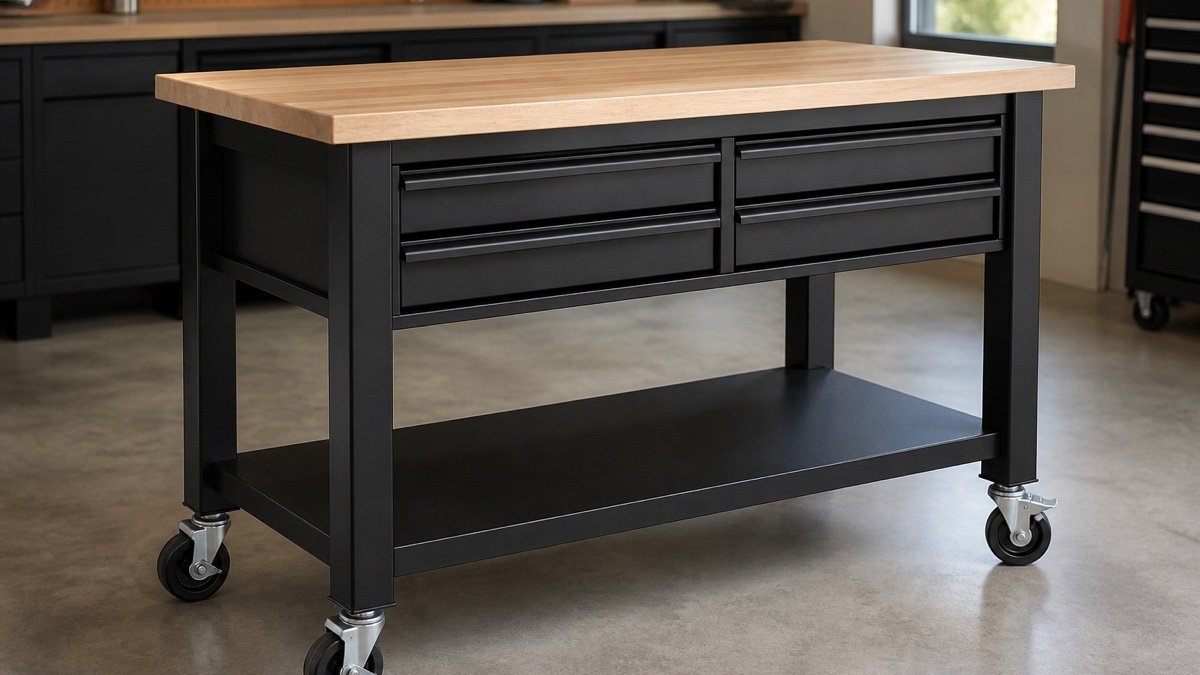
Drawers keep measuring tools and hand tools close, but a deep drawer bank can remove knee space for seated work. An open lower shelf holds cases and heavy tools, though it collects dust and may interfere with feet. Cabinets hide clutter and slow down quick access. Pegboard places light tools in sight while consuming the wall directly behind the bench.
Choose storage for the tools that support bench work. Lawn supplies and seasonal decorations belong elsewhere. When unrelated items colonize the bench base, the daily tools end up on top and the useful surface shrinks.
Check drawer extension, latch behavior, and clearance around a vise. On a mobile bench, drawers should stay closed during movement according to the product design. If a bench includes locks, treat them as access control for ordinary tools, not automatically as secure hazardous storage.
Plan vise, clamp, power, and lighting access
A vise needs more than a corner. Its jaws, handle, mounting bolts, and clamped work all extend into space. Decide whether the user is right or left handed and where long material will project. Confirm that the top and frame support the mounting location.
Clamping is easier when the top has usable edges and no drawer face directly beneath every inch. Dog holes or accessory tracks help only if they fit the work and do not weaken a top that was not designed for modification.
Put outlets where cords do not cross the aisle or the work surface. Use electrical products approved for the garage environment and intended load. Lighting should illuminate the hands without putting the user’s head between the fixture and project. A movable task light often solves shadows better than another decorative ceiling fixture.
Inspect the buying details people skip
- Assembled width, depth, and height, including handles and backsplash
- Packaged dimensions and the route from delivery point to garage
- Top material, thickness, coating, and permitted modifications
- Published total and component ratings, plus load distribution language
- Frame joints, braces, feet, and floor adjustment
- Drawer extension, shelf openings, and knee clearance
- Caster type and rating on mobile models
- Vise or tool mounting provisions
- Replacement parts, warranty, and current assembly manual
Prices and bundles change, so compare the current complete package. One bench may include a hardwood top and drawers. Another attractive price may cover only the frame. Delivery charges, assembly time, casters, lighting, and a vise can change the real cost.
A practical final choice
For a garage that doubles as parking every day, start with the smallest bench that supports the common project. A mobile bench earns its place when there is a clear parking spot for it and a real need to work away from the wall. A fixed bench is the better anchor when vise work, mounted tools, and repeated setup dominate. Folding benches are honest space savers for light tasks, not miniature replacements for every heavy bench.
Make a cardboard top or tape the dimensions on a folding table. Spend one normal project at that size. Notice where the parts pile up, which edge needs clamps, and whether the car can still open. That short trial tells you more about fit than a page of lifestyle photos.
Then compare current models and manuals. Buy capacity you can verify and space you will use.
Useful products to compare
These links open current Amazon search results so you can compare dimensions, manuals, ratings, and availability for the exact models on your shortlist.
Before you buy or install
Check the current manual for the exact product you are considering. Confirm the assembled dimensions, load rules, mounting requirements, included hardware, clearances, warranty, and any limits that apply to your wall, floor, or garage layout.
Frequently asked questions
What size workbench is best for a garage?
Use the smallest top that supports your common projects while preserving vehicle and walking clearance. Measure the complete footprint, including vise, handles, casters, and projecting materials.
Is a fixed or mobile workbench better?
Fixed benches usually suit forceful work and mounted tools. Mobile benches suit shared floor space when the frame, casters, locks, floor, and loaded weight all support safe movement.
What is a good workbench height?
The useful height depends on the user and task. Lower surfaces often suit downward force, while fine work may feel better higher. Test the task at several temporary heights.
Is wood or steel better for a workbench top?
Wood is clamp friendly, quieter, and often repairable. Steel is durable and easy to wipe but can be noisy and conductive. Construction, coating, thickness, and the intended work matter more than the material name alone.