Affiliate disclosure: As an Amazon Associate I earn from qualifying purchases. This article may contain affiliate links, and Bay & Bench may earn a commission at no extra cost to you. Read our full Affiliate Disclosure.
You know the missing screw is somewhere in the garage. The problem is whether it lives under forty nearly identical drawer fronts or at the bottom of a portable case. The best small parts organizer for garage use makes that one screw easy to find without turning sorting into a second hobby. Tiny drawers look orderly when empty, but real bolts, anchors, and dark washers expose every poor compartment choice.
This shortlist covers three stationary drawer cabinets and two portable cases. Each solves a different retrieval problem. The dimensions and construction notes come from current manufacturer pages, but model colors and availability can change. Before buying, spread your hardware on the bench, group it the way you search for it, and measure the longest item in every group.
Quick answer
The Akro-Mils 10144 is the broad home garage pick because its 44 drawers include two useful sizes. Choose the IRIS 64 drawer cabinet for many small, light fasteners, or the steel Durham 013-95 for fewer, deeper drawers and heavier shop use. A Stanley FatMax shallow organizer suits portable project kits, while the smaller SortMaster Junior works for mixed parts and a few hand tools.
Best small parts organizer for garage: quick comparison
The right format depends on whether parts stay at one bench or travel to the job. A wall cabinet gives instant access to dozens of groups. A latched case uses more shelf space, yet it keeps a selected kit together while you move.
| Organizer | Layout | Published outside size | Best fit | Watch for |
|---|---|---|---|---|
| Akro-Mils 10144 | 44 clear drawers in two sizes | 20 x 6.375 x 15.813 inches | Mixed screws, anchors, connectors | Limited included dividers |
| IRIS 64 drawer cabinet | 64 small clear drawers | 19.5 x 7 x 15.5 inches | Many light, compact fasteners | Long parts need another home |
| Durham 013-95 | 12 deep steel drawers | 33.813 x 12.313 x 7.375 inches | Heavier or larger small parts | Wide footprint and no clear fronts |
| Stanley FatMax shallow organizer | Removable cups under clear lid | 17.5 inches long | Portable project kits | Needs horizontal shelf space |
| Stanley SortMaster Junior | 14 compartments with dividers | 14.8 x 2.6 inches | Compact mixed kit | Lower total capacity |
For a wider plan that includes hand and power tools, start with the garage tool storage guide.
Akro-Mils 10144 for a mixed hardware collection
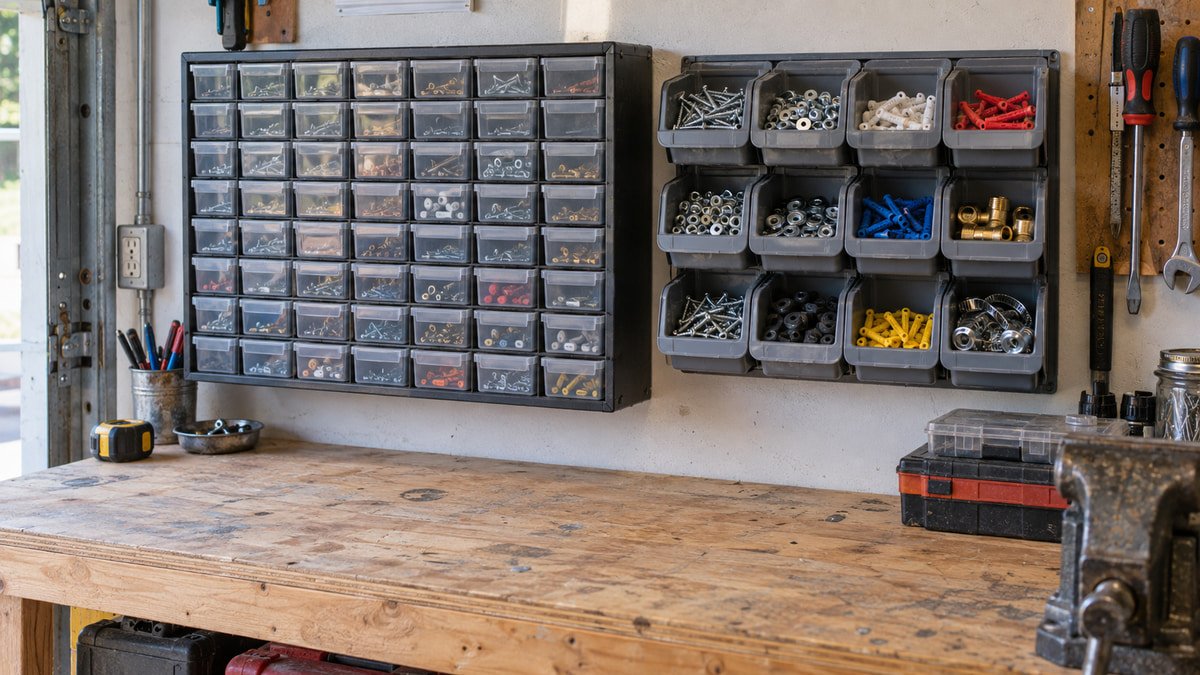
The Akro-Mils 10144 has 32 small drawers and 12 large drawers, which is a useful split for an ordinary garage. Its official product page lists the cabinet at 20 inches wide, 6.375 inches deep, and 15.813 inches high. Clear drawers have finger pulls and rear stop tabs. The frame can stack or mount to a wall using its keyhole slots.
The two drawer sizes let you separate small screws and electrical terminals without forcing longer lag bolts into the same narrow compartment. Akro-Mils includes a limited set of molded dividers, so count how many split drawers you need and price extras before ordering. A divider steals a little usable length too.
This is the most versatile all-around pick for someone starting with several coffee cans of mixed hardware. It offers enough categories to be useful without demanding a label for every screw length on the first afternoon.
IRIS 64 drawer cabinet for many tiny fasteners
The IRIS 64 drawer cabinet goes all in on small compartments. IRIS lists each inner drawer at 6 by 1.75 by 1.5 inches, with outside dimensions of 19.5 inches wide, 7 inches deep, and 15.5 inches high. The manufacturer page shows side mounting holes and ribs intended to help stacked units stay in place.
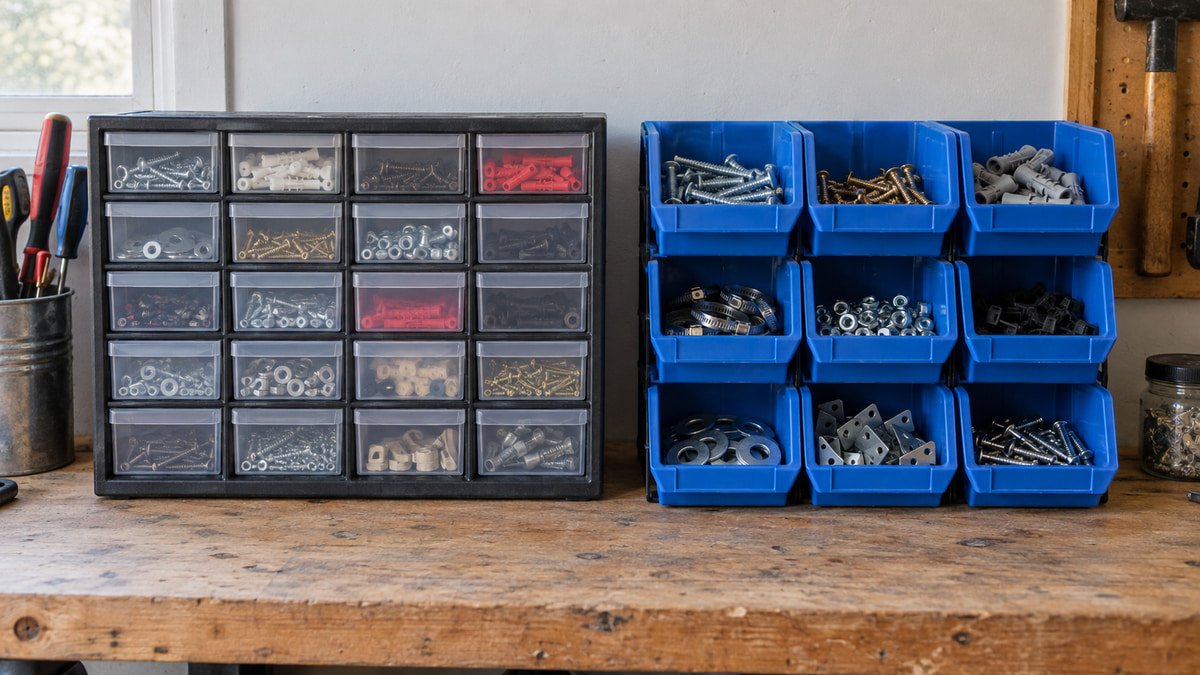
Sixty four identical drawers suit electronics parts, machine screws, small nuts, rivets, and specialty clips. They are less friendly to hand tools, long anchors, or a broad assortment of plumbing fittings. Before committing, fill a paper rectangle with the largest expected group. A drawer may fit ten bolts but become irritating when you need room for fifty.
The cabinet is light enough that mounting details matter. Support it according to the instructions, keep dense contents low, and avoid yanking a stuck drawer. Clear fronts save search time, though a small sample fixed to a label slot can be easier to read than a handwritten size viewed from across the bench.
Durham 013-95 for deeper steel drawers
Durham’s 013-95 uses twelve cold rolled steel drawers rather than dozens of clear plastic ones. The official specification page lists a 20 gauge cabinet, an outside size of 33.813 by 12.313 by 7.375 inches, and individual drawers roughly 4.469 inches wide, 11.25 inches deep, and 3.188 inches high. The unit ships assembled.
Those long drawers make room for larger anchors, U bolts, drill accessories, electrical fittings, and repair parts that never settle comfortably in tiny plastic cells. Durham says its drawers include two adjustable dividers on one inch centers. The cabinet is wide, low, and heavy compared with a plastic drawer grid, so plan a full shelf or suitable mounting support.
This is the shop minded choice. It has fewer categories, but each category can hold a meaningful supply. Because the fronts are opaque, a consistent label system matters. Put a sample, size, and material on the label rather than relying on a vague word such as bolts.
Stanley FatMax shallow organizer for project kits
A portable case is better than a wall drawer when the parts need to travel across the garage, up a ladder, or into the house. The Stanley FatMax shallow organizer page describes removable cups in two sizes, a clear impact resistant lid, metal latches and hinges, and a lid design that holds the cups in place. Stanley also lists an integrated water seal.
Removable cups are the clever part. Carry the full case to the job, lift out only the screws and anchors you need, and return the cups later. The lid must meet the cup rims closely enough to stop small pieces migrating when the case is turned upright. Test that before trusting it with tiny washers.
This organizer uses far more shelf depth per category than a drawer cabinet, but it controls active project kits beautifully. Store it flat or upright only as the manufacturer permits, and keep the latches clear of grit.
Stanley SortMaster Junior for a compact mixed kit
The SortMaster Junior is a smaller case with fourteen compartments and eight removable dividers. The official Stanley SortMaster Junior page lists an overall length of 14.8 inches, a height of 2.6 inches, and a special angled main compartment that can accept a hammer or tape measure beside the small parts. Its lid is shaped to meet the dividers and reduce movement between compartments.
This case makes sense for household repairs where a few anchors, picture hooks, wire nuts, and hand tools travel together. It is easier to grab than a large professional case and less tempting to overload. The angled bay does reduce the tidy grid, which is either useful or annoying depending on the kit.
Buy this for one repeatable job, such as wall hanging or bicycle repair, rather than as the main home for every fastener. A portable case works best when its contents have a clear theme. Otherwise it becomes another mystery box.
Match drawer dimensions to the parts you keep
Empty the old jars and group hardware on a tray. Sort first by how you look for a part. That may mean screw type, diameter, and length for woodworking fasteners, while plumbing repair parts may make more sense by fixture. Do not create forty categories merely because the cabinet has forty drawers.
Measure the longest item, the biggest useful handful, and the volume of each group. A six inch drawer does not provide six inches of internal length, and a divider reduces it again. Leave finger room above the pile. If you must shake a drawer to expose the item underneath, it is too full.
Use larger drawers for odd shapes and reserve the smallest cells for parts that remain easy to distinguish. The garage shelf spacing guide helps when deep organizer cases or steel cabinets need a dedicated shelf. Build around the actual outside depth, including handles and space to pull a case forward.

Use portable organizers for work that moves
A wall drawer is quick at the bench but awkward when the repair is beside the garage door. Portable cases cut the return trips. Give each repeatable job its own case, or keep one empty project case and load cups from the main cabinet as needed. The second method uses less duplicate hardware and reveals what needs restocking.
Close every latch before lifting. Carry the case level until you know the lid contains the smallest pieces, then gently tip it over a clean bench as a test. Removable cup cases usually control migration better than loose dividers, but fit and wear still matter. Replace cracked cups or warped lids before a spill.
A case should have a parking spot. Shoving it vertically between paint cans may deform the lid or hide its contents. Open shelving sized to the case can work well; the garage storage planning guide explains how to assign homes before buying more containers.

Mount drawer cabinets where hands can reach safely
A parts cabinet belongs close enough that you can read and open drawers without leaning across the bench. It should not crowd a vise, block task lighting, or sit where long stock can strike it. Hold the empty cabinet at the proposed height and reach the top corners with both feet flat on the floor.
Use the manufacturer’s mounting points and fasteners suited to the real wall. A wood backing board fixed to structure can give multiple cabinets a continuous mounting surface, but it must be sized and installed for the load. Plastic keyhole slots are not a reason to guess. If the wall construction is uncertain, get qualified help.
The garage wall storage systems guide covers wall conditions and access. Renters can also review nonpermanent garage wall storage. A freestanding cabinet can sit on a stable shelf when wall holes are off limits, provided it cannot slide forward as a drawer opens.

Make labels useful from three feet away
Label by the decision you make at the drawer. For a screw, that might be number 8, one and a quarter inches, exterior. For a metric bolt, use diameter, pitch, and length. Material and finish matter when corrosion or strength is part of the repair. Avoid labels such as misc or small metal. They postpone the same sorting problem.
Print is neat, but clear block handwriting works. Put the same information in the same order and use a sample fastener where the drawer front allows it. Blank label slots in the images are intentional because real text belongs on the organizer, not baked into a stock photo.
Leave several drawers unassigned. New hardware arrives, and an empty drawer is easier to rename than a crowded category is to split. The garage pegboard layout guide offers a similar lesson for tools: organize around retrieval and return, not a perfect display.
Control dust moisture and accidental mixing
Open front bins offer the fastest access, but garages send dust into every horizontal pocket. Clear drawers and fitted lids slow contamination. Neither is airtight unless the manufacturer says so. Keep rust prone hardware away from doors that admit rain and from floor level where condensation and splash are common.
Do not store incompatible chemicals or loose batteries beside metal hardware. Leaking fluids can ruin an entire cabinet, and exposed terminals can short against conductive parts. Give electrical components clean, dry compartments and follow their storage instructions. Sharp items should not protrude through thin plastic.
Vacuum the empty frame rather than blowing dust through the drawers. Wash removable plastic parts only with cleaners allowed by the manufacturer and dry them fully before refilling. Once a year, pull every drawer, discard damaged fasteners, and merge tiny duplicate groups. The organizer should become easier to use with age, not denser and more mysterious.
Buy enough capacity without buying empty categories
Lay the parts into temporary cups and count the groups that deserve separate access. Add roughly a fifth more compartments for growth, unusual project leftovers, and future splits. That is usually better than doubling the count. Sixty four drawers sound efficient until half remain empty and the long hardware still needs a box.
Compare the full cost: cabinet, dividers, labels, mounting hardware, shelf space, and portable cases. A mixed system often wins. One drawer cabinet can hold the reserve supply while two lidded cases carry active kits. Deep bins can take bulky fittings that would waste ten small drawers.
Start with the hardware you already own. Sort it, discard unsafe or unidentified pieces, and buy the organizer after the pile has a shape. That slightly untidy afternoon produces a better result than selecting a cabinet from a pretty empty grid.
Useful products to compare
These links open current Amazon search results. Check the dimensions, manual, mounting hardware, warranty, and current availability for the exact model before you order.
Before you buy or install
Read the current manual for the exact product you are considering. Confirm its assembled dimensions, rated capacity, mounting requirements, included hardware, working clearances, warranty, and any limits that apply to your wall, floor, electrical circuit, or garage layout.
Frequently asked questions
Are drawers or open bins better for garage hardware?
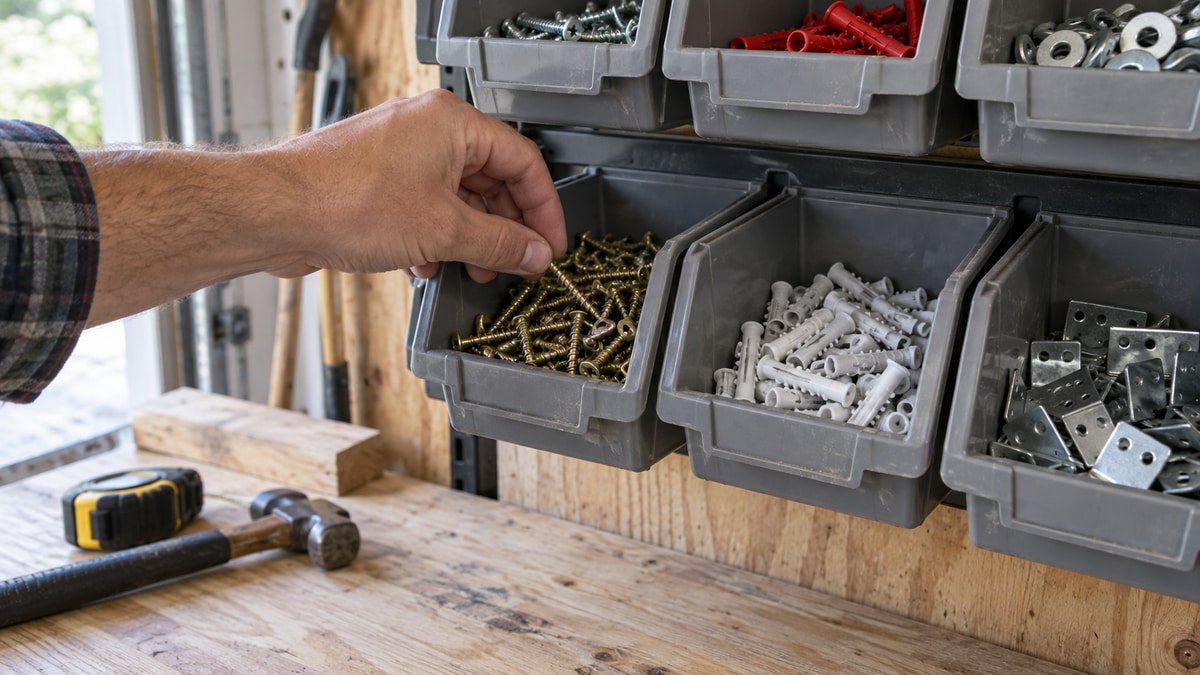
Drawers protect small hardware from dust and accidental bumps, while open bins are faster for bulky parts used constantly. In most home garages, clear drawers suit screws and fittings, and a few larger open bins suit gloves, sanding discs, or wrapped project parts. Mount any open bin where contents cannot spill into a walkway.
How many drawers should a small parts organizer have?
Count the groups you already use, then add room for future splits. A useful starting margin is about twenty percent. Drawer dimensions matter more than the total count. Forty four mixed drawers can be more useful than sixty four tiny drawers when your collection includes long bolts and bulky anchors.
Can plastic parts cabinets be wall mounted?
Many can, including models with molded keyhole slots or mounting holes. Follow the exact manufacturer’s instructions and use fasteners suited to the wall and loaded cabinet. Mount the cabinet empty, keep heavy parts low, and confirm that pulling a drawer does not flex or shift the frame.
What is the easiest way to label nuts and bolts?
Use diameter, thread pitch when relevant, length, material, and finish in the same order on every label. A sample fastener attached safely near the label can speed recognition. Avoid broad labels such as bolts. They force you to search the whole drawer each time.
How do I stop small parts moving between case compartments?
Choose a case whose lid meets the cups or dividers closely, keep all dividers seated, and replace warped or cracked pieces. Test the closed case over a clear bench before carrying tiny washers vertically. Removable cup designs often contain mixed sizes more reliably than short loose dividers.