Affiliate disclosure: As an Amazon Associate I earn from qualifying purchases. This article may contain affiliate links, and Bay & Bench may earn a commission at no extra cost to you. Read our full Affiliate Disclosure.
Workbench caster size and weight capacity planning should start with the loaded bench. An empty frame that is easy to lift tells you very little. Add the top, drawers, tools, vise, benchtop equipment, hardware, and the heaviest normal project. Then account for uneven floors, joints, thresholds, off center loads, and the chance that one wheel briefly loses contact. A four caster bench does not always share weight in four perfect quarters. Capacity is only one part of the choice. Small hard wheels may carry the number on paper yet roll poorly over a garage joint. Soft wheels may protect the floor and run quietly but require more starting effort. Brakes can stop wheel rotation without stopping swivel motion. Use a transparent worksheet, inspect the real route, and follow the caster and bench manufacturers’ mounting instructions before you drill the legs.
Quick answer
Add the empty bench, stored tools, mounted equipment, hardware, and maximum normal project to find gross loaded weight. For a four caster cart, Hamilton Caster advises dividing gross weight by three because an uneven floor can leave only three wheels carrying the load. Treat that result as a minimum per caster rating, then account for shock, slope, debris, moisture, speed, and off center loading with the manufacturer. Choose the largest practical wheel that clears the frame and keeps the final work surface at the right height.
Workbench caster size and weight capacity start with gross load
Build a weight list before looking at caster sets. Start with the bench frame and installed top. Add every drawer, shelf, vise, power strip, bench dog, and mounting plate. Weigh the tools that normally stay inside. Add mounted equipment at its real weight, then include the heaviest project you expect to place on the bench.
Do not rely on a guess such as 300 pounds of tools if the drawers hold sockets, clamps, fasteners, and metal parts. A bathroom scale can handle individual removable groups. Product manuals can provide equipment weight. Keep the worksheet beside the garage storage budget calculator so the cost of mounting plates, brakes, and reinforcement does not disappear from the project.
Gross loaded weight equals bench plus storage plus equipment plus project. It does not include a mystery safety multiplier. The final allowance depends on the caster maker’s rating method and the actual application, so keep the measured total visible and ask the manufacturer when conditions fall outside the published assumptions.
Use a load worksheet that another person can check
| Example component | Example weight | How to verify yours |
|---|---|---|
| Frame and top | 220 lb | Bench specification or weigh parts before assembly |
| Drawers, vise, and stored tools | 180 lb | Weigh removable groups and hardware |
| Maximum normal project | 100 lb | Use the heaviest recurring work, not an unrealistic one time load |
| Gross loaded weight | 500 lb | 220 + 180 + 100 |
| Three contact calculation | 166.7 lb per caster | 500 divided by 3 |
| Rounded minimum before application review | 167 lb per caster | Round upward, then check conditions and maker guidance |
The numbers are a planning example, not a recommendation for a specific bench. Hamilton Caster’s FAQ advises dividing the total of cart and load by three for a typical four caster setup because uneven surfaces can leave only three wheels in contact. If your bench has a different caster arrangement, use the guidance for that design.
Capacity ratings have conditions attached
A per caster rating usually assumes stated speed, floor, duty cycle, temperature, and loading conditions. The Hamilton capacity guidance describes ratings for intermittent operation on relatively smooth floors and calls for extra capacity when shock loading, rough surfaces, powered movement, or other unfavorable conditions appear.
A garage creates several of those conditions. A wheel can strike a slab joint. A drawer bank can put most of the weight on one side. A heavy part can be set down near the vise. The floor may slope toward the door. If one caster lifts during a turn, the remaining wheels receive more load.
Do not mix ratings from a wheel, caster fork, mounting plate, bolt, bench leg, and frame as if the largest number governs. The whole installation is limited by the weakest verified component. Read both the caster and bench instructions, and ask the maker about unusual loads or modifications. A higher printed capacity does not repair a weak leg or an undersized mounting plate.
Wheel diameter changes rollability more than appearance
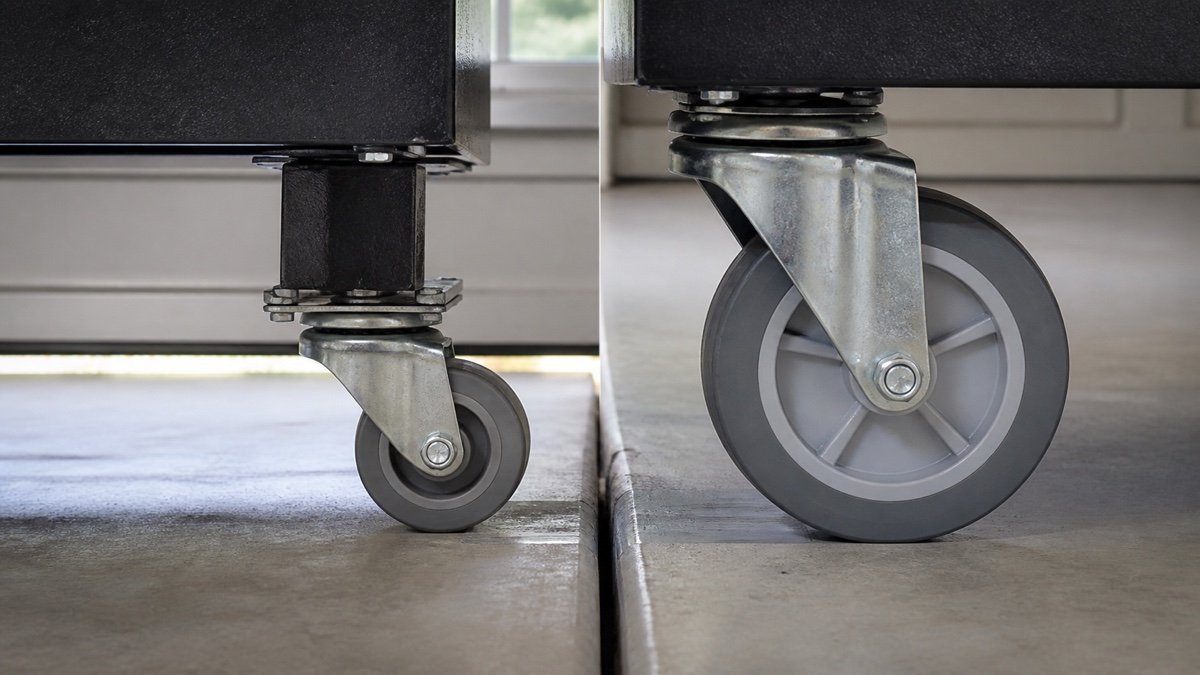
Larger wheels generally start and roll more easily, all else equal. They also approach a floor joint or threshold at a gentler angle. Hamilton identifies wheel size as a major factor in rollability, along with load, tread, bearing, and floor condition. That does not mean the largest wheel is always correct. It raises the bench, needs more swivel clearance, and can increase leverage on the mounting area.
| Wheel diameter to compare | Likely garage behavior | What to verify |
|---|---|---|
| 3 inches | Compact, but more sensitive to debris and joints | Smooth route, load rating, and starting effort |
| 4 inches | Moderate height and obstacle ability | Joint depth, swivel radius, brake access |
| 5 inches | Generally easier over common floor irregularities | Added bench height and leg clearance |
| 6 inches | Better obstacle approach, but a larger package | Mounting strength, swivel envelope, final work height |
This table compares tendencies, not capacity. A small industrial caster can carry more than a large light duty caster. Use the exact model data.
Tread material trades rolling effort for floor behavior
Hard wheels generally roll more easily on smooth concrete and can carry high loads, but they may be noisy and hard on the floor. Resilient wheels can reduce noise and cushion small irregularities, though they may need more force to start. Moisture, oil, cleaners, temperature, and metal debris can change material performance.
Hamilton’s wheel comparison separates rollability, capacity, quiet operation, floor protection, cushioning, impact resistance, moisture resistance, and abrasion resistance. That is a better way to choose than assuming every polyurethane wheel behaves alike.
| Wheel family | Typical reason to consider it | Garage concern to check |
|---|---|---|
| Rubber or other soft resilient tread | Quieter travel and floor cushioning | Starting effort, load rating, flat spotting, chemicals |
| Polyurethane tread | Balance of capacity, floor protection, and wear | Compound hardness, moisture, debris, bonded tread condition |
| Nylon or other hard polymer | Easy rolling on smooth floors and compact size | Noise, floor marking or damage, poor obstacle cushioning |
| Metal wheel | Special high load or temperature applications | Concrete damage, noise, debris, and whether it belongs in a home garage |
Choose the lock by the motion you need to stop
A wheel brake stops or resists wheel rotation. A swivel lock controls the caster’s turning action. A total lock is designed to control both, though the exact mechanism and holding performance vary. Read the product description and manual instead of treating every foot pedal as the same brake.
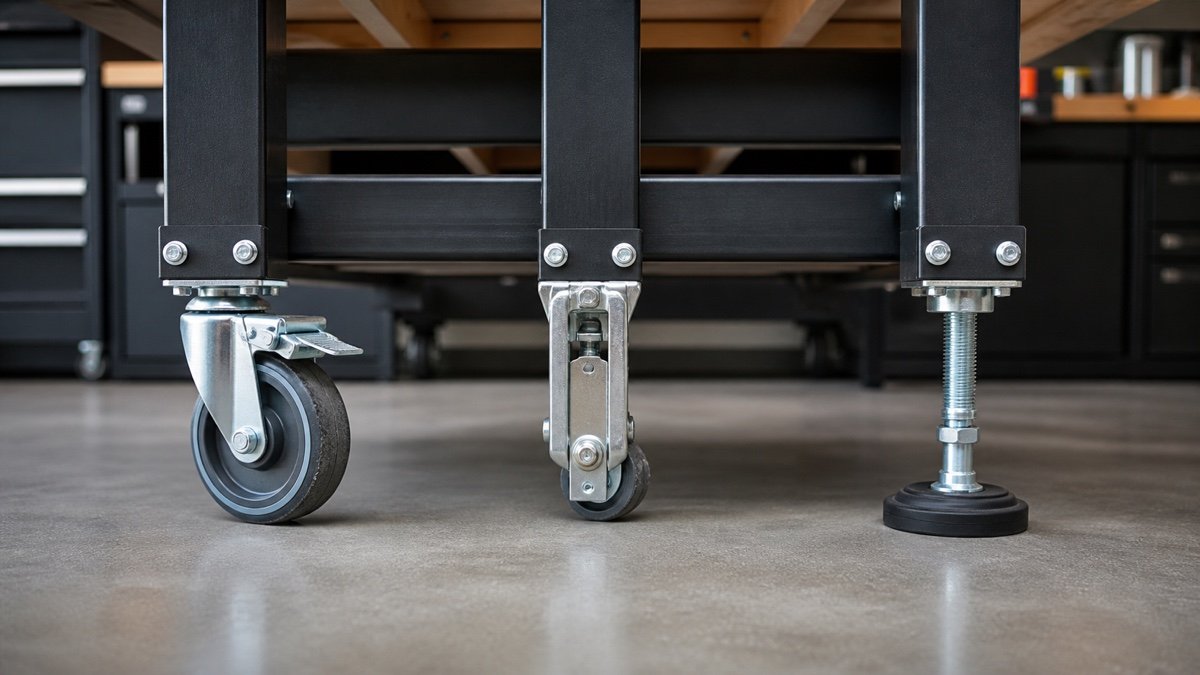
Four swivel casters make tight garage turns easier, but the bench can wander sideways if swivel movement remains. Two rigid and two swivel casters track more predictably in a long route but need more room to turn. Retractable caster kits lift wheels away so the bench rests on fixed feet. Leveling casters combine rolling hardware with a separate pad that carries the bench during work.
Each system changes the load path and working height. Confirm whether the published rating applies while rolling, while resting on pads, or both. Check that pedals and adjusters remain reachable without putting fingers or shoes under a loaded bench. Never crawl beneath an unsupported bench to operate or repair the hardware.
Mounting plates and bench legs must agree
Top plate casters spread load through several bolts, but only if the plate sits on a flat, strong mounting area. Stem casters concentrate force differently and require a compatible socket or leg construction. A thin hollow leg, end grain block, or narrow wood rail may need a maker approved bracket or reinforcement.
Measure bolt spacing, plate size, overall caster height, swivel radius, and brake sweep. A large wheel can strike a stretcher or cabinet before it completes a turn. The added overall height raises the work surface and the center of gravity. Recheck comfort with the garage workbench buying guide open beside the caster drawing.
Fastener grade, washers, locking method, edge distance, and access for inspection all matter. Do not drill through a steel leg, alter a welded frame, or add a wood block without confirming that the change is allowed. Tight bolts cannot make an unsuitable mounting surface safe.
Test the route, slope, and turning space
Mark the bench footprint and caster swivel envelope in the actual garage. Use the garage storage fit calculator for the main dimensions, then add wheel swing, a push position, and the largest normal project. The garage measuring guide helps record joints, drains, slopes, thresholds, and door hardware.
With a secured representative load, push slowly across the clean route. Repeat through the tightest turn and over each joint in both directions. Notice starting effort, wheel deflection, noise, brake access, and whether any caster loses contact. Stop if the frame racks, a mounting plate shifts, or the bench accelerates on a slope.
Inspect again after several work sessions. Look for loose fasteners, cracked tread, debris wrapped around axles, damaged brakes, bent forks, and movement in the leg. Keep the floor clean. A small screw can abruptly stop a wheel even when the caster has ample load capacity.
A caster buying and installation checklist
- Calculate gross loaded bench weight with a visible worksheet.
- Use the caster maker’s rule for how many wheels may carry the load.
- Review shock, slope, floor joints, debris, moisture, temperature, and speed.
- Choose wheel diameter and tread for the real route.
- Confirm whether the brake controls wheel rotation, swivel, or both.
- Check plate size, bolt pattern, fasteners, leg strength, and swivel clearance.
- Add overall caster height to the finished workbench height.
- Test with a secured load and inspect hardware regularly.
If the numbers require a heavy industrial caster but the bench legs cannot accept its plate, change the bench or use a separate mobile base designed for the load. If movement is rare, fixed feet and a pallet jack style solution may be more sensible, provided the equipment is designed for it. The garage storage planning guide can sometimes remove the need to roll a dense bench by giving it a permanent clear zone.
Useful products to compare
These links open current Amazon search results so you can compare dimensions, manuals, ratings, and availability for the exact models on your shortlist.
Before you buy or install
Check the current manual for the exact product you are considering. Confirm the assembled dimensions, load rules, mounting requirements, included hardware, clearances, warranty, and any limits that apply to your wall, floor, or garage layout.
Frequently asked questions
What caster capacity do I need for a 500 pound workbench?
Hamilton advises dividing total cart and load by three for a typical four caster setup on uneven surfaces. That gives 166.7 pounds per caster before reviewing shock, floor, environment, and the published rating conditions. Round up and confirm the application.
Are 3 inch casters large enough for a workbench?
They may be on a smooth, clean route with a suitable rating, but small wheels are more sensitive to joints and debris. Compare starting effort and obstacle crossing with 4 or 5 inch options.
Do I need total lock casters?
Total locks can reduce wheel and swivel movement, which is useful for a bench. They do not remove frame flex, mounting play, floor slope, or the need to follow the workbench and caster instructions.
Will casters make my workbench too tall?
They can. Add the overall installed caster height to the bench and top, then include the workpiece or vise. Test the finished working level before drilling the legs.