Affiliate disclosure: As an Amazon Associate I earn from qualifying purchases. This article may contain affiliate links, and Bay & Bench may earn a commission at no extra cost to you. Read our full Affiliate Disclosure.
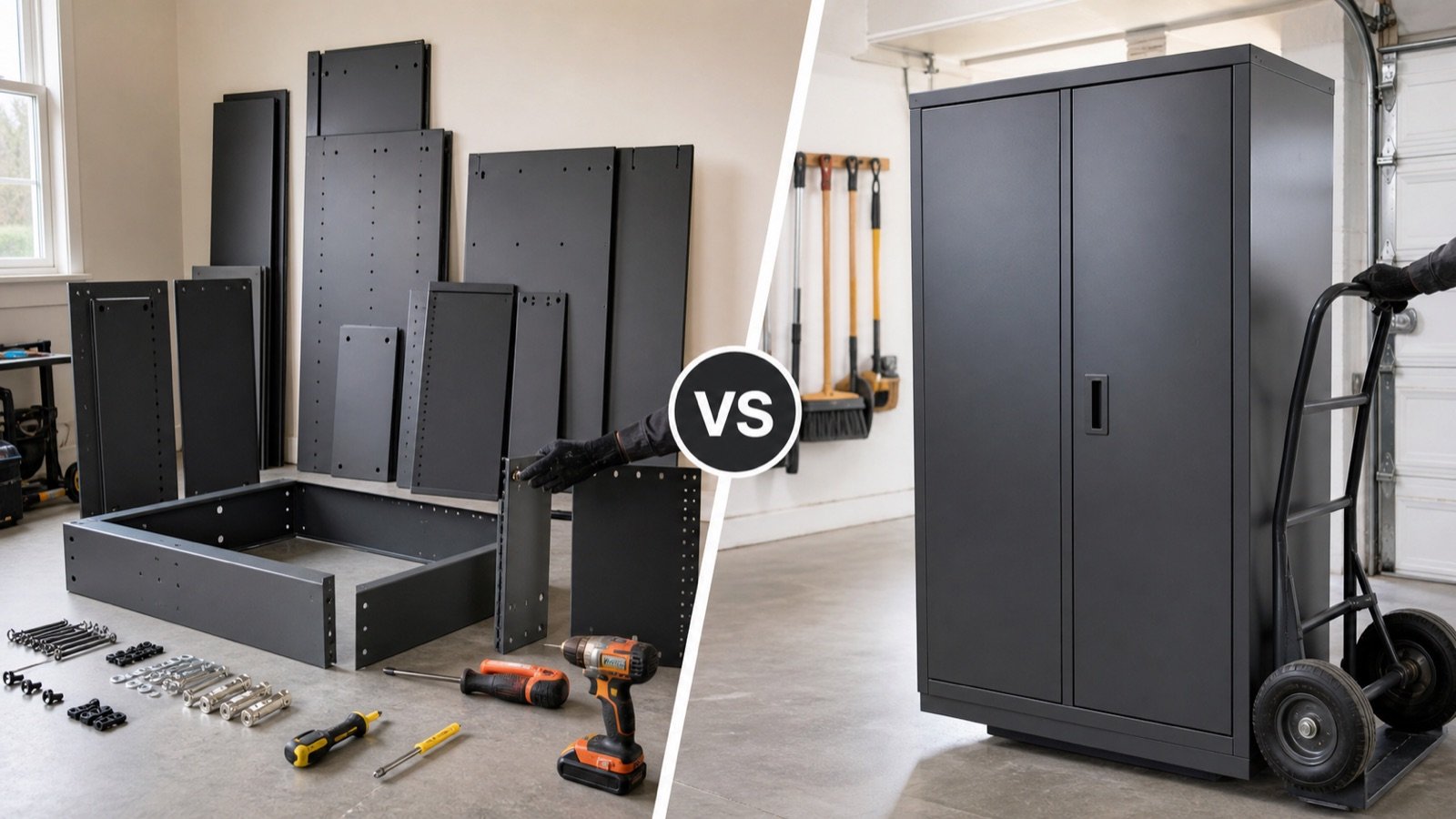
Ready-to-assemble modular cabinets are easier to deliver through tight routes and often easier to expand. Fully welded or preassembled cabinets reduce setup and can provide a rigid square case, but are heavier and harder to move.
Quick answer
Choose modular when access, budget, reconfiguration and phased expansion matter. Choose preassembled when you value reduced assembly and can safely receive, move and place the heavier cabinet. Compare exact construction and ratings—not labels alone.
Useful products to compare
These searches are a practical starting point for comparing current sizes, materials, load ratings, and availability.
What the terms really mean
“Modular” describes a system of compatible components; it does not necessarily mean flat-packed. “Ready to assemble” describes delivery format. “Preassembled” can range from a completed case that needs feet and shelves to a fully welded unit. Read the assembly manual before purchase.
Delivery and access
Flat packages can pass through narrow doors and be carried in pieces. A welded locker may arrive on a pallet and require a truck-accessible delivery point, two capable people, and a hand truck. Compare packaged dimensions and weight with every turn between curb and garage.
Assembly time and accuracy
RTA cabinets require sorting hardware, protecting panels, following sequence, squaring the case and aligning doors. A rushed assembly can cause poor operation. Preassembled cases save these steps but still require leveling, shelf installation and restraint.
Strength and repair
Welded construction can reduce joints, but sheet design and shelf ratings remain decisive. Bolted modular cases can also be strong when engineered and assembled correctly. Modular panels may be easier to replace; welded damage may be harder to correct. Compare published ratings and parts support.
Expansion and moving
A broad modular family lets you add matching wall cabinets, lockers, worktops and accessories. Confirm individual pieces are sold separately. If you expect to move homes, RTA does not automatically mean the cabinet is designed for repeated disassembly; check the manual.
Choose with a logistics scorecard
- Package dimensions and weight
- Delivery method and threshold service
- People and equipment needed
- Estimated assembly steps
- Leveling and anchoring hardware
- Replacement parts and future modules
Measure the route with the garage measurement checklist before ordering.
Before you order: the verification pass
Put the exact model number—not merely the product-family name—at the top of your worksheet. Copy the assembled exterior dimensions, usable interior dimensions, individual shelf or drawer ratings, total cabinet weight, packaged dimensions, adjustable-foot range, and required clearances from the current manufacturer page and manual. Note which accessories are included and which appear only in styled photographs.
Then return to the garage with painter’s tape. Mark the cabinet case, handles, open doors or extended drawers, and the path needed to load the largest object. Park the vehicle in its normal position and test every door, hatch, step, switch and service panel. Photograph the mock-up from the driver’s seat, house entry and driveway. If a critical measurement is unpublished, ask the manufacturer before placing the order.
Finally, calculate total delivered cost: cabinet, worktop, shelves, drawer liners, casters or feet, mounting rails, appropriate fasteners, delivery surcharge, assembly help and sales tax. A lower sticker price can become the more expensive installation when essential components are optional.
Installation-day checklist
- Inspect packages for damage before assembly and keep model labels and receipts.
- Read the complete manual before lifting or fastening anything.
- Confirm the floor is stable and the planned attachment locations are suitable.
- Use a second capable person whenever the manual or cabinet size calls for one.
- Level and square the case before aligning doors and loading shelves.
- Install wall mounting or tip restraints exactly as instructed.
- Load heavy objects low and distribute weight within every shelf and drawer rating.
- Recheck fasteners, leveling and door alignment after the cabinet has been loaded.
Do not improvise around electrical, gas, plumbing, fire-safety or structural conditions. When the required attachment or clearance is uncertain, pause and consult a qualified professional.
Common mistakes to avoid
Most disappointing installations trace back to one of five mistakes: measuring only the empty wall; treating total capacity as a per-shelf rating; forgetting doors, drawers and vehicle movement; selecting depth from a catalog image; or filling every wall without reserving adaptable space. A slower specification check is cheaper than returning a pallet-sized cabinet.
Frequently asked questions
Are welded cabinets always stronger?
No. Welding is one construction feature. Shelf design, steel thickness, frame geometry and published load ratings all matter.
Do preassembled cabinets arrive ready to use?
Not always. Shelves, feet, casters, handles or restraints may still need installation. Read the exact delivery and assembly notes.
Can one person assemble a tall cabinet?
Follow the manual. Large panels and uprighting steps often require two people even when individual parts are light.
Last reviewed: July 2026. Product specifications can change; check the manufacturer’s current documentation before purchase.