Affiliate disclosure: As an Amazon Associate I earn from qualifying purchases. This article may contain affiliate links, and Bay & Bench may earn a commission at no extra cost to you. Read our full Affiliate Disclosure.
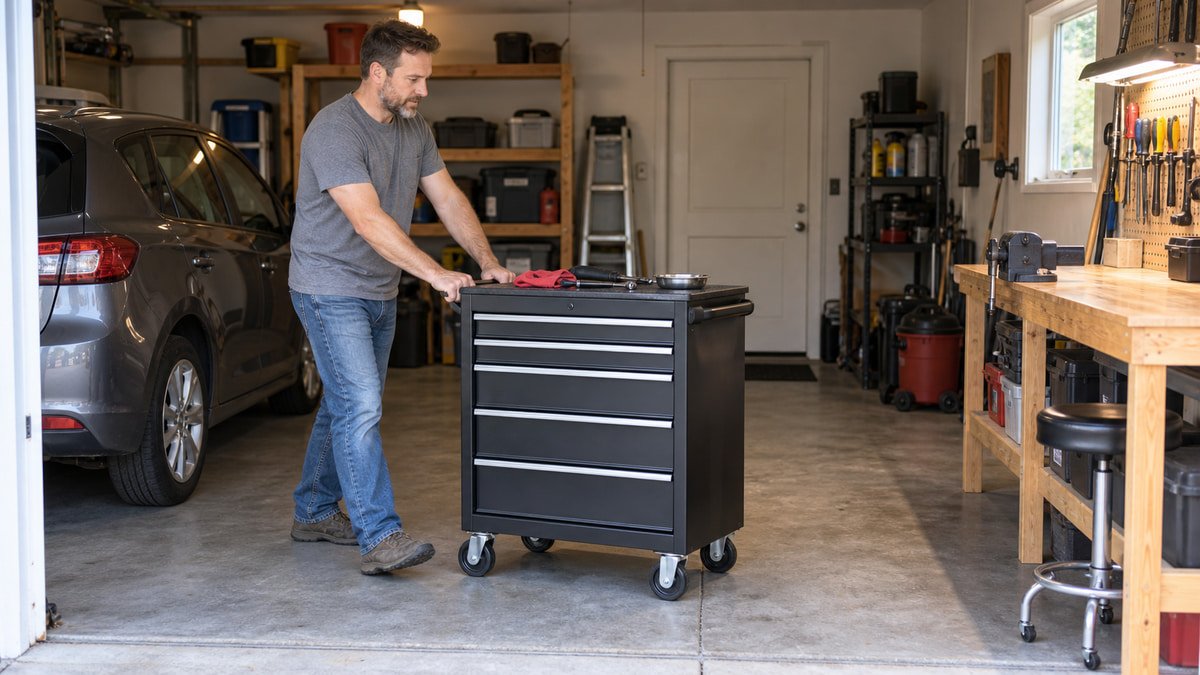
The driver’s door is open, one wheel is off, and the cart has nowhere useful to stand. That familiar squeeze is why the best rolling tool cart for small garage work cannot be chosen by drawer count alone. You need a cart that moves beside the car, opens without pinning you against a wall, and parks after the project. A deep mechanics cart can hold plenty, yet its handle, lid, and drawers may turn a narrow aisle into a dead end.
This guide favors useful access over maximum capacity. The three named carts have current published dimensions and load information, while two generic cart styles cover jobs that a drawer cabinet handles poorly. Prices and colors change often, so confirm the exact model page before buying. More important, measure your garage with the vehicle parked. Empty floor space has a habit of disappearing once a door swings open.
Quick answer
For most small garages, a 30 to 33 inch mechanics cart with four or five drawers offers the best balance of access and storage. The five drawer U.S. General cart is the broad value pick, and the Husky 33 inch cart gives you a useful open bottom shelf. Sunex suits a heavier collection but needs more room and costs more. Choose an open shelf cart for bulky project supplies or a narrow two drawer cart when aisle width is the hard limit.
Best rolling tool cart for small garage use at a glance
Start with the parked footprint, then compare drawers. Width alone can fool you because a handle adds several inches and a raised lid may hit a shelf. The table separates the five layouts by the job each handles well.
| Cart setup | Approximate body size | Storage style | Best small garage fit | Main compromise |
|---|---|---|---|---|
| U.S. General 30 inch mechanics cart | 37.25 x 22 inches with handle | Five drawers, top compartment, bottom tray | Broad home mechanic tool set | Lid must open for full access |
| Husky 33 inch mechanics cart | 33 x 20 x 39.8 inches | Four drawers, top compartment, open shelf | Tools plus one bulky case | Open shelf collects dust |
| Sunex 8057XT | 39.25 x 21.5 x 39.25 inches with handle | Six full drawers and top compartment | Dense hand tool collection | Heavy and less compact |
| Open shelf service cart | Varies, often 30 to 36 inches wide | Two or three open shelves | Project bins and cleaning gear | No secure small parts storage |
| Narrow two drawer utility cart | Varies, often under 30 inches wide | Shallow drawers and open shelf | Tight side aisle and light tool kit | Limited drawer depth and load |
If you are still deciding between fixed and mobile storage, the tool chest and cabinet comparison explains where each format fits.
U.S. General 30 inch cart for the strongest value balance
Harbor Freight lists its 30 inch U.S. General five drawer mechanics cart at 37.25 inches long, 22 inches wide, and 41.375 inches high. The current product page states 15,000 cubic inches of total storage, a 700 pound working load, and 75 pounds per pair of drawer slides. Five inch casters include two fixed wheels and two locking swivels.
That combination makes it the easy value choice for someone who keeps sockets, wrenches, pliers, and a few power tools close to a car. The top compartment is fast to scan, and the bottom tray accepts items that do not belong in shallow drawers. An integrated power port can route charger cords with the lid closed, though any charging setup still needs suitable electrical protection and open ventilation around the equipment.
The catch is geometry. The 37.25 inch length includes the working shape, not just a tidy nominal width. Its lid opens to 90 degrees, so check shelves and wall rails above the parking spot. A 144 pound empty weight also means you will feel a rough slab once the drawers are filled.
Husky 33 inch cart when an open lower shelf helps
The Husky four drawer cart takes a slightly different approach. Its Home Depot product listing gives assembled dimensions of 33 inches wide, 20 inches deep, and 39.8 inches high, with a load capacity of up to 672 pounds. Four drawers ride on 75 pound ball bearing slides, and the lower reinforced shelf leaves roughly 14.5 inches of vertical storage room.
That shelf is useful for a compact vacuum, fluid drain pan, or one rugged tool case. It also shows every bit of sanding dust and road grit. If the cart will live near a woodworking bench, keep precision instruments in the enclosed drawers and reserve the shelf for items that wipe clean. The lid and drawers lock together, which is convenient for basic household security but does not turn a mobile cabinet into a safe.
The 20 inch depth is friendly to a narrow aisle. Still, the push handle and open lid change the real envelope. Tape those projections on the floor and wall before pickup. This cart makes sense for mixed work where the bottom shelf will be used every week, not filled with forgotten bottles.
Sunex 8057XT for a dense hand tool collection
The Sunex 8057XT is the grown up option in this group. Sunex publishes 18 gauge steel construction, six full extension drawers, a 600 pound total capacity, and a 244 pound product weight. On the official 8057XT page, the cabinet measures 34.5 inches wide without its handle and 39.25 inches with it, by 21.5 inches deep and 39.25 inches high. The open lid raises the total height to 60 inches.
Six full width drawers are easier to divide than a small drawer stack over an open shelf. They suit a serious socket collection, diagnostic tools, and specialty hand tools that need their own layer. Four swivel casters can make tight turns easier than a fixed wheel pair, although every wheel needs room to rotate under load.
For many home garages, this is more cart than the aisle wants. It is heavy before the first wrench goes in, and its handle width approaches 40 inches. Buy it because the drawer layout solves a real access problem, not because the capacity sounds reassuring. A lighter kit on a smaller cart often moves more pleasantly.
Open shelf carts for bulky project supplies
An open steel or polymer service cart can be the better tool cart when the job changes every weekend. One shelf can hold a project bin, the top can carry measuring gear, and the lower level can take a small vacuum or finishing supplies. There are no drawer slides to consume interior width. You can also see what was left behind before rolling the cart back into its corner.
The trade is containment. Loose sockets rattle away, spray cans fall when a wheel catches a joint, and fine dust settles on everything. Use low bins with fitted lids, keep liquids upright, and respect the manufacturer’s shelf and total load ratings. A raised lip helps, but it does not secure a tall object during movement.
This format pairs well with fixed tool storage. The garage tool storage guide suggests keeping tools near the work that uses them. Load only the current project’s kit, roll it to the bench, then put the tools back. That rhythm stops a utility cart from becoming a permanent pile on wheels.
Narrow two drawer carts for the side of a parked car
A narrow cart with one or two shallow drawers and an open base earns a place where every inch counts. It can hold daily screwdrivers, a ratchet set, a meter, and the current job’s parts without creating a second full tool cabinet. Look for a genuine push handle, drawer latches, and casters large enough for the actual slab.
Small carts can be surprisingly tippy. A narrow wheelbase, a tall load, and an open top drawer form an unhappy combination. Store dense tools at or below axle height when the design allows it. Open one drawer at a time, apply the brakes while working, and do not use the cart as a step. If a product has no published limits or manual, skip it. Mystery steel thickness is not a bargain.
This is the sensible choice for apartment style garages, motorcycle bays, and one car shops with a fixed bench along the opposite wall. It will not absorb a growing collection forever. That constraint can be healthy because it forces rarely used gear back into cabinets instead of letting the aisle shrink by inches each season.
Measure the cart in its working position
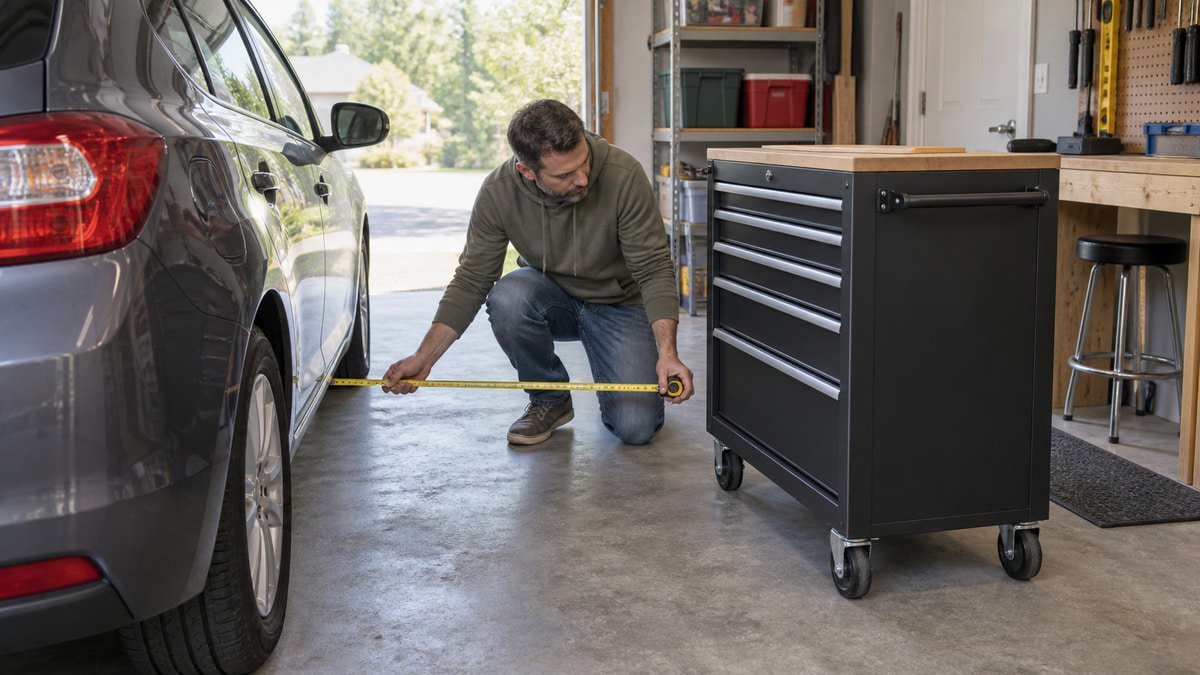
Park the largest vehicle as it sits on an ordinary evening. Open the driver’s door, passenger door, hatch, and any garage entry door that shares the aisle. Mark the cart body with painter’s tape, then add the handle, side tray, and the deepest open drawer. Raise a cardboard panel to the stated open lid height. The garage measuring guide covers tracks, curbs, outlets, and other obstacles that a clean floor plan misses.
Walk through the mockup carrying a grocery bag and a long workpiece. Can you reach the driver’s door without turning sideways? Can you pull the cart toward the workbench while the garage door is down? Does the handle strike a cabinet before the cart clears the car? Those ordinary movements decide whether the cart will be used.
Measure the parking location too. A cart that fits beside a fender during work may need to tuck under a bench afterward. Confirm closed height, caster height, handle position, and any lip beneath the bench. Allow finger room rather than designing a slot so tight that every parking attempt scrapes paint.
Choose drawer depths from the tools you own
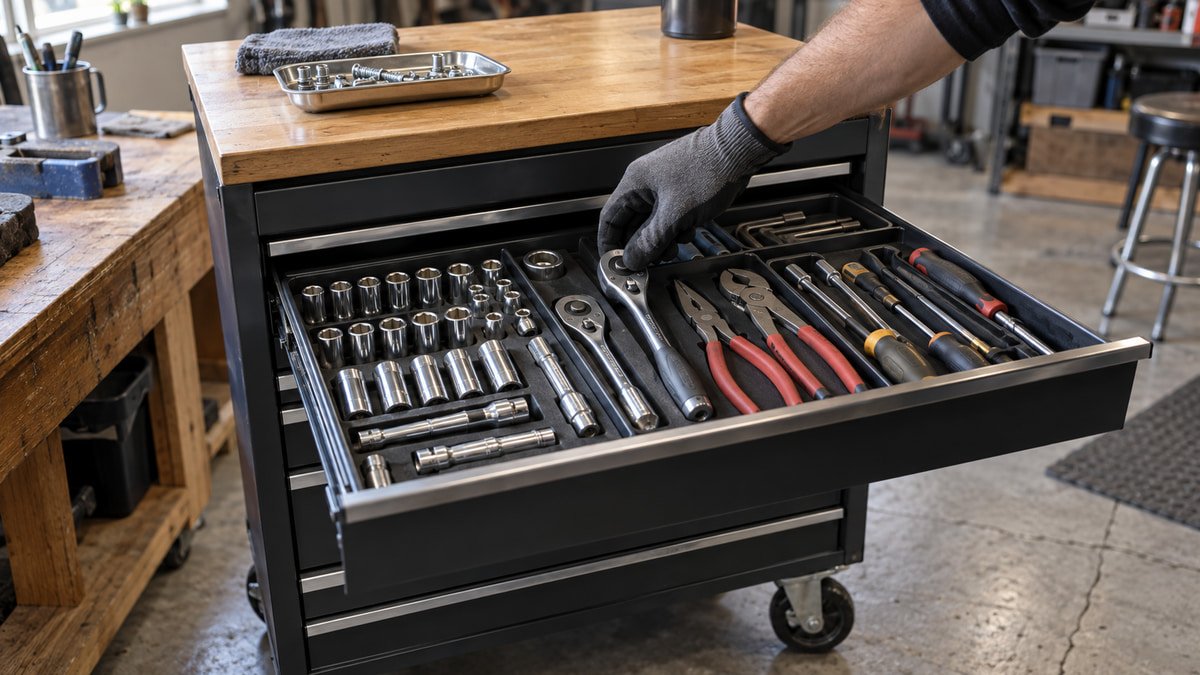
Shallow drawers are excellent for sockets, ratchets, pliers, and layout tools because you see the whole layer. Deep drawers accept drills and bulky cases but encourage stacking. Once three tools occupy the same vertical column, the bottom one becomes invisible. Count the drawer heights and sketch a home for the ten tools you use most.
Bring the dimensions of molded cases, not just the tools inside them. A compact drill may fit while its charger or bit case does not. Decide which cases can move to a shelf and which protect calibrated or delicate gear. Drawer liners reduce sliding, while fitted organizers save search time at the cost of some capacity.
Do not treat every published drawer limit as permission to fill each drawer to that number. The overall cart rating still applies, and a heavy upper drawer changes stability. The rolling tool chest buying guide goes deeper into slide ratings, drawer layout, and loaded weight. Keep dense sockets low and leave one shallow drawer slightly loose for the tools that are on the job today.
Match casters to the garage floor
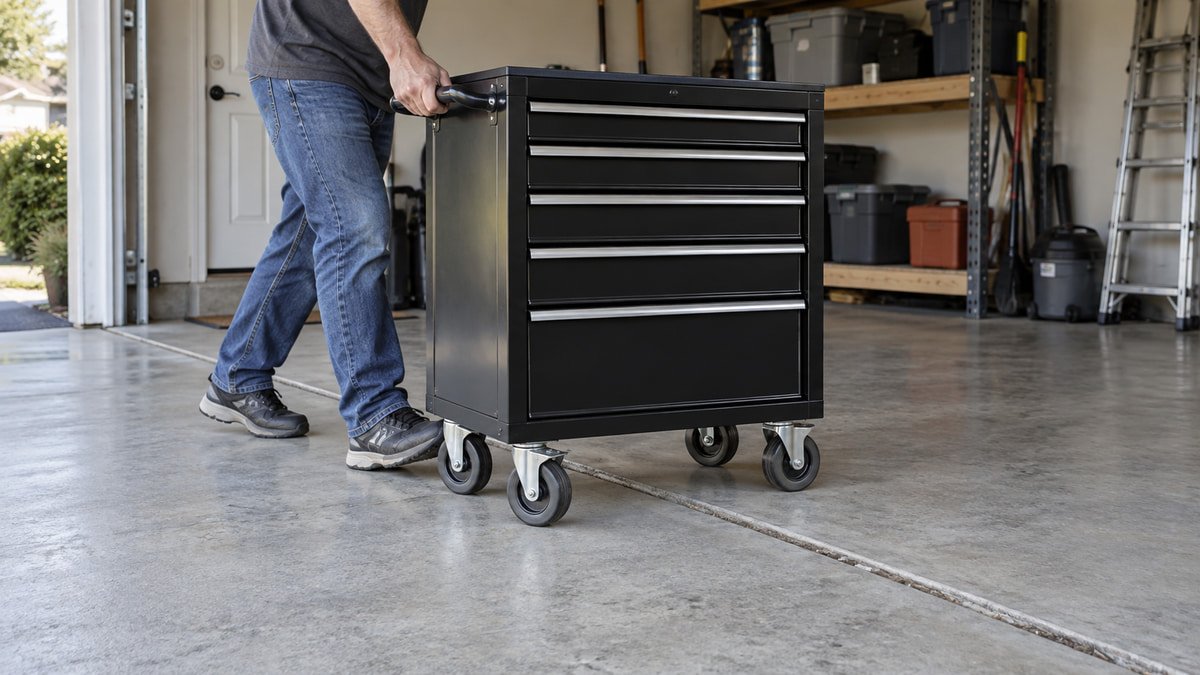
Five inch casters are common on full mechanics carts for good reason. They cross shallow joints and stray grit more easily than small hard wheels. Diameter is only part of the story. Wheel material, tread width, bearing quality, mounting, and caster layout determine how the cart steers once loaded.
Two fixed wheels with two swivels track predictably down a straight aisle. Four swivels can rotate inside a smaller area but may wander when pushed over a seam. Try to push from the provided handle rather than pulling the cart behind you. Close and latch drawers, remove loose objects from the top, and slow down before thresholds. Sunex tells owners of the 8057XT to push from the end handle, lock the lid and drawers before moving, and use the cart on flat surfaces.
Check the full route under real lighting. The garage aisle clearance guide is useful when a bench, shelving, or vehicle creates a pinch point. Sweep abrasive grit before rolling. It damages finishes and turns a manageable joint into a sudden stop.
Read load ratings as limits, not goals
A cart’s large total capacity number can distract from smaller limits. Drawer slides may have their own ratings. A side tray can carry far less than the cabinet. The top compartment may have another number, and the total usually assumes the load is distributed. Read the current manual for the exact model and color code because similar looking generations can differ.
Weigh the heavy drawer groups if you are unsure. A few socket sets, pullers, and large wrenches add up quickly. Put the dense drawers near the bottom, keep the left and right sides reasonably balanced, and avoid hanging heavy accessories from one end. Never climb, sit, or lean hard on an open drawer.
Brakes stop rolling; they do not widen the wheelbase. The cart can still tip if several loaded drawers are extended or if someone uses the open lid as a work shelf. Load conservatively, especially around children and pets. If you need to move hundreds of pounds of tools only twice a year, a fixed cabinet plus a light project cart may be the calmer answer.
Inspect assembly and service parts before buying
Look for a downloadable manual and a real parts list. Replacement keys, slides, caster hardware, liners, and gas struts can matter more than a decorative accessory after five years. Sunex publishes a parts breakdown for the 8057XT, while the U.S. General and Husky pages link manuals and support material. Save the model number and key code somewhere outside the locked cart.
After assembly, verify that every caster fastener is tight, drawers latch, locks operate without force, and the cart sits level. Recheck hardware after a few loaded trips. Clean grit from wheel treads and drawer slides. A modest cart that rolls straight and closes cleanly is far more pleasant than a larger one that fights you at every floor joint.
Useful products to compare
These links open current Amazon search results. Check the dimensions, manual, mounting hardware, warranty, and current availability for the exact model before you order.
Before you buy or install
Read the current manual for the exact product you are considering. Confirm its assembled dimensions, rated capacity, mounting requirements, included hardware, working clearances, warranty, and any limits that apply to your wall, floor, electrical circuit, or garage layout.
Frequently asked questions
What size rolling tool cart works in a small garage?
A body around 30 to 33 inches wide and about 20 to 22 inches deep is a useful starting range, but the right size comes from your parked aisle. Add the handle, open drawer depth, side accessories, and lid height before deciding. Mock up the complete working envelope with tape and cardboard.
Are four swivel casters better than two fixed and two swivel casters?
Four swivels can turn in a smaller area, which helps beside a parked car. Two fixed and two swivel casters tend to track more predictably on a straight run. Wheel size, floor joints, load distribution, and handle placement matter as much as the layout. Follow the cart manual and lock the brakes while working.
Should power tools go in a rolling tool cart?
They can, if the drawer or shelf fits the tools and stays within its rating. Deep drawers often waste space around bulky molded cases. Many owners get better access by keeping hand tools in shallow drawers and putting one or two current power tools on a lower shelf or in a fitted deep drawer.
Can I charge tool batteries inside a closed cart?
Use only an arrangement allowed by the battery and charger instructions. A cart power port only routes a cord. It does not guarantee ventilation, temperature control, cord protection, or electrical suitability. Keep chargers clear of combustible clutter, avoid pinched leads, and unplug temporary connections before moving the cart.
How should I load a mechanics cart to reduce tipping?
Keep dense tools low, balance weight across the cabinet, and open one loaded drawer at a time. Stay below every drawer, shelf, accessory, and total rating. Close and latch the drawers before moving. Apply the brakes on a flat surface while you work, and never stand or sit on the cart.