Affiliate disclosure: As an Amazon Associate I earn from qualifying purchases. This article may contain affiliate links, and Bay & Bench may earn a commission at no extra cost to you. Read our full Affiliate Disclosure.
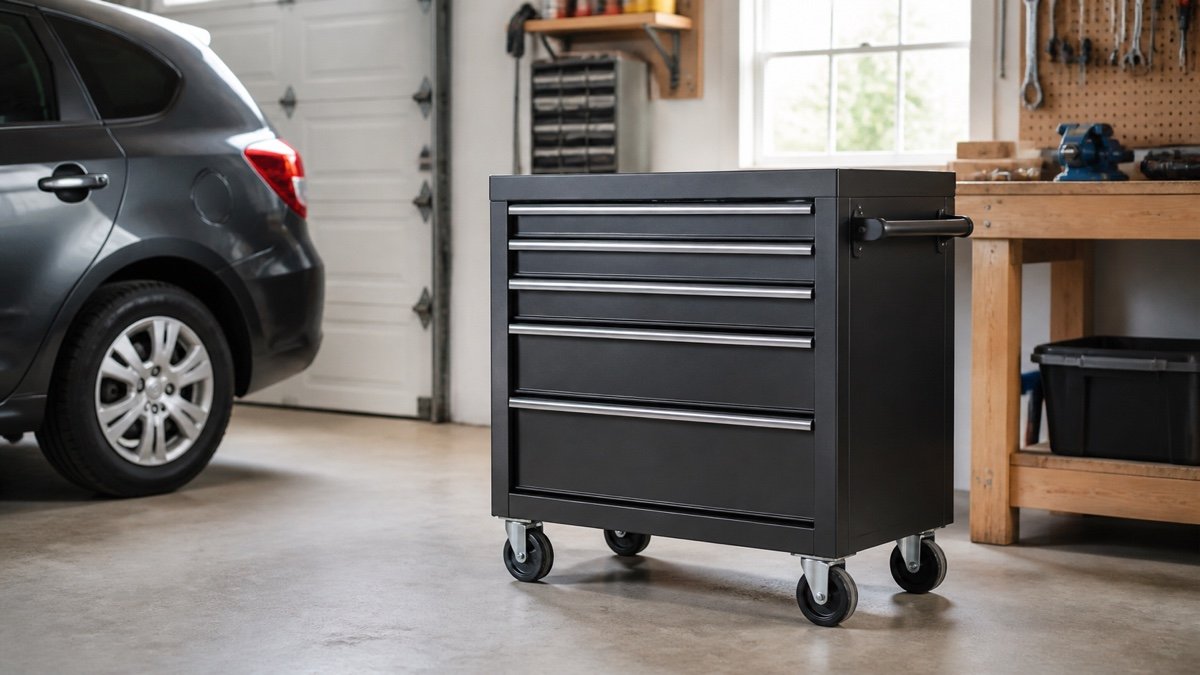
Learning how to choose a rolling tool chest is mostly an exercise in resisting oversized specifications. A huge capacity number looks reassuring until the cabinet blocks a car door, the shallow drawers do not fit your cordless tools, or the loaded box cannot cross a slab joint. Start with a drawer map and loaded footprint. Then judge capacity wording, casters, stability, worktop, power, locks, and expansion. The comparison uses current manufacturer specifications to show how differently similar-looking cabinets can be rated, so treat it as a fit guide rather than a shop test.
Quick answer
Measure your tool groups in one layer, then choose drawer widths and heights that fit them with room for organizers and fingers. A 26 to 42 inch cabinet often suits a home collection better than a 56 or 72 inch unit, but the tool map decides. Put dense drawers low, compare per-drawer and overall ratings separately, and plan the fully assembled footprint. Check empty weight, caster diameter, threshold route, drawer-open clearance, power cord, compatible top pieces, and delivery before ordering.
How to choose a rolling tool chest in ten checks
Use this list in order. Later features cannot rescue the wrong footprint or drawer layout.
| Check | What to record | Failure it prevents |
|---|---|---|
| Tool map | Grouped tool dimensions and weight | Wide cabinet with useless drawers |
| Cabinet footprint | Body, handle, bumpers, caster sweep | Blocked vehicle or door |
| Drawer map | Internal width, depth, height | Stacked tools and jammed latches |
| Ratings | Drawer, cabinet, top, accessory limits | Overloaded slides or base |
| Stability | Drawer latches, load order, floor level | Tip or uncontrolled opening |
| Casters | Diameter, width, locks, floor joints | Cabinet that cannot move |
| Worktop | Surface material and allowed tasks | Damaged top or lost landing area |
| Power | Cord exit, outlets, ventilation | Snagged cord or hot charging zone |
| Expansion | Approved chest, locker, side cabinet | Mismatched unstable stack |
| Delivery | Packaged size, weight, threshold route | Crated cabinet stuck outside |
Plot the two-dimensional footprint with the garage storage fit calculator before comparing paint colors.
Inventory by drawer, not by total tool count
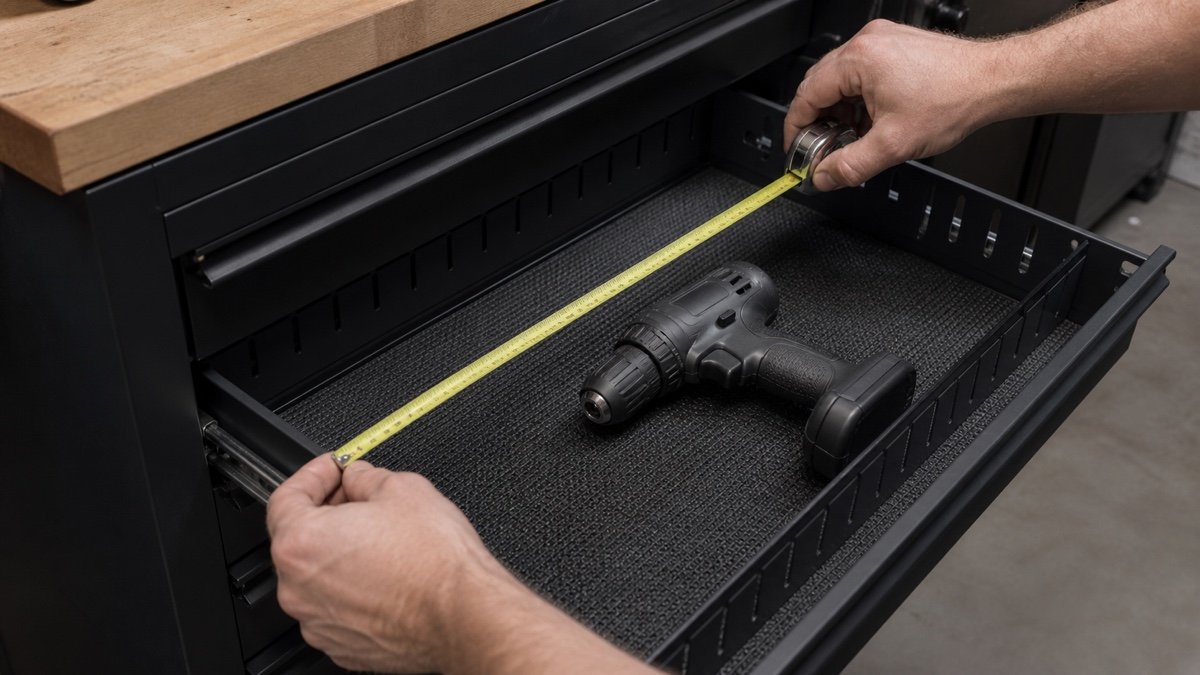
Lay sockets, wrenches, pliers, measuring tools, cordless tools, and specialty equipment in separate groups. Arrange each group as you would like to see it in a drawer. Measure the rectangle, the tallest item, and the rough weight. Leave room for a hand to lift the tool and for an organizer to hold it.
This exercise often points to fewer, better-shaped drawers. Ten shallow drawers are wasteful when half the collection consists of drills and large pullers. Four deep drawers are miserable when every socket hides below another. Photograph the layouts and carry the numbers while shopping. A cabinet width tells you little about usable drawer width.
Pick width after the parking test
A 26-inch single-bank cabinet is easy to place and steer. A 41 or 42-inch double-bank cabinet opens a broad top drawer and holds a mature home collection. Wider 52, 56, and 72-inch boxes provide volume and work surface, but their depth, weight, and turning radius become serious room-planning issues.
Tape the cabinet body and side handle on the floor. Add the deepest open drawer. Park the vehicle and walk past it carrying a case. If the layout works only with the handle removed or the cabinet rolled out for every use, choose a smaller width. The garage workshop aisle clearance guide helps test the active space rather than the closed rectangle.
Read drawer and overall ratings separately
The cabinet rating, drawer slide rating, caster rating, and worktop rating are not interchangeable. Craftsman lists its S2000 41-inch 9-drawer cabinet with 100-pound soft-close drawer slides and a 2,000-pound overall weight capacity. The manufacturer page also identifies 6 by 2 inch casters and steel gauge range.
A high overall number does not mean one drawer can hold that load. Nor should you multiply the drawer ratings and ignore the cabinet limit. Check how the manual defines evenly distributed loads and accessory limits. Weigh dense drawers with a bathroom or shipping scale when the estimate is close.
Build a stable load from the bottom up
Put jacks, large sockets, pullers, and other dense tools in the lowest suitable drawers. Light hand tools can sit higher. Open one loaded drawer at a time and close it before moving the cabinet. Full-width latches are useful because they reduce accidental opening, but you still need to verify that every drawer is fully shut.
Harbor Freight publishes a 2,600-pound overall rating and 120-pound capacity per pair of drawer slides for the U.S. General Series 3 42-inch roll cabinet. See the current official listing and manual for the exact loading language. Use the ratings only for that model. Another cabinet of the same width may be built very differently.
Caster size has to match the floor
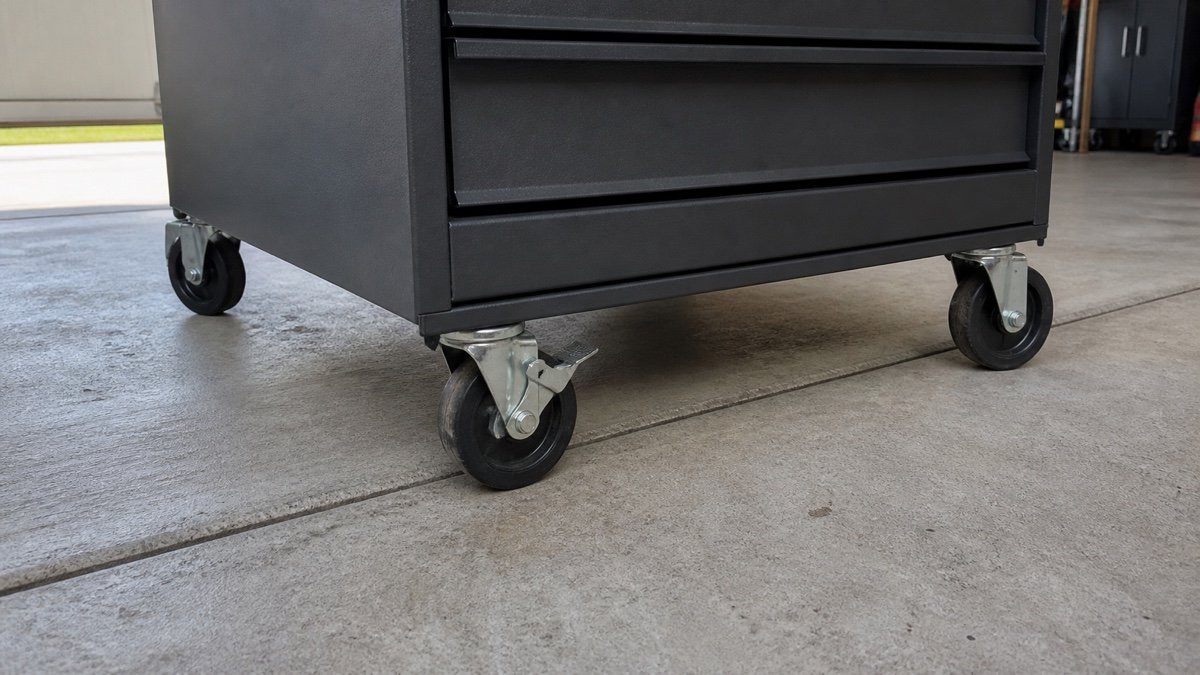
Large-diameter, wider casters cross small joints and debris more easily than tiny hard wheels. The arrangement matters too. Two fixed and two swiveling casters track predictably in a straight move, but they need room to turn. Four swivel casters maneuver in tighter spaces and can feel less settled while steering a heavy box.
Inspect the slab for control joints, spalls, slope, mats, and the lip at the garage door. A caster brake may stop rolling while allowing swivel. Park the cabinet on level concrete and use any leveling system as instructed. Do not test mobility for the first time after filling every drawer.
Decide whether the top is storage or work space
A rubber-matted steel top makes a convenient staging area. A wood top can support light assembly and protects tools from a hard surface. Adding a matching top chest converts that same area into more drawers. Choose the final role before buying either component.
If you need a real bench for clamping and forceful work, keep it separate. The garage workbench buying guide covers frame stiffness, overhang, vise access, and surface choice. A mobile tool cabinet is storage first. Do not infer hammering, vise, welding, or standing capacity from the overall tool-load number.
Treat built-in power with ordinary caution
Integrated outlets can keep chargers and diagnostic tools ready, but they require a clean cord route and accessible plug. Confirm outlet type, total rating, cord length, and how the cord exits with drawers open. Keep it away from caster paths and do not move the cabinet while it is plugged in.
Charging inside a drawer may be a listed feature on a specific cabinet, yet charger and battery instructions still apply. Keep contacts free of metal debris. Do not assume a powered drawer is fireproof or appropriate for damaged batteries. If the cabinet sits near grinding or finishing, a separate clean charging station is usually easier to manage.
Plan compatible expansion before you need it
Ask which matching top chests, side lockers, end cabinets, and hutches the manufacturer currently supports. Record how they attach and how each accessory changes total width, height, load, caster behavior, and wall clearance. A side cabinet can add leverage to a base that is not approved for it.
Milwaukee lists the 46-inch 8-drawer steel cabinet at an 1,800-pound overall capacity with 100-pound soft-close slides on its official product page. That is a good example of why you should compare a whole model family rather than assuming the specifications of a familiar competitor carry across.
Delivery deserves its own measurement sheet
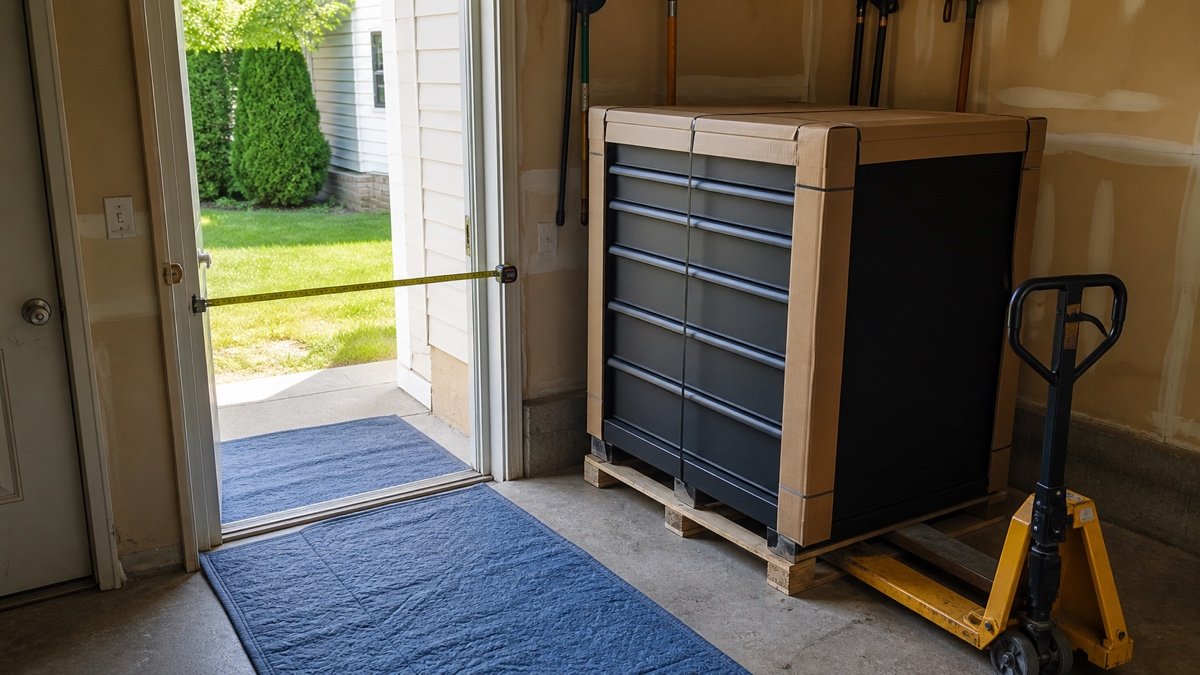
Find the packaged dimensions and shipping weight. Measure gates, driveway turns, thresholds, door openings, and any step. Decide where the pallet or carton can be opened and how the cabinet will be controlled during the move. Remove drawers only if the manual allows it and explains the procedure.
Large cabinets may need lift-gate service, a pallet jack, several capable adults, or professional delivery into place. Do not use drawers as lifting handles. Assemble near the final location, then inspect fasteners, caster attachment, drawer action, brakes, and locks before loading. Our garage measuring guide includes fixed obstacles, but the delivery path must extend beyond the room.
Check parts support and warranty details
A rolling cabinet lives a hard life even in a home garage. Drawer clips, locks, keys, liners, caster hardware, slides, and power components may need service long before the steel shell is worn out. Look for a current parts diagram, a reachable support channel, and warranty terms that explain what the manufacturer will provide in practice. A long headline warranty is less useful when routine wear parts cannot be identified.
Save the model, serial information, receipt, manual, and key code before the cabinet is loaded. Photograph the label. If replacement casters are offered, match the exact mounting plate and rating rather than installing a similar wheel that changes cabinet height or load distribution. Availability changes, so confirm service information at purchase instead of assuming a familiar brand keeps every part forever.
A right-sized cabinet beats an empty giant
Buy enough room for the collection you can reasonably expect, not every tool you might own. Twenty percent spare drawer area is pleasant. Half an empty 72-inch cabinet is an expensive way to lose a wall. A smaller box also keeps categories from spreading until each drawer contains three unrelated things.
Choose only after the taped footprint, drawer map, rating check, and delivery plan all work. Then load slowly and revise the drawer arrangement after several projects. A rolling tool chest should shorten a job. Its size and polish are secondary.
Useful products to compare
These links open current Amazon search results. Check the dimensions, manual, mounting hardware, warranty, and current availability for the exact model before you order.
Before you buy or install
Read the current manual for the exact product you are considering. Confirm its assembled dimensions, rated capacity, mounting requirements, included hardware, working clearances, warranty, and any limits that apply to your wall, floor, electrical circuit, or garage layout.
Frequently asked questions
What size rolling tool chest is best for a home garage?
Many home collections fit a 26 to 42 inch cabinet, but width alone is a poor selector. Map the tools into measured drawer groups and tape the body, handle, and open-drawer footprint beside the parked vehicle. Choose the smallest cabinet that fits those groups with modest room to grow.
How much spare drawer space should I buy?
Around 15 to 25 percent spare usable area is a reasonable planning cushion for a stable hobby. More may make sense for an expanding trade collection. Do not buy a huge cabinet solely for hypothetical tools if it compromises parking, work surface, or delivery.
Are bigger casters always better?
Larger wheels generally cross joints and debris more easily, but cabinet height, caster width, steering arrangement, locks, and floor slope still matter. Compare the full system and test the unloaded cabinet first. Keep the rolling route clear.
Can I add any top chest later?
No. Use only a chest and attachment method approved for the exact cabinet. Confirm the model family, combined height, load limits, installation sequence, and access to upper drawers. Similar width and color do not establish compatibility.