Affiliate disclosure: As an Amazon Associate I earn from qualifying purchases. This article may contain affiliate links, and Bay & Bench may earn a commission at no extra cost to you. Read our full Affiliate Disclosure.
The wall-mounted vs freestanding garage shelves decision sounds simple until you put both options in a real room. A shelf can be strong, well made, and still be wrong for the garage. Wall-mounted shelving clears the floor and can span awkward equipment below. Freestanding shelving is easier to place, easier to move, and less dependent on the wall. The better choice comes down to what you store, what the wall can support, and how the garage changes through the year. Those practical limits matter more than whether one format looks cleaner.
Quick answer
Choose wall-mounted garage shelves when you have a verified mounting structure, need open floor space below, and are comfortable with a fixed layout. Choose freestanding shelves when the walls are unsuitable, the layout may change, or you want simpler assembly. A mixed setup often works best: fixed wall shelves above equipment, plus a freestanding rack for heavy bins that need to stay low.
Start with the room, not the shelf
Stand in the garage with both vehicles parked where they normally sit. Open every car door, lift the hatch, move the mower, and walk the route from the house to the driveway. The empty rectangle on a product page doesn’t show any of that.
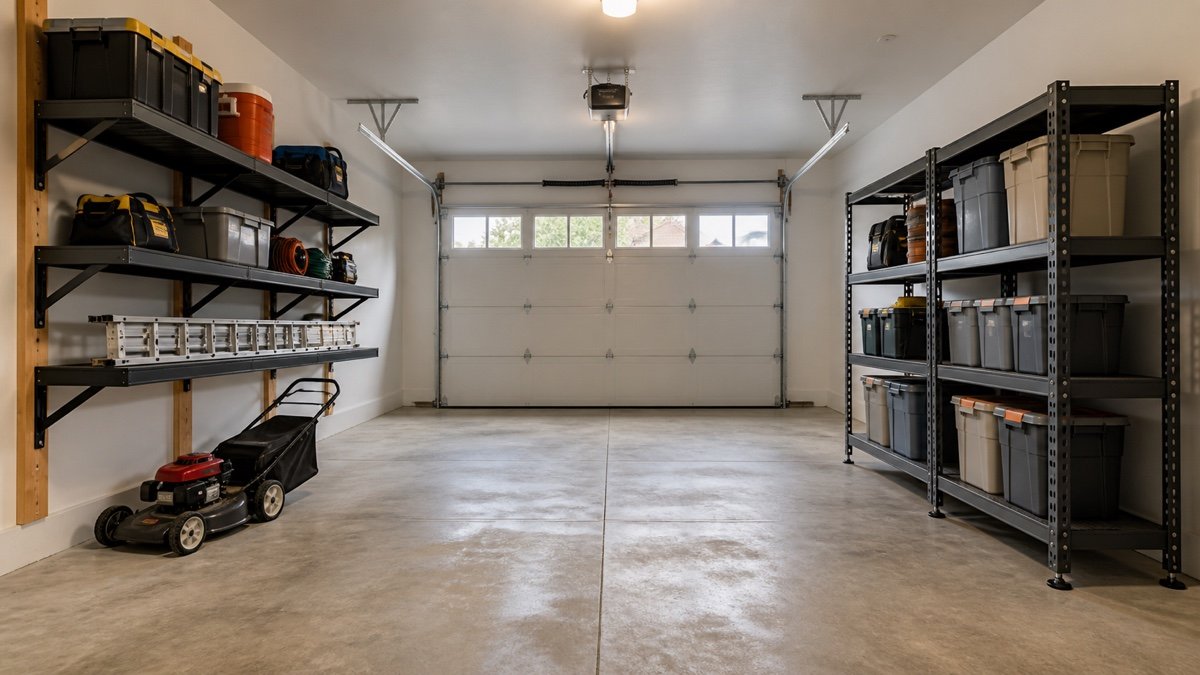
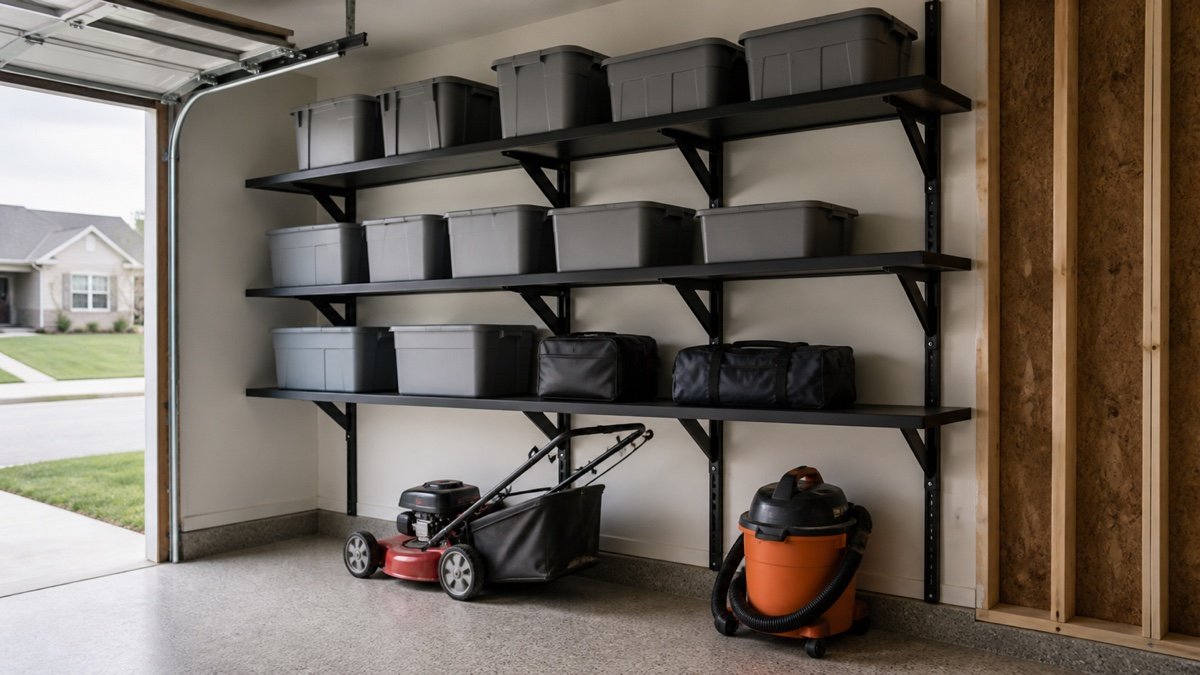
Wall-mounted shelves work well where the floor needs to stay open. A mower, snow blower, rolling cart, or shop vacuum can live underneath. Freestanding racks claim floor space from the first day, but they can cover a wall that isn’t suitable for structural mounting. They can also move when a workbench grows or a second vehicle arrives.
Measure the usable wall width, available depth, and clear aisle before comparing products. Our garage measuring guide covers doors, outlets, controls, and vehicle movement that are easy to miss. If shelf depth is the main problem, the 18 vs 24 inch shelf comparison gives that decision its own treatment.
Where wall-mounted shelves earn their place
The obvious benefit is a clear floor. That matters in a garage because dirt, leaves, and water collect around anything that sits permanently at ground level. Open space is easier to sweep, and it leaves room for equipment with an irregular footprint.
Wall shelving can also start above a work surface or above the hood line of a parked mower. You choose the vertical position rather than accepting the lowest shelf height built into a rack. A long run may feel less bulky because there are no front posts breaking up the view.
There is a tradeoff. The layout becomes tied to the wall and to the manufacturer’s approved mounting points. Stud position, masonry condition, shelf depth, bracket spacing, fasteners, and the stored load all matter. Drywall is a finish, not proof of support. Find out what is behind it before buying a system, and use the exact installation instructions for that model.
Wall-mounted shelves are a sensible match for totes, garden supplies, detailing gear, and other items that fit the published shelf depth. Keep the heaviest objects within comfortable reach and avoid loading a high shelf with something you can barely lift on the floor.
Why freestanding shelves are easier to live with
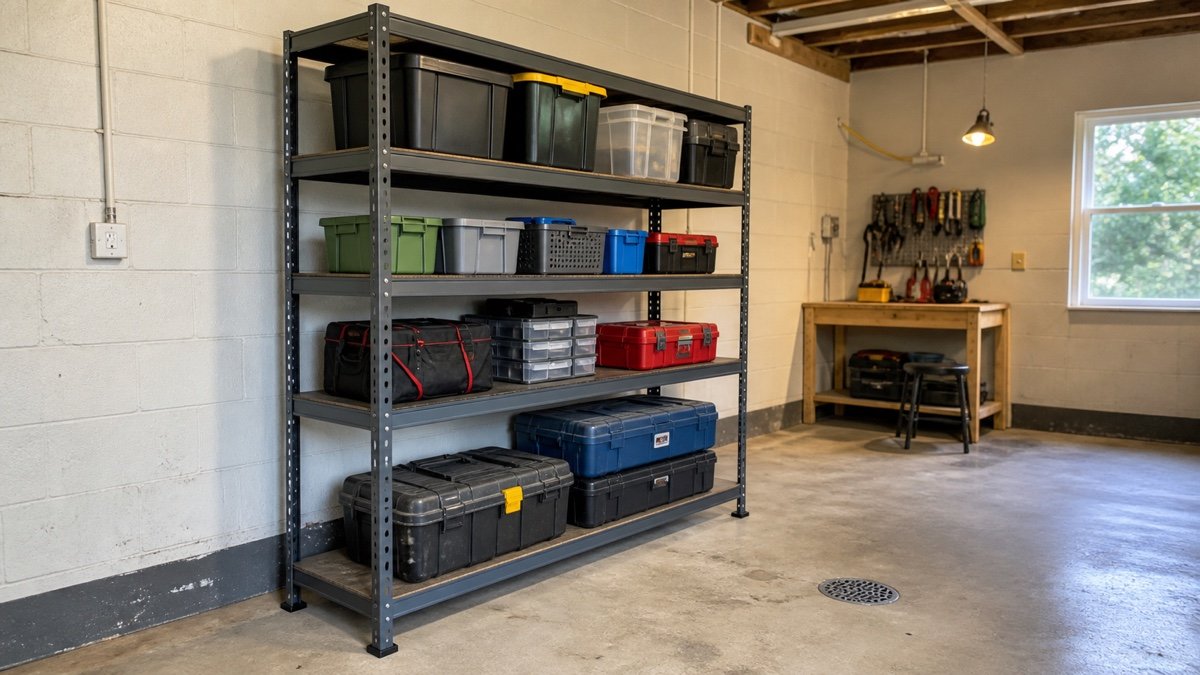
A freestanding rack asks less of the wall. Assemble it on a suitable floor, level it as the instructions require, and you can start organizing without opening drywall or drilling masonry. That makes it useful for renters, unfinished block walls, and garages crowded with plumbing or electrical runs.
Adjustable shelf levels are another practical advantage. If the camping cooler is replaced by a taller model, the opening can often be changed without relocating the entire unit. A rack can also move to the opposite wall during a garage redesign, although a loaded rack should be emptied before it moves.
The front posts cost a little access width, and the feet occupy floor area. A sloped, cracked, or uneven slab may need approved leveling provisions. Tall racks may also require restraint against tipping according to the maker’s directions. Being called freestanding does not automatically mean a unit should remain unattached in every situation.
Put dense tool cases and other heavy objects on lower shelves. Lighter totes can go higher. This lowers the center of gravity and makes everyday lifting less awkward. Still, the rack’s published rating and distribution rules set the limit. A tidy arrangement isn’t a substitute for those numbers.
Wall-mounted and freestanding shelves compared
| Decision point | Wall-mounted shelves | Freestanding shelves |
|---|---|---|
| Floor access | Floor can remain open below the shelf run | Posts and feet stay on the slab |
| Wall requirement | Needs a suitable, verified mounting structure | Less dependent on the wall, though restraint may still be required |
| Layout changes | Relocation means removing and reinstalling hardware | Can be repositioned after it is fully unloaded |
| Uneven surfaces | Wall condition and alignment affect installation | Floor slope and approved leveling method affect stability |
| Access | No front posts, but brackets may limit some placements | Front posts reduce the clear loading width |
| Best fit | Fixed zones above equipment or a work surface | Heavy bins, changing inventories, and unsuitable walls |
Neither column tells you which product can carry more. Capacity varies by design, size, mounting, and load distribution. Compare the manuals for the exact models on your shortlist.
Wall and floor conditions can settle the decision
A finished wall can hide studs, blocking, pipes, and wiring. A masonry wall can have hollow areas, weak joints, or a surface that needs a specific anchor. If you cannot identify a suitable structure and match it to the shelf instructions, don’t guess. A qualified installer can assess a questionable wall.
Freestanding racks shift the question to the slab. Check for a strong slope, broken edges, drains, curbs, and places where water regularly pools. Follow the maker’s directions for leveling, foot placement, anchoring, and wall restraint. Don’t stack scrap wood under one leg as a permanent fix.
Also look upward. Garage door tracks, opener hardware, windows, overhead lights, and an open vehicle hatch may occupy space above either shelf style. Mark the proposed shelf outline with painter’s tape, then operate the door and vehicle hatch while someone watches from a safe position.
Capacity is a chain, not one headline number
Product listings often lead with a large capacity figure. Read the smaller wording. The number may apply per shelf, per complete unit, or only when the load is spread evenly. Accessories and added shelf spans can have different limits.
For a wall system, the shelf deck, brackets, rails, fasteners, mounting pattern, and building structure all take part. The weakest verified limit governs the setup. For a freestanding rack, shelf beams, deck panels, posts, connectors, feet, floor condition, and any required restraint matter in the same way.
Weigh loaded totes if the contents are dense. A bin of shop towels and a matching bin of metal hardware look identical from the aisle, but they don’t behave alike. Place concentrated loads over supported areas as the instructions allow, and stop using a unit if you notice movement, bent parts, loose hardware, or damage around mounting points.
Depth and access matter every day
Deep shelves hold more front to back, but capacity isn’t useful if the rear tote disappears behind the front one. In a narrow garage, extra depth also steals door clearance and walking space. A shallow wall shelf may be perfect for car care bottles and small bins, while a deeper freestanding rack handles large totes at the end wall.
Run the intended tote layout through the garage shelving planner. Measure the loaded tote, including handles and a lid that bows upward. Leave enough opening height to lift the rim over the shelf edge without scraping your knuckles.
Think about retrieval, too. Items used every week belong between knee and shoulder height when practical. Seasonal items can sit higher. Store heavy objects low, and don’t plan around repeated twisting from a ladder.
A mixed layout often feels less forced
You don’t have to choose one format for the whole garage. A wall-mounted run above lawn equipment keeps an awkward floor zone useful. A sturdy freestanding rack at the back wall can hold bulky bins and tool cases. Closed cabinets can take chemicals or items that need controlled access, subject to their labels and local requirements.
Before ordering, compare the complete dimensions, shelf adjustment method, deck material, replacement parts, installation instructions, and warranty. The garage shelving buying guide turns those checks into a broader shopping process. Our steel vs resin guide helps once you have settled on the basic format.
The most useful system is the one that leaves the garage easy to move through after everything is loaded. Tape both footprints into the room, place the actual bins inside those boundaries, and live with the mock layout for a day. Annoying clearances show up quickly.
Useful products to compare
These links open current Amazon search results so you can compare dimensions, manuals, ratings, and availability for the exact models on your shortlist.
Before you buy or install
Check the current manual for the exact product you are considering. Confirm the assembled dimensions, load rules, mounting requirements, included hardware, clearances, warranty, and any limits that apply to your wall, floor, or garage layout.
Frequently asked questions
Are wall-mounted garage shelves stronger than freestanding shelves?
Not automatically. Strength depends on the exact shelf design, span, brackets or frame, fasteners, installation, building structure, and load distribution. Compare published ratings and instructions for the specific models.
Do freestanding garage shelves need to be anchored?
Some do. Height, depth, floor condition, location, and the manufacturer’s instructions affect restraint requirements. Follow the manual rather than relying on the word freestanding.
Which shelf type works better in a small garage?
Wall-mounted shelves can preserve floor space, while a shallow freestanding rack may work where the wall cannot be drilled. Vehicle and door clearance usually decide the better fit.
Can I combine both shelf types?
Yes. Wall shelves are useful above equipment, while a freestanding rack can carry bulky bins at a convenient height. Keep each system within its own installation and loading rules.