Affiliate disclosure: As an Amazon Associate I earn from qualifying purchases. This article may contain affiliate links, and Bay & Bench may earn a commission at no extra cost to you. Read our full Affiliate Disclosure.
The choice between 4000K vs 5000K garage lighting is mostly about the character of the white light, not how much light you get. A 5000K fixture is not automatically brighter than a 4000K fixture. Lumens, distribution, glare control, and surface reflectance decide visibility. Color fidelity decides whether wood, paint, wires, and skin look believable.
For a garage shared with vehicles and household storage, 4000K is the safer neutral default. A well-made 5000K source can feel crisp at a detail bench or in a dedicated workshop, but it can also feel stark late at night. The best decision comes from comparing actual fixtures with similar output and color quality in your room.
Quick answer
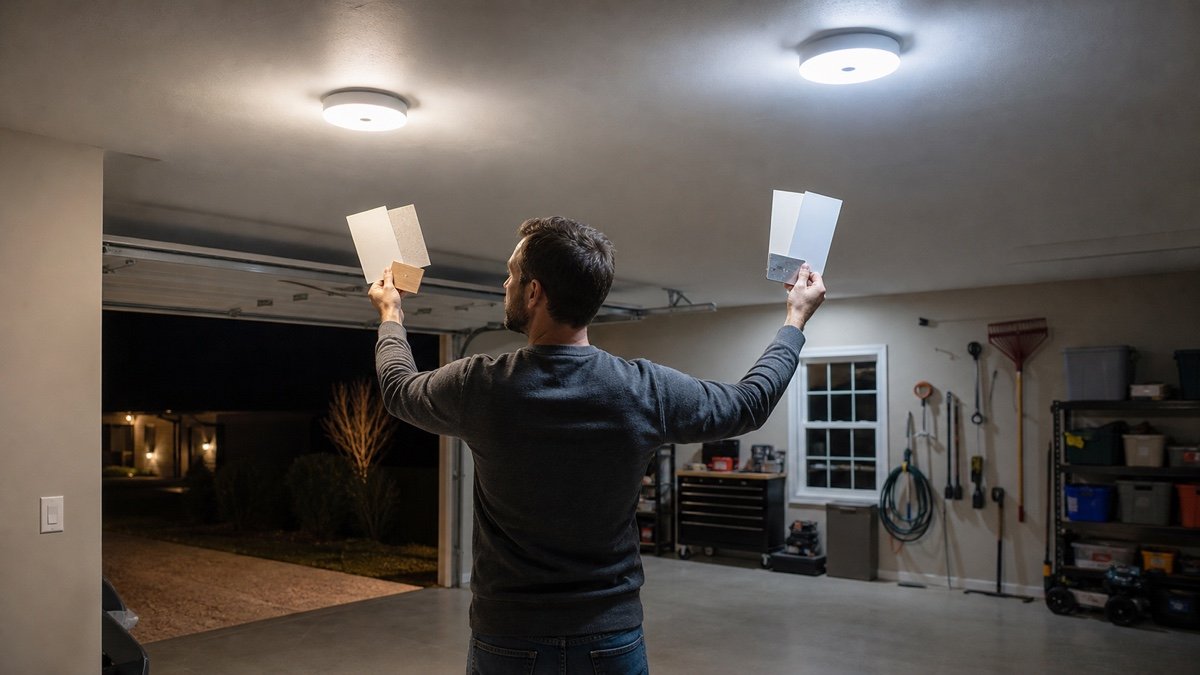
Choose 4000K for a balanced, neutral garage that serves parking, storage, repairs, and general projects. Choose 5000K if you genuinely prefer cooler white light and the garage functions mainly as a workshop. Neither CCT guarantees better visibility. Match lumens, beam distribution, CRI or other color-quality data, flicker performance, and diffusion before comparing the Kelvin value. When uncertain, install one 4000K sample and one 5000K sample temporarily and view familiar materials at night.
4000K vs 5000K garage lighting at a glance
| Question | 4000K | 5000K |
|---|---|---|
| Visual character | Neutral white | Cooler, daylight-like white |
| Shared garage comfort | Usually the easier default | Can feel stark to some people |
| Detail-work impression | Clear without a strongly cool cast | May feel crisp when the fixture is well diffused |
| Brightness | Depends on lumens and distribution | Depends on lumens and distribution |
| Color fidelity | Depends on the product, not CCT alone | Depends on the product, not CCT alone |
| Best buying method | Compare samples with similar output, optics, and color quality | |
If the room still lacks enough general output, calculate that separately with the garage lighting calculator. Changing from 4000K to 5000K does not repair a poor lumen budget.
CCT describes appearance, not brightness
Correlated color temperature, or CCT, is expressed in kelvins. Lower values generally look warmer; higher values look cooler. The U.S. Department of Energy’s color and spectrum guidance explains that CCT is only one part of how a light source appears.
Two fixtures can both claim 5000K while one produces 4,000 lumens and another produces 8,000. Their optics may send that output in completely different directions. A brighter-looking wall may come from wider distribution or lighter paint, not the cooler color.
Shop by lumens and photometrics for quantity and placement. Shop by CCT for the white-light character. Then evaluate color quality, glare, dimming, flicker, temperature range, and warranty. Keeping those questions separate prevents the Kelvin number from carrying jobs it cannot do.
Why 4000K works in a mixed-use garage
A 4000K garage usually reads as clean and neutral without feeling aggressively blue. That makes it comfortable for unloading a car, finding storage, maintaining bicycles, repairing household items, and working at a bench. It also transitions more gently to typical indoor lighting when the garage connects directly to the house.
Wood tones and warm paint colors often feel more natural under a good 4000K source than under a strongly cool one. That is a preference, not a universal performance fact. A low-quality 4000K fixture can still render colors poorly or show an unpleasant green tint.
Use 4000K as the default when several household members use the garage or when the lights stay on for long evening sessions. Pair it with broad diffusion and local task lighting. Comfort comes from the whole system, not the nominal CCT alone.

When 5000K makes sense at a workbench
Some people prefer the cooler appearance of 5000K for mechanical work, cleaning, sorting hardware, or detailed assembly. It can give the room a crisp visual character, especially when surfaces are pale and the fixture has good diffusion. That preference is legitimate if you have seen the light in person.
Cooler light can also feel clinical or tiring at night, particularly when bare diodes sit in the field of view. Do not assume a warehouse-like appearance creates better detail. Shadows, glare, and poor color rendering can hide information even when the room feels intensely white.
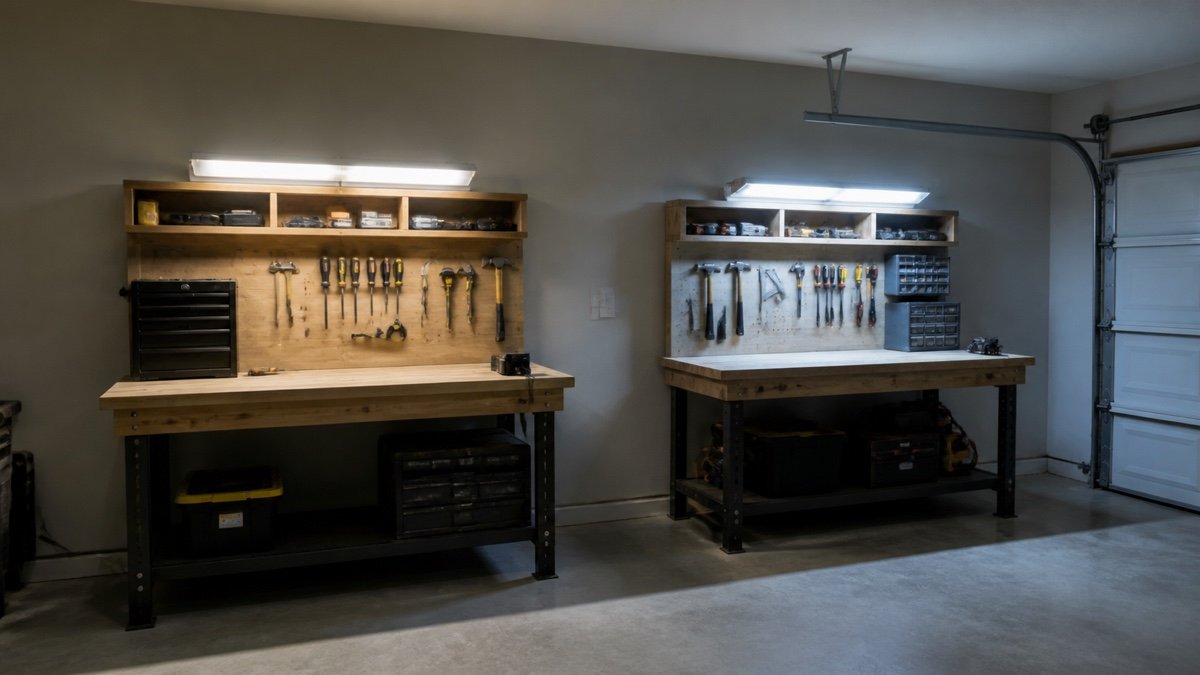
A dedicated 5000K task fixture over one bench is a reasonable compromise when the rest of the garage is 4000K. Keep the zones deliberate and view a workpiece at their boundary before committing. Random alternating fixtures often create a patchy ceiling and inconsistent surface color.

Compare color quality after matching CCT
Color rendering index, or CRI, gives familiar information about color fidelity, but it is not the complete story. DOE’s LED basics notes that lighting performance includes several color and spectral qualities. Newer evaluation methods such as IES TM-30 can add detail when manufacturers publish them.
For ordinary parking and storage, a credible interior fixture with common color quality may be adequate. When you match stains, paint panels, wire colors, or finishes, look for stronger documentation and sample the light on the real material. An advertised high CRI from an unknown model is less reassuring than a traceable specification from a manufacturer that identifies the exact fixture.
Also check consistency. Six lights should not vary visibly from greenish to pinkish. Color stability between fixtures and over time can matter more than choosing 4000K or 5000K on paper.
Do not mistake a cooler source for clearer vision
Visibility depends on contrast, size, glare, adaptation, age, and where the light lands. A cooler source may feel subjectively brighter at the same nominal output, but that sensation does not guarantee better inspection. A dark pencil line under a body shadow remains dark.
Match two sample fixtures as closely as possible for lumens, beam pattern, diffuser, mounting height, and color quality. Switch between them after your eyes adapt. Read a small label, inspect a scratch, sort colored wire, and look at the same wood offcut. Avoid judging from a phone camera, which changes white balance automatically.
Give each sample ten or fifteen minutes at night. The first cool impression can seem energetic, while long-session comfort tells a different story. Ask other regular users, since a garage shared by a household should not be optimized around one quick glance.
Glare can dominate the CCT decision
An exposed high-output LED source can be uncomfortable at either 4000K or 5000K. Look from the parked driver’s seat, the house entry, the bench, and a seated repair position. If bright points remain in the normal line of sight, choose a better diffuser, reposition the fixture, or reduce contrast.
Cooler light may make harsh glare feel more obvious to some users, but fixture design is the larger issue. Deep optics, broad lenses, indirect reflection, and multiple lower-output sources can produce a calmer room than one intense lamp.
Glossy floors and polished car paint reflect source images. Check them before buying the remaining fixtures. A sample that looks fine against bare concrete may become distracting after an epoxy floor or white worktop is installed.
Keep the ceiling consistent and zone the exceptions
A consistent CCT across the ambient ceiling makes the garage feel coherent. If 4000K handles general use, keep that base and add 5000K only where a cooler task source has a clear purpose. Put it on a separate switch. The reverse approach can work in a dedicated cool-white workshop with a warmer inspection area.
Do not alternate 4000K and 5000K fixtures in the same row. The floor may show visible bands, and workpieces can change appearance as they move. Mixing different manufacturers at the same nominal CCT can also create mismatch because CCT tolerances and spectra vary.
Plan fixture positions after choosing the bench and machine zones in the garage workshop layout guide. A well-zoned light should support the task without spilling an abrupt color boundary across the main surface.
Read credible labels and documentation
ENERGY STAR’s downlight criteria recognize nominal CCT values including 4000K and 5000K and pair color requirements with other performance criteria. Your garage fixture may be another product type, but the useful lesson is that CCT belongs inside a broader specification.
Look for exact model number, delivered lumens, CCT tolerance, CRI or richer color data, efficacy, operating temperature, location rating, dimming compatibility, expected lifetime, and warranty. Confirm safety listing and installation conditions. Marketing phrases such as daylight, crystal white, or ultra bright are not substitutes for numbers.
Run a two-fixture sample test
- Choose one 4000K and one 5000K fixture with similar lumens, optics, color quality, and size.
- Mount or support them safely at the intended height according to instructions.
- Test at night with vehicles, shelves, and the garage door in normal positions.
- View the bench, floor, storage labels, car paint, wood, wires, and skin.
- Check standing, seated, and driver sight lines for glare.
- Use each sample for a normal 20-minute task.
- Ask every regular user which feels easier, not merely brighter.
Do not energize an improvised hardwired setup. Use approved temporary arrangements or have a qualified electrician handle wiring. Once you choose, buy the same model and specification together where practical so the ceiling has consistent color.
Choose from the room you have
Pick 4000K when the garage is a household transition space, storage room, parking bay, and occasional shop. Pick 5000K when you have sampled it, prefer the cooler appearance, and spend most garage time on focused work. If opinions are split, a 4000K ambient system with separately controlled task lighting is the least risky compromise.
Check the garage workshop aisle guide while placing fixtures so walking routes stay visible without direct glare. For a compact room, the one-car workshop layout helps account for the open garage door and vehicle shadows.
Finally, remember the hierarchy: enough lumens, useful distribution, controlled glare, good color quality, then preferred CCT. Get the first four wrong and neither Kelvin choice will feel right. Get them right and both can produce an excellent garage.
Useful products to compare
These links open current Amazon search results. Check the dimensions, manual, mounting hardware, warranty, and current availability for the exact model before you order.
Before you buy or install
Read the current manual for the exact product you are considering. Confirm its assembled dimensions, rated capacity, mounting requirements, included hardware, working clearances, warranty, and any limits that apply to your wall, floor, electrical circuit, or garage layout.
Frequently asked questions
Is 5000K brighter than 4000K in a garage?
No. Brightness depends on lumen output, distribution, room surfaces, and where the light lands. 5000K looks cooler and may seem crisper, but a 4000K fixture can produce more usable light.
Is 4000K warm white?
4000K is generally described as neutral white rather than traditional warm white. It looks cooler than common 2700K or 3000K household lamps but warmer than 5000K.
Can I mix 4000K and 5000K lights in one garage?
Yes, but use deliberate zones and separate controls. Keep the ambient ceiling consistent, then add a different CCT only where a task benefits and the color boundary does not cross the work surface.
What is the best color temperature for a woodworking garage?
A good 4000K fixture is a comfortable general choice for wood and long sessions. More important, choose strong color fidelity and low glare, then inspect stains and finishes under the light used for the final judgment.