Affiliate disclosure: As an Amazon Associate I earn from qualifying purchases. This article may contain affiliate links, and Bay & Bench may earn a commission at no extra cost to you. Read our full Affiliate Disclosure.
Garage wall storage for renters works best when the floor carries most of the weight. A rental garage still needs a home for tools, sports gear, and household overflow, but the walls may not be yours to drill, paint, or cover. That rules out many permanent systems without condemning the room to cardboard boxes.
The safest renter plan keeps every unit stable and treats “removable” as a claim to verify rather than a promise. Adhesive and tension products can leave damage too.
Quick answer
Start with the lease and written permission. Use low or appropriately stable freestanding shelves, rolling carts, portable cabinets, floor racks, and closed totes. Consider tension systems only when the surfaces, ceiling, product instructions, and lease allow them. Avoid hanging heavy tools from adhesive strips, and do not use tall furniture unanchored when its manufacturer requires anchoring.
Read the lease before shopping
Rental agreements differ on holes, anchors, paint, adhesive, and alterations. A landlord may allow a few small fasteners but prohibit panel systems. Another may ban every wall change. Ask in writing if the wording is unclear, and describe the exact proposal. “Storage” can mean a rolling rack or a full slatwall installation.
Photograph the empty garage before moving equipment in. Capture existing holes, stains, cracks, and damaged trim. Keep the images with the move-in records. This is basic protection for both renter and owner.
Check garage specific restrictions too. Fire equipment, electrical panels, water heaters, doors, and utility access need clear space. Local rules and appliance manuals may set requirements that the lease does not explain. A storage plan cannot borrow those areas just because the wall looks empty.
Freestanding shelves do most of the work
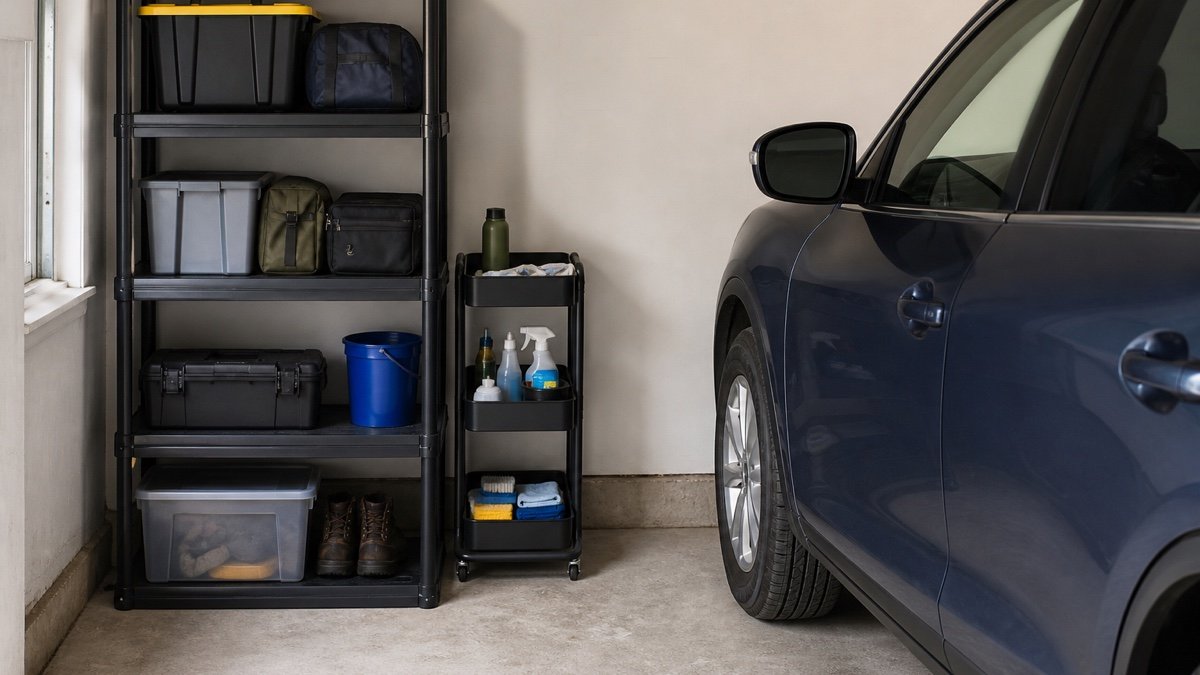
A freestanding rack gives a renter vertical storage without making the wall carry it. Choose a depth that leaves parking and walking room, then match the shelf openings to the totes you already own. Deep shelves can swallow floor space and hide a second row of bins that nobody remembers.
Stability is the catch. Many tall shelving and cabinet products require wall anchoring. If the instructions require it, do not simply skip the step because you rent. Choose a lower, wider unit, seek permission to anchor correctly, or use another product designed to remain stable in the intended configuration.
Place the heaviest bins on the bottom. Keep each shelf within its listed limit and load it as directed. Check that all feet sit firmly on the sloped garage floor. Shims, levelers, and casters should only be used when approved by the manufacturer.
Compare renter friendly formats
| Storage format | Good use | Main caution |
|---|---|---|
| Low freestanding shelving | Totes, supplies, and tool cases | Consumes floor depth; verify stability and ratings |
| Rolling cart | Daily tools, car care, or gardening supplies | Lock casters and keep it out of door travel |
| Portable cabinet | Dust control and concealed storage | Tall cabinets may require anchoring |
| Tension pole organizer | Light sports gear or small baskets | Pressure can mark surfaces; follow approved height and load |
| Freestanding bike rack | One or several bicycles | Check handlebar width and tipping resistance |
| Adhesive holder | Very light items only when explicitly allowed | Heat, texture, dust, and removal can cause failure or damage |
The word “no-drill” describes installation, not safety. A loaded unit still needs a secure stance and a clear operating area.
Rolling storage earns its footprint
A rolling tool chest or utility cart can live beside the wall and move toward the job. That is useful in a one car garage where the work zone appears only after the vehicle leaves. Measure the cart with handles, bumpers, and casters included. Product width alone may not capture the real parking conflict.
Choose casters intended for the loaded weight and garage floor. The total includes the cart, drawers, tools, and anything placed on top. Locks should stop both rolling and unwanted swiveling if the design offers that function. A cart that creeps down the floor slope is not wall storage. It is a moving obstacle.
Give the cart a marked parking spot. Keep drawers closed while moving it, and do not let tools project into the vehicle path. The close fit shown in a catalog can be unpleasant when a mirror, door, or shoulder needs the same few inches.
Tension systems are useful within a narrow job
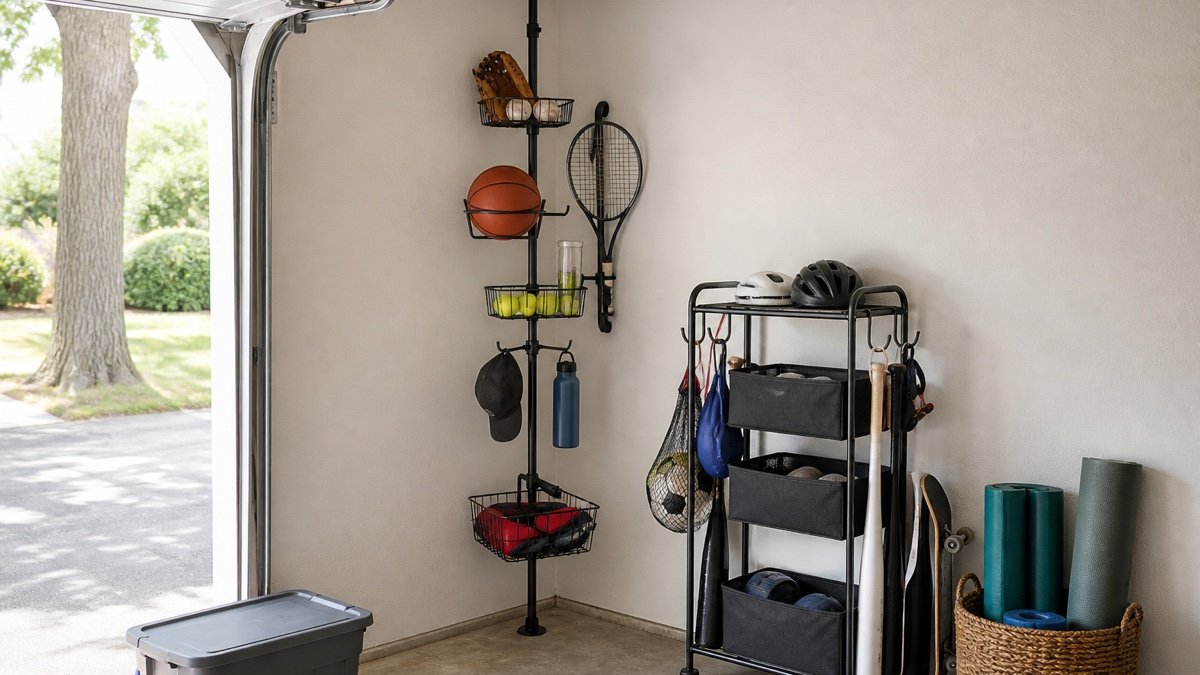
Floor to ceiling tension poles can hold light baskets, balls, helmets, or long handled gear without drilled anchors. They work best when the ceiling and floor are solid, flat, and approved by the product instructions. A suspended ceiling, weak drywall surface, or sloped contact area may not be suitable.
Pressure can leave rings, compress texture, or mark paint. Add only manufacturer approved pads, since improvised padding may reduce grip. Stay below the listed load and distribute equipment as instructed. Check the pole after temperature changes and after anyone bumps it.
Do not place a tension system where failure could drop equipment onto a car, person, garage door track, or appliance. Light sports gear is a more sensible assignment than a rack of dense power tools.
Adhesive storage has hard limits in a garage
Adhesive hooks sound ideal for renters, but garages are difficult environments. Dust, textured paint, humidity, and hot or cold surfaces can weaken the bond. Removal can lift paint or leave residue even when the package says removable.
Use adhesive only on approved surfaces, within the stated temperature and load limits, and after the prescribed cleaning and curing time. It is a poor choice for sharp tools, glass, chemicals, heavy cords, or anything mounted above a vehicle. Never combine several small hooks and assume their ratings add up.
If the item would cause damage when it falls, put it on a floor supported rack instead. That decision removes a lot of uncertainty for a small sacrifice in floor area.
Build a storage wall without attaching to the wall
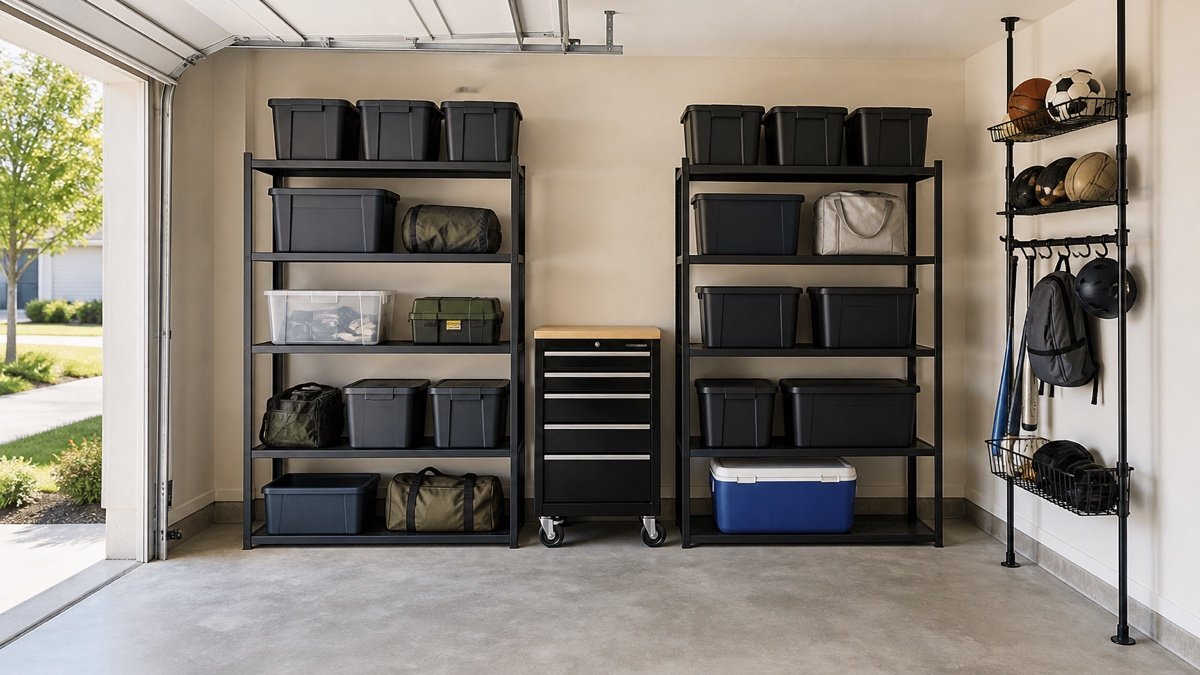
Arrange two stable shelf units with a narrow rolling cart between them. Use matching closed totes on upper shelves and daily supplies between waist and shoulder height. A freestanding long tool rack can sit at one end, while a bike stand occupies the other. The result reads like a complete storage wall even though every part can move out.
Keep a small gap behind units so dampness, pests, and dropped items can be noticed. Do not hide outlets or vents. On a foundation curb, confirm that every foot sits on the same supported level rather than balancing half the rack on concrete and half on the slab.
Use the garage storage fit calculator to test the footprint. Then tape the shelf depth on the floor and park the car. Open every door and carry a tote through the remaining aisle before ordering.
Make the system easy to move
Renters eventually move, so standard sizes beat custom built pieces. Choose shelving that breaks into manageable sections, carts that fit through the home or garage door, and totes that stack without depending on one discontinued lid. Save assembly instructions and spare hardware in a marked bag.
Photograph each loaded shelf before packing. Number the totes and keep a basic inventory on your phone. At the next garage, you can rebuild the zones without opening every bin.
Avoid cutting freestanding units to fit one odd corner unless the manufacturer allows modification. The few inches gained now may make the system unstable or useless in the next home. Portable storage should remain portable.
A renter safety check
- Confirm lease terms and permissions in writing.
- Follow every anchoring requirement. Choose another unit if required anchoring is not permitted.
- Put dense loads low and stay within each shelf or cart rating.
- Keep garage door tracks, springs, sensors, and travel paths clear.
- Protect electrical panels, appliances, vents, and exits.
- Test vehicle doors, hatch, mirrors, and walking routes.
- Inspect tension and adhesive products regularly.
- Store fuel, chemicals, batteries, and heat sensitive products according to their labels and local rules.
The goal is not to imitate a permanent garage on temporary terms. A good rental setup is stable, useful, and boring to remove. If every unit can be emptied, moved, and reassembled without wall repair, the plan has done its job.
Useful products to compare
These links open current Amazon search results so you can compare dimensions, manuals, ratings, and availability for the exact models on your shortlist.
Before you buy or install
Check the current manual for the exact product you are considering. Confirm the assembled dimensions, load rules, mounting requirements, included hardware, clearances, warranty, and any limits that apply to your wall, floor, or garage layout.
Frequently asked questions
Can renters drill into garage walls?
Only the lease and property owner can answer for a specific rental. Ask for written permission before making holes, adding anchors, painting, or covering a wall.
Are adhesive hooks safe for garage tools?
Usually only for light items on approved surfaces and within stated temperature limits. Sharp, heavy, or valuable tools are better kept on floor supported storage.
Can I use tall shelving without anchoring it?
Not when the manufacturer requires anchoring. Seek permission to anchor it correctly or choose a stable product designed for the intended unanchored use.
What is the easiest renter storage to move?
Modular freestanding shelves, rolling carts, portable cabinets, standardized totes, and floor racks move more easily than fitted wall panels or custom built-ins.
Leave a Reply