Affiliate disclosure: As an Amazon Associate I earn from qualifying purchases. This article may contain affiliate links, and Bay & Bench may earn a commission at no extra cost to you. Read our full Affiliate Disclosure.
Adjustability is useful when it solves a measured problem. If every support ends up at the same height and never moves again, a simpler fixed setup may be the cleaner choice.
Quick answer
Choose adjustable drop supports when ceiling height, obstructions, or tote sizes demand a specific platform level permitted by the manual. Choose fixed supports when the required height is known, the mounting plane is straightforward, and fewer joints suit the application.
What adjustable usually means
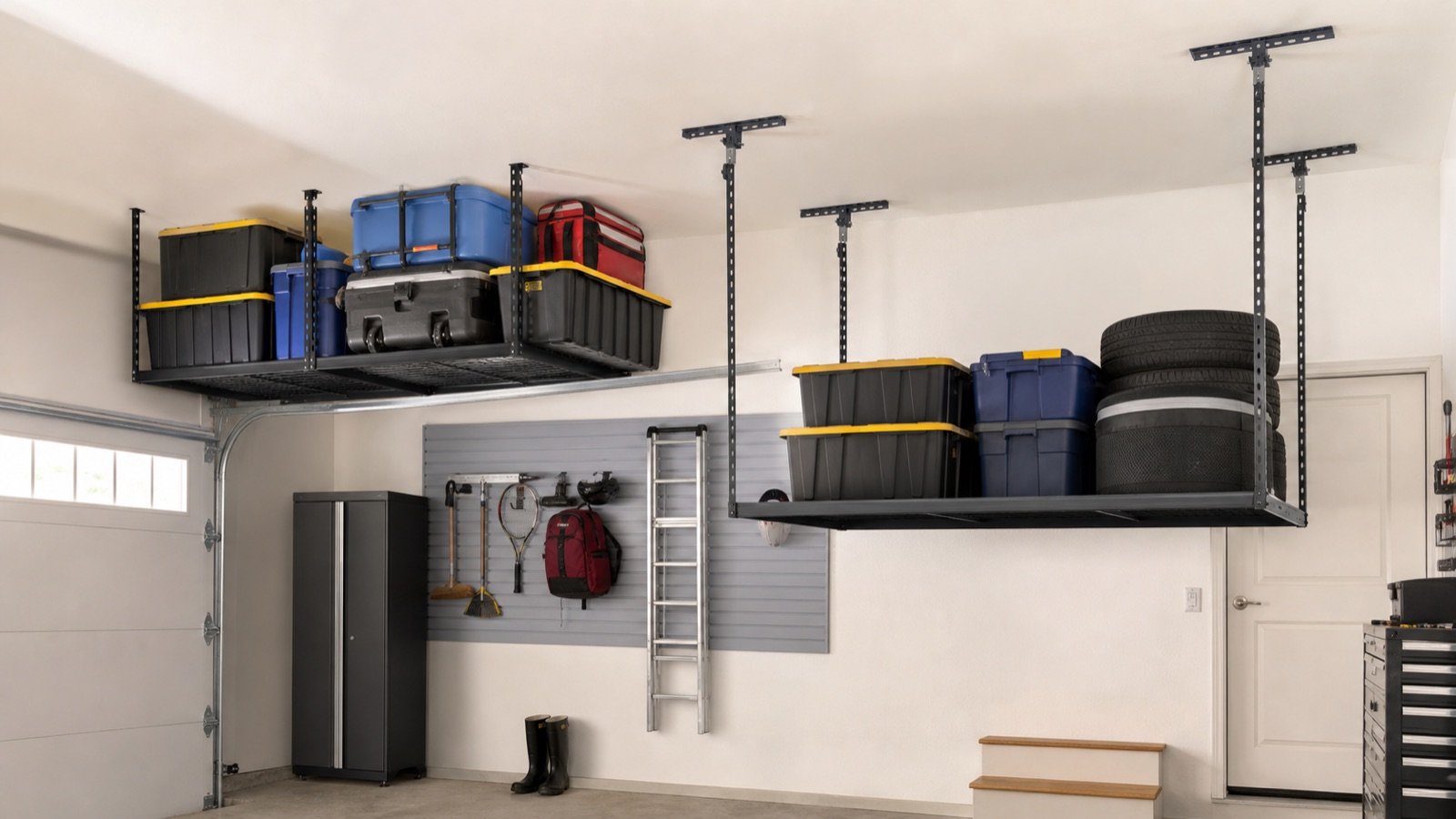
Many adjustable racks use slotted vertical posts with a set of approved hole positions. Adjustment is not continuous, and the allowed range may change with rack size or configuration. Read the exact manual before assuming a desired drop is available.
Where adjustment helps
A measured drop can place the platform above an open door while preserving tote space. Separate approved settings may also help with a sloped ceiling or a beam, although every support and connection must follow the instructions.
The clearance guide shows which dimensions to collect.
Why fixed can be appealing
Fixed hardware has fewer adjustment points and fewer opportunities to choose the wrong hole. That simplicity can make inspection easier. It does not remove the need for correct structure, fasteners, leveling, and load distribution.
Side by side
| Factor | Fixed | Adjustable |
|---|---|---|
| Drop choices | One designed height | Approved positions within a range |
| Changing totes | May require new storage plan | May permit a different setting |
| Parts | Often fewer joints | More connection points to inspect |
| Uneven geometry | Less flexible | Can offer approved correction |
Do not plan on frequent adjustment
A loaded ceiling rack is not a height adjustable desk. Changing the drop normally means unloading, supporting, loosening, aligning, and reinstalling parts according to the manual. Choose a setting you expect to keep.
Decision rule
Measure the lowest obstruction and the loaded tote. If one fixed configuration gives comfortable handling room and clearance, extra adjustment may add little. If the fit depends on a narrow height window, an adjustable model can be worth comparing.
Whatever you choose, record the final setting and include it in periodic inspections.
Adjustment can create setup errors
More holes mean more possible configurations to verify. Count exposed holes or measure the final drop at every post before loading. Photograph the connections so a later inspection can tell whether anything moved.
Use only approved fasteners and hole positions. A post that looks nearly aligned should not be forced into a custom setting.
Future vehicles are worth one measurement
If you expect to replace a sedan with an SUV, record the likely roof and hatch height before settling on a low rack. This does not justify buying excess adjustment. It simply prevents a platform from locking the garage to the current vehicle.
Changing the rack later may be possible, but unloading and reinstalling it is work. A sensible initial height is cheaper.
Useful products to compare
Use these searches to compare current dimensions, ratings, manuals, and availability. Check the exact model before buying.
Before you buy or install
Download the current manual for the exact model. Confirm assembled and packaged dimensions, individual and total load ratings, required clearances, mounting structure, included hardware, warranty, and inspection instructions. Product listings and specifications can change.
Mark the footprint or platform edges in the garage. Operate the vehicle doors and garage door, carry the intended bin through the access route, and check service panels and utilities. Do not improvise around electrical, gas, fire, or structural conditions.
Frequently asked questions
Can I change rack height after installation?
Only as the manufacturer permits. Unload the rack and follow the adjustment procedure rather than moving loaded supports.
Are fixed racks stronger?
Not automatically. Compare the exact published ratings and required configuration.
Can adjustable posts handle a sloped ceiling?
Some systems may accommodate certain layouts, but the manual must explicitly support the installation.
Last reviewed: July 2026. Verify current product specifications and installation requirements before purchase.