Tag: garage lighting

  • Best LED Shop Lights for Garage: Five Fixtures Compared by Fit

    Best LED Shop Lights for Garage: Five Fixtures Compared by Fit

    Affiliate disclosure: As an Amazon Associate I earn from qualifying purchases. This article may contain affiliate links, and Bay & Bench may earn a commission at no extra cost to you. Read our full Affiliate Disclosure.

    The best LED shop lights for garage use are the ones that put usable light on the bench, floor, and machine surfaces without turning every polished tool into a glare source. That sounds obvious, yet lumen numbers make it easy to buy one fierce fixture and leave the corners dim. This comparison uses current manufacturer data and official retailer specifications, so treat it as a fit shortlist rather than a lab ranking. It covers five current U.S. fixtures, then shows how to judge quantity, mounting, linking, color, and controls in your own room.

    Quick answer

    For an ordinary residential garage, begin with several diffused 4-foot fixtures in two rows rather than one bright line. The Feit SHOP/4/840/MM is a practical control-focused option with 5,000 lumens, 4000K light, motion sensing, and linkability. The Braun 59506 is a simpler 5,500-lumen hanging light, while the Braun 56780 supplies 10,000 lumens where a higher ceiling or demanding task warrants it. Pick the layout first. Then confirm fixture rating, mounting method, cord route, switching, and the manufacturer’s linking limit.

    Best LED shop lights for garage use at a glance

    These are not ranked as universal winners. Each solves a different garage problem, and the published output does not describe beam distribution or glare by itself. Current specifications can change, so use the linked product page and manual as the final reference.

    FixturePublished outputColorMounting and controlsBest fit
    Feit SHOP/4/840/MM5,000 lumens, 55 W4000KPlug-in, hang or flush mount, motion sensor and remoteEveryday garage with automatic entry lighting
    Braun 595065,500 lumens, 55 WCheck current listingHanging chains, pull chain, linkableSimple budget-minded rows
    Braun 5678010,000 lumens, 100 W5000KHanging chains, pull chain, linkableTaller bay or concentrated high-output zone
    Commercial Electric 545911425,500 lumens, 60 W4000KSurface or suspended, pull chain, linkableWider fixture body and general work light
    Lithonia 1290L3,300 lumensCheck exact configuration4-foot integrated shop lightLow-output layer, small bay, or supplemental row

    Before laying out fixtures, map the active stations in the garage workshop layout guide. A light directly over an empty aisle does less work than one positioned beside a bench or machine.

    How this shortlist was built

    We looked for current fixtures with an accessible manufacturer page or official retailer listing, published lumen output, and enough installation information to compare them honestly. The shortlist deliberately includes modest and high-output choices. A 10,000-lumen fixture is not automatically better than a 3,300-lumen one. It may create a hot stripe, pull more power, or feel harsh below a low ceiling.

    We also favored ordinary linear shapes. Four-foot fixtures are easier to place in rows, beside garage door tracks, and across a bench than multi-panel screw-in lamps with intense point sources. The models below are examples of useful configurations, not a claim that their LEDs last exactly as long as a laboratory rating in every hot, cold, dusty, or frequently switched garage. Read the environmental rating and warranty terms for the exact SKU.

    Feit SHOP/4/840/MM for useful controls without an app

    Feit lists the SHOP/4/840/MM at 5,000 lumens, 4000K, 55 watts, and 80 CRI. It can hang or flush mount, and its motion sensor offers several detection and timer settings. A remote gives you manual control without reaching a pull chain. The official Feit product page also describes it as damp-location rated and linkable, with up to six fixtures in the specified arrangement.

    This is the most balanced choice here for a garage that doubles as a passage into the house. The sensor can bring up the room while your hands are full, yet 4000K light is less stark than the daylight cast many people associate with basic shop fixtures. Still, motion control can be annoying over a quiet seated task if the timer is set too short. Confirm that the sensor sees the entry path, and keep a convenient manual option.

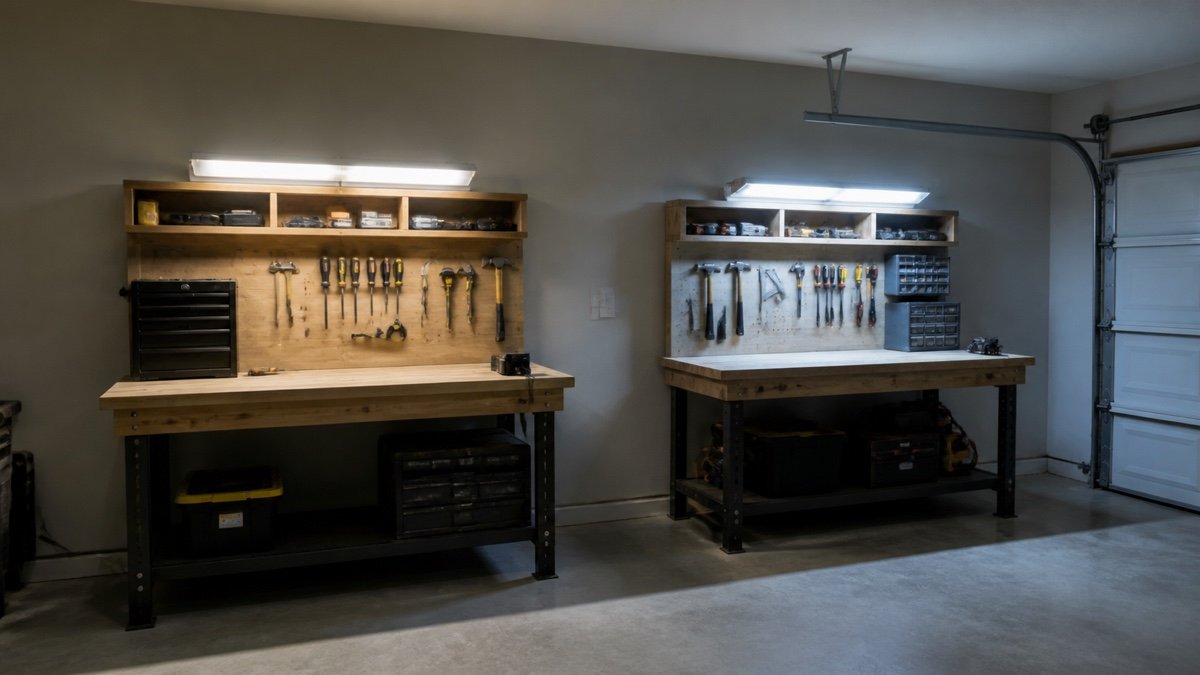
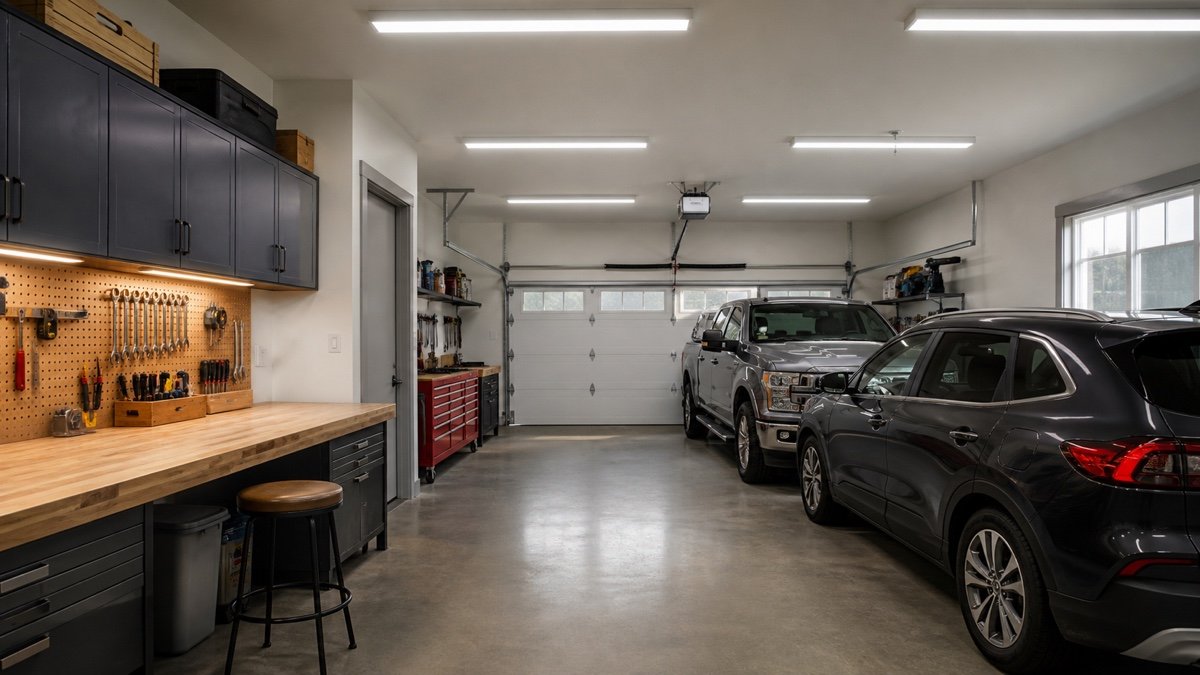
    Four-foot LED shop lights mounted over a garage workbench and tool wall
    A broad fixture over the bench reduces the hard shadows created by a single ceiling bulb.

    Braun 59506 for a straightforward hanging row

    The Braun 59506 is a light, narrow 4-foot hanging fixture. Harbor Freight publishes 5,500 lumens from 55 watts, a 5-foot power cord, included chains and S-hooks, and a limit of eight linked fixtures. The current official Braun listing states a 30,000-hour LED life and ETL certification.

    Its appeal is simplicity. Hang a pair over a bench line or create two parallel rows across a garage, then use the pull chain only where it remains reachable. The narrow body leaves more ceiling space around tracks and openers. It also concentrates the luminous surface, so position it where you cannot stare directly into the LEDs while working under a car hood. If you need a fixed wall switch or flush appearance, another fixture may be cleaner.

    Braun 56780 when 10,000 lumens genuinely help

    The Braun 56780 doubles the nominal output to 10,000 lumens at 100 watts. Its official product page lists 5000K light, a wider 7.43-inch body, included 24-inch chains, and a maximum link of four fixtures. That combination fits a tall bay, a detailed mechanical zone, or a room where one row must cover a broad working area.

    Do not buy four merely because they link. At a low residential ceiling, 10,000 lumens concentrated over a polished workbench can feel brutal. Start with a layout calculation, separate general and task lighting when possible, and use the table saw clearance guide to keep suspended fixtures and cords away from the full material path. The heavier fixture also deserves careful mounting into the structure named in its manual.

    Linkable hanging LED fixtures arranged in two rows above an open garage bay
    Two modest rows usually distribute light more evenly than a high-output strip down the centerline.

    Commercial Electric 54591142 for a broader 4000K source

    The Commercial Electric 54591142 is listed at 5,500 lumens, 60 watts, and 4000K. Its wider 10-inch housing can soften the visual impression compared with a bare narrow strip. The official retailer page describes surface and suspended mounting, included chains and cord, damp-location suitability, and linkability up to the stated limit.

    This model makes sense above a fixed bench where a broader luminous surface matters more than a minimal body. Check the actual mounting kit before choosing its exact ceiling position. A 10-inch housing can conflict with a garage door support or storage rack where a slim strip would pass. If the fixture sits above open drawers or the edge of a wall cabinet, stand at the work position and look up before drilling. That quick sightline test catches a surprising amount of glare.

    Lithonia 1290L for a smaller or layered lighting plan

    Lithonia lists the 4-foot 1290L at 3,300 lumens. The manufacturer page is sparse, so the exact SKU documentation should settle color, input, cord, mounting parts, and environmental limits before purchase. Its lower output can be useful in a one-car bay, over a secondary bench, or as one of several closely spaced fixtures.

    A lower-output light is often easier to live with when the ceiling is low and the walls are pale. More fixtures also let you reduce shadows at the sides of a vehicle or machine. The tradeoff is more mounting points and a more complicated power route. If you are replacing an existing fluorescent body, do not assume a shop light can reuse the old wiring. A plug-in fixture and a hardwired fixture are different installations.

    Plan total light, then split it across the room

    Multiply room length by width to get square feet, then use a starting target appropriate to the work. The number is only a planning estimate because wall color, fixture distribution, mounting height, and shadows change what reaches the surface. A 22 by 22 foot garage is 484 square feet. Four 5,000-lumen fixtures provide 20,000 initial lumens, or about 41 lumens per square foot before losses. That may feel comfortable for general work in one room and weak in another.

    Place the total in two rows and add task lighting at the bench rather than chasing one huge center fixture. Run the positions through the garage workshop aisle clearance guide; you should be able to move a tall project, ladder, or sheet good without striking a low hanging chain. Paint and clean surfaces matter too. A dusty dark ceiling swallows more light than a clean pale one.

    Check linking, cords, and switching as one system

    A published linking limit is not a suggestion to fill every socket. It is the maximum arrangement for that exact model under its instructions. Never mix a manufacturer’s linking cords with unrelated fixtures. Add the input watts of the planned run, follow the manual, and keep cords away from door hardware, sharp edges, hot surfaces, vehicle roofs, and any place they can be snagged.

    Decide what should turn on together. General rows may share a wall control, while a bench light benefits from its own switch. Motion sensing works well for entry light but may switch off during careful stationary work. Smart controls add scheduling, yet an app should not be the only practical way to light a dark garage. Permanent electrical work belongs with a qualified electrician and the requirements that apply at the property.

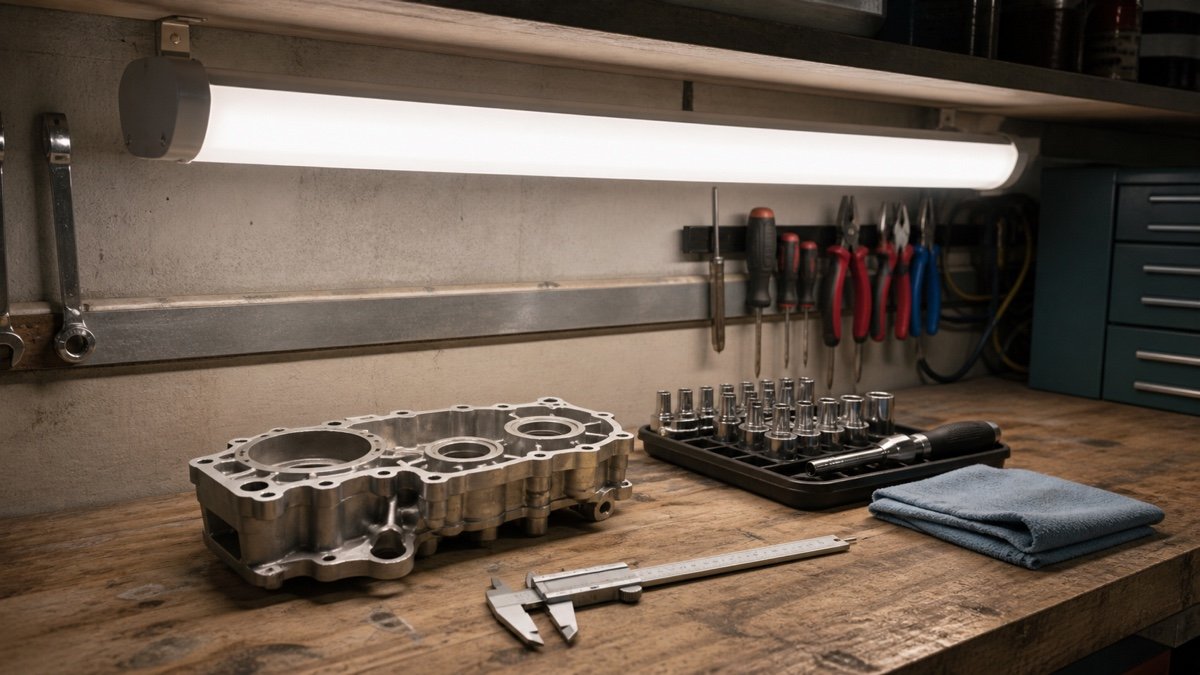
    Close view of a diffused LED shop light above detailed mechanical work
    A frosted lens and thoughtful angle can be easier on the eyes during close work.

    Look beyond lumens before ordering

    Confirm color temperature, CRI, damp or dry location rating, operating temperature, dimming compatibility, warranty, and whether the LEDs or driver can be serviced. Look at the fixture dimensions rather than the familiar “4-foot” label. Width and hanging depth determine whether it clears an open garage door, ceiling rack, or tall cabinet. If the manufacturer supplies photometric files, they are more useful than a marketing photo for a serious layout.

    Then check the room at night. Tape the proposed fixture centerlines to the ceiling and stand at the bench, vehicle hood, and floor work area. Note where your head and hands cast shadows. A small movable work light can reveal whether the fixed layout needs another row. Lighting should support the garage storage system, not disappear behind open cabinet doors or illuminate the tops of bins.

    The sensible pick for each garage

    Choose the Feit motion model if automatic entry lighting and 4000K color suit the room. Choose the Braun 59506 when you want a simple, light, linkable hanging row. The Braun 56780 earns its place where mounting height and demanding work can use 10,000 lumens without glare. Commercial Electric’s broader body suits a fixed bench, while the Lithonia 1290L makes more sense as a modest layer than a brute-force centerpiece.

    Whichever you choose, order one fixture first when returns are practical. Temporarily hang it at the intended height, inspect shadows and glare, then copy the successful spacing. That small test tells you more than a lumen race and avoids covering the ceiling with a layout you dislike.

    Useful products to compare

    These links open current Amazon search results. Check the dimensions, manual, mounting hardware, warranty, and current availability for the exact model before you order.

    Before you buy or install

    Read the current manual for the exact product you are considering. Confirm its assembled dimensions, rated capacity, mounting requirements, included hardware, working clearances, warranty, and any limits that apply to your wall, floor, electrical circuit, or garage layout.

    Frequently asked questions

    How many LED shop lights does a two-car garage need?

    There is no fixed count. Multiply the room area by a reasonable starting lumen target for your work, then divide that total across several fixtures. Check ceiling height, wall color, beam spread, shadows, and task lighting. A mockup with one temporary fixture is more reliable than choosing by floor area alone.

    Is 4000K or 5000K better for a garage?

    4000K usually feels neutral and comfortable for a mixed-use garage. 5000K looks cooler and can make detail feel crisp, but some people find it stark at night. Color temperature does not measure brightness or color accuracy. Compare both if the room is also a laundry, entry, or hobby space.

    Can I link different brands of LED shop lights?

    Do not assume so. Use only the linking cord, connector, and arrangement approved for the exact fixture. Stay within the manufacturer’s unit and electrical limits. A matching plug shape does not prove electrical or mechanical compatibility.

    Should garage shop lights hang or mount flush?

    Hanging lights are easier to lower over a bench and can avoid an uneven ceiling. Flush fixtures preserve headroom and reduce movement near doors and stored items. Check the exact fixture instructions, structure, cord path, open garage door envelope, and every overhead storage location.

  • 4000K vs 5000K garage lighting: choose by comfort and task

    4000K vs 5000K garage lighting: choose by comfort and task

    Affiliate disclosure: As an Amazon Associate I earn from qualifying purchases. This article may contain affiliate links, and Bay & Bench may earn a commission at no extra cost to you. Read our full Affiliate Disclosure.

    The choice between 4000K vs 5000K garage lighting is mostly about the character of the white light, not how much light you get. A 5000K fixture is not automatically brighter than a 4000K fixture. Lumens, distribution, glare control, and surface reflectance decide visibility. Color fidelity decides whether wood, paint, wires, and skin look believable.

    For a garage shared with vehicles and household storage, 4000K is the safer neutral default. A well-made 5000K source can feel crisp at a detail bench or in a dedicated workshop, but it can also feel stark late at night. The best decision comes from comparing actual fixtures with similar output and color quality in your room.

    Quick answer

    Choose 4000K for a balanced, neutral garage that serves parking, storage, repairs, and general projects. Choose 5000K if you genuinely prefer cooler white light and the garage functions mainly as a workshop. Neither CCT guarantees better visibility. Match lumens, beam distribution, CRI or other color-quality data, flicker performance, and diffusion before comparing the Kelvin value. When uncertain, install one 4000K sample and one 5000K sample temporarily and view familiar materials at night.

    4000K vs 5000K garage lighting at a glance

    Question4000K5000K
    Visual characterNeutral whiteCooler, daylight-like white
    Shared garage comfortUsually the easier defaultCan feel stark to some people
    Detail-work impressionClear without a strongly cool castMay feel crisp when the fixture is well diffused
    BrightnessDepends on lumens and distributionDepends on lumens and distribution
    Color fidelityDepends on the product, not CCT aloneDepends on the product, not CCT alone
    Best buying methodCompare samples with similar output, optics, and color quality

    If the room still lacks enough general output, calculate that separately with the garage lighting calculator. Changing from 4000K to 5000K does not repair a poor lumen budget.

    CCT describes appearance, not brightness

    Correlated color temperature, or CCT, is expressed in kelvins. Lower values generally look warmer; higher values look cooler. The U.S. Department of Energy’s color and spectrum guidance explains that CCT is only one part of how a light source appears.

    Two fixtures can both claim 5000K while one produces 4,000 lumens and another produces 8,000. Their optics may send that output in completely different directions. A brighter-looking wall may come from wider distribution or lighter paint, not the cooler color.

    Shop by lumens and photometrics for quantity and placement. Shop by CCT for the white-light character. Then evaluate color quality, glare, dimming, flicker, temperature range, and warranty. Keeping those questions separate prevents the Kelvin number from carrying jobs it cannot do.

    Why 4000K works in a mixed-use garage

    A 4000K garage usually reads as clean and neutral without feeling aggressively blue. That makes it comfortable for unloading a car, finding storage, maintaining bicycles, repairing household items, and working at a bench. It also transitions more gently to typical indoor lighting when the garage connects directly to the house.

    Wood tones and warm paint colors often feel more natural under a good 4000K source than under a strongly cool one. That is a preference, not a universal performance fact. A low-quality 4000K fixture can still render colors poorly or show an unpleasant green tint.

    Use 4000K as the default when several household members use the garage or when the lights stay on for long evening sessions. Pair it with broad diffusion and local task lighting. Comfort comes from the whole system, not the nominal CCT alone.

    Wood and painted metal samples under neutral 4000K garage lighting
    A good 4000K fixture often feels balanced in a garage shared by tools, storage, and household tasks.

    When 5000K makes sense at a workbench

    Some people prefer the cooler appearance of 5000K for mechanical work, cleaning, sorting hardware, or detailed assembly. It can give the room a crisp visual character, especially when surfaces are pale and the fixture has good diffusion. That preference is legitimate if you have seen the light in person.

    Cooler light can also feel clinical or tiring at night, particularly when bare diodes sit in the field of view. Do not assume a warehouse-like appearance creates better detail. Shadows, glare, and poor color rendering can hide information even when the room feels intensely white.

    A dedicated 5000K task fixture over one bench is a reasonable compromise when the rest of the garage is 4000K. Keep the zones deliberate and view a workpiece at their boundary before committing. Random alternating fixtures often create a patchy ceiling and inconsistent surface color.

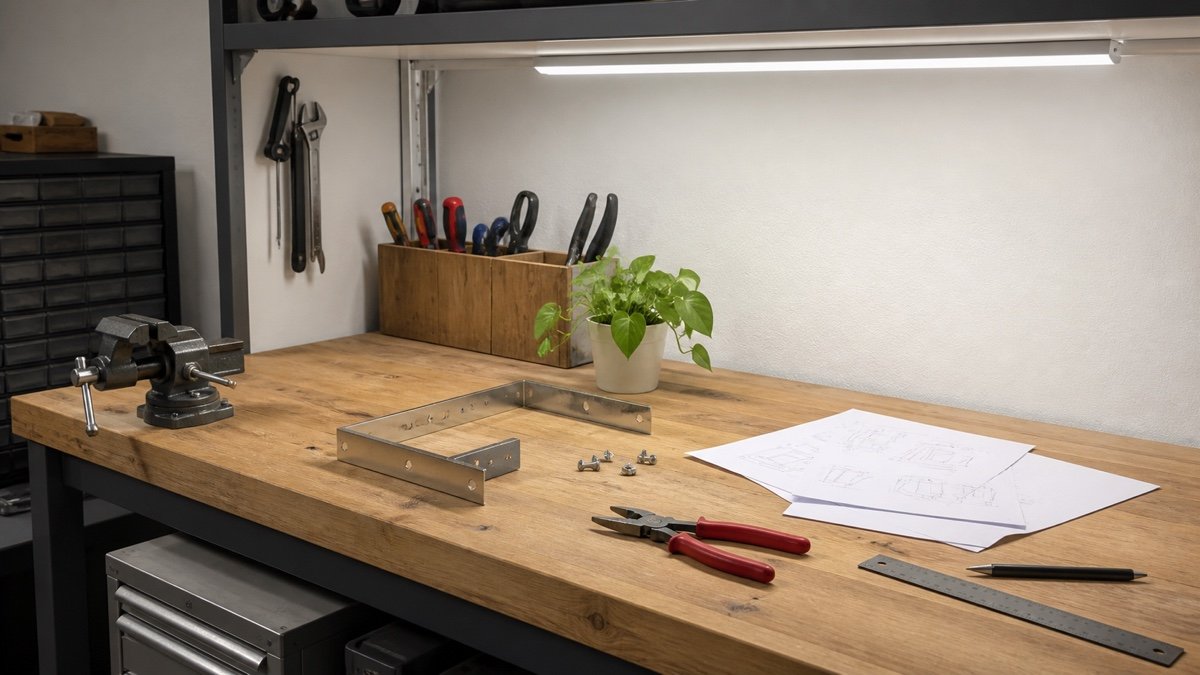
    Detailed workbench under crisp 5000K garage task lighting
    5000K can feel crisp at a detail bench, but distribution and color quality still determine what the hands can see.

    Compare color quality after matching CCT

    Color rendering index, or CRI, gives familiar information about color fidelity, but it is not the complete story. DOE’s LED basics notes that lighting performance includes several color and spectral qualities. Newer evaluation methods such as IES TM-30 can add detail when manufacturers publish them.

    For ordinary parking and storage, a credible interior fixture with common color quality may be adequate. When you match stains, paint panels, wire colors, or finishes, look for stronger documentation and sample the light on the real material. An advertised high CRI from an unknown model is less reassuring than a traceable specification from a manufacturer that identifies the exact fixture.

    Also check consistency. Six lights should not vary visibly from greenish to pinkish. Color stability between fixtures and over time can matter more than choosing 4000K or 5000K on paper.

    Do not mistake a cooler source for clearer vision

    Visibility depends on contrast, size, glare, adaptation, age, and where the light lands. A cooler source may feel subjectively brighter at the same nominal output, but that sensation does not guarantee better inspection. A dark pencil line under a body shadow remains dark.

    Match two sample fixtures as closely as possible for lumens, beam pattern, diffuser, mounting height, and color quality. Switch between them after your eyes adapt. Read a small label, inspect a scratch, sort colored wire, and look at the same wood offcut. Avoid judging from a phone camera, which changes white balance automatically.

    Give each sample ten or fifteen minutes at night. The first cool impression can seem energetic, while long-session comfort tells a different story. Ask other regular users, since a garage shared by a household should not be optimized around one quick glance.

    Glare can dominate the CCT decision

    An exposed high-output LED source can be uncomfortable at either 4000K or 5000K. Look from the parked driver’s seat, the house entry, the bench, and a seated repair position. If bright points remain in the normal line of sight, choose a better diffuser, reposition the fixture, or reduce contrast.

    Cooler light may make harsh glare feel more obvious to some users, but fixture design is the larger issue. Deep optics, broad lenses, indirect reflection, and multiple lower-output sources can produce a calmer room than one intense lamp.

    Glossy floors and polished car paint reflect source images. Check them before buying the remaining fixtures. A sample that looks fine against bare concrete may become distracting after an epoxy floor or white worktop is installed.

    Keep the ceiling consistent and zone the exceptions

    A consistent CCT across the ambient ceiling makes the garage feel coherent. If 4000K handles general use, keep that base and add 5000K only where a cooler task source has a clear purpose. Put it on a separate switch. The reverse approach can work in a dedicated cool-white workshop with a warmer inspection area.

    Do not alternate 4000K and 5000K fixtures in the same row. The floor may show visible bands, and workpieces can change appearance as they move. Mixing different manufacturers at the same nominal CCT can also create mismatch because CCT tolerances and spectra vary.

    Plan fixture positions after choosing the bench and machine zones in the garage workshop layout guide. A well-zoned light should support the task without spilling an abrupt color boundary across the main surface.

    Read credible labels and documentation

    ENERGY STAR’s downlight criteria recognize nominal CCT values including 4000K and 5000K and pair color requirements with other performance criteria. Your garage fixture may be another product type, but the useful lesson is that CCT belongs inside a broader specification.

    Look for exact model number, delivered lumens, CCT tolerance, CRI or richer color data, efficacy, operating temperature, location rating, dimming compatibility, expected lifetime, and warranty. Confirm safety listing and installation conditions. Marketing phrases such as daylight, crystal white, or ultra bright are not substitutes for numbers.

    Run a two-fixture sample test

    1. Choose one 4000K and one 5000K fixture with similar lumens, optics, color quality, and size.
    2. Mount or support them safely at the intended height according to instructions.
    3. Test at night with vehicles, shelves, and the garage door in normal positions.
    4. View the bench, floor, storage labels, car paint, wood, wires, and skin.
    5. Check standing, seated, and driver sight lines for glare.
    6. Use each sample for a normal 20-minute task.
    7. Ask every regular user which feels easier, not merely brighter.

    Do not energize an improvised hardwired setup. Use approved temporary arrangements or have a qualified electrician handle wiring. Once you choose, buy the same model and specification together where practical so the ceiling has consistent color.

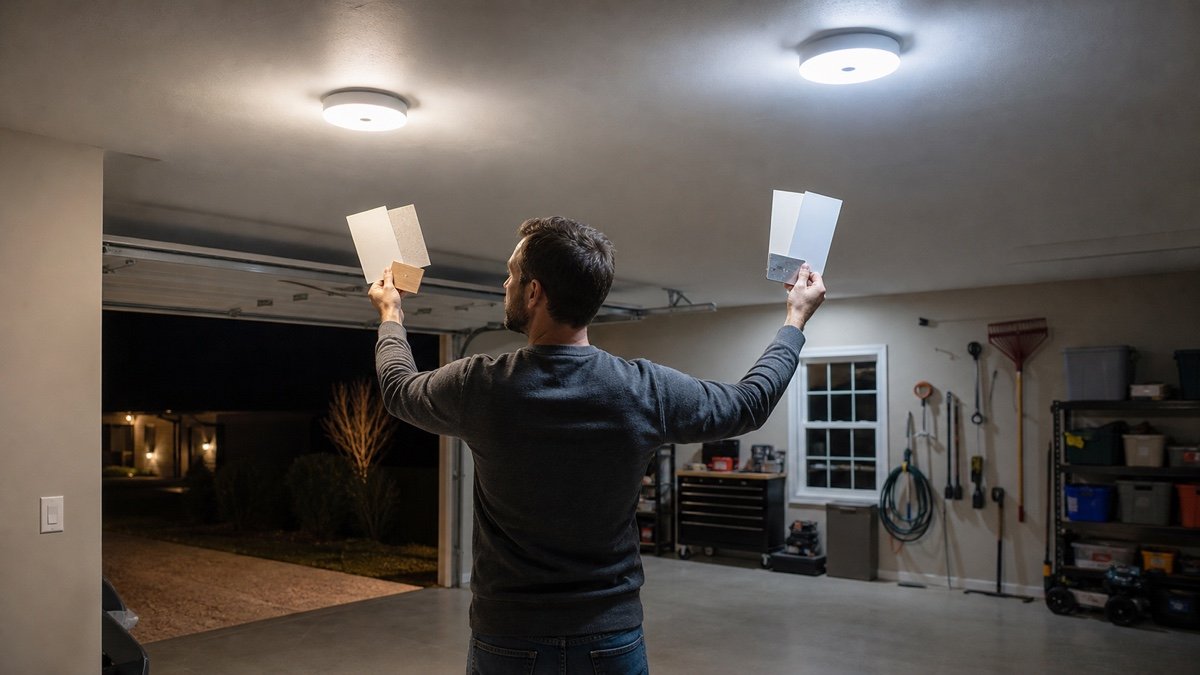
    Two sample LED fixtures being compared in a finished garage
    Sample one fixture of each CCT at night before ordering a ceiling full of lights.

    Choose from the room you have

    Pick 4000K when the garage is a household transition space, storage room, parking bay, and occasional shop. Pick 5000K when you have sampled it, prefer the cooler appearance, and spend most garage time on focused work. If opinions are split, a 4000K ambient system with separately controlled task lighting is the least risky compromise.

    Check the garage workshop aisle guide while placing fixtures so walking routes stay visible without direct glare. For a compact room, the one-car workshop layout helps account for the open garage door and vehicle shadows.

    Finally, remember the hierarchy: enough lumens, useful distribution, controlled glare, good color quality, then preferred CCT. Get the first four wrong and neither Kelvin choice will feel right. Get them right and both can produce an excellent garage.

    Useful products to compare

    These links open current Amazon search results. Check the dimensions, manual, mounting hardware, warranty, and current availability for the exact model before you order.

    Before you buy or install

    Read the current manual for the exact product you are considering. Confirm its assembled dimensions, rated capacity, mounting requirements, included hardware, working clearances, warranty, and any limits that apply to your wall, floor, electrical circuit, or garage layout.

    Frequently asked questions

    Is 5000K brighter than 4000K in a garage?

    No. Brightness depends on lumen output, distribution, room surfaces, and where the light lands. 5000K looks cooler and may seem crisper, but a 4000K fixture can produce more usable light.

    Is 4000K warm white?

    4000K is generally described as neutral white rather than traditional warm white. It looks cooler than common 2700K or 3000K household lamps but warmer than 5000K.

    Can I mix 4000K and 5000K lights in one garage?

    Yes, but use deliberate zones and separate controls. Keep the ambient ceiling consistent, then add a different CCT only where a task benefits and the color boundary does not cross the work surface.

    What is the best color temperature for a woodworking garage?

    A good 4000K fixture is a comfortable general choice for wood and long sessions. More important, choose strong color fidelity and low glare, then inspect stains and finishes under the light used for the final judgment.