Affiliate disclosure: As an Amazon Associate I earn from qualifying purchases. This article may contain affiliate links, and Bay & Bench may earn a commission at no extra cost to you. Read our full Affiliate Disclosure.
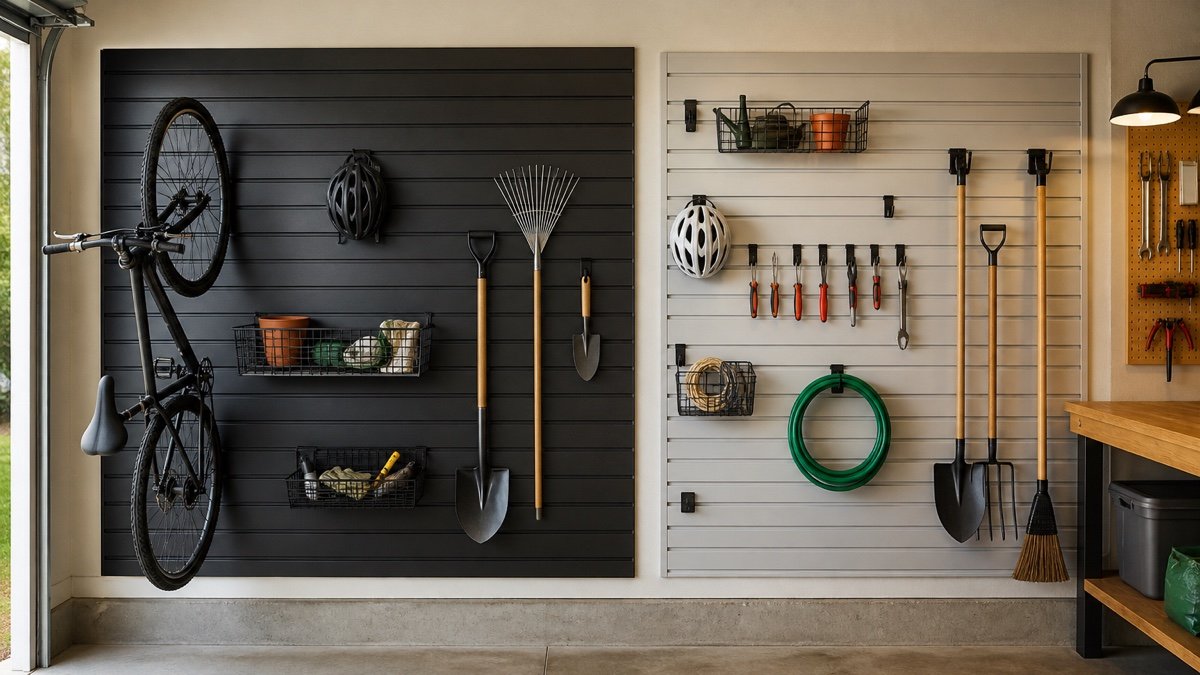
The Proslat vs Gladiator slatwall choice starts with the shape of the wall you want to organize. Both systems create adjustable garage storage, but they approach the job differently. Proslat is easiest to understand as a broad panel system intended to cover a meaningful section of wall. Gladiator gives you two related formats: full GearWall panels and narrow GearTrack channels. That difference changes the installation, the first purchase, and the way the system grows.
Product lines, bundles, and ratings can change. Match every specification to the exact panel and accessory you plan to buy, then keep the current manuals with your garage records.
Quick answer
Choose Proslat Classic PVC when you want a finished 4 by 8 foot wall section, a listed panel capacity of 75 pounds per square foot, and you are comfortable committing to Proslat accessories. Consider Proslat PROCORE when its higher listed capacity and compatible structure suit the job. Choose Gladiator GearWall when you prefer modular 12 inch high panels, or GearTrack when you want to organize one strip at a time. Gladiator lists GearWall at 50 pounds per square foot and certain GearTrack channels at 75 pounds per linear foot. Those numbers use different units and should never be treated as a direct capacity contest.
The systems solve different versions of the same problem
A slatwall purchase starts with the shape of the storage zone. A broad wall behind a bench, beside a vehicle, or along the back of a garage is a natural fit for panel coverage. A short run for rakes or bikes may only need a track. Buying a full wall system for six tools wastes money and installation time. Trying to stretch a narrow track into cabinet support and whole-wall storage can be equally awkward.
Proslat Classic PVC is sold in sections that cover 32 square feet when assembled as a 4 foot by 8 foot area. Ten horizontal slats and perimeter trim make up that section. Gladiator GearWall panels are 12 inches high and come in 4 foot and 8 foot lengths, while GearTrack is a much narrower channel. This lets Gladiator owners add storage in smaller vertical steps.
Before comparing finishes, draw the proposed wall and mark outlets, switches, windows, hose connections, foundation ledges, and door hardware. Then use the pegboard and slatwall layout planner to estimate the active area. The cleanest product is the one that fits around real interruptions without leaving expensive scraps.
Panel capacity needs context
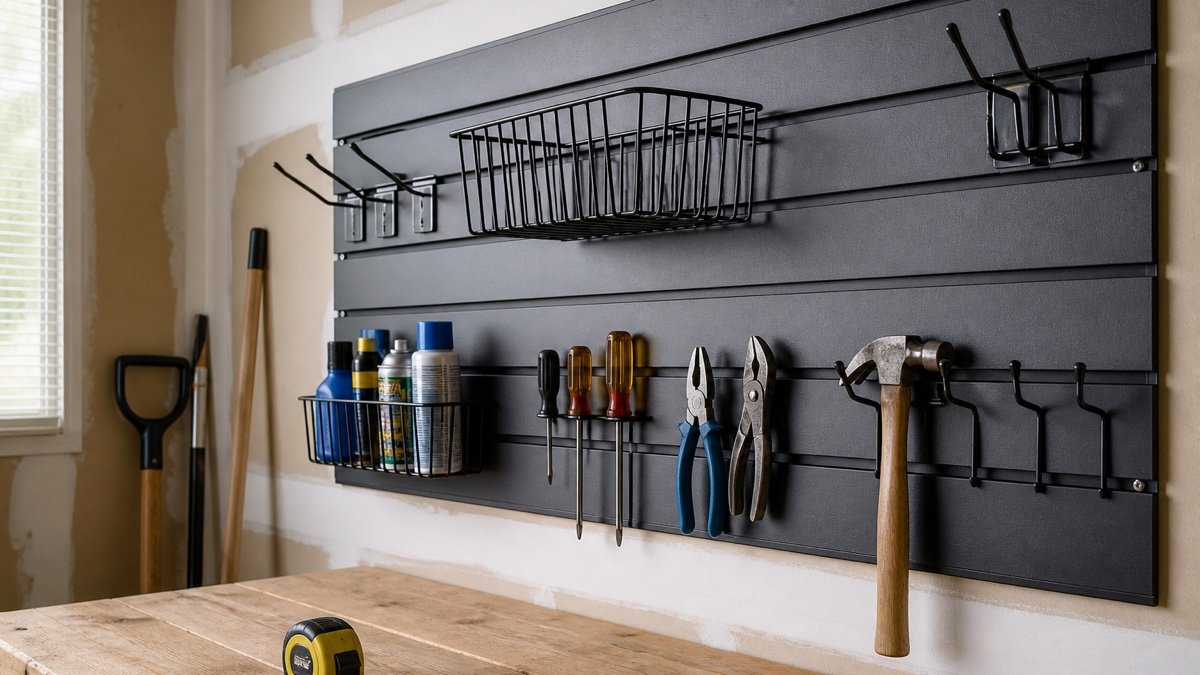
Proslat currently lists Classic PVC slatwall at up to 75 pounds per square foot. The company lists PROCORE at up to 200 pounds per square foot. Gladiator currently lists GearWall panels at up to 50 pounds per square foot. GearTrack uses a different measure, up to 75 pounds per linear foot for certain channels.
None of those numbers tells you how much a random hook will hold. The panel, hook, shelf, fastener pattern, wall framing, and installation all have their own limits. A Proslat single hook may carry less than a heavy duty hook even though both attach to the same wall. Gladiator hooks and shelves likewise have individual ratings. Use the lowest applicable rating in the complete setup.
The difference between square feet and linear feet matters. A 4 foot channel listed per linear foot cannot be compared to a panel listed per square foot by glancing at the largest number. Read the current manual for the exact model. Check whether the rating assumes distribution across the panel and correct fastening at every required location. If the studs, masonry, or wall condition are uncertain, pause before loading the system.
A side by side planning table
| Planning point | Proslat | Gladiator |
|---|---|---|
| Common wall format | Classic PVC and PROCORE sections commonly cover 4 by 8 feet | GearWall uses 12 inch high panels; GearTrack uses narrow channels |
| Listed panel capacity | Classic PVC: up to 75 lb per sq ft; PROCORE: up to 200 lb per sq ft | GearWall: up to 50 lb per sq ft |
| Track rating | Not the basis of the Classic PVC comparison | Certain GearTrack channels: up to 75 lb per linear ft |
| Expansion style | Add another panel section or planned adjacent coverage | Add panel rows or separate track runs |
| Accessory choice | Use accessories approved for the exact Proslat panel family | Use accessories approved for GearWall or GearTrack |
| Best first question | Do I want a finished panel field? | Do I want panels, tracks, or a mix within one brand system? |
The table is a planning shortcut, not an installation specification. PROCORE does not interlock with Proslat Classic PVC, according to Proslat. Treat them as separate panel families even though the same company sells both.
Accessory lock-in deserves more attention than color
People tend to compare black, gray, and white panels first. Hooks become the bigger decision after the wall is installed. Each brand builds an ecosystem of baskets, shelves, bike hooks, tool holders, and cabinet mounts. The useful question is not which catalog has more pieces. It is whether the catalog has the few pieces your garage needs, at ratings that fit those objects.
Proslat states that its slatwall panels are designed for Proslat accessories. Its product pages also identify which accessories fit Classic, PROCORE, or XL PROCORE systems. Gladiator describes its wall accessories for GearWall panels and GearTrack channels. Do not assume that an accessory from one brand will seat, lock, or carry its listed load on the other brand. Similar horizontal grooves do not prove compatibility.
Make an accessory bill before buying panels. Count long tool hooks, double hooks, baskets, shelves, bike storage, and any cabinet brackets. Compare the total system, not the panel price alone. If a required holder is missing, a beautiful wall will still leave the awkward item on the floor.
Installation scope may decide the winner
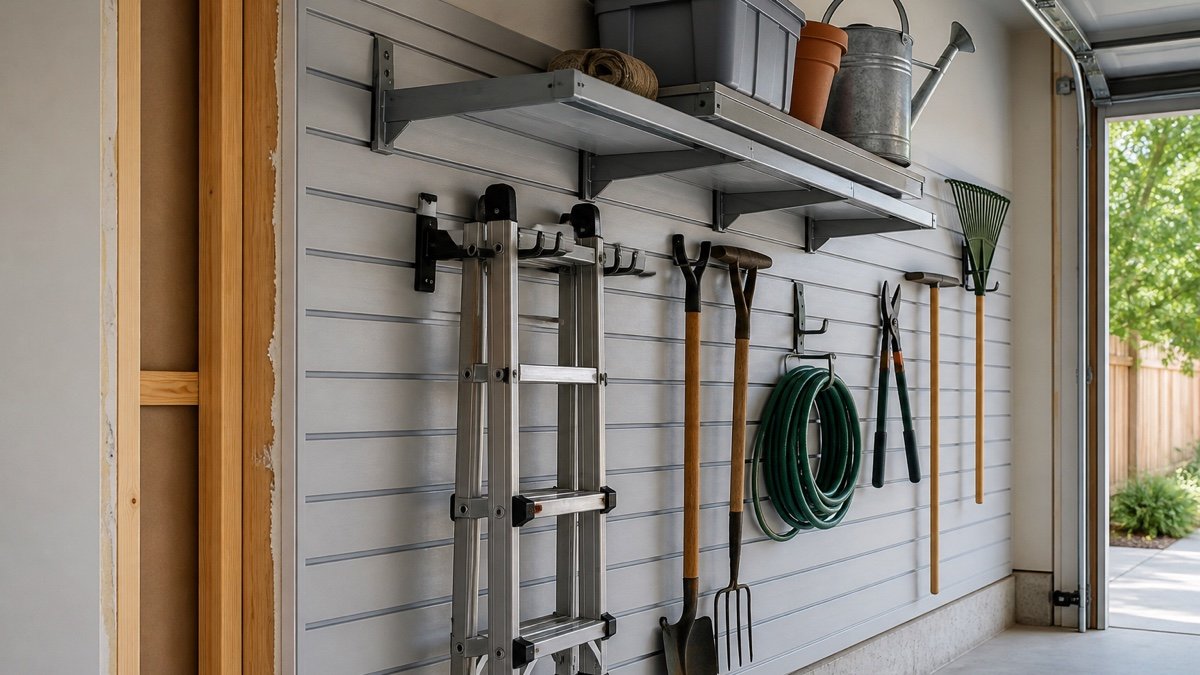
A Proslat 4 by 8 section creates a finished field quickly, but the project commits you to leveling, cutting, fastening, and trimming a broad area. Manufacturer guidance calls for fastening into appropriate structure, with details that vary by panel family and wall type. Concrete or block installations may require a framed support method rather than fastening the decorative panels wherever convenient.
GearWall rows also need careful alignment, yet the 12 inch panel height gives you a way to build the wall in horizontal stages. GearTrack is the smallest starting point. A homeowner can plan one channel for garden tools, another for sports gear, and leave the remaining drywall exposed. That flexibility helps when outlets or cabinets break up the wall.
Small does not mean casual. Gladiator instructions specify screw placement and structural connection requirements. Proslat instructions do the same. Locate studs, confirm their spacing, inspect wall condition, and read the complete manual before ordering. If the wall hides plumbing or electrical runs, find a safe mounting plan rather than treating every stud bay as available.
Cleaning, moisture, and appearance
Both systems are sold for garages, where dust, temperature swings, and damp equipment are normal. Proslat says its PVC panels can be wiped with a damp cloth and, for a full wall installation, hosed down. Gladiator describes GearWall as suitable for harsh garage conditions. Those statements do not remove the need to protect outlets, wall cavities, tools, and nearby finishes from water.
A full panel field hides patched drywall and makes the wall look deliberate. It also covers more area that you may need to remove or work around later. Tracks leave more drywall visible, which is cheaper and visually lighter, but every scuff and old anchor remains part of the room.
Dark panels make bright steel tools easy to spot, though dust may show sooner. Light panels brighten a garage with weak daylight. Pick the finish after checking the accessory plan and coverage. Color is easy to enjoy on day one. A misplaced shelf or unavailable holder is annoying every week.
Which system fits each garage
Proslat Classic PVC makes sense for a homeowner who wants a substantial wall section, likes a continuous panel look, and finds every needed holder in the Proslat catalog. PROCORE is worth comparing when the project calls for its higher published panel rating, but that rating still depends on correct installation and compatible accessories.
Gladiator GearWall suits a wall that may grow by rows, especially if the owner already likes Gladiator shelves, baskets, or cabinet mounting options. GearTrack is the practical entry when the job is narrow: a garden tool strip, a bicycle zone, or a few items beside the workbench. A mixed GearWall and GearTrack plan may make sense within the Gladiator ecosystem, provided each accessory and installation follows current documentation.
Neither brand wins every garage. Sketch the wall, price the complete accessory list, and leave at least a little open capacity for tools you have not bought yet. For a broader look at wall formats, start with our garage storage systems guide.
A buying checklist that prevents expensive surprises
- Confirm the exact panel family and model, not just the brand.
- Measure usable wall width and height after every obstruction.
- Check stud spacing, wall material, and any required backing or framing.
- List each accessory and its individual published rating.
- Verify that every accessory is approved for the chosen panel or track.
- Compare complete cost, including trim, fasteners, shelves, baskets, and delivery.
- Save the current manuals and warranty documents.
- Plan how you will reach high hooks without standing beside a vehicle.
One last check is worth doing on the floor. Lay out your tools inside a rectangle matching the planned panel area. Large items often consume more horizontal space than expected because handles, pedals, and baskets overlap. A paper plan can look generous while the real equipment refuses to nest.
Useful products to compare
These links open current Amazon search results so you can compare dimensions, manuals, ratings, and availability for the exact models on your shortlist.
Before you buy or install
Check the current manual for the exact product you are considering. Confirm the assembled dimensions, load rules, mounting requirements, included hardware, clearances, warranty, and any limits that apply to your wall, floor, or garage layout.
Frequently asked questions
Are Proslat and Gladiator accessories interchangeable?
Do not assume they are. Proslat describes its panels for approved Proslat accessories, while Gladiator designs accessories for GearWall and GearTrack. Confirm compatibility in the current documentation for both the panel and accessory.
Is Proslat stronger than Gladiator GearWall?
Proslat currently lists Classic PVC at up to 75 pounds per square foot and PROCORE at up to 200. Gladiator lists GearWall at up to 50 pounds per square foot. Those panel ratings do not override the lower rating of a hook, shelf, fastener, wall, or installation.
Can I start with a small section?
Gladiator GearTrack is designed for narrow runs, and GearWall can grow by panel rows. Proslat is commonly planned in broader 4 by 8 foot sections. Check current package contents and installation instructions before choosing.
Can either system mount on concrete block?
Both brands provide installation guidance for supported wall types, but the method may require specific fasteners or added framing. Follow the manual for the exact system and ask a qualified installer when the structure is uncertain.