Affiliate disclosure: As an Amazon Associate I earn from qualifying purchases. This article may contain affiliate links, and Bay & Bench may earn a commission at no extra cost to you. Read our full Affiliate Disclosure.
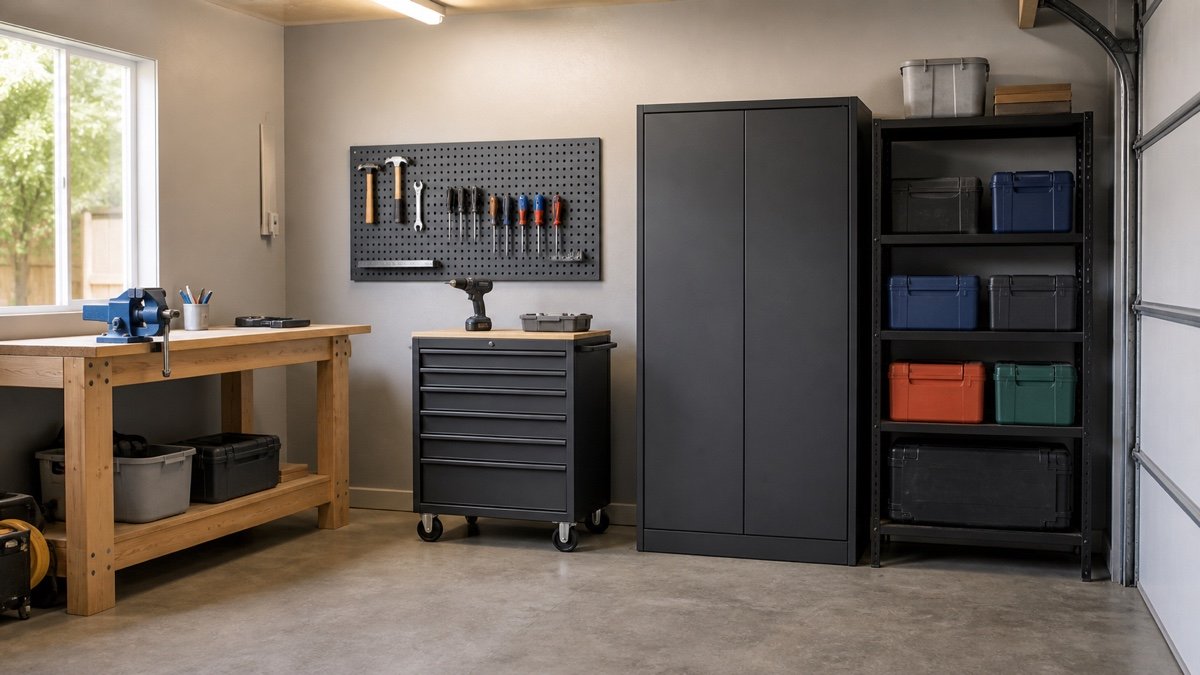
A garage tool storage guide should begin with the work, not a wall full of matching bins. Put the tools for tire service near the parking bay. Keep measuring and marking tools at the bench. Give portable kits a clear landing place when they come home. This approach may look less showroom-perfect, but it saves steps and makes missing tools obvious. The plan below sorts hand tools, power tools, hardware, batteries, long tools, and mobile cases by frequency, weight, and the route each one takes during a normal project.
Quick answer
Sort tools into daily, monthly, and occasional use. Store daily hand tools between knee and shoulder height near their work zone. Put dense tools low in drawers, portable kits on shelves that fit their cases, and long tools on rated wall hardware away from doors and vehicles. Measure the tallest and widest tool before buying drawers. Keep batteries dry and clean, follow each battery manual, and do not treat a charging cabinet as fire protection unless the manufacturer explicitly designed it for that purpose.
Garage tool storage guide by tool type
No single container handles a whole workshop well. Drawers are excellent for shallow, dense tools. Open wall storage keeps familiar hand tools visible. Cases protect tools that leave the garage. Cabinets keep dust off items used less often. Start with this division, then adjust for children, moisture, theft concerns, and the jobs you repeat.
| Tool group | Best first home | Placement | Main check |
|---|---|---|---|
| Sockets, wrenches, pliers | Shallow labeled drawers | Beside mechanical work | Open drawer clears car and stool |
| Measuring and marking tools | Protected shallow drawer or cabinet | At the clean bench | No abrasive dust or loose pile |
| Cordless tools | Drawer, shelf, or fitted case | Near charging area | Tool fits with battery removed if required |
| Fasteners and small parts | Small bins or drawer organizers | Eye level near assembly | Labels visible and bins cannot spill |
| Long tools | Rated hooks or floor rack | Near outdoor door | Head, vehicle, and door clearance |
| Jobsite cases | Measured shelf or mobile stack | Near exit route | Handles and latches remain reachable |
The broader garage storage systems guide helps place these tool homes beside household and seasonal storage.
Map the project route before buying organizers
Choose three recurring jobs. For example: bicycle service, household repair, and vehicle maintenance. Walk each job from setup to cleanup and note where tools accumulate. If sockets always land on a rolling cart next to the car, a chest across the garage creates needless travel. If drills leave in a portable case, unpacking them onto a decorative wall wastes time.
Draw a simple floor plan using the method in how to plan garage storage. Mark the bench, parking envelope, doors, outlets, and the place where a mobile cart rests. Tool storage belongs on that map. Leave working surfaces deliberately empty. A bench covered with permanent organizers has become a shelf, and every project will begin by moving someone else’s project.
Use retrieval frequency, not matching colors
Daily tools deserve the easiest reach. Monthly tools can occupy lower drawers or the second row of wall storage. Once-a-year pullers, specialty sockets, and spare jigs can live in labeled cases higher or farther away. Frequency changes, so write labels that can move rather than printing a permanent museum map on day one.
There is a useful exception. Hazardous, sharp, or expensive tools may need locked storage even when used often. Security and child access outrank convenience. Put the key or combination where authorized adults can use it without leaving the cabinet unlocked. Store personal protective equipment near the task that needs it, but keep clean respiratory and eye protection away from dust and overspray.
Choose drawers from tool dimensions
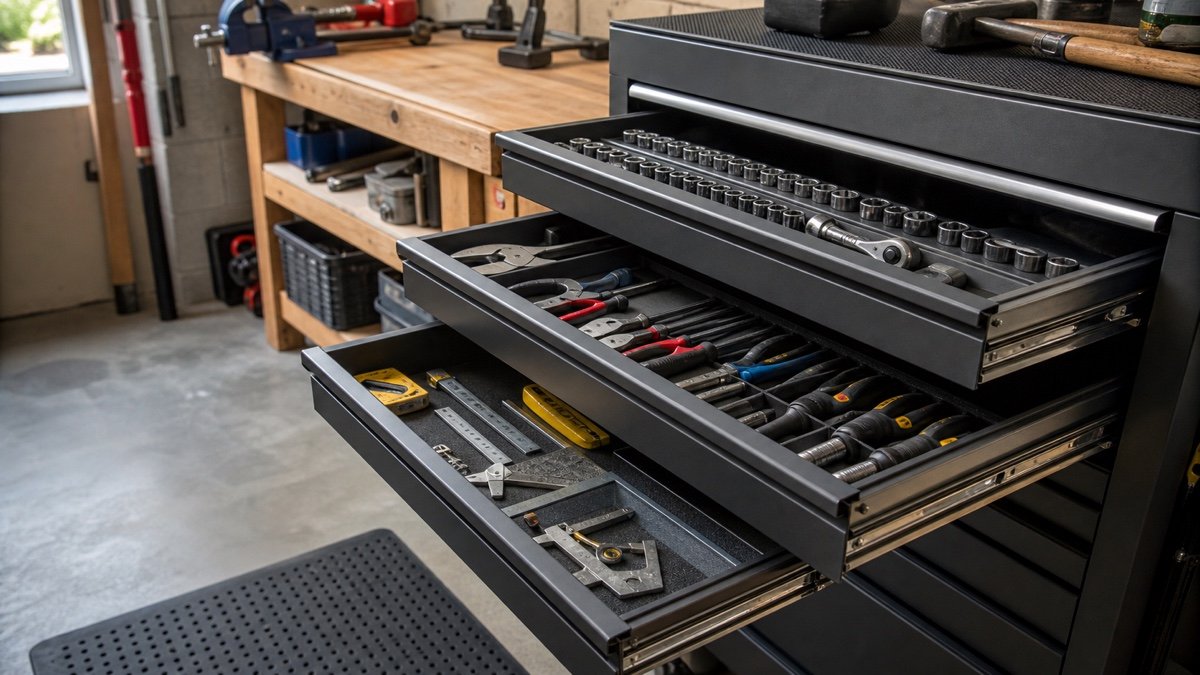
Count drawers only after measuring the tools. A chest with many shallow drawers is excellent for sockets and pliers but hopeless for a tall cordless saw. Lay each tool group on the floor in a single layer and measure the required width, depth, and height. Add room for dividers and your fingers. Then compare those numbers with the manufacturer’s internal drawer dimensions, not the cabinet’s outside width.
Dense tools should sit low. Divide them into modest groups so one drawer does not consume its full rating before the rest of the cabinet is loaded. A nonslip liner reduces movement but does not raise capacity. If you need help choosing the furniture around those drawers, compare the storage and work surface in the garage workbench buying guide.
Build wall storage around structure and published capacity
Wall systems keep daily tools visible, but the mounting surface and fasteners carry the load. Milwaukee lists its PACKOUT Compact Wall Plate at 50 pounds in a shop, while the Large Wall Plate is listed at 150 pounds. The manufacturer page and the exact installation manual matter because plate size, substrate, fasteners, and mounting context change the rating.
Do not transfer a capacity from one plate or hook to another. Include the organizer, case, tool, and attachments in the load. Place heavy cases low enough to lift with control, and keep protruding hooks outside walking and vehicle paths. The existing garage wall storage systems guide compares pegboard, slatwall, and track hardware once you know what the wall needs to hold.
Give power tools a clean landing place
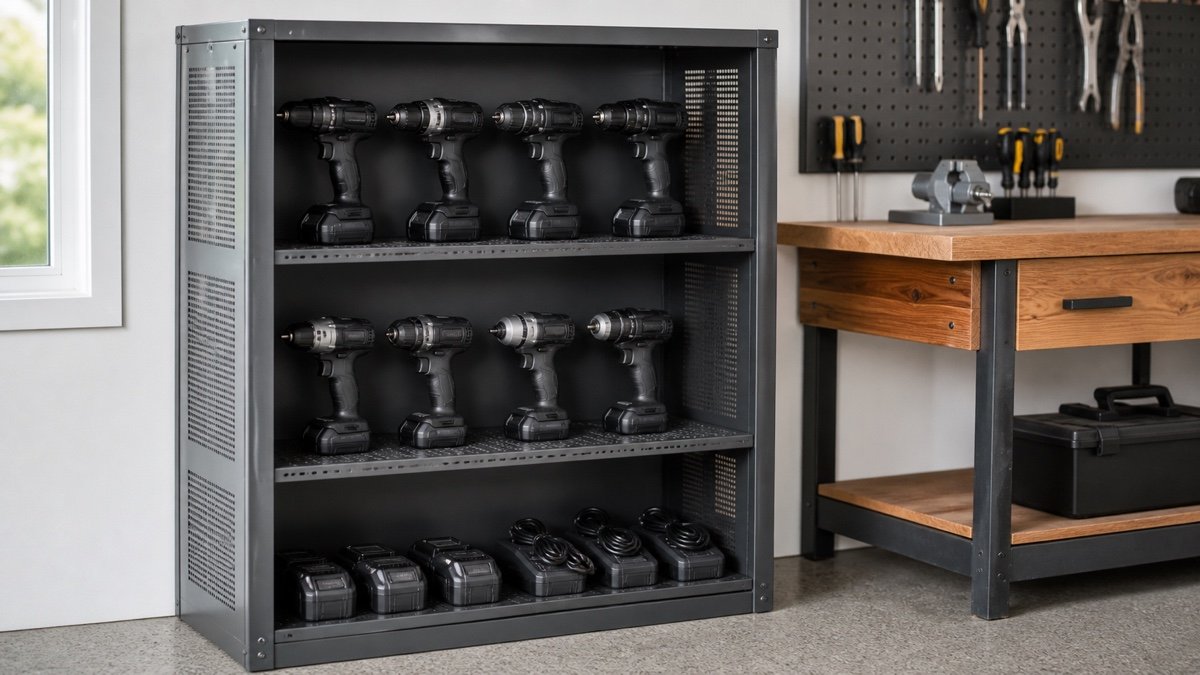
A cordless drill can stand on a shelf, hang from a tool-specific holder, sit in a drawer, or stay in its transport case. The right choice depends on dust, frequency, and whether the tool leaves the garage. Remove loose bits before hanging a tool overhead. Check that the holder supports the tool body without pressing a trigger or damaging a battery interface.
Deep modular drawers can keep kits together, but published capacities vary widely. DEWALT lists the TOUGHSYSTEM 2.0 DXL Deep Drawer Unit at 27.5 pounds per drawer and 55 pounds total. See the official product page for the current configuration. Those numbers are a reminder to weigh the actual kit rather than assuming every large plastic drawer can hold a dense pile of metal tools.
Treat batteries and charging as their own zone
Keep batteries and chargers dry, clean, and easy to inspect. Follow the temperature, ventilation, and storage instructions for each battery platform. Do not bury an operating charger in a closed drawer unless the manufacturer specifically approves that arrangement. Keep the charging area away from grinding sparks, oily rags, flammable finishes, and a bench where metal offcuts can bridge contacts.
Mounting a power strip inside a cabinet does not make the cabinet a listed charging enclosure or fireproof box. Use intact chargers and cords, avoid improvised adapters, and give heat somewhere to go. If an electrical outlet is damaged, loose, or badly placed, solve that problem rather than building an extension-cord maze around it.
Separate small parts by decision, not by appearance
Fasteners become useful when the label answers the question you ask during a repair. Sort common screws by diameter and length, electrical terminals by type and wire range, and anchors by the wall material they are approved for. Mixing every shiny metal fastener into one bin saves space and wastes the next Saturday afternoon.
Use lidded organizers for parts that travel. Open bins work for high-use items at a fixed assembly station, provided they cannot be knocked into a car path. Keep an intake bin for loose hardware discovered during cleanup. Empty it weekly. This prevents every drawer from developing a mysterious layer of one-off washers and unidentified clips.
Store long tools where their movement makes sense
Rakes, shovels, levels, clamps, and extension poles need more than a hook that carries their static weight. Measure the full sweep as you lift each item on and off. A secure rake can still scratch a vehicle when its handle rotates. Put outdoor tools near the exterior door and shop clamps near the bench, even if that breaks a symmetrical wall display.
Use two support points for long or awkward items when one hook lets them twist. Keep sharp ends covered or turned away from the aisle. Floor racks are often better for tools used by someone who cannot comfortably lift overhead. Recheck fasteners after the first loaded week and at regular cleanups.
Make portable cases part of the garage system
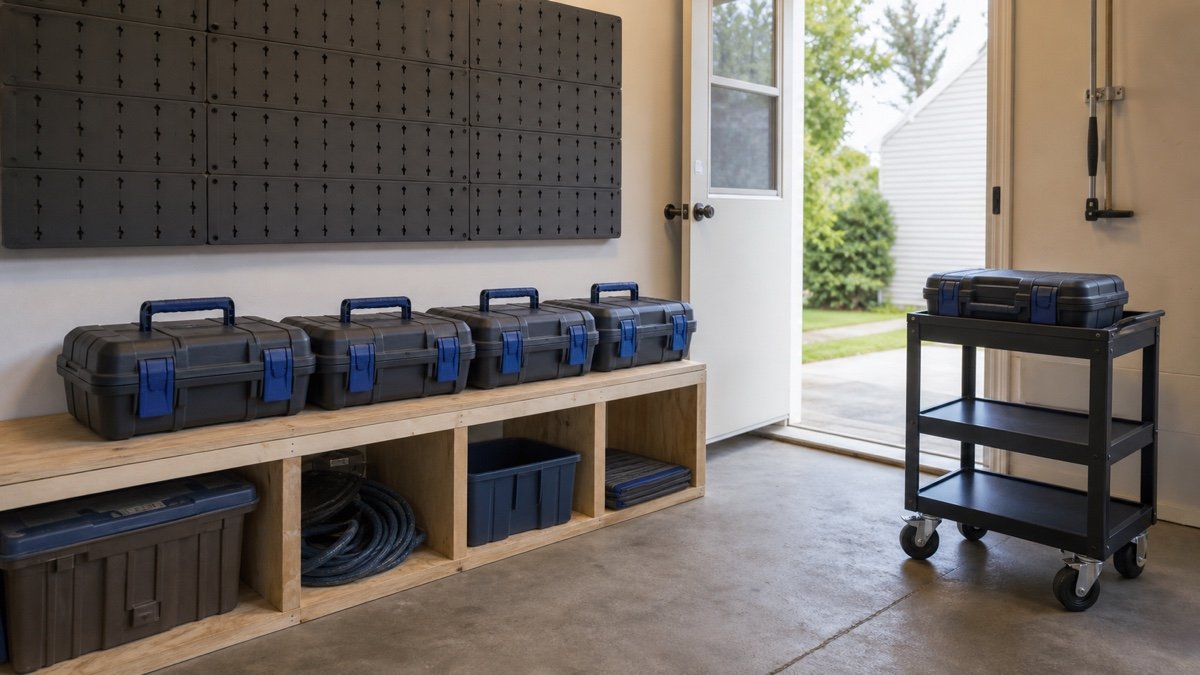
A case needs a home that accepts it without removing the handle, opening a latch, or unloading the stack. Measure the case at its widest projection. Leave enough shelf height to grasp it safely, and put the most frequently carried module between knee and chest height. Heavy boxes belong low.
Modular wall plates and rolling stacks are handy, but confirm every connection in the exact orientation. Milwaukee’s PACKOUT mounting plate manual, for instance, publishes different limits for plate models and mounting contexts. A case that locks to a floor plate may not be approved on a wall in the same arrangement. Follow the manual instead of reasoning from the shape of the cleats.
Reset one zone at a time
Do not empty the whole garage unless you can finish the job. Start with one bench drawer or one four-foot wall section. Remove duplicates and broken tools, group what remains by task, then mock up the new home with cartons and tape. Work from the zone for a week before buying inserts for every drawer.
Take a photo of the successful arrangement. Label only after it proves useful. At the monthly reset, return wandering tools, inspect wall hardware, clean drawer slides, and update the odd-items bin. A tool system earns its floor and wall space by making work easier. If an organizer creates more steps, move it.
Useful products to compare
These links open current Amazon search results. Check the dimensions, manual, mounting hardware, warranty, and current availability for the exact model before you order.
Before you buy or install
Read the current manual for the exact product you are considering. Confirm its assembled dimensions, rated capacity, mounting requirements, included hardware, working clearances, warranty, and any limits that apply to your wall, floor, electrical circuit, or garage layout.
Frequently asked questions
What tools should stay visible on a garage wall?
Keep frequently used hand tools visible when quick access outweighs dust and security concerns. Measuring tools, high-cost tools, and items sensitive to grit often belong in a drawer or cabinet. Heavy tools should not hang high merely to complete a wall display.
Are deep drawers better for power tools?
They are useful when the tool, battery, and accessories fit without stacking into a loose pile. Measure internal height and depth, then compare the full loaded weight with the drawer rating. Shallow drawers are usually better for sockets and pliers because every item remains visible.
Can I charge tool batteries inside a cabinet?
Only if the charger and cabinet arrangement follow the manufacturers’ instructions and the space provides the required conditions. Do not assume a metal cabinet is a fire-rated charging enclosure. Keep chargers clean, dry, ventilated, and away from sparks, flammables, and loose conductive debris.
How often should I reorganize garage tools?
Use a quick monthly reset and a deeper review when projects or tool ownership change. If a tool repeatedly lands somewhere other than its assigned home, the home is probably wrong. Move the storage closer to the work rather than relying on perfect habits.