Affiliate disclosure: As an Amazon Associate I earn from qualifying purchases. This article may contain affiliate links, and Bay & Bench may earn a commission at no extra cost to you. Read our full Affiliate Disclosure.
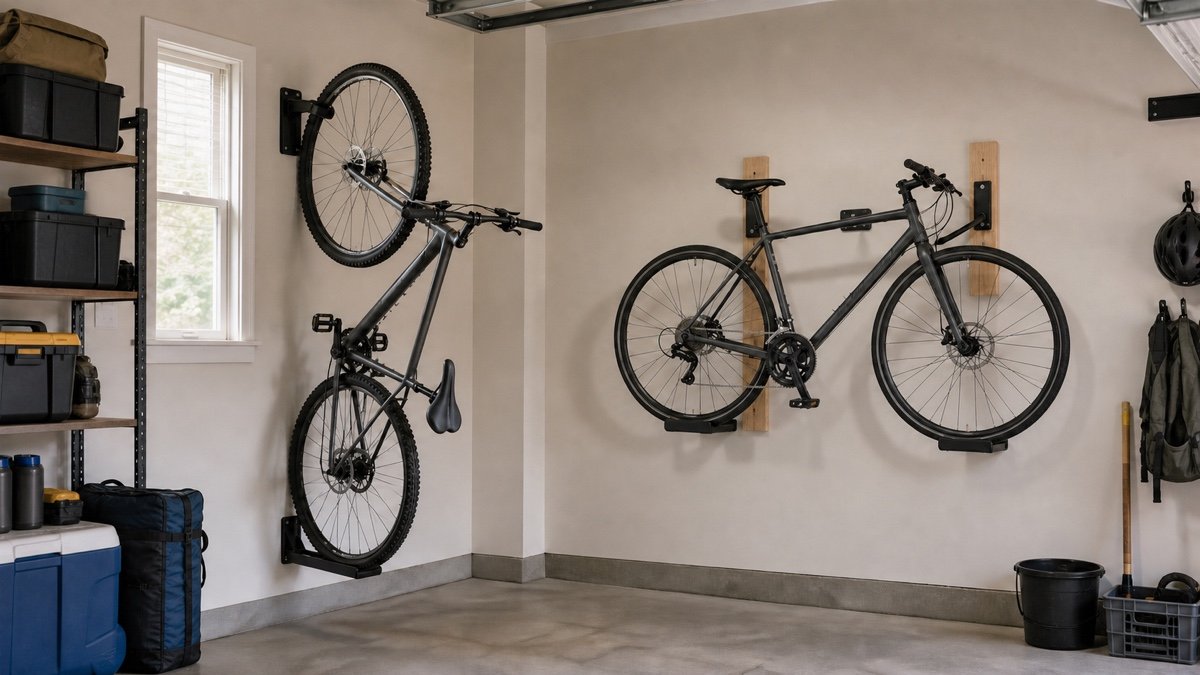
The vertical vs horizontal bike storage decision comes down to which dimension your garage can spare. Vertical racks use less wall width per bicycle but push the bike farther into the room and usually require a higher lift. Horizontal cradles use a long wall section and tend to keep the bike at a friendlier height. Neither orientation is automatically safer for a rim or frame. Fit depends on the exact rack, bicycle, mounting structure, and the person loading it.
Quick answer
Choose vertical storage for three or more light to medium bikes when wall width is limited and riders can lift the front wheel comfortably. Stagger rack heights so handlebars overlap. Choose horizontal storage for one or two bikes, frequent access, and riders who prefer a lower lift. It works best on a long clear wall and with frame geometry that sits securely on padded cradles. Heavy electric bikes often belong on the floor even when a wall rack lists enough capacity.
Vertical vs horizontal bike storage at a glance
| Decision | Vertical storage | Horizontal storage |
|---|---|---|
| Wall width | Lower per bike, especially when staggered | Roughly a bike-length wall per bike |
| Projection into room | Bike length unless rack pivots | Handlebar, pedal, and rack projection |
| Lifting | Front wheel rises high | Whole bike lifts to cradle height |
| Bike contact | Usually tire or rim at front wheel | Usually frame tubes on padded arms |
| Multiple bikes | Dense rows are practical | Rows require substantial wall length |
| Daily access | Good when each bike has a clear loading lane | Very good for one bike at waist to chest height |
| Common mismatch | Tire, fender, weight, or lift | Frame shape, wide bars, or short wall |
The garage storage systems overview helps decide whether bicycles should share a wall with tools or claim a separate zone.
Compare wall width and floor projection together
A vertical bike may need only a modest strip of wall, but its wheels can project five to six feet into the garage during loading and storage. A pivoting rack reduces that projection after the bike is hung, though pedals and bars still occupy depth. A horizontal bike stretches along most of its wheelbase while the bars and pedals define room depth.
Measure the complete bicycle, not a generic diagram. Mark both the wall outline and the floor shadow. Open the nearest car door. A vertical system may win on paper yet block the driver’s shoulder path, while a horizontal bike above a low cabinet may use otherwise dead wall space.
Vertical bike rack spacing depends on handlebars
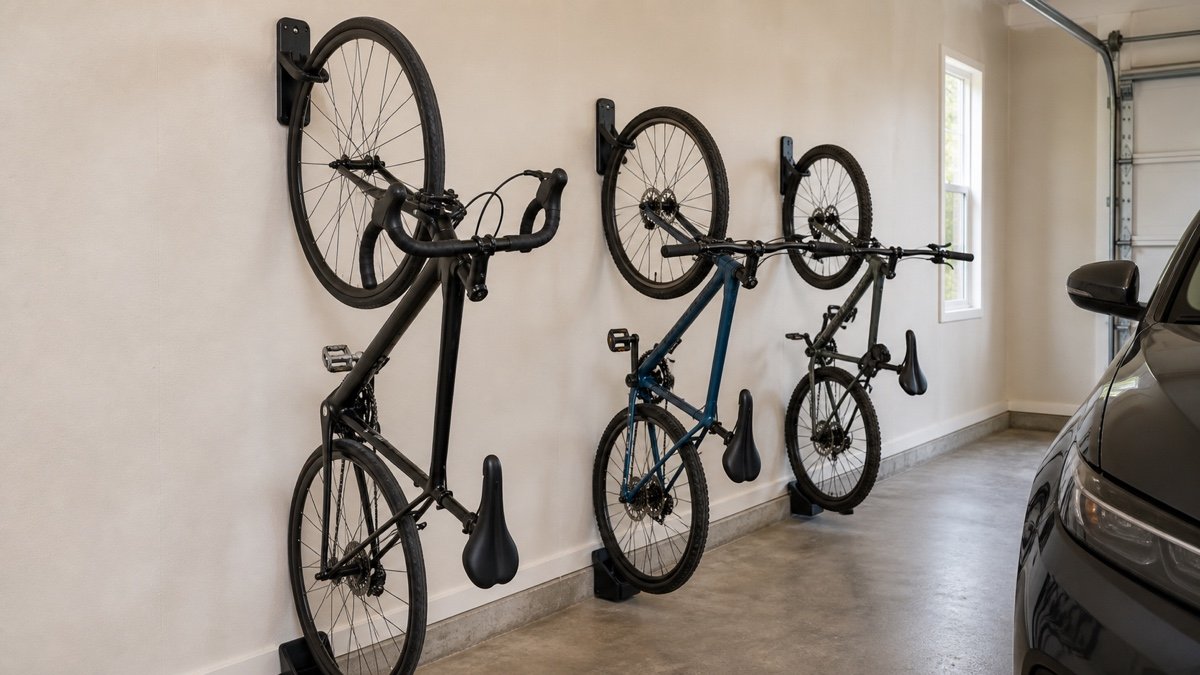
Feedback Sports recommends roughly 16 to 24 inches between its Velo Hinge 2.0 hooks, depending on stud spacing and staggered heights. The manufacturer FAQ suggests laying bikes together to see how the handlebars fit into neighboring frame triangles, then carrying the height difference to the wall.
This is a useful mockup technique, not a universal spacing rule. A modern mountain bike with broad bars may require more room than a drop-bar road bike. Baskets, mirrors, brake levers, and child seats can prevent the intended overlap. Stagger only as high as the regular rider can comfortably load.
Horizontal racks depend on frame geometry
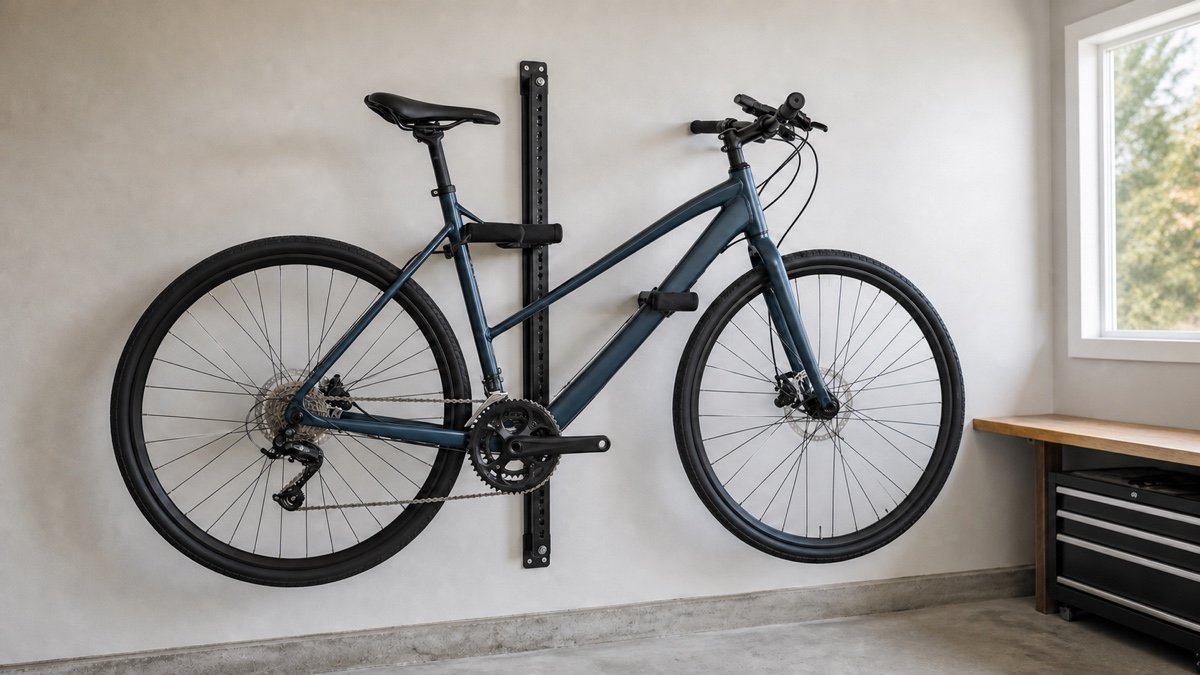
Horizontal racks usually support the top tube or other frame tubes on two padded cradles. A level traditional diamond frame is easy to picture. Step-through, compact, full-suspension, and small children’s frames may require independently adjustable arms or a different storage style.
The Feedback Sports Velo Wall Rack 2D allows horizontal and vertical arm adjustment, with cradles 8 to 12 inches from the wall and a 50-pound maximum load. Its official product page notes possible limitations with 780 mm and wider handlebars, long wheelbases, and fat bikes. Check cable routing and frame finish at both support points before trusting the fit.
Lifting style may decide before space does
To load a vertical hook, you usually roll the bike onto the rear wheel and raise the front. To load a horizontal cradle, you lift most of the bike and place it onto two arms. One motion is not easier for everyone. Bicycle weight, handlebar shape, rider height, shoulder mobility, and balance all matter.
Rehearse with the real bike away from vehicles. If the rider twists, strains, or loses control, lower the rack or choose floor storage. Capacity is only the hardware limit. It does not measure whether a parent, child, or tired commuter can make the required movement safely every day.
Tire and wheel fit control vertical storage
A vertical rack may contact the front tire, rim, or wheel at several points. Read the allowed wheel diameter, tire width, rim depth, fender clearance, and bike weight. Feedback Sports lists its Velo Hinge 2.0 for 700C by 23 mm through 29 by 3.0 inch combinations and up to 50 pounds with proper stud mounting. The product page provides the current fit details.
Do not squeeze a fat tire into a narrow hook or let a hook press a fender. Deep carbon rims and unusual wheel systems deserve explicit manufacturer confirmation. A basic hook may carry plenty of weight but still be the wrong shape for the wheel.
Frame contact controls horizontal storage
Padded cradles protect paint only when the bike rests at stable, approved points. Dirt trapped under a pad can abrade a finish. Brake hoses, shift cables, and electronic wires should not carry the load. Inspect the support after the first few uses and periodically afterward.
Some adjustable racks can angle their arms to accommodate a sloping tube. That does not guarantee every suspension layout or carbon frame is suitable. Ask the bicycle and rack manufacturers when the frame has delicate aerodynamic shapes, integrated storage, or unusual routing. If contact remains uncertain, tire-supported floor storage is the conservative choice.
A pivot changes the vertical footprint
Pivoting vertical racks let a stored bike swing toward the wall, which can recover aisle space. Steadyrack’s Classic range illustrates how fit is split by wheel diameter and tire width: its road, mountain, and fat-bike racks use different tire ranges. The current comparison page also publishes maximum weights and fender compatibility for each model.
Measure the entire sweep. The handlebar arcs sideways and the pedal may approach the wall. Bikes must still separate enough to retrieve one without scraping its neighbor. Pivoting helps a dense row, but it does not erase the physical width of bars and bodies.
Heavy electric bikes favor the floor
An electric bike can fall below a wall rack’s published weight limit and still be impractical to lift. A stable floor stand avoids the high movement and makes daily access easier. It also accommodates many step-through frames without cradle questions.
If wall storage remains attractive, weigh the complete bicycle as stored and follow both the bike and rack instructions. Consider the battery, front fender, wheel size, and where the motor mass sits. Keep charging cords outside the walking and rolling path. Do not use the rack as a charging-cable anchor.
Test the orientation against the whole garage
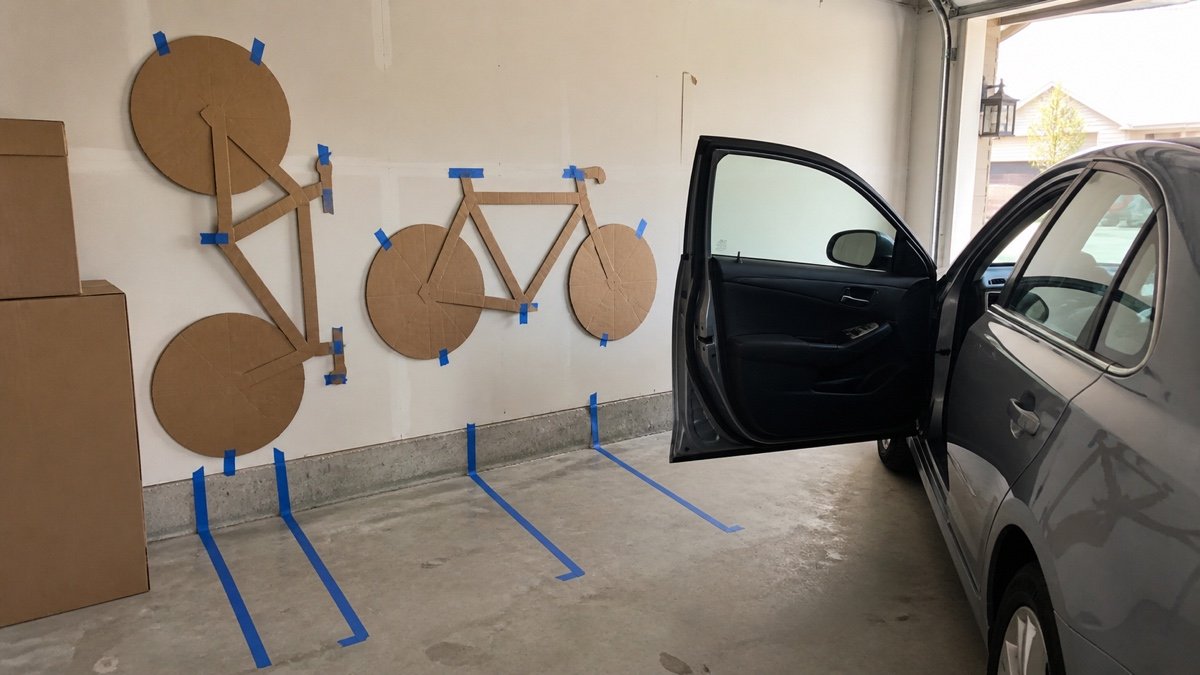
Tape full-size bike outlines on the wall and floor. Include a loading lane. Park the vehicle, open every door, run the garage door, and move trash bins or lawn equipment through their normal route. Compare the active space with the garage workshop aisle clearance guide.
The test should include the shortest rider and the heaviest bike. Use cartons to represent nearby cabinets so handles and pedals cannot hide in a flat drawing. A few days of living with the tape usually settles the vertical vs horizontal argument faster than another product review.
One bike and a family row need different answers
For one frequently ridden bicycle, horizontal storage can be wonderfully simple. Put the cradles at a height the rider can reach, leave space for the bars, and the bike comes down in one motion. The long wall footprint is less troublesome because no neighboring bikes need to overlap. A single vertical hook wins when the available wall is narrow, but make sure its loading lane does not cross the car.
A family row changes the math. Vertical racks usually pack more bikes into a reasonable width, especially when road and mountain-bike handlebar heights alternate. Keep children’s bikes low or on the floor and reserve the highest position for a light bicycle handled by a capable adult. Use the garage storage planning guide to assign each rider a route. Test with every bicycle present. Product photos often make the row look easier by leaving one bike out.
Choose the orientation that stays easy
Vertical storage is the strong choice for a family row on a short wall, particularly when bikes are light enough to tip and lift. Horizontal storage is better for one or two bikes on a long wall and for riders who want a more direct lift. A mix is often best: daily heavy bikes on the floor, light adult bikes vertical, and one high-cost bike on an adjustable horizontal cradle.
Renters and anyone unsure about wall structure should review garage wall storage for renters. A freestanding rack can be less compact, but it is better than an anchor chosen by guesswork.
Useful products to compare
These links open current Amazon search results. Check the dimensions, manual, mounting hardware, warranty, and current availability for the exact model before you order.
Before you buy or install
Read the current manual for the exact product you are considering. Confirm its assembled dimensions, rated capacity, mounting requirements, included hardware, working clearances, warranty, and any limits that apply to your wall, floor, electrical circuit, or garage layout.
Frequently asked questions
Does vertical bike storage damage wheels?
A compatible wheel-support rack used within its fit and weight limits should support the bike as designed. Confirm tire width, rim depth, wheel diameter, fenders, and contact points. Do not force an incompatible wheel into a hook, and inspect both rack and wheel regularly.
Which orientation saves more garage space?
Vertical storage usually saves wall width per bike. Horizontal storage may use dead space above a low cabinet and can project less than a fixed vertical bike. Measure both the wall outline and floor projection with the car and doors in place.
Is horizontal storage easier to load?
It often keeps the bike at a lower final height, but you lift most of the bicycle at once. Vertical loading raises the front wheel while the rear stays on the floor for part of the motion. Test both movements with the real bike and regular rider.
Can I mix vertical and horizontal racks?
Yes. Many garages work better with daily heavy bikes on floor stands, lighter bikes in a vertical row, and one frequently maintained bike on a horizontal cradle. Keep every loading lane and rack sweep clear.