Tag: layout guide

  • Garage Storage Rack Above the Garage Door: A Clearance Guide

    Garage Storage Rack Above the Garage Door: A Clearance Guide

    Affiliate disclosure: As an Amazon Associate I earn from qualifying purchases. This article may contain affiliate links, and Bay & Bench may earn a commission at no extra cost to you. Read our full Affiliate Disclosure.

    The space above a garage door can be useful, but it is not empty space. Door panels, tracks, the opener, springs, cables, and emergency hardware all need room to move and service access.

    Quick answer

    Operate the door through its full cycle and map the highest moving point. Add the rack frame, tote height, handling gap, and every clearance required by both the rack and door equipment. If those zones overlap, move or resize the rack.
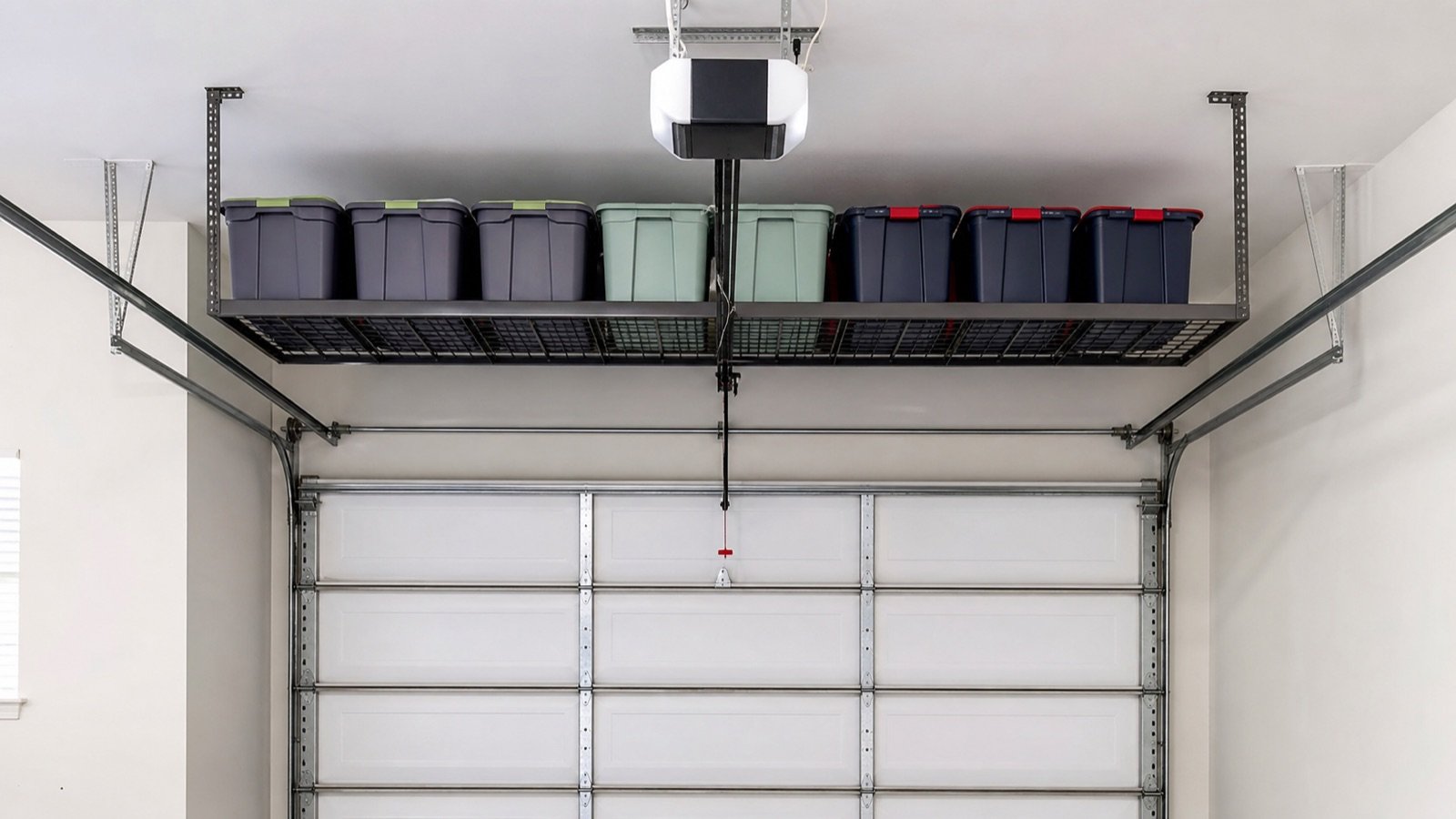
    Garage Storage Rack Above the Garage Door: A Clearance Guide
    Planning example for garage storage rack above the garage door: a clearance guide.

    Watch a complete door cycle

    Stand inside the garage and watch from the side while another person operates the door safely. The panel path changes through the curved track. The opener arm and emergency release move too.

    Never place yourself beneath unsupported components or interfere with door hardware while measuring.

    Map service space

    Technicians need access to springs, cables, tracks, fasteners, opener components, and manual release hardware. A rack that clears normal movement can still make inspection or repair difficult.

    Ask the door manufacturer or service provider when required clearances are not documented.

    Build the vertical stack

    Start at the lowest usable ceiling point. Subtract mounting space, tote height, handling room, platform thickness, and the moving door envelope. Use the calculator to organize the numbers, then verify them physically.

    Choose the rack orientation

    A narrow platform parallel to the door may stay outside the opener rail. A rack across the garage may offer more capacity but cross several moving and service zones. Smaller modules can work around hardware more easily.

    Store the right things

    Above-door storage favors light seasonal totes. Keep each bin closed and stable. Avoid loose objects that vibration might move, and do not store materials whose labels prohibit garage heat or overhead locations.

    Final check before ordering

    • Door clears through the entire cycle.
    • Emergency release remains visible and reachable.
    • Tracks, springs, cables, and opener retain service access.
    • Rack mounting follows the exact structural requirements.
    • Totes can be loaded from a stable position.
    • The selected load remains within every verified limit.

    Return to the broader overhead storage buying guide to compare platform sizes and deck formats.

    Door type changes the available zone

    A sectional overhead door follows curved tracks. Other door types move differently, and high-lift configurations change the ceiling envelope. Do not transfer measurements from a neighbor’s garage or an online diagram to your door.

    Record the door and opener model when possible. Current technical documents or a service technician can answer questions that a tape measure cannot.

    Vibration and falling objects deserve attention

    A garage door cycles beneath or beside the storage area. Use closed bins in good condition and keep every object within the platform edge. Loose sports gear, scrap wood, and open boxes do not belong above a moving door.

    Listen after loading. New rattles, rubbing, or movement are reasons to stop the door and inspect the area.

    Useful products to compare

    Use these searches to compare current dimensions, ratings, manuals, and availability. Check the exact model before buying.

    Before you buy or install

    Download the current manual for the exact model. Confirm assembled and packaged dimensions, individual and total load ratings, required clearances, mounting structure, included hardware, warranty, and inspection instructions. Product listings and specifications can change.

    Mark the footprint or platform edges in the garage. Operate the vehicle doors and garage door, carry the intended bin through the access route, and check service panels and utilities. Do not improvise around electrical, gas, fire, or structural conditions.

    Frequently asked questions

    Can a rack touch the garage door tracks?

    No. Keep the clearances required by the rack and door equipment, including service access.

    Can I move the opener to make space?

    Changes to door and opener systems should follow manufacturer requirements and may need qualified service. Do not redesign them around a rack casually.

    What is best stored above the door?

    Light, stable, seasonal goods in closed totes are usually the sensible use.

    Last reviewed: July 2026. Verify current product specifications and installation requirements before purchase.
  • How Much Clearance Do You Need for Overhead Garage Storage?

    How Much Clearance Do You Need for Overhead Garage Storage?

    Affiliate disclosure: As an Amazon Associate I earn from qualifying purchases. This article may contain affiliate links, and Bay & Bench may earn a commission at no extra cost to you. Read our full Affiliate Disclosure.

    The useful number is not ceiling height. It is the smallest clear opening left after the door, opener, rack frame, tote, and retrieval movement have all taken their space.

    Quick answer

    Find the lowest obstruction in the proposed rack area. Subtract the platform thickness and selected drop. Then check the rack bottom against the open door, vehicle, walking route, and the way you will lift each tote.

    How Much Clearance Do You Need for Overhead Garage Storage?
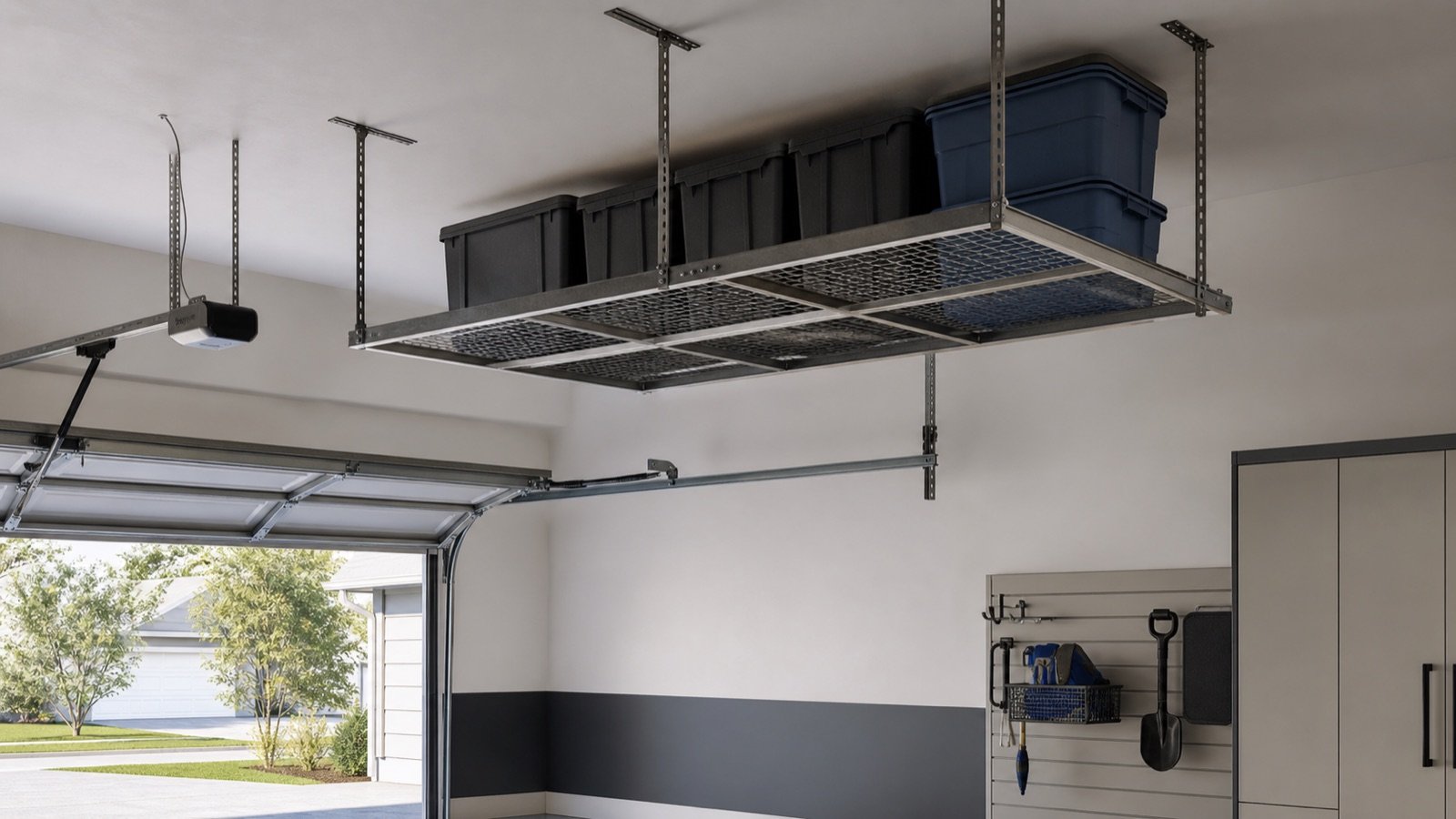
    Planning example for how much clearance do you need for overhead garage storage?.

    Measure the garage in motion

    Record ceiling height at each rack corner, not at one convenient spot. Open and close the garage door while watching the highest panel, curved track section, opener arm, and emergency release. A still photograph of the closed door misses most conflicts.

    Measure the vehicle too. Roof rails, an open hatch, and a tall replacement vehicle can change the usable zone.

    Use a simple vertical stack

    Write the stack from top to bottom: ceiling or obstruction, required mounting space, tote height, handling gap, platform thickness, and clear space below. If any item is unknown, stop. A catalog image cannot supply the missing dimension.

    Try the numbers in the clearance calculator, then tape the proposed rack-bottom height on two walls. View it from the driveway and from beside the parked car.

    Do not forget the tote opening

    A 17 inch tote does not fit comfortably in a 17 inch opening. You need enough room to lift the rim over any lip and slide the tote without scraping the lid. Bulging lids, handles, and wheels add height.

    Measure the loaded tote. Flexible bins often grow after they are packed.

    Headroom depends on location

    A rack over a parked vehicle can sit lower than one crossing an active walking route, but access still matters. Check where a person stands while loading it. The lowest hardware should remain obvious and out of the natural path.

    Do not use one universal headroom claim. People, vehicles, and local conditions differ.

    Clearance worksheet

    MeasurementWhere to take it
    Ceiling heightAt every proposed mounting corner
    Lowest fixed obstructionBeam, light, opener, duct, or pipe
    Highest moving obstructionDoor panel, arm, hatch, or vehicle
    Rack thicknessOutside frame and deck
    Tote heightLoaded, including lid and handles
    Handling gapSpace needed to lift and slide

    When the margin is tight

    Change one variable at a time. A shallower tote may recover more space than changing the whole rack. A smaller rack may move into a clearer ceiling bay. If the rack must sit around the garage door, review the above-door guide.

    Do not modify hangers, tracks, or structural parts to rescue a poor fit unless the manufacturer specifically permits it.

    Check all four corners

    Ceilings and garage floors are rarely perfect. A platform that clears at the front left corner may sit closer to a track or vehicle at the rear. Record the limiting height for every support position and use the smallest number in the first calculation.

    If the rack permits different post settings, verify that the chosen combination is allowed. Do not use mismatched heights simply because the hardware can be bolted together that way.

    Make retrieval part of the drawing

    Draw the ladder or step platform on the floor plan. Add the person, open vehicle door, and tote being carried. If the only usable ladder spot puts you beneath the opener or forces a long sideways reach, the rack is in the wrong place.

    Repeat the test with the garage in its normal condition. An empty bay can make a poor location look generous.

    Useful products to compare

    Use these searches to compare current dimensions, ratings, manuals, and availability. Check the exact model before buying.

    Before you buy or install

    Download the current manual for the exact model. Confirm assembled and packaged dimensions, individual and total load ratings, required clearances, mounting structure, included hardware, warranty, and inspection instructions. Product listings and specifications can change.

    Mark the footprint or platform edges in the garage. Operate the vehicle doors and garage door, carry the intended bin through the access route, and check service panels and utilities. Do not improvise around electrical, gas, fire, or structural conditions.

    Frequently asked questions

    How much gap should be above a tote?

    Enough to lift the tote over the platform lip and slide it without forcing the lid. Test the real tote and follow the rack instructions.

    Can a rack hang over a car?

    It may, if every clearance and installation condition is satisfied. Keep retrieval practical and secure the stored items.

    Should I measure with the garage door open?

    Measure through the complete travel cycle. The highest conflict may occur while the door is moving, not when fully open.

    Last reviewed: July 2026. Verify current product specifications and installation requirements before purchase.