Affiliate disclosure: As an Amazon Associate I earn from qualifying purchases. This article may contain affiliate links, and Bay & Bench may earn a commission at no extra cost to you. Read our full Affiliate Disclosure.
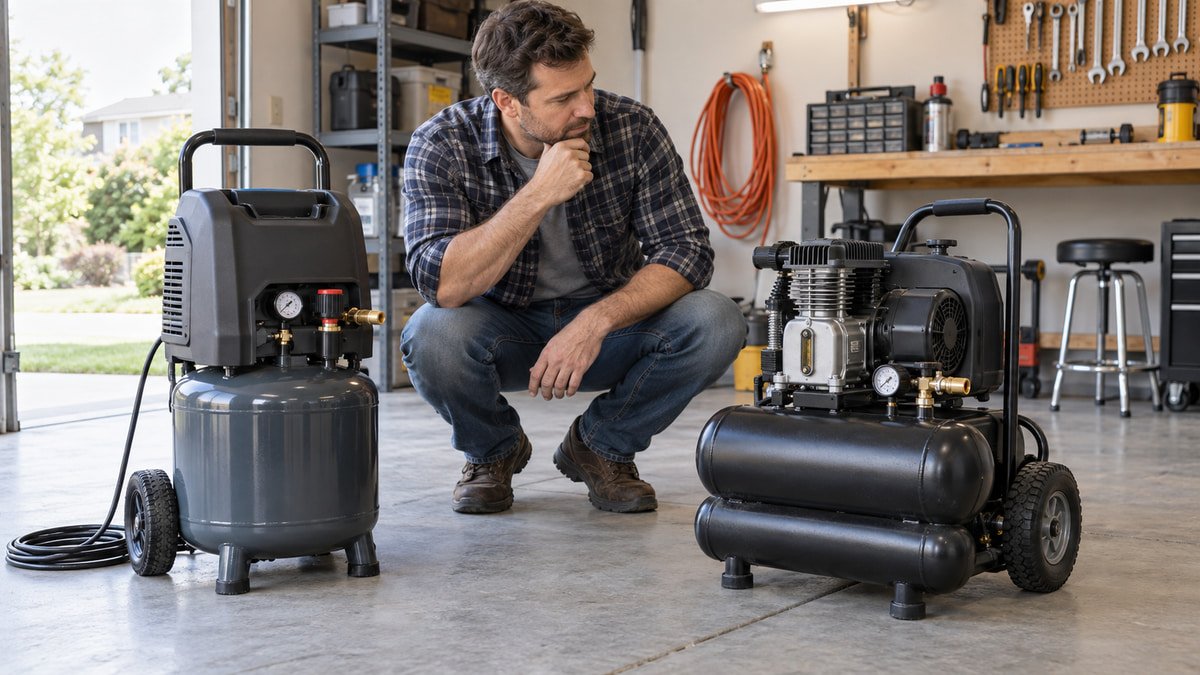
An oil free vs oil lubricated air compressor choice is really a maintenance and use pattern decision. Oil free pumps remove the crankcase oil checks and spills that come with a splash lubricated design. Oil lubricated pumps ask for more care but are often built for slower running, repairable service. Neither label guarantees quiet operation, strong airflow, long duty cycles, or a compressor that starts happily on your garage circuit.
Compare the delivered CFM at the pressure your tools require first. Then look at duty cycle, sound rating, tank size, starting current, weight, orientation limits, parts support, and the maintenance chart. The two current compressor examples below show how different the packages can be. They are reference points, not a claim that every pump in the category behaves alike.
Quick answer
Choose an oil free compressor when easy movement, low routine pump care, and cleaner outlet air matter most. Choose an oil lubricated model when you will maintain it faithfully and want a slower running, serviceable pump for frequent work. For occasional inflation, brad nailing, and blow gun use, oil free is usually simpler. For repeated shop duty, compare a quality oil lubricated model, but buy by delivered CFM and duty cycle before pump type.
Oil free vs oil lubricated air compressor at a glance
The comparison describes common tendencies, not universal rules. A slow oil free pump can be quieter than a fast lubricated one, and a well designed portable unit can outlast a cheap compressor of either type.
| Question | Oil free pump | Oil lubricated pump |
|---|---|---|
| Routine pump oil service | No crankcase oil change | Oil checks and scheduled changes |
| Transport orientation | Usually more forgiving, follow manual | Often must stay level and upright |
| Outlet air | No pump oil carried from crankcase | Filtration may be needed for sensitive work |
| Cold weather routine | No thick crankcase oil | Oil grade and unloaded start may matter |
| Typical home use | Inflation, trim tools, occasional repairs | Frequent shop work and service minded owner |
| Purchase test | Delivered CFM, duty cycle, sound, circuit, tank, parts, and manual | |
Use the garage air compressor size guide to total the air demand before comparing pumps.
What oil free means inside the pump
An oil free compressor does not use an oil bath to lubricate its pump mechanism. That removes oil level checks and changes from the routine. It does not mean maintenance free. Intake filters, drains, cooling passages, fasteners, hoses, and the receiver still need attention according to the manual.
The California Air Tools 8010 is a useful current example. Its official product page lists an oil free dual piston pump, 2.20 CFM at 90 PSI, a 70 percent duty cycle, an eight gallon steel tank, and a 48 pound weight. The company also specifies periodic intake filter replacement.
That package is attractive for a shared garage because it is movable and simple to maintain. Yet 2.20 CFM at 90 PSI still sets a firm limit. It can run tools with modest intermittent demand; it will not become a high air production machine because the pump lacks oil.
What oil lubricated means in a portable compressor
An oil lubricated pump carries compressor oil in its crankcase and uses it to reduce friction in moving parts. The owner must maintain the right level, use the specified oil, and change it on schedule. Transport and operation may require the compressor to remain level so the lubrication system works and oil does not migrate where it should not.
Rolair’s FC2002 shows the format clearly. The manufacturer page lists splash lubrication, 4.1 CFM at 90 PSI, a 4.3 gallon tank, a 3,400 RPM pump, a 79 dBA sound rating, and a 62 pound shipping weight. It also specifies 12 ounces of pump oil.
The two example pages publish 4.1 CFM at 90 PSI for the Rolair and 2.20 CFM for the California Air Tools unit. California Air Tools lists a 48 pound product weight, while Rolair reports a 62 pound shipping weight, so those weight figures are not measured on the same basis. The differences come from the complete designs, not oil alone.
Size airflow and duty cycle before choosing lubrication
Delivered CFM at a stated PSI is the number that connects the compressor to a tool. Read the tool requirement and add reasonable margin. Ignore displaced CFM when a delivered figure is available. Rolair’s official compressor FAQ recommends delivered CFM for sizing because displacement is theoretical.
Duty cycle tells you how long the pump may run within a time period. A small tank does not lower the tool’s average air demand; it only changes the timing of pump cycles. High demand grinders, sanders, and spray equipment can outrun a portable compressor even when a short test feels successful.
List the longest continuous task, not the easiest one. Tire inflation and a few brad nails are forgiving. Sustained sanding is not. If the required compressor overwhelms the garage circuit or aisle, reconsider the pneumatic tool rather than buying a pump that barely fits.
Oil free advantages in a shared home garage
Oil free pumps remove one messy service task. There is no crankcase oil bottle to store, no sight glass to read, and less concern about keeping the pump level during ordinary transport. That simplicity is persuasive when the compressor moves between a garage, driveway, and house for short jobs.
Outlet air also avoids oil introduced by a lubricated pump crankcase, although water, dirt, and other contaminants still require control. Sensitive finishing or laboratory applications have stricter air requirements than casual tire work. Use the filtration and drying system specified for the job rather than trusting an oil free label as proof of air purity.
Many compact quiet models are oil free, but low sound comes from motor speed, pump design, enclosure, vibration control, and cooling choices. Read the published dB test conditions. The category itself does not promise neighbor friendly sound.
Oil lubricated advantages for frequent service
A well designed splash lubricated pump can run cooler and wear slowly when the oil film, speed, and cooling system are right. Manufacturers often pair this pump type with cast iron cylinders, replaceable service parts, and lower motor speeds. Owners who inspect equipment regularly may prefer that repairable feel.
Rolair says its splash lubricated compressors have a longer expected service life than the high speed homeowner oil less models it compares against. Treat that as manufacturer guidance for its designs, not a blanket lifespan promise. Service life depends on temperature, filtration, duty cycle, electrical supply, drainage, and correct operation.
The maintenance is small but unforgiving. Wrong oil, low oil, operation on a slope, or a skipped change can erase the reason you chose the design. If you know the sight glass will be ignored for years, the simpler pump is the more honest purchase.
Oil lubricated compressor maintenance starts at the sight glass
Check oil with the compressor cool, unplugged, depressurized as required, and sitting on a level surface. Follow the exact manual because some pumps use a sight glass while others use a dipstick. The correct level, grade, break in change, and later interval are model specific.
Keep the fill and drain areas clean. Dirt introduced during a change can be worse than slightly dark oil. Dispose of used oil through a suitable local collection program. Never substitute automotive oil unless the compressor maker permits it.
Inspect the intake filter, vibration mounts, tubing, and guards at the same time. Store the manual near the machine and record each service date. A ten minute routine is easier than diagnosing a pump that has begun to run hot.

Portability favors the lighter honest fit
California Air Tools lists the 8010 at a 48 pound product weight, while Rolair gives the FC2002 a 62 pound shipping weight. Those numbers are not directly equivalent, but both confirm that portable still means lifting and rolling real mass. Measure the handle, wheels, gauges, hose connections, and path to the work. If the unit must enter a vehicle, package shape matters more than a wheel kit.
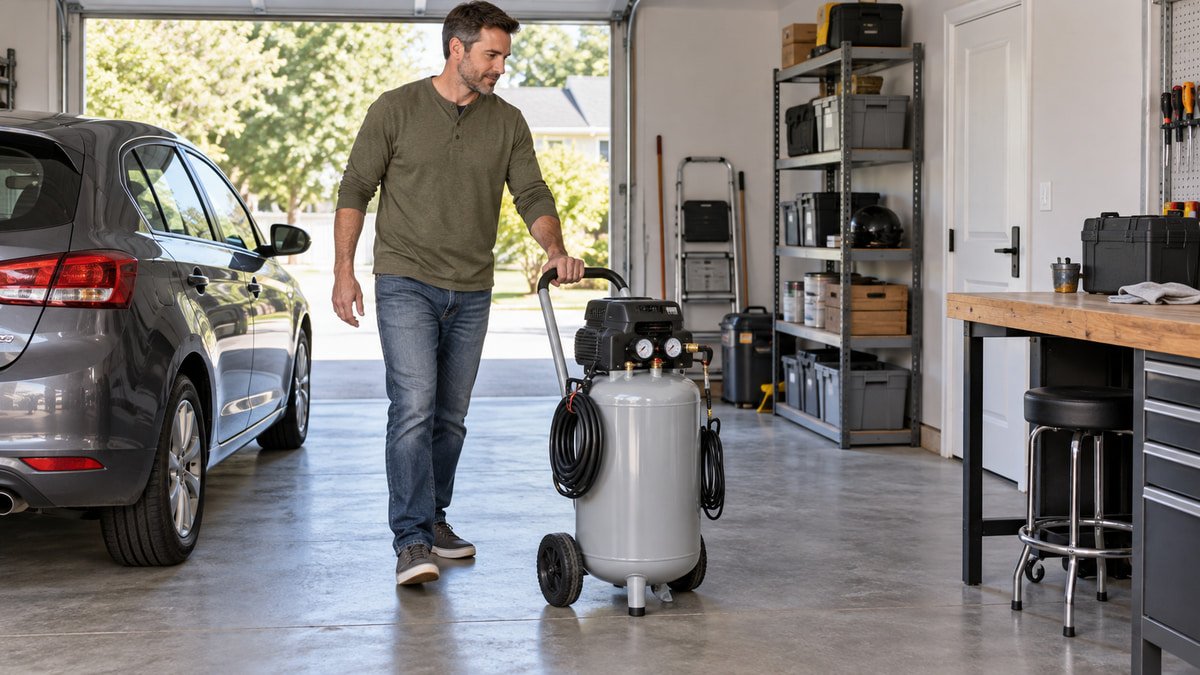
Oil lubricated compressors commonly need level operation and upright transport. Rolair instructs owners of splash lubricated models to operate level because the connecting rod dipper must remain in the oil bath. Oil free machines avoid that issue, but tanks, gauges, cords, and valves still require careful handling.
The garage aisle clearance guide helps plan the route. Give the compressor a dry parking home with space around every cooling opening.
Noise comes from the complete machine
Do not assume oil lubricated means quiet or oil free means loud. The example California Air Tools 8010 is listed at 60 dB, while Rolair lists the FC2002 at 79 dBA. They have different output, tank, motor, pump, and test context. Compare ratings for complete machines with similar airflow.
Motor speed often matters, as do intake noise, vibration through the slab, fan sound, and unloader exhaust. Rubber feet need a stable surface, not a soft improvised pad that blocks cooling. Place the machine away from ears and shared walls while keeping controls visible.
A suitable longer hose may move sound farther from the bench, though pressure drop and trip hazards must be managed. Hearing protection may still be needed for the work.
Cold starts and clean air need separate checks
Cold thickens compressor oil and can raise starting effort. Rolair advises an unloaded start and an oil grade suited to temperature for its machines. Use the procedure for your model. Oil free pumps avoid cold crankcase oil, but seals, drains, electrical starting, and condensation still react to low temperature.
Every receiver collects moisture. An oil lubricated pump may add oil carryover, while an oil free pump removes that source but not water, rust, hose debris, or intake contamination. Painting may need filtration and drying beyond the compressor package. Compressed air is not breathing air unless an engineered, monitored system is built for that purpose.
For dust cleanup, a vacuum is usually the better first tool. The shop vac and dust collector comparison can help. Never blow compressed air at skin or clothing.
Both pump types still need tank drainage
Water condenses in both systems. Drain the receiver at the interval and pressure condition specified by the manufacturer. Wear eye protection, aim discharge safely, and keep hands away from a forceful stream. A cooled, unplugged compressor with controlled residual pressure is easier to service safely when the manual calls for it.
OSHA’s air receiver rule requires a drain at the lowest point for covered workplace equipment and says receivers should be drained often enough to prevent excessive liquid. Homeowners should follow their compressor manual and never assume a dry outlet means a dry tank.
Do not repair, weld, drill, or coat a damaged receiver. Rust, dents, leaking seams, or a suspect safety valve deserve manufacturer or qualified service guidance.

Choose by work pattern rather than a pump slogan
For occasional inflation, trim nailing, and light repairs, a quiet oil free unit with enough delivered CFM is usually the least fussy choice. It moves easily and does not add an oil schedule to a machine used six weekends a year.
For frequent pneumatic fastening or repair work, a quality oil lubricated pump may justify its weight and care. Check parts availability, duty rating, and the manual before paying for an imagined lifetime. Spray finishing and sustained air tools can push either portable category beyond comfort.
The garage workshop zones guide helps place the compressor and hose route away from parking. For a very tight bay, review the one car garage workshop plan. The right answer may be a different tool or rented capacity for a rare job.
Useful products to compare
These links open current Amazon search results. Check the dimensions, manual, mounting hardware, warranty, and current availability for the exact model before you order.
Before you buy or install
Read the current manual for the exact product you are considering. Confirm its assembled dimensions, rated capacity, mounting requirements, included hardware, working clearances, warranty, and any limits that apply to your wall, floor, electrical circuit, or garage layout.
Frequently asked questions
Is an oil lubricated air compressor always quieter?
No. Pump speed, motor, intake, enclosure, vibration control, output, and test method all affect sound. Compare published dB figures for complete machines with similar airflow. California Air Tools’ oil free example is rated lower than Rolair’s oil lubricated example, though they differ in output and design.
Does an oil free compressor produce completely clean air?
It removes pump crankcase oil as one contamination source. Moisture, rust, dust, hose residue, and intake contaminants may remain. Painting and sensitive tools can still need separators, filters, or dryers sized and maintained for the job. Oil free is not the same as breathing air.
How often does an oil lubricated compressor need an oil change?
Use the schedule in the exact model manual. Break in oil may have an early change, and later intervals vary by oil type, hours, temperature, and service. Check the level as directed, use only an approved compressor oil, and keep a dated record.
Can I lay an oil lubricated compressor on its side for transport?
Assume no unless the manufacturer gives a specific transport procedure. Oil can move into unwanted areas, and a splash lubricated pump usually needs level operation. Keep the compressor upright, secure it against movement, close drains and valves as instructed, and protect gauges and fittings.
Which pump type lasts longer in a home garage?
Build quality, speed, heat, duty cycle, electrical supply, maintenance, and parts support matter more than one label. A maintained professional oil lubricated pump may outlast a light homeowner oil free design, but a quality oil free unit can be the better match for intermittent use. Compare specific models and warranties.