Affiliate disclosure: As an Amazon Associate I earn from qualifying purchases. This article may contain affiliate links, and Bay & Bench may earn a commission at no extra cost to you. Read our full Affiliate Disclosure.
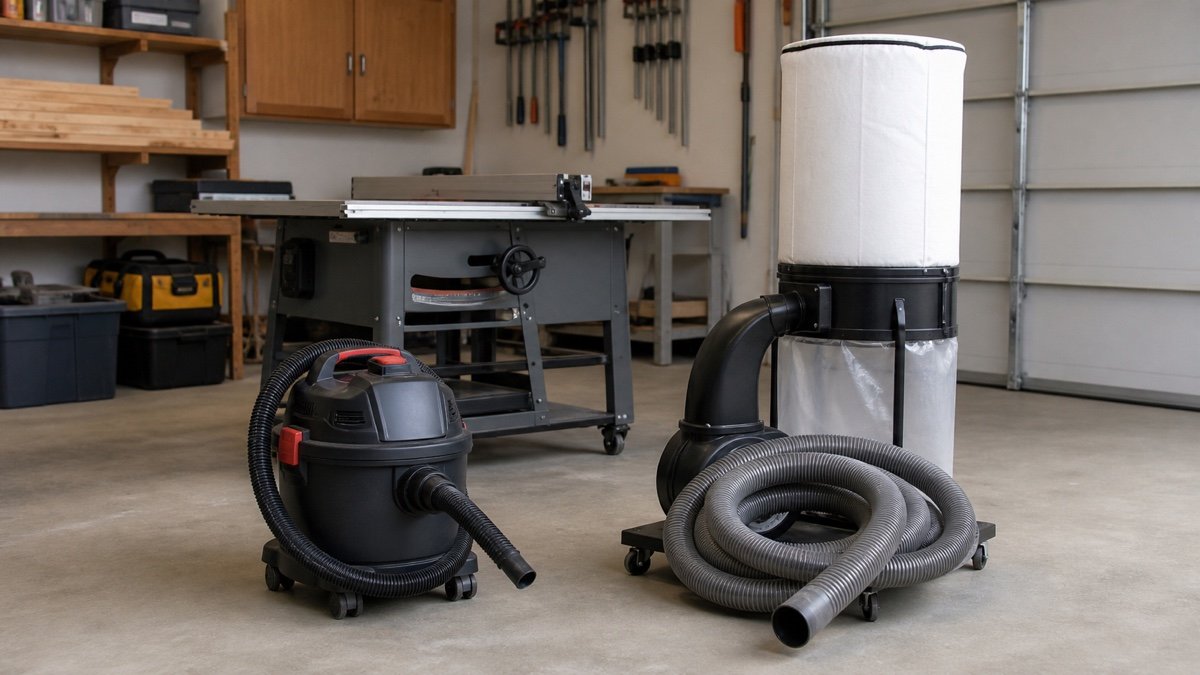
The shop vac vs dust collector small garage decision starts with the way each machine moves air. A shop vacuum makes high suction through a narrow hose. A traditional dust collector moves a larger volume of air through a wide hose at lower static pressure. Put either one on the wrong tool and the result can be noisy, awkward, and disappointing. Start with the dust port, the material the tool produces, and the hose route you can fit. Then compare filtration, cleanup, electrical load, and storage.
Quick answer
Choose a shop vacuum or certified dust extractor for handheld sanders, routers, track saws, cleanup nozzles, and tools with ports around 1 to 2.5 inches. Choose a traditional dust collector for a stationary planer, jointer, cabinet saw, or other machine designed around a 4-inch or larger port. A small garage often benefits from both: a compact extractor at small-port tools and a mobile collector moved to one chip-producing machine at a time.
Shop vac vs dust collector small garage: the useful distinction
Airflow and pressure work together, but the machines trade one for the other. A wet/dry shop vacuum uses a relatively narrow hose and produces substantial pressure to pull through that restriction. A dust collector uses a larger impeller and hose to move more air through a broad machine hood. The names are casual; the fan curve, filter, and complete connected system decide performance.
Oneida’s Super Dust Deputy documentation draws a practical dividing line. It describes traditional collectors as high-airflow, low-pressure systems, generally above 350 CFM and below 10 inches of water column, while shop vacuums are the opposite, generally below 250 CFM and above 60 inches of water. Those ranges explain why shrinking a 4-inch collector to a tiny sander port does not turn it into a better vacuum.
Read figures as test points, not guarantees at the tool. Hose length, diameter, corrugation, bends, adapters, filter loading, leaks, and the tool hood reduce delivered performance. Manufacturer numbers from different test methods may not be directly comparable.
Match the collector to the port and the debris
| Tool or task | Usual port behavior | Better starting system | Reason |
|---|---|---|---|
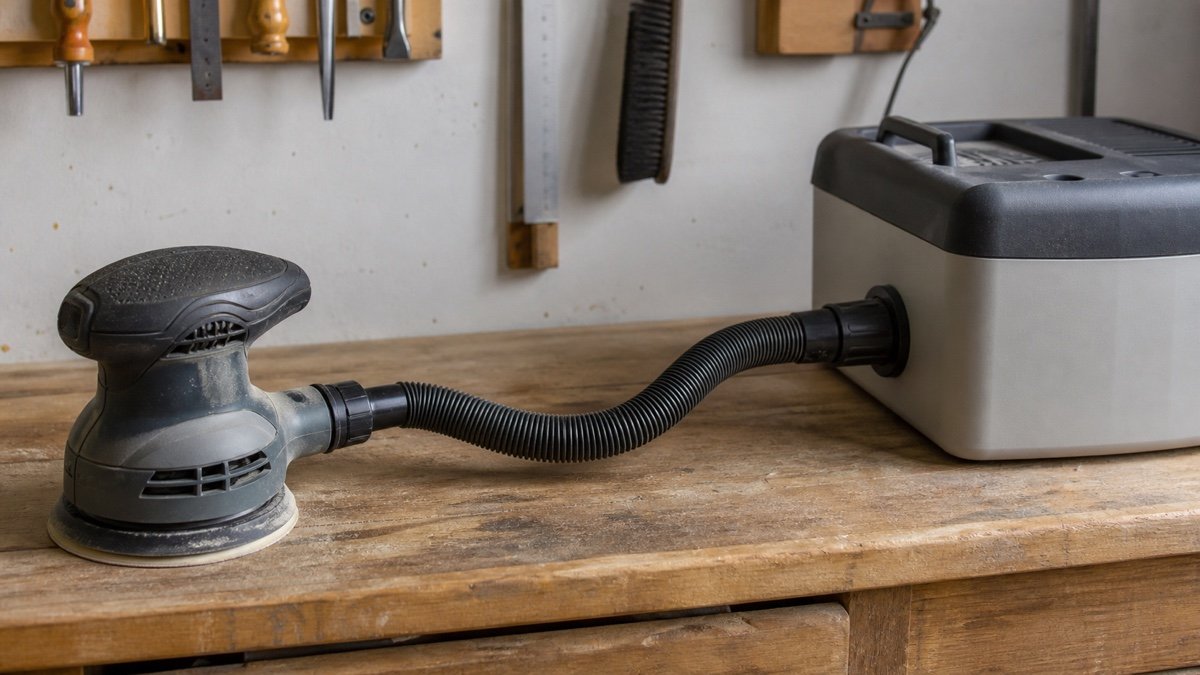
| Random-orbit sander | Small port, fine dust, narrow hose | Dust extractor or shop vacuum with suitable filter and bag | High pressure works through the small passage |
| Track saw or compact router | Small to medium port, intermittent chips and dust | Tool-triggered extractor | Short narrow hose and automatic start are convenient |
| Thickness planer | Large port, high chip volume | Large-hose dust collector sized to the machine manual | Bulk airflow carries chips before the hose plugs |
| Cabinet or contractor saw | Lower cabinet port, sometimes a second guard port | Dust collector for the large port, possibly a separate small-port solution | The base and blade area create different capture problems |
| Floor and vehicle cleanup | Hand nozzle, changing restriction, mixed debris | Wet/dry shop vacuum | Portable high suction suits the nozzle |
Always begin with the tool manufacturer’s port size and collection recommendation. Do not open, remove, or modify a guard merely to attach a hose. NIOSH found that bottom extraction alone often controlled table-saw dust poorly and that an added local hood over the blade substantially reduced emissions in its test. The NIOSH engineering control page is a useful reminder that capture location matters as much as the collector.
A shop vacuum handles restriction well
A shop vacuum is compact, readily available, and useful beyond woodworking. It can pull through a narrow tool port, crevice nozzle, or long small-diameter hose. A bag can keep fine dust out of the tank and make disposal cleaner, while a suitable filter addresses the particles that reach it. Neither item should be assumed from the word “vacuum.” Check the exact configuration.
Current specifications show how this class behaves. Shop-Vac’s 12-gallon Contractor Series model lists a maximum 105 CFM and 70 inches of sealed pressure. The company also explains that maximum sealed pressure occurs at zero airflow and that a dirty filter, accessories, and system load change actual performance. That caveat matters more than the peak horsepower label, which Shop-Vac says is a consumer comparison term rather than operating horsepower.
The drawbacks are familiar: loud high-pitched noise, modest tank volume, rapidly loading filters, and limited performance at a large open machine hood. A cyclone separator can keep much bulk debris out of the vacuum filter, but it adds footprint, hose, joints, and another bin to seal.
A certified dust extractor adds control features
A professional dust extractor is still a high-pressure vacuum, but many models add tool activation, antistatic hose options, automatic filter cleaning, adjustable suction, better bags, and a documented filtration configuration. Those features are useful for sanding and portable tools. They do not make a narrow-hose extractor equivalent to a large-volume collector at every stationary machine.
DeWalt lists its DWV015 at up to 155 CFM and 73 inches of static water lift, plus automatic filter cleaning. This is a current model example, not a ranking or evidence that it fits your tools. Compare its manual with the port, hose, material, and work pattern in your shop.
Read certification language carefully. A HEPA filter sold for a machine does not automatically prove that the complete vacuum is certified for every regulated application. Use the exact filter, bag, pre-separator, hose, and operating procedure specified for the material and rule involved. For unknown, toxic, lead, silica, asbestos, or other hazardous dust, stop and use the applicable professional guidance.
A traditional collector moves chips through a wide hose
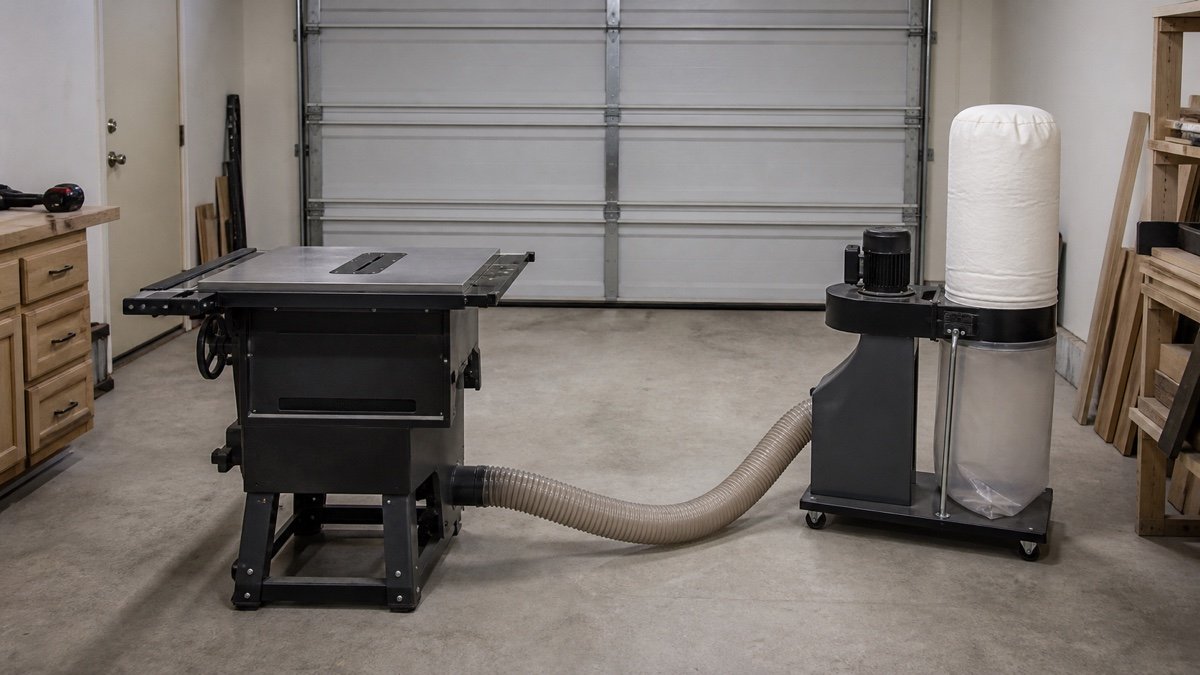
A mobile single-stage collector can be a compact answer for one planer, jointer, saw, or router table at a time. It usually has a 4-inch inlet, a large filter bag or canister, and much more collection volume than a shop vacuum. Keep the hose short and full size until the machine connection. Every unnecessary reducer spends the airflow advantage you bought.
Grizzly’s current G8027 one-horsepower collector lists 500 CFM, 2.76 inches maximum static pressure, one 4-inch inlet, and a 2.5-micron filter specification. Grizzly describes it as a point-of-use collector for one average machine at a time. That is an honest model for a small garage: roll the unit close, connect one short hose, and avoid pretending a small fan will support a maze of branches.
A collector that catches chips may still allow fine dust through its filter or around leaks. Look at the filtration specification and complete-system claims, not the size of the bag. A better filter may add resistance, and actual airflow changes as the filter loads. Leave room to remove the lower bag or drum without dismantling the shop.
Hose diameter and fittings can decide the result
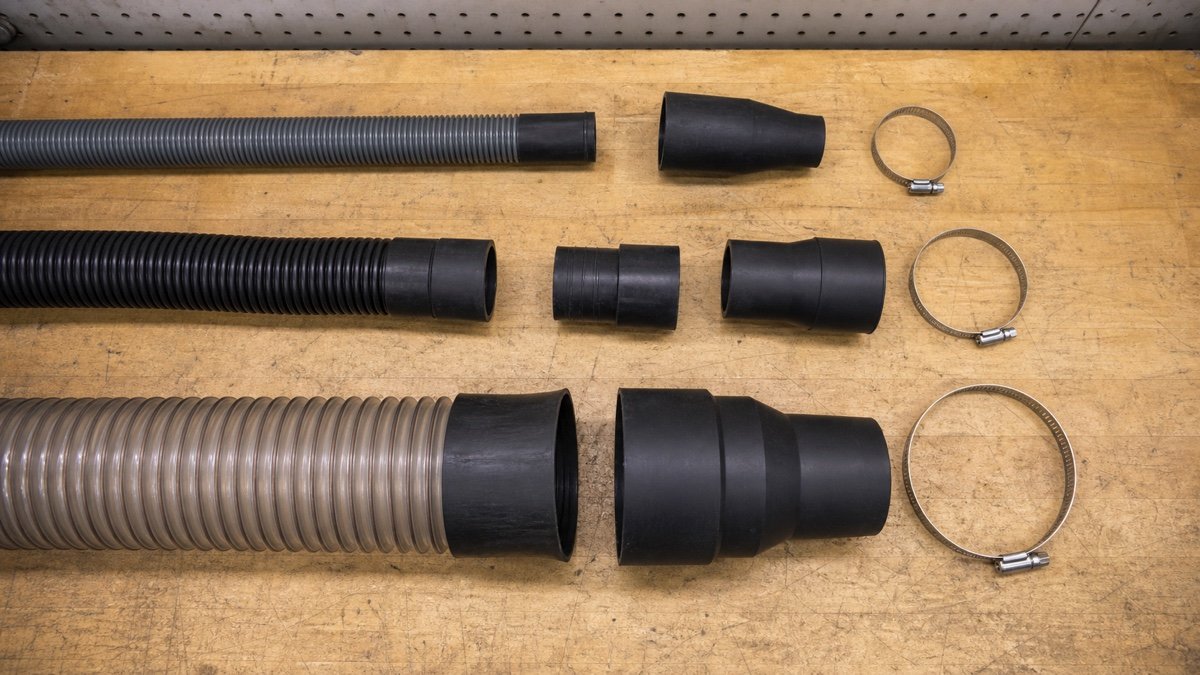
A hose is part of the machine. Long corrugated runs, sharp elbows, undersized adapters, leaky cuffs, and a clogged separator all add resistance. With a shop vacuum, use the tool maker’s recommended hose and keep it as short as the work allows. With a dust collector, preserve the large diameter to the tool and avoid reducing early.
Do not force a random plumbing fitting onto a dust port and call it sealed. A loose cuff can disconnect, while a fitting that blocks a guard or strain-relieves nothing can create a new hazard. Use compatible adapters and clamps, support hose weight, and keep connections accessible for inspection. If static-control components or grounding are specified by the system manufacturer, follow that design rather than inventing a wire scheme from a forum photo.
Plan the hose in the room using our garage workshop layout guide. A theoretically efficient run that crosses the only aisle is a poor installation. A mobile collector often wins because it reduces both hose length and permanent obstruction.
Filtration and capture are separate questions
Capture asks whether dust enters the hood. Filtration asks what happens after the air reaches the collector. Strong suction at a sealed small port can capture well, yet a leaking filter can return fine particles to the room. A fine filter cannot repair a hood that misses the dust plume. Inspect the whole path.
OSHA’s wood-dust guidance says local exhaust ventilation should remove dust at or near its source and that hoods should sit as close to the emission source as practical. It also calls for system inspection and maintenance. Although OSHA rules address workplaces, source capture is a sound planning principle for a home shop too.
Do not use a room air cleaner as a substitute for source capture. It may reduce suspended particles that escape, but it cannot pull chips from a planer or stop dust from crossing your breathing zone first. Likewise, a respirator is not a reason to accept a badly connected tool. Use controls in layers and follow current instructions for the material, tool, collector, and personal protective equipment.
Space, power, and noise matter in a shared garage
Measure the stored machine, operating footprint, hose coil, filter-cleaning access, and bin-removal path. A tall bag collector may fit the floor yet hit the garage door track. A shop vacuum may slide under the bench until a cyclone doubles its height. Use the method in the small garage workbench guide to protect knee space and avoid burying serviceable equipment behind cabinets.
Check electrical requirements for both collector and tool. Many tool-triggered extractors limit the connected tool load. A dust collector and planer starting on the same circuit may trip a breaker or exceed the intended setup. Follow both manuals and use a qualified electrician for permanent circuit work. Extension cords are not a substitute for suitable fixed wiring.
Noise changes behavior. If a screaming vacuum makes you skip collection for a quick cut, the system is failing. Compare published sound data where manufacturers provide it, listen to the machine if possible, and place it without blocking cooling airflow. Hearing protection may still be required for the tool and collector together.
The best small-garage setup is often a two-machine kit
For a mixed shop, the most practical arrangement is a compact extractor for sanders, routers, track saws, and cleanup, plus a mobile 4-inch collector for the planer, jointer, and table saw cabinet. Each stays near the tool family it serves. You avoid a permanent duct network and stop asking one fan to work far outside its useful pressure range.
If the budget only allows one, list the hours spent on each tool and the volume of debris it makes. Mostly sanding and portable-tool work points toward an extractor. Regular planing or jointing points toward the large-hose collector, with a separate strategy for cleanup. Someone making occasional small projects with benchtop tools may begin with a well-filtered vacuum and separator, provided the tool manuals support that connection.
Start with measured garage dimensions, then test the parked and operating machine against the daily aisle. If a table saw is part of the plan, preserve the full material path described in the table saw clearance guide. Do not buy a tall collector before checking the door path and ceiling hardware. The machine you cannot position near the tool will spend its life parked and disconnected.
Common buying mistakes
Peak horsepower is a poor shortcut. So is CFM by itself. Compare airflow and pressure at stated conditions, hose size, filter configuration, bin capacity, sound, electrical load, dimensions, and maintenance access. Be suspicious when a listing gives one heroic number without a manual or test context.
Another mistake is building too much duct too soon. Small collectors lose useful performance through long branches, tight elbows, reducers, and open gates. Start with one short connection and observe real capture. Add complexity only after the base system works and the manufacturer supports the design.
Finally, do not treat ordinary wood dust as harmless housekeeping. NIOSH links wood-dust exposure with several adverse health effects and recommends limiting exposure. Capture at the source, maintain the system, clean with a suitable vacuum rather than blowing dust into the air, and deal carefully with unknown or hazardous materials. A clean-looking floor is not proof that the finest particles were controlled.
Useful products to compare
These links open current Amazon search results. Check the dimensions, manual, mounting hardware, warranty, and current availability for the exact model before you order.
Before you buy or install
Read the current manual for the exact product you are considering. Confirm its assembled dimensions, rated capacity, mounting requirements, included hardware, working clearances, warranty, and any limits that apply to your wall, floor, electrical circuit, or garage layout.
Frequently asked questions
Can a shop vacuum replace a dust collector?
It can serve small-port handheld tools and cleanup very well, but it usually cannot move the air volume expected by a stationary machine designed for a 4-inch port. Match the collector to the tool manufacturer’s requirement rather than adapting by convenience alone.
Is a dust extractor different from a shop vacuum?
Both are high-pressure vacuum systems. Many professional extractors add tool activation, automatic filter cleaning, antistatic hose options, documented filter configurations, and better dust bags. The exact features and certifications vary by model, so read the current manual.
Does a cyclone separator improve filtration?
A cyclone can remove much of the bulk debris before it reaches the vacuum filter, which can slow filter loading. It does not replace the final filter, prove HEPA performance, or fix leaks. Use a separator designed for the airflow class and hose size of your system.
Should I use a room air cleaner instead of dust collection?
No. A room air cleaner may reduce particles that escape, but source capture should collect dust where the tool produces it. Use room filtration only as another layer, not as a replacement for a suitable hood, hose, collector, and work practice.
Leave a Reply