Affiliate disclosure: As an Amazon Associate I earn from qualifying purchases. This article may contain affiliate links, and Bay & Bench may earn a commission at no extra cost to you. Read our full Affiliate Disclosure.
The slatwall vs pegboard vs track system decision sounds simple until you list what needs to hang. A garage wall can look organized in a product photo and still be irritating to use. The usual mistake is choosing the organizer first, then trying to make every rake, drill, extension cord, and box fit it. These three formats solve different storage problems. None is the automatic winner. The better choice depends on object size, how often the layout changes, and how much wall you want to cover.
Quick answer
Pegboard is usually the most efficient choice above a workbench where many small hand tools need fixed positions. A horizontal track is a good fit for long handled tools, bikes, ladders, hoses, and other bulky objects that need a few strong hooks. Garage rated slatwall makes sense when you want broad wall coverage and expect to mix hooks, baskets, shelves, and bins. Many garages work better with two systems than with one system stretched beyond its strengths.
Start with the objects, not the wall system
Make a rough inventory before comparing panels and rails. Put objects into four groups: small hand tools, long or awkward gear, items that need a basket or shelf, and things that should stay inside a closed cabinet. This takes twenty minutes and prevents a surprisingly expensive wall full of unused hooks.
Pegboard earns its keep when the wall needs many close attachment points. Think screwdrivers, pliers, layout tools, sanding accessories, and small bins above a bench. A track does the opposite. It gives a small number of attachment points along a narrow horizontal rail, which is often enough for a shovel, bicycle, hose, or ladder. Slatwall sits between them. It covers more wall and accepts a wider mix of accessories, though the exact selection depends on the system.
Measure the stored object as well as the wall. A bicycle hook needs room for the wheel and handlebars. A deep basket may project into a car door path. Run the first layout through our pegboard and slatwall layout planner, then mark the real footprint with painter’s tape.
The practical differences at a glance
| Factor | Pegboard | Slatwall | Horizontal track |
|---|---|---|---|
| Best everyday use | Small tools in dense layouts | Mixed tools, bins, and display storage | Bulky gear on spaced hooks |
| Wall coverage | Full panel or selected area | Usually broad panel coverage | Narrow rail across the wall |
| Rearranging | Fast, but loose hooks may need retainers | Fast within the matching accessory system | Very fast along the rail |
| Small item storage | Excellent with bins and tool holders | Good with matching bins and shelves | Limited unless the system offers bins |
| Large item storage | Possible only within panel and hook ratings | Good when the system is rated for the load | Often the cleanest choice |
| Accessory lock in | Hole size and board thickness matter | Profiles are commonly proprietary | Rails and hooks are commonly proprietary |
The table describes common formats, not a load chart. Published ratings vary by product, fastener pattern, wall construction, and accessory. Check the manual for the exact panel or rail you are considering.
When pegboard is the sensible answer
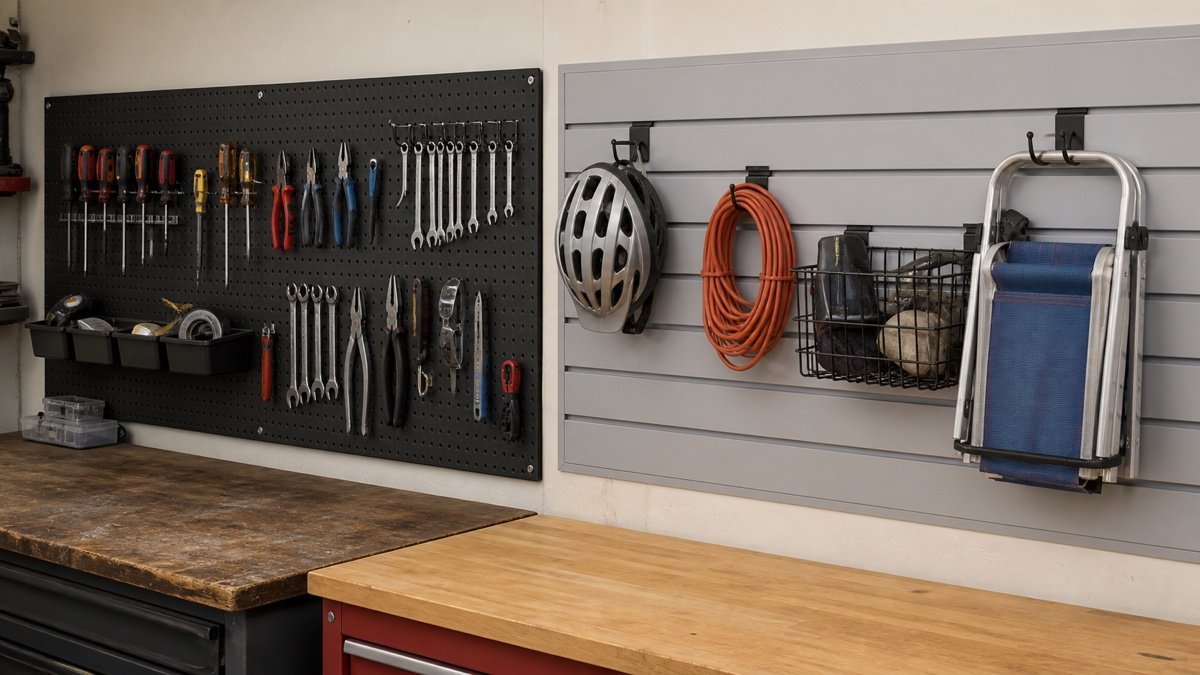
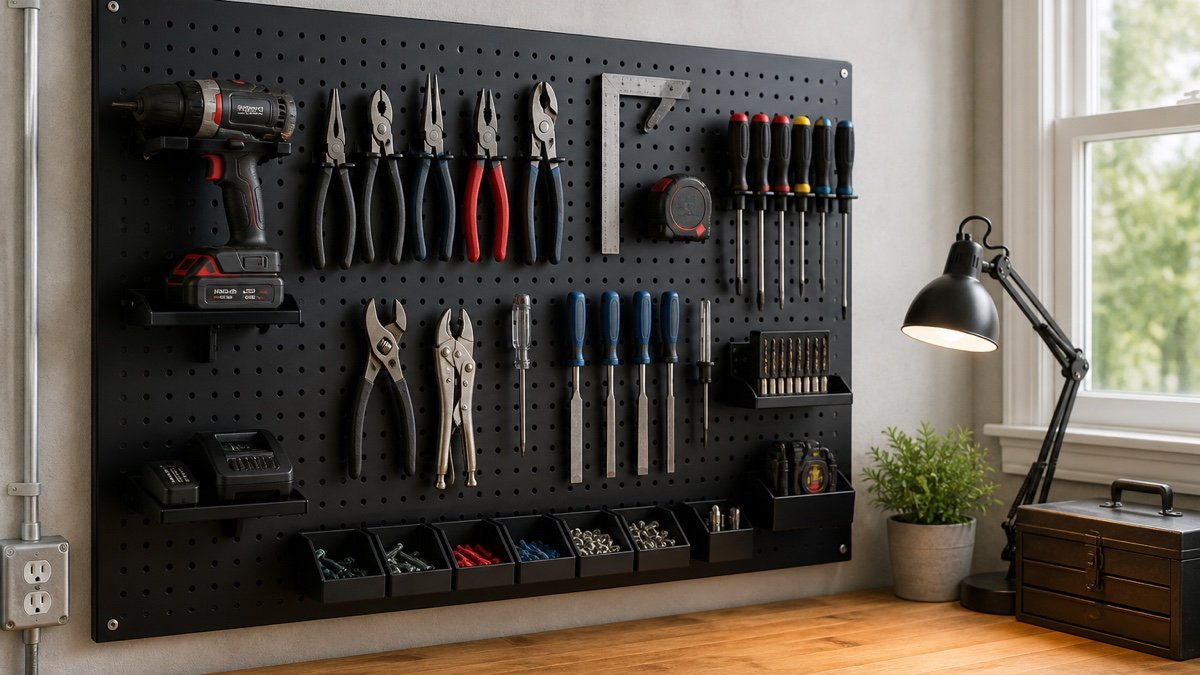
Pegboard is hard to beat above a working bench. The hole grid lets you place a short hook beside a long one, tuck a driver holder into a narrow gap, and change the layout without drilling another hole in the wall. You can see missing tools at a glance. That matters more during a project than a perfectly symmetrical display.
The weak point is often the accessory fit, not the board. Pegboard comes in different materials, thicknesses, hole sizes, and hole spacing. Hooks advertised as universal may sit loosely or fail to engage a thicker panel. Buy a small accessory pack first and test it before ordering dozens. Retaining clips can keep frequently grabbed hooks from coming off with the tool.
Leave a gap behind the panel so hook ends have room to pass through. Some metal panels form their own standoff, while wood or fiber panels usually need a frame or spacers. Mount the support into appropriate structure rather than asking the thin face of drywall to carry the layout.
Pegboard becomes less pleasant with deep objects. A hedge trimmer, folded ladder, or heavy bicycle reaches farther from the wall and applies more leverage. Even when a specialty pegboard system publishes a suitable rating, the crowded hole pattern can make a large item feel wedged among small tools. Give bulky gear its own zone.
Why people choose garage slatwall
Slatwall gives the wall a finished, continuous surface. Horizontal channels run across the panel, so hooks and baskets can move sideways without leaving a patchwork of old screw holes. It is a good visual fit when the same wall needs to hold sports equipment, hand tools, cords, helmets, and a few containers.
The word slatwall is broad. Retail display panels, wood based shop panels, PVC composite garage panels, and metal systems can look similar while carrying very different ratings. A hook that fits one channel profile may not seat correctly in another. Treat the panel and accessories as a matched system unless both manufacturers explicitly say otherwise.
Full wall coverage costs more than one narrow track, and it takes more work to cut around outlets, switches, corners, and wall cabinets. That cost buys flexibility. You do not have to know the final hook location while installing the panels. If the garage changes from children’s bikes to lawn equipment a few years later, the wall can change with it.
Slatwall also gives you places for baskets and short shelves without making the wall look improvised. Still, it should not replace proper shelving for every tote. Deep shelves hung high on a panel can make contents awkward to reach and place more force away from the wall. Use the system’s own load rules and keep dense storage low.
Where a track system works best
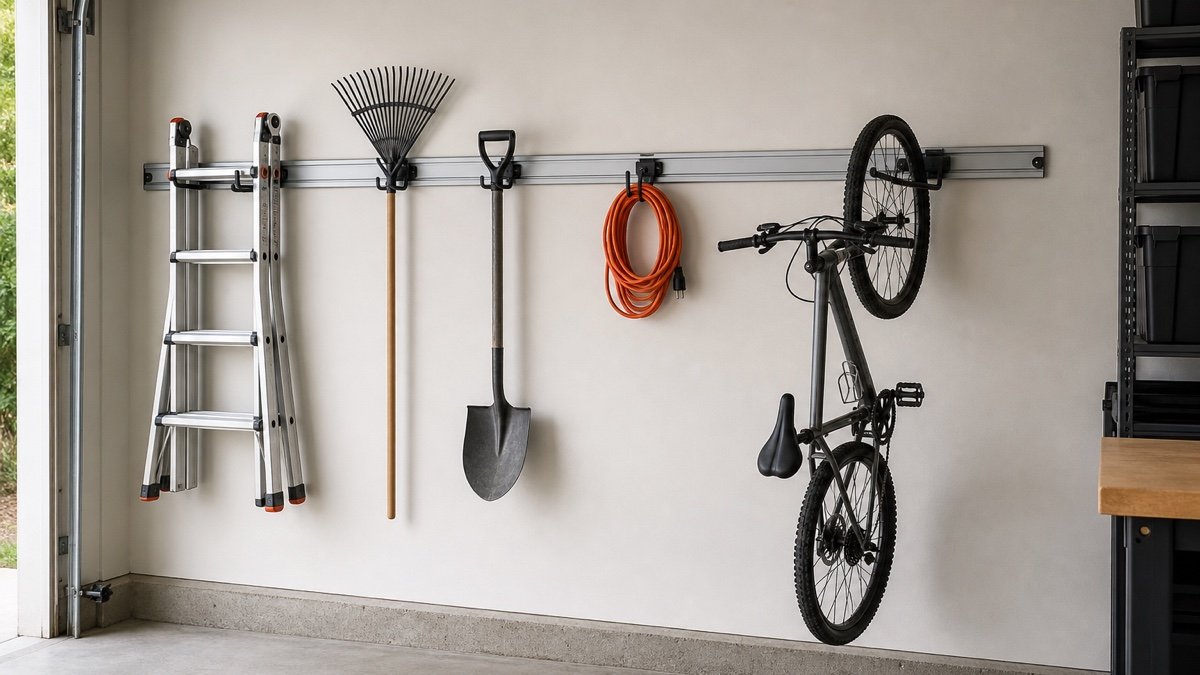
A horizontal garage track uses little wall area. Once the rail is mounted, hooks can usually slide or clip into new positions. That makes a track appealing for an unfinished garage or a wall that may receive cabinets later. The open drywall around it stays accessible.
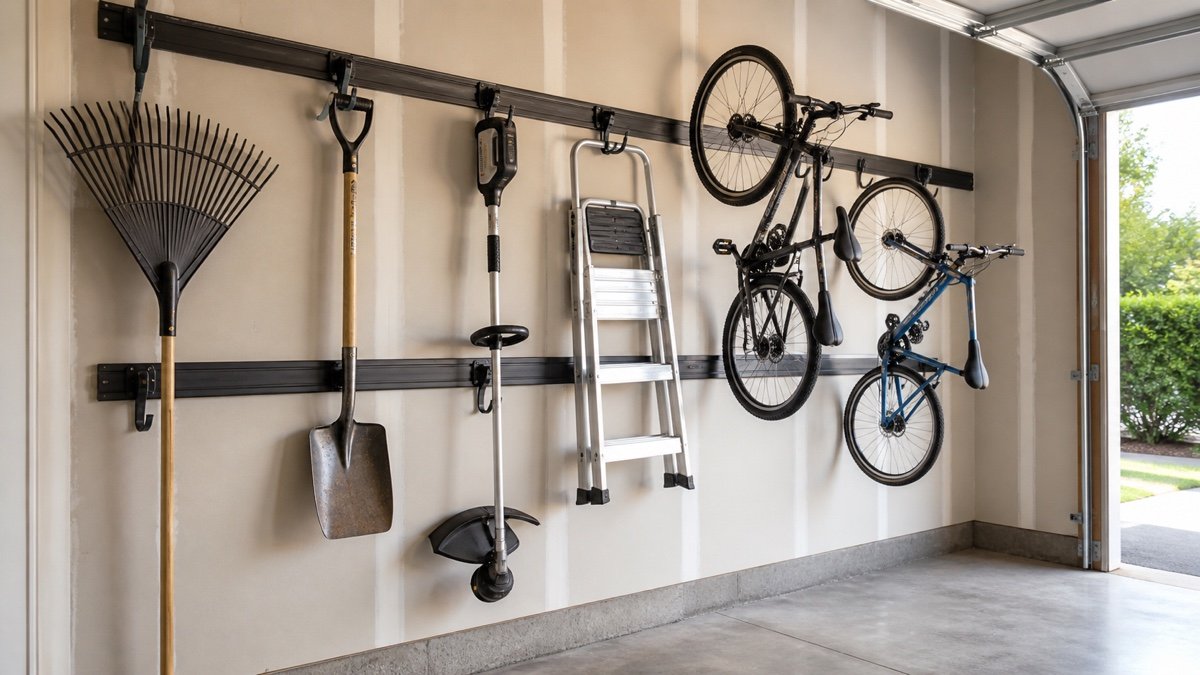
Tracks are particularly good for objects with odd outlines: long handled garden tools, folded chairs, hoses, ladders, strollers, and bicycles. Each item gets breathing room. You can move one hook instead of reorganizing a whole panel.
The limitation shows up with small objects. Filling a track with tiny hooks and cups often wastes rail length, and the result can be less stable than a dense pegboard arrangement. Keep the track for gear that genuinely benefits from a substantial hook. Put drill bits, driver handles, and measuring tools closer to the bench.
Rail shape and locking details differ among brands. Do not assume a hook will work because it appears to hang on the lip. A partially engaged hook can look fine while empty and shift when loaded. Buy accessories made for the selected system, observe each accessory rating, and follow the mounting instructions for the wall type.
Installation changes the comparison
The best organizer on paper can be the wrong one for a particular wall. Find studs, wiring, plumbing, masonry joints, and existing damage before choosing a panel size. Measure stud spacing instead of assuming it. An outlet in the center of a proposed slatwall area creates more cutting work than it would with a single track.
Pegboard usually needs support around its perimeter and often across the middle. Full slatwall installations may need repeated fasteners across every panel. A track has fewer square feet of material, but its fasteners carry concentrated loads. None of these systems should be fastened according to a generic online diagram when the product includes its own instructions.
Wall flatness matters too. A bowed wall can twist a rigid panel. An uneven masonry surface may keep a rail from sitting flat. Correct the mounting surface in the way the manufacturer permits. Do not force the organizer against a hump and hope the screws pull it straight.
Plan height with the object attached, not just the empty hook. A rake handle can hit the ceiling. A bicycle may hang low enough to meet a car hood. Our broader garage measuring guide covers door travel, parking clearances, and work zones.
A hybrid wall is often better
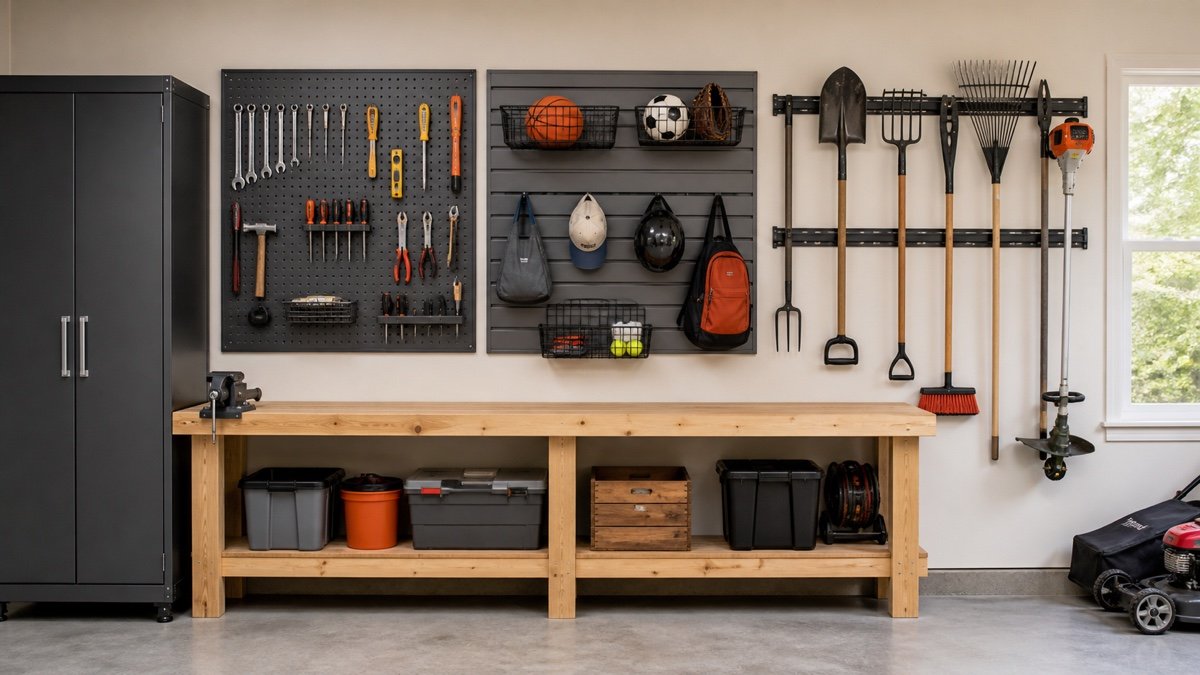
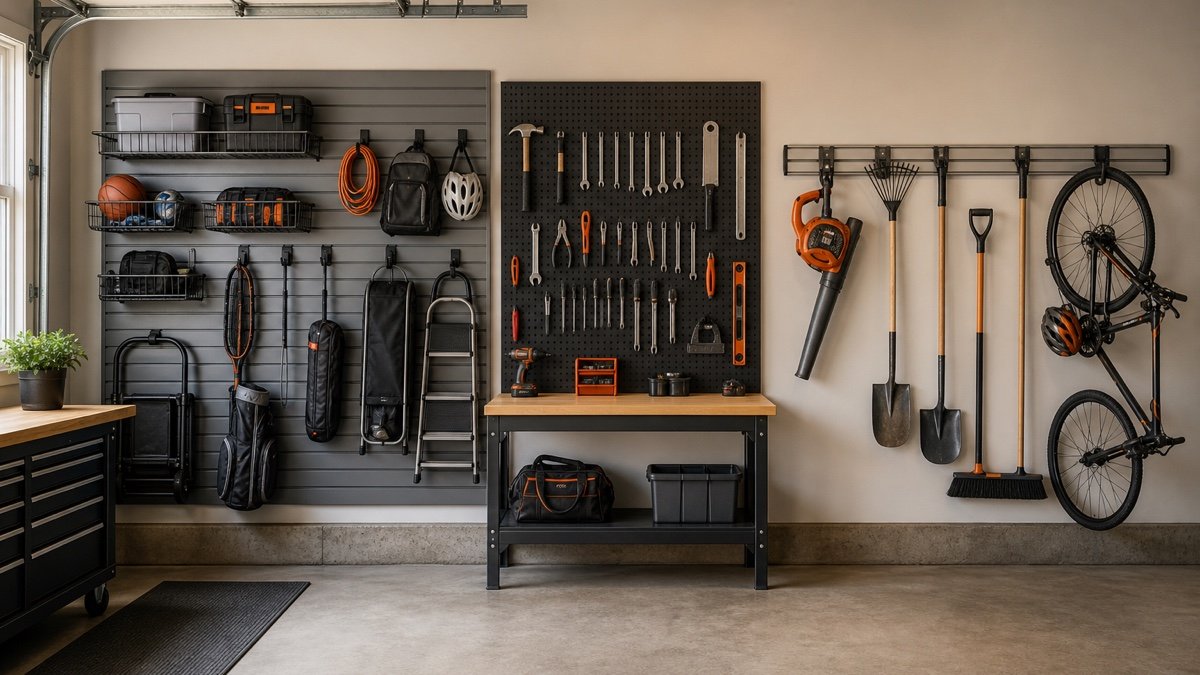
One useful layout is a pegboard centered over the workbench, a track near the garage door for yard tools, and a short slatwall section for sports gear that changes with the season. This looks less uniform than a single showroom system, but it usually works better.
Keep frequently used tools between comfortable shoulder and waist height. Place long tools where they can lift off the hook without striking a shelf. Reserve upper positions for light items. A wall mounted cabinet can handle chemicals, sharp items, and anything that should be kept away from children.
Leave empty space. Filling every hole and channel on installation day gives you nowhere to put the next tool. A quarter of the wall can remain open without being wasted. That spare capacity will matter later.
If the garage is still in the planning stage, begin with the garage storage planning guide. It helps separate parking, work, household, and outdoor equipment zones before hardware starts going up.
Buying checklist
- List the exact objects that will hang in the first six months.
- Measure their weight, depth, and removal path.
- Confirm panel material, rail profile, hole size, and accessory compatibility.
- Read separate ratings for the wall system and each hook, basket, or shelf.
- Check the required wall construction, fastener pattern, and hardware.
- Price a usable setup, including hooks, bins, trim, screws, and spacers.
- Verify that additional accessories are readily available before committing to a proprietary system.
- Leave clear wall space for future changes.
For a bench focused tool wall, pegboard is the simple starting point. For a flexible finished wall, slatwall is easier to expand. For large hanging objects, a track is tidy and efficient. The choice gets much easier once each wall zone has one job.
Useful products to compare
These links open current Amazon search results so you can compare dimensions, manuals, ratings, and availability for the exact models on your shortlist.
Before you buy or install
Check the current manual for the exact product you are considering. Confirm the assembled dimensions, load rules, mounting requirements, included hardware, clearances, warranty, and any limits that apply to your wall, floor, or garage layout.
Frequently asked questions
Is slatwall stronger than pegboard?
Material alone does not answer that. Compare the published rating for the exact panel, its mounting method, and the specific hook or shelf. A garage rated pegboard can outperform a light display panel, and the reverse can also be true.
Can pegboard hooks fit slatwall or track rails?
Usually not. The attachment shapes are different, and even similar looking rail systems may use incompatible profiles. Use accessories approved for the exact system.
Which system is best for bikes?
A rated track or garage slatwall system with a matching bicycle hook is often easier to position than basic pegboard. Check the bicycle weight, wheel or frame contact, wall mounting, and the hook rating.
Do I need to cover the whole garage wall?
No. Selected zones are usually more economical. Cover the workbench area with pegboard or slatwall and use shorter tracks where bulky gear needs to hang.