Affiliate disclosure: As an Amazon Associate I earn from qualifying purchases. This article may contain affiliate links, and Bay & Bench may earn a commission at no extra cost to you. Read our full Affiliate Disclosure.
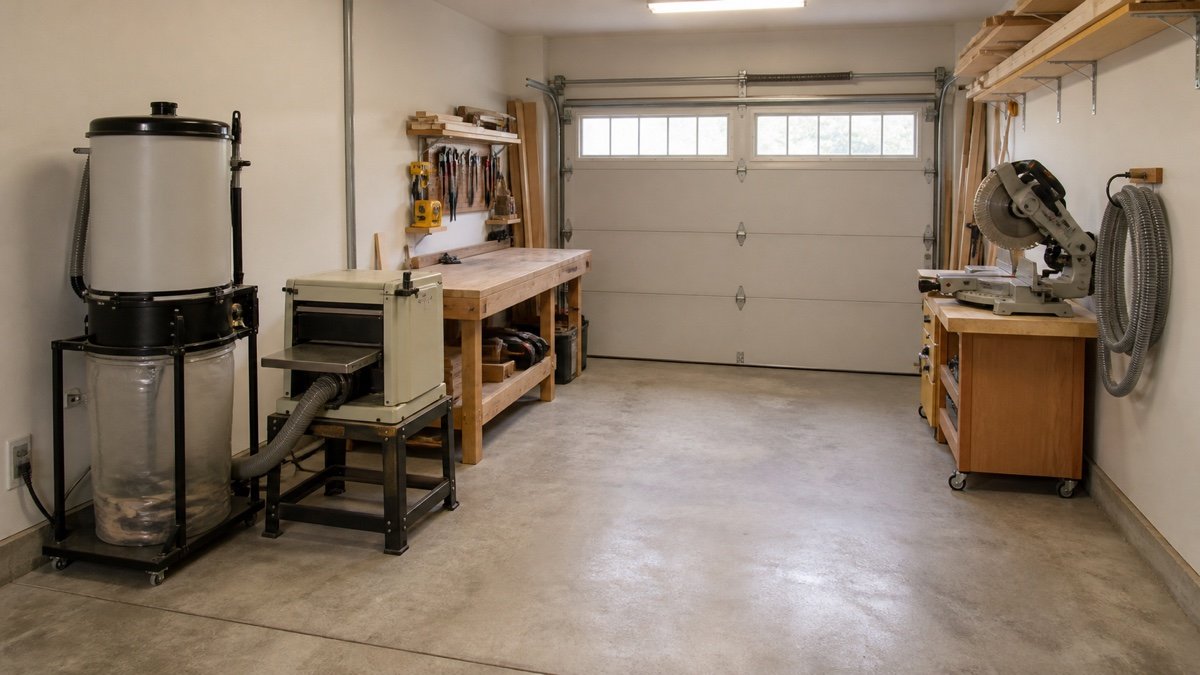
A small garage dust collection layout succeeds by refusing to imitate a large commercial shop. Long mains, several branches, and a blast gate at every machine look tidy in a diagram, but a modest collector may lose too much performance along the route. In a one-car or shared garage, short hoses and mobile equipment are often the more honest design. Put capture close to the tool, connect one chip-producing machine at a time, store hoses off the floor, and leave enough room to empty the bin without rebuilding the room.
Quick answer
Group tools by port size and dust behavior. Park a high-pressure vacuum or extractor near small-port tools, and roll a large-hose collector to the planer, jointer, or saw it serves. Keep hoses short, avoid early reducers and tight bends, and capture dust at the factory hood or approved guard. Protect the walking aisle, check electrical loads, and reserve straight-out access for the collection drum and filter.
Small garage dust collection layout: map dust sources first
List every task that creates dust or chips. Include handheld sanding, routing, track-saw work, table-saw cuts, planing, jointing, miter cuts, sweeping, and vehicle cleanup. Record each tool’s dust-port diameter, factory hood, electrical requirement, stored location, and operating location. The manual should tell you what collection connection the maker intended.
Next, mark how often each task happens and what it produces. A planer may run for twenty minutes and fill a bin with chips. A sander may run for two hours while making far less visible but finer dust. That difference argues for separate collection strategies even if both tools fit the same room.
Put those notes on the measured plan from our garage measurement guide. Add the garage door, opener, windows, panels, outlets, service doors, parked vehicle, and the path used to carry long stock. Dust equipment must fit during real work and in its stored position against the wall.
Divide the shop by airflow class, not brand
| Tool group | Connection pattern | Practical small-garage layout | Main warning |
|---|---|---|---|
| Sanders, routers, track saws | Small port and narrow hose | Compact extractor near the bench, short tool hose | Do not assume every filter configuration is HEPA |
| Planer, jointer, table-saw cabinet | 4-inch or larger port | Mobile collector moved to one machine | Do not reduce the hose early |
| Miter saw | Mixed port and open dust plume | Manufacturer connection plus a well-designed close hood where permitted | Do not interfere with guard or saw travel |
| Floor cleanup | Hand nozzle and variable restriction | Wet/dry vacuum stored near the exit | Do not blow dust across the room |
| Ambient cleanup | Room air rather than source port | Supplemental room filtration after source capture | It cannot replace collection at the tool |
The rule is simple: narrow restrictions need pressure, while open hoods need air volume. One collector can sometimes cover a small set of similar machines, but adapters cannot change the fan it contains. Sort tools by port behavior before buying hose or committing wall space.
Put the collector close to the highest-volume machine
Start with the planer, jointer, or saw that produces the most chips. Give the collector a parked position close enough for one short, gentle hose. If two large-port machines sit nearby, use quick connections and move the hose between them while both are off. A small fan is more likely to perform well through ten uncomplicated feet than through a ceiling loop and several branches.
Grizzly’s current support guidance for its compact G8027 says the 500 CFM unit is intended for one average machine at a time and recommends keeping hose lengths short. It also says the collector is not intended as general room filtration. That model-specific FAQ should not be applied to every collector, but it illustrates a sensible layout for a small unit.
Keep the collector away from the garage door track and the stock path. Do not bury its air inlet or motor cooling openings against a cabinet. If the machine has a tall filter, draw its full height beneath open door hardware. The overhead clearance method is useful even when the storage item is a dust collector.
A mobile cart can replace a permanent duct network
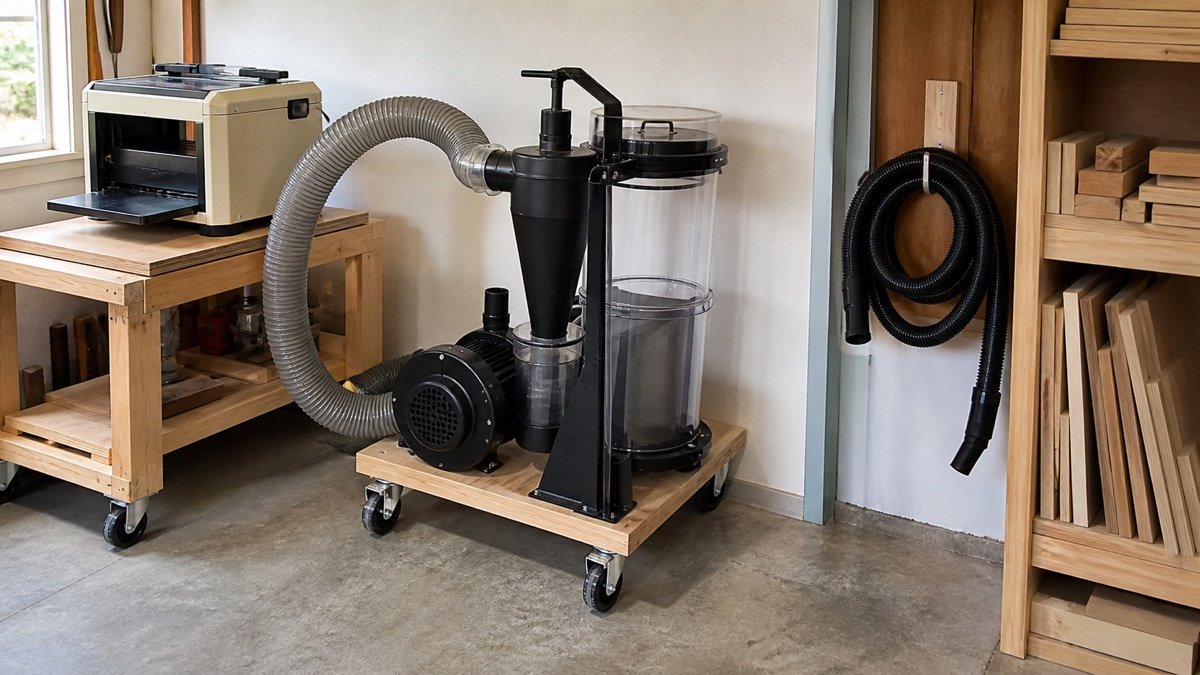
A well-built cart can carry a collector or vacuum, cyclone, hoses, cuffs, and a small adapter drawer. Give it a low center of gravity, rated locking casters, secure components, and a handle that does not become the widest part by surprise. The bin must come out without lifting the upper assembly.
Mobility only helps when the route is clear. Roll the empty cart between its parking spot and each tool. Cross the slab joints, curb, and threshold. Check whether the hose or cord catches a caster. Then mark a parking box on the floor so the cart returns to a location where it cannot drift into a vehicle or door.
The cart in a shared garage should connect after the car moves out, not snake a hose around the bumper. Use the measured scenarios in the one-car garage workshop layout to decide whether shop mode and parking mode overlap at all. A rolling collector is easier to move than a fixed duct, but it still needs a safe home in both modes.
Source capture begins at the factory hood
Use the tool’s intended port, hood, shroud, and guard. Keep the opening close to where chips or dust leave the work. OSHA’s wood-dust guidance identifies local exhaust ventilation as the primary control and says hoods should sit as close as practical to the emission source. That is workplace guidance, but the physics does not change in a garage.
Do not remove a blade guard or defeat a safety interlock to improve hose access. If capture from a tool is poor, check the manual, clear blockages with the machine safely de-energized, inspect the hose, and ask the manufacturer about approved accessories. A homemade box around a miter saw can obstruct the head, fence, or stock. Test the full operating envelope before adding any enclosure.
NIOSH’s table-saw dust control research found that bottom exhaust alone often missed high-speed dust and that an auxiliary hood over the blade substantially reduced emissions in its laboratory test. The takeaway is not to copy an old research hood blindly. It is to treat upper and lower capture as separate problems and use current approved solutions.
Route hoses where feet, wheels, and stock do not travel
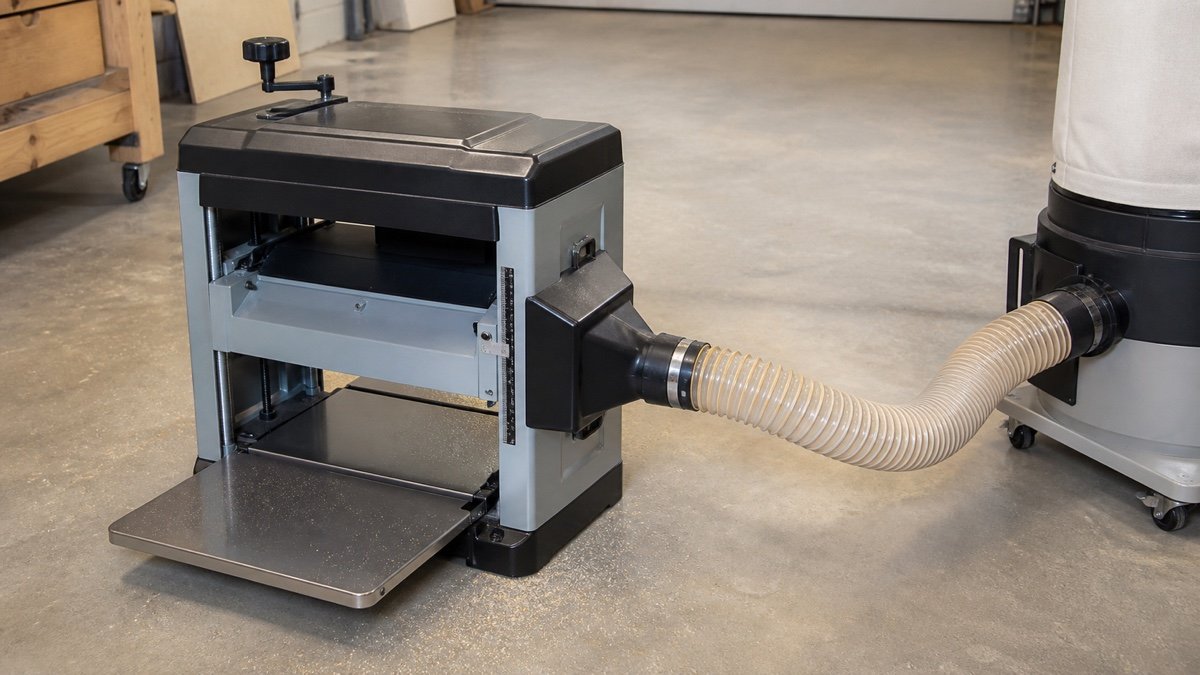
Keep the active hose inside the tool’s work zone. Run it along a wall or behind the machine when the manual permits, with enough slack for normal movement and no loop underfoot. Store inactive hoses on large-radius hooks so they do not kink. A floor hose across the only exit is not temporary if every cut requires it.
Avoid tight elbows and sudden reductions. Keep large hose at full diameter until the tool connection. Support the weight of a hanging hose so it does not pull on a plastic port. Use compatible cuffs, gates, clamps, and static-control parts specified for the system. Seal leaks in the manner the manufacturer allows; do not wrap a failing fitting in layers of unknown tape and forget it.
Our garage workshop aisle guide treats a hose as a moving obstruction, not a line on a plan. Walk the route carrying a full sheet, push the mobile cart, open every drawer, and simulate the collector connection. If the hose gets crushed under a wheel or forces a sideways step, change the layout.
Plan service space before the filter gets dirty
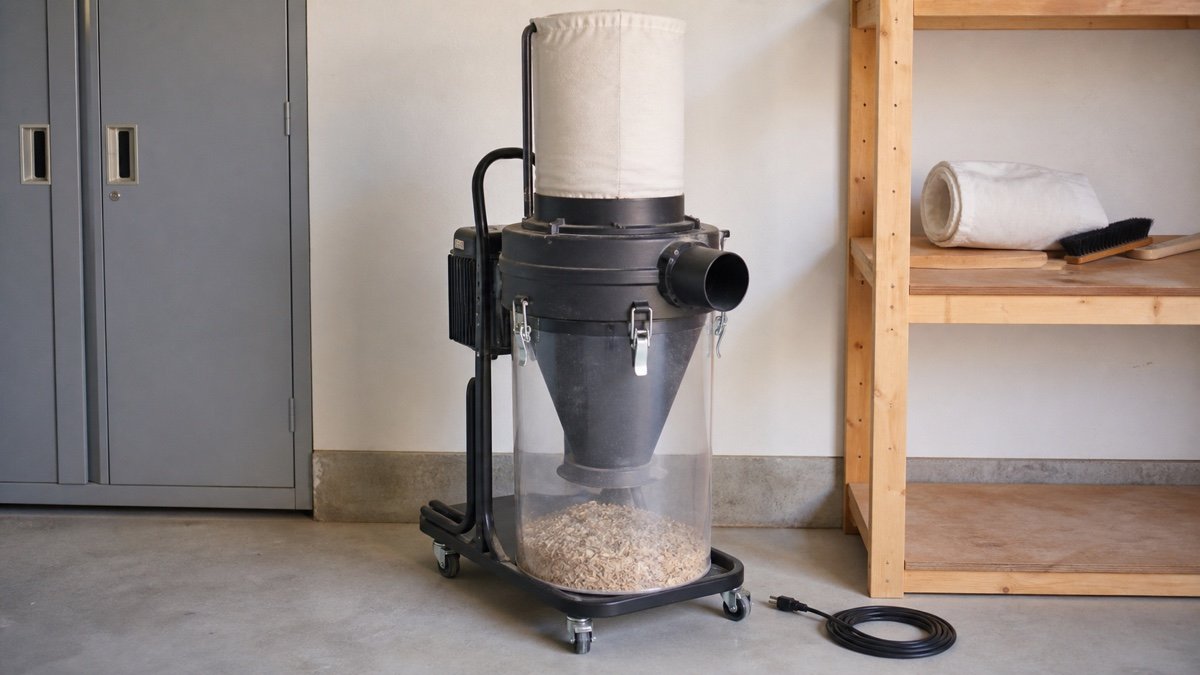
Draw the bin or bag removal direction. Some drums roll forward; others drop down; fabric bags need room around their clamps. Canister filters may need overhead or side access for cleaning. A transparent collection bin still needs room to unlatch. Leave the straight path the manual expects.
Put spare bags, filters, and approved cleaning tools nearby but outside the dust stream. Keep a lidded disposal container accessible. Empty the collector before the waste becomes too heavy or reaches the maker’s fill limit. Fine dust disposal can release what the system captured, so follow the manual and the material’s precautions.
Inspect ducts, hoses, seals, gates, filters, and collection containers regularly. OSHA specifically calls for maintaining local exhaust systems and checking damaged or loose ductwork. Power down and isolate equipment before service. Never use compressed air to blast accumulated wood dust around the room; OSHA’s fire guidance warns against creating a dust cloud that way.
Check power and automatic-start limits
Map circuits along with hoses. A tool-triggered extractor may have a stated maximum connected-tool load. A planer and dust collector can draw substantial current at startup. Do not assume two nearby receptacles are separate circuits. Consult the manuals and have a qualified electrician evaluate permanent wiring or repeated breaker trips.
Keep cords out of the aisle and away from wet areas. Do not hide extension-cord connections inside cabinets or treat an extension cord as permanent wiring. The collector’s emergency controls should remain visible and reachable from the operator’s normal position. Remote starts are convenient only when you can confirm which gates or hoses are connected and no one is servicing the unit.
Grounding and static-control advice varies with equipment and duct material. Follow the complete system manufacturer’s instructions. Do not add a loose wire inside a hose because a generic diagram online shows one. Dust collection combines moving air, combustible material, electrical equipment, and sometimes plastic components. Use components designed to work together.
Keep dust work away from clean storage and ignition sources
Put sanding and chip-producing tools on the collector side of the room. Keep clean household items, soft goods, and vehicle detailing supplies in closed storage across the aisle. Finishes, solvents, fuel, and battery charging need separate handling according to their labels and equipment instructions.
OSHA’s woodworking fire and explosion guidance notes that fine wood dust can accumulate in unexpected high places and recommends controlling ignition sources, using local exhaust, and separating combustible stock from flammable chemicals. A hobby garage is not an industrial facility, yet the housekeeping lesson is straightforward. Dust on rafters and motors is not harmless decoration.
Vacuum settled dust with equipment and filters suitable for the material. Clean the slab, ledges, door tracks, lights, and cabinet tops. Do not dry sweep or blow a cloud into the driveway. If the project involves silica, lead paint, treated materials, or unknown dust, use the specific control method and professional guidance for that hazard.
Test the layout with one tool at a time
Commission the simplest connection first. Clean the filter, empty the bin, use the correct hose, close unused openings, and connect one tool exactly as the manufacturer intends. Observe whether chips escape at the hood, the hose plugs, the bag inflates normally, or the filter loads unusually fast. Stop if the machine behaves unexpectedly.
Add only one change at a time: a slightly longer hose, an approved separator, a second pickup, or a different filter configuration. That discipline tells you which addition cost performance. A system assembled all at once leaves you guessing whether the problem is the hood, duct, filter, or leak.
Document the final configuration with photos and a short list of compatible cuffs. Mark which collector serves which tool and where the cart parks. Revisit the table-saw stock-path guide before accepting a hose route behind or beside the saw. Dust control should support safe material movement rather than stealing the outfeed area.
A compact layout should be easy to explain
If another adult cannot understand how to connect, start, stop, empty, and park the system after a two-minute explanation, simplify it. One large-hose collector, one small-port extractor, two obvious parking places, and a few compatible adapters can outperform a clever wall of gates that nobody maintains.
Measure before adding future branches. Keep the source hood close, the hose short, the filter appropriate, and the service path open. Capture chips and dust before they cross the breathing zone. Use room filtration only as another layer. Clean the high ledges on a schedule.
The visual test is useful: the aisle should still look like an aisle when the collector is connected. The filter and bin should still look removable. The garage door should still move. If dust control makes the room harder to use, it will eventually be bypassed. A modest system that connects in seconds and parks cleanly has a better chance of running for every job.
Useful products to compare
These links open current Amazon search results. Check the dimensions, manual, mounting hardware, warranty, and current availability for the exact model before you order.
Before you buy or install
Read the current manual for the exact product you are considering. Confirm its assembled dimensions, rated capacity, mounting requirements, included hardware, working clearances, warranty, and any limits that apply to your wall, floor, electrical circuit, or garage layout.
Frequently asked questions
Should dust collection hose run overhead in a small garage?
Only if the collector can handle the added length and resistance, the structure supports the installation, and the route clears the garage door, lights, vehicles, and tall stock. A short floor-level mobile connection is often simpler for a modest collector.
Can one dust collector serve every tool?
Sometimes one collector can serve similar tools one at a time. Small-port handheld tools and large-port stationary machines usually need different pressure and airflow characteristics. Match each connection to the tool and collector manuals rather than relying on reducers.
Where should a dust collector sit in a garage?
Place it close to the highest-volume machine while preserving the walking aisle, garage door travel, cooling airflow, electrical access, and bin-removal path. A mobile unit should have a marked parking spot where its casters can lock.
Does ambient air filtration replace source collection?
No. Capture dust at the hood or tool port before it spreads. Ambient filtration may reduce particles that escape, but it cannot collect planer chips or stop the initial plume from crossing the operator’s breathing area.