Affiliate disclosure: As an Amazon Associate I earn from qualifying purchases. This article may contain affiliate links, and Bay & Bench may earn a commission at no extra cost to you. Read our full Affiliate Disclosure.
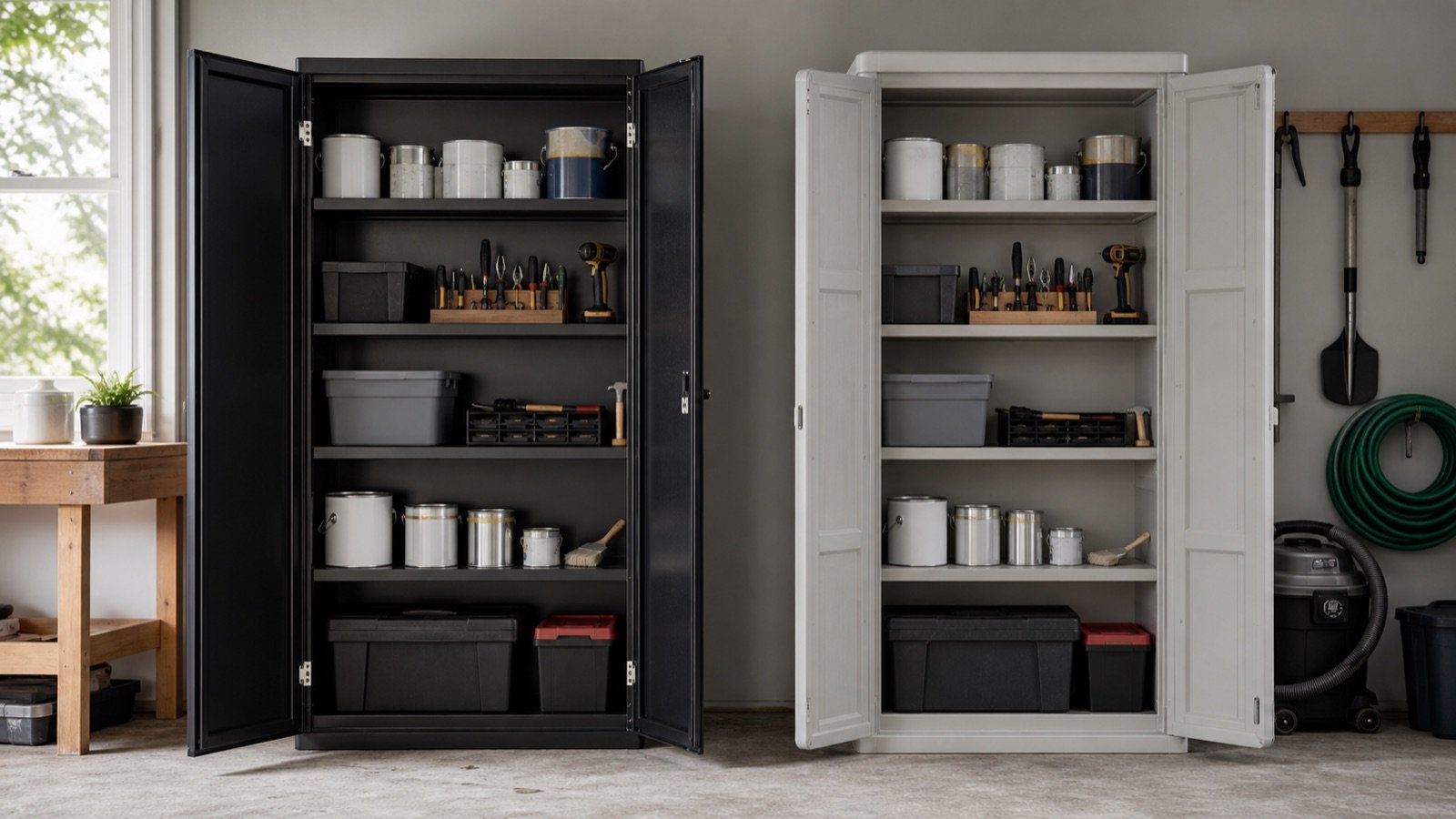
The best garage cabinets under $1000 are usually focused setups, not wall-to-wall suites. That is a useful constraint. A tall cabinet can swallow garden gear and shop cases. A base cabinet gives you a landing surface. Two wall cabinets rescue space above a bench. Trying to buy all three at maximum size often leads to thin shelves, awkward delivery, or a layout that crowds the car.
This shortlist uses current U.S. brand and retailer pages, with prices checked on September 1, 2026. Prices, bundles, colors, and stock move quickly, so open the linked page and confirm the total before ordering. None of these picks is a universal winner. Each one earns its place by fitting a clear storage job and staying below the stated budget at the time of review.
Quick answer
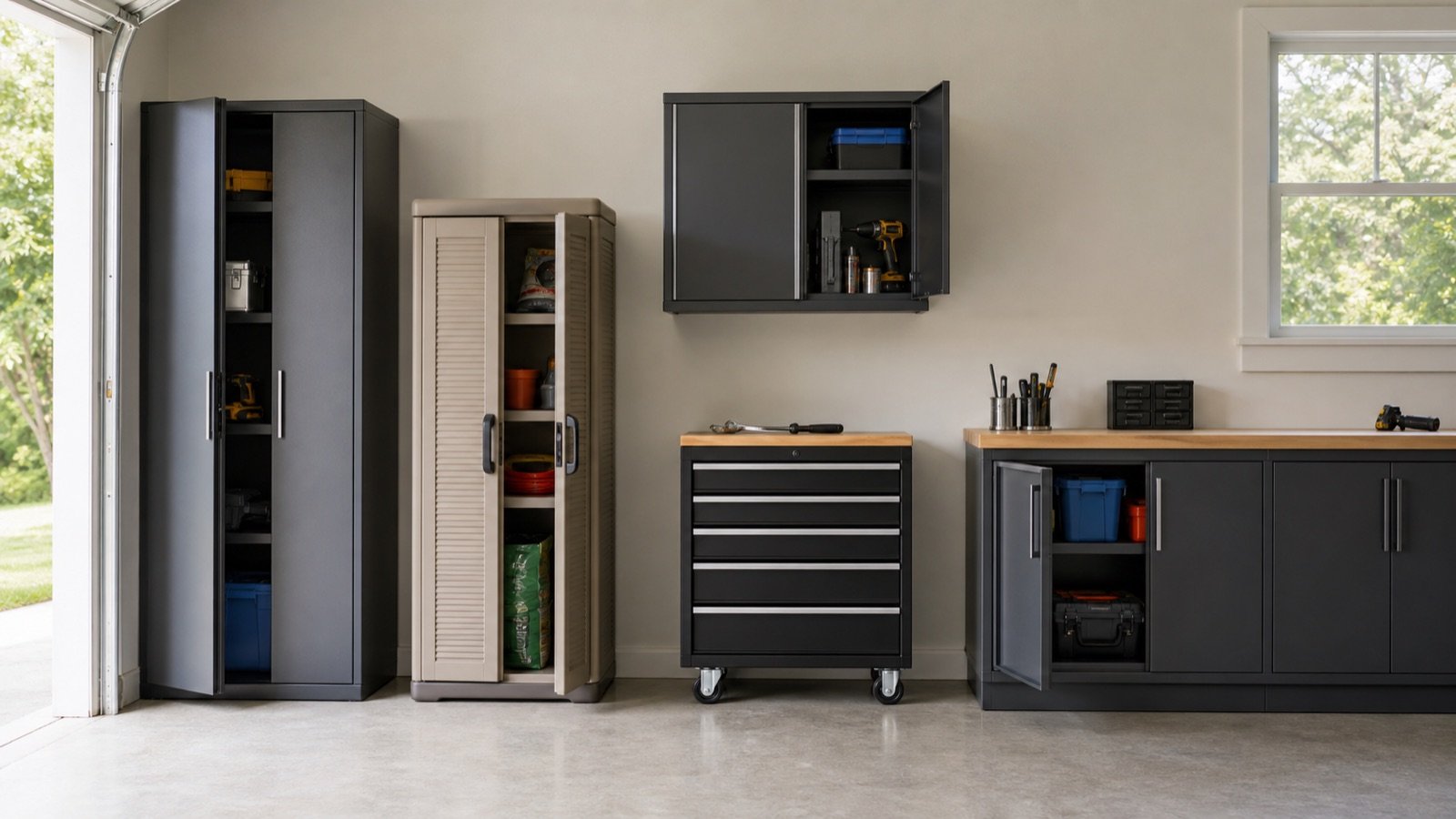
For a compact cabinet wall with a work surface, the NewAge Bold 48-inch five-piece set is the strongest all-in-one fit here. A Husky ready-to-assemble tall, base, and wall trio gives more mixed storage when the individual pieces are in stock. Choose a Seville Classics UltraHD 60-inch cabinet if one broad, deep enclosure matters more than a coordinated suite. For mobility, the 36-inch UltraHD rolling cabinet is the cleanest starting point. Measure the wall, door swings, parked vehicle, and largest stored item before deciding.
Best garage cabinets under $1000 at a glance
The prices below were visible on official U.S. pages when this article was prepared. A sale can push one option up or down the list overnight. Compare the current checkout total, shipping, and required accessories rather than treating the table as a promise.
| Setup | Price checked | Published size | Best use | Main compromise |
|---|---|---|---|---|
| NewAge Bold 48-inch five-piece set | $699.99 | 48 W x 18 D x 76.75 H overall | Compact bench and cabinet wall | Narrow work surface |
| Husky RTA tall, base, and wall trio | About $747 from displayed unit prices | Tall 36.6 W x 18.3 D x 72 H; base 28 W; wall 28 W | Mixed bulky and everyday storage | Bundle stock was unavailable |
| Seville UltraHD 60-inch cabinet | $579.99 | 60 W x 24 D x 72 H | One deep, broad enclosure | Large delivery path and footprint |
| Seville UltraHD 36-inch rolling cabinet | $319.99 | 36 W x 18 D x 72 H | Mobile enclosed storage | No bench-height top |
| NewAge Bold 36-inch base plus wall cabinet | About $575 before worktop | Base 36 W x 16 D; wall 36 W x 12 D | Build a starter bench zone | Worktop and installation add cost |
Run the proposed footprint through the garage cabinet capacity calculator before comparing colors or handles.
What a $1000 cabinet budget can realistically buy
A thousand dollars can buy one substantial cabinet, a compact coordinated set, or several lighter ready-to-assemble pieces. It rarely buys a deep welded suite across a full two-car wall. Delivery and tax can also consume part of the budget. If the price ceiling is firm, leave at least ten percent unassigned until you know whether you need a worktop, anchors, extra shelves, lighting, or help carrying a large carton.
Closed storage costs more per cubic foot than open shelving, so give cabinets the items that benefit from doors: cleaners, paints permitted by their labels, dusty cases, sharp tools, or gear that makes the room look chaotic. Totes and bulky seasonal items can stay on a measured rack. The garage storage budget calculator helps split the total between cabinets, shelves, wall hardware, and small bins.
Do not confuse a lock with a rated security container. Most garage cabinet locks discourage casual access. They do not turn thin sheet steel or resin into a safe.
NewAge Bold 48-inch set for a compact work zone
NewAge lists its compact Bold five-piece set at 48 inches wide, 18 inches deep, and 76.75 inches high. The configuration combines wall cabinets, a base cabinet, a worktop, and narrow storage in a remarkably small run. On the official product page, the set was priced at $699.99 when checked.
This is the neatest answer for a small garage where one person needs a repair or packing station without surrendering an entire wall. The 48-inch width fits many gaps that cannot accept two full base cabinets. It also creates a coordinated setup immediately, which can be cheaper than discovering later that separate doors, tops, and fillers do not line up.
The compromise is obvious once a project lands on the top. Forty-eight inches fills quickly. A vise, charger, and open tool case can leave little assembly room. Measure the task as well as the available wall, and keep the floor in front clear enough for drawers and doors.
Husky RTA trio when you need three cabinet formats
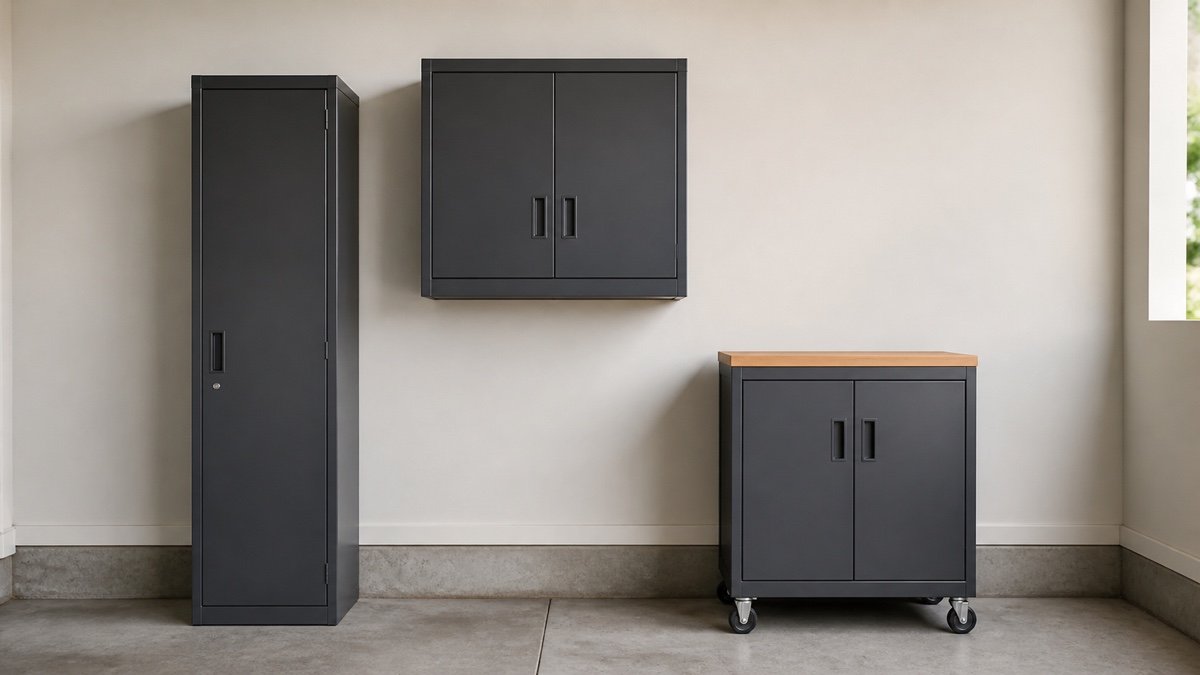
Home Depot’s Husky three-piece ready-to-assemble bundle pairs a 36.6-inch tall cabinet with a 28-inch base cabinet and a 28-inch wall cabinet. The official retailer page showed the bundle out of stock during this check, but it also showed the component dimensions and current unit pricing. The displayed tall, base, and wall prices added to roughly $747 before tax.
This mix is more flexible than the compact NewAge run. The tall cabinet takes upright tools and cases, the base handles dense everyday items, and the wall cabinet uses space above a separate bench. It also asks more from the wall. The three pieces do not form one narrow block, so map every door swing and decide whether the tall cabinet belongs near outdoor tools or beside the bench.
Ready-to-assemble steel saves shipping volume but transfers work to the buyer. Inspect every panel before bending tabs or peeling protective film. A damaged corner can turn a simple assembly into an afternoon of forced alignment.
Seville UltraHD 60-inch cabinet for bulky enclosed storage
Seville Classics lists the 60-inch UltraHD cabinet at $579.99, with published exterior dimensions of 60 inches wide, 24 inches deep, and 72 inches high. The official UltraHD cabinet collection also lists narrower 18-inch-deep and 24-inch-deep versions. That range makes the brand useful when depth is the deciding variable rather than a matching workbench.
The 60-inch model is a serious piece of furniture. Its width can hold wide cases and its depth can accept bins that hang out of an 18-inch cabinet. Those same dimensions make delivery, assembly, and final placement harder. Measure the carton route, steps, door openings, ceiling fixtures, and the turn from driveway to garage. A cabinet that fits the wall may not fit the path to it.
This option suits someone who wants one broad enclosure and already owns a bench. It is less persuasive if small tools need many shallow drawers or if the car leaves only a narrow side aisle.
Seville UltraHD rolling cabinet for storage that moves
The 36-inch-wide, 18-inch-deep, 72-inch-high UltraHD rolling cabinet was listed at $319.99 in the same official collection. Its tall shape and casters make it different from a rolling base cabinet. Think of it as a movable enclosure for lighter bulky gear, cleaning supplies, or project kits, not as a substitute for a low mechanic’s tool cabinet.
Mobility helps when one wall must change between parking and project use. It also introduces a clearance problem. Count the caster width, handle projections, door opening, and the force required to control a loaded cabinet on a sloped slab. Use brakes whenever the cabinet is parked, and follow the manufacturer’s loading and movement instructions. Do not add a heavy top or vise unless the exact product permits it.
I would choose this only when moving the storage is part of the weekly routine. If it will sit in one corner forever, a fixed cabinet usually gives you fewer compromises.
NewAge base and wall pair for a starter bench
A coordinated base and wall cabinet can be smarter than a discounted set with a locker you do not need. NewAge publishes its Bold 36-inch base cabinet at 36 inches wide and 16 inches deep, with a listed price of $354.99 during the check. The matching 36-inch wall cabinet was $219.99 and is 12 inches deep. The base cabinet page lists a 600-pound total capacity, while the wall cabinet page lists 100 pounds for that wall model.
Together they leave room in a $1000 budget for a suitable top, installation supplies, and a task light. The shallow 16-inch base preserves aisle width better than a 24-inch cabinet, although it may reject deep cases. Confirm the worktop support method and final height. A loose board laid across a cabinet is not automatically a safe bench.
Measure the parked garage before choosing a sale item
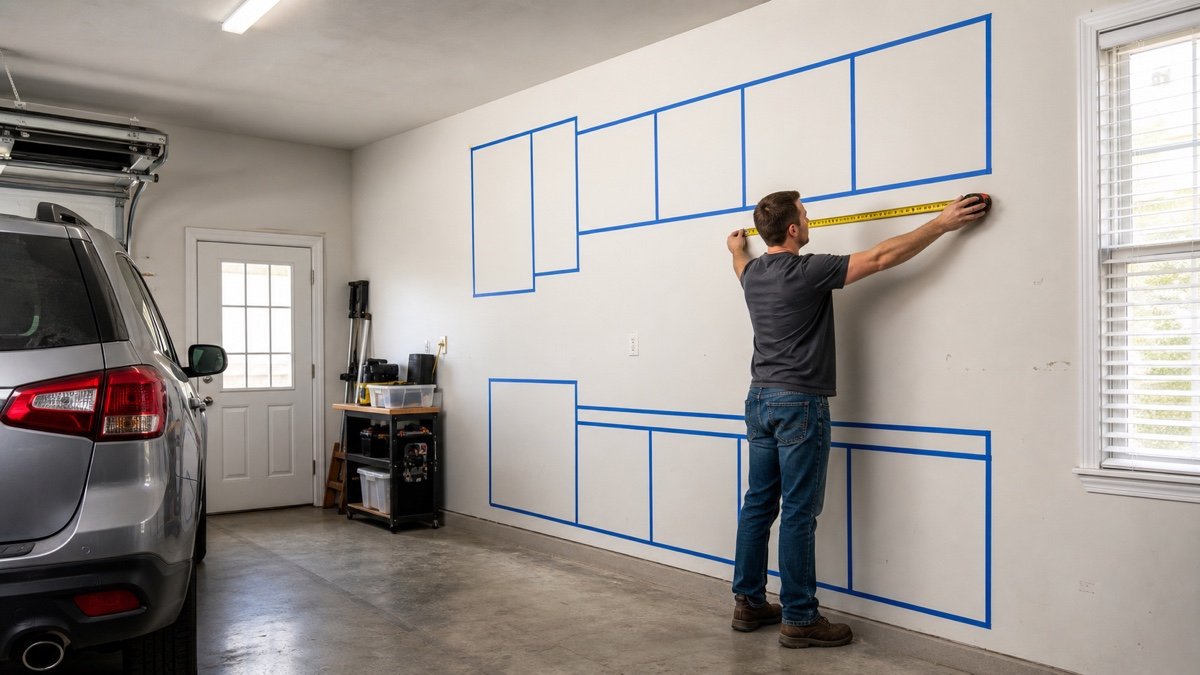
Park the largest vehicle in its normal position. Open every passenger door and the hatch, then tape the cabinet footprint on the floor. Mark the height and width on the wall. Repeat the test with garage doors open and closed. The garage measuring guide covers tracks, outlets, windows, base curbs, and other details that disappear from a simple width measurement.
Depth deserves special attention. An 18-inch cabinet may preserve a comfortable route where a 24-inch cabinet makes you turn sideways. Door and drawer projections add to the working depth, even though they do not appear in the closed product dimension. Measure the largest tote, case, and long-handled tool too. Buying a deep cabinet for one oversized item can waste the rest of the shelves.
Use cardboard boxes to mock up the front edge for two days. If everyone bumps it while carrying groceries, the cabinet is too deep or in the wrong place.
Compare shelf limits with real load placement
Published capacity usually assumes an evenly distributed load and correct assembly. A dense toolbox in the center of a wide shelf creates a different demand from several light bins spread across it. Read the exact manual, count the shelf itself where required, and keep heavy items low. Never borrow a rating from a similar cabinet in the same product family.
Adjustable shelves are useful only if the hole spacing matches your items. Measure the tallest bottle or case and sketch a shelf plan before ordering extras. Leave room to lift objects over the shelf lip. Check whether additional shelves are sold for the exact model and whether adding one changes the allowed total cabinet load.
A wall cabinet also transfers its load through the mounting system into the structure. Use the specified brackets and fasteners for the actual wall. When the substrate is uncertain, bring in someone qualified to inspect it.
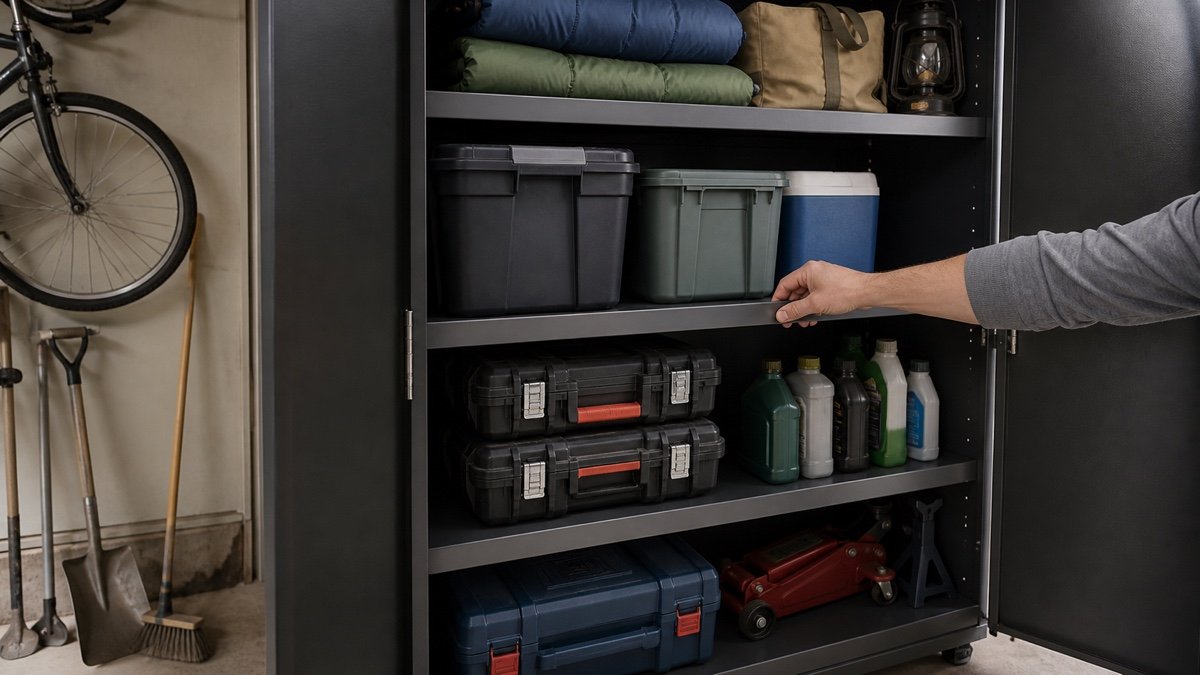
Plan for delivery, assembly, and anchoring
Welded cabinets save assembly time but arrive large and heavy. Flat-pack cabinets fit through tighter routes but expose more panels to assembly errors. Neither style is automatically easier. Check package count, individual package weight, required people, and the point at which the cabinet must be stood upright. A tall unit may fit under the ceiling once vertical yet lack room to rotate from the floor.
Open cartons while the carrier’s damage policy still applies. Photograph dents, missing hardware, and torn packaging before repair attempts. Build on a protected flat surface so a small twist does not become a door alignment problem. Level the cabinet on the real slab, connect adjoining units as instructed, then install the required anti-tip or wall hardware.
Do not rely on weight alone to stop a tall cabinet from tipping. Children, open doors, uneven floors, and a heavy item pulled from an upper shelf can change the balance quickly.
Spend the last part of the budget where it fixes friction
A cabinet purchase often fails in the final ten percent. The shelves are too far apart, there is no light under the wall unit, or every charger cord hangs across the worktop. Hold money for shelf liners, approved extra shelves, bins that fit the measured interior, and a task light. Skip decorative pieces until the cabinet has survived a few projects.
Use the garage cabinets buying guide to compare steel gauge, door construction, leveling, worktops, and warranties. Then pick one storage problem to solve first. Bulky sports gear wants a locker. Dense hand tools want drawers. Car-care bottles want protected shelves with enough height. A mixed starter zone wants one base and one wall unit.
The best budget result can look incomplete on day one. That is fine. A measured pair of cabinets leaves room to expand. A cheap wall of mismatched boxes can trap the layout for years.
Useful products to compare
These links open current Amazon search results. Check the dimensions, manual, mounting hardware, warranty, and current availability for the exact model before you order.
Before you buy or install
Read the current manual for the exact product you are considering. Confirm its assembled dimensions, rated capacity, mounting requirements, included hardware, working clearances, warranty, and any limits that apply to your wall, floor, electrical circuit, or garage layout.
Frequently asked questions
Can a good garage cabinet system really cost less than $1000?
Yes, if the system is focused. A compact bench set, one broad tall cabinet, or a tall, base, and wall trio can fit below the limit. Full welded suites across a large wall usually cost more once delivery, worktops, and accessories are counted.
Is an 18-inch cabinet deep enough for a garage?
It is enough for many tool cases, bottles, and smaller totes, and it protects aisle width. Measure the deepest item before buying. Large storage bins and automotive gear may need a 24-inch cabinet, but that extra six inches can crowd a parked car.
Should I buy one large cabinet or several small cabinets?
Buy one large cabinet when wide bulky items need a shared enclosure. Choose smaller cabinets when different zones need separate access or when delivery and wall interruptions make a wide unit awkward. Several cabinets cost more hardware and assembly time, so compare the full setup.
Do garage cabinets have to be anchored?
Follow the exact installation manual. Tall and wall-mounted cabinets commonly require attachment to suitable structure, and adjoining units may need to be connected. Leveling feet do not replace anti-tip hardware. If the wall or fastener choice is uncertain, use a qualified installer.