Affiliate disclosure: As an Amazon Associate I earn from qualifying purchases. This article may contain affiliate links, and Bay & Bench may earn a commission at no extra cost to you. Read our full Affiliate Disclosure.
Eighteen-inch cabinets preserve roughly six more inches of aisle than 24-inch cabinets. Twenty-four-inch cabinets accept bulkier totes and create a deeper work surface. The right choice is determined by the largest stored object and the tightest movement clearance.
Quick answer
Choose 18 inches for narrow parking aisles, visible shelf contents, and compact tools. Choose 24 inches for large bins, deep equipment, or a substantial worktop—only after testing the full cabinet and door envelope beside the vehicle.
Useful products to compare
These searches are a practical starting point for comparing current sizes, materials, load ratings, and availability.
The six-inch difference changes the room
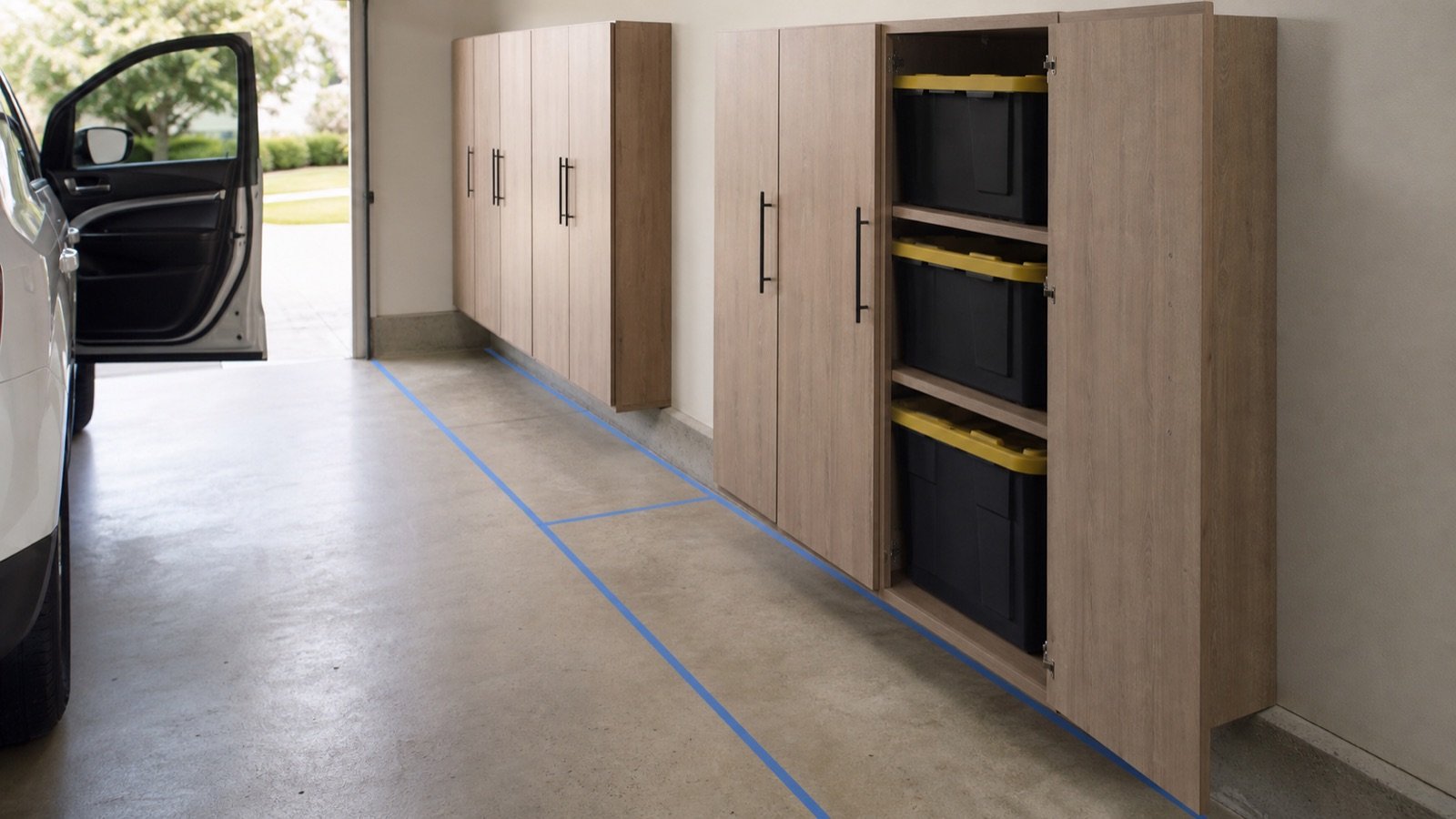
Six inches along a long cabinet run can determine whether a car door opens comfortably or a person can carry a tote past the vehicle. Mark both depths with tape. Include handles and worktop overhang rather than using the nominal case depth alone.
What fits at 18 inches
Shallow cabinets work well for hand tools, chargers, paint supplies, compact power tools and many medium bins. Contents are easier to see because fewer items sit behind one another. Current product families illustrate the format: NewAge’s Bold lockers reach up to 18 inches deep, while its wall cabinets are shallower.
What fits at 24 inches
Deeper cabinets can accept large totes, bulky automotive equipment and wide shop accessories. They also pair naturally with a deep worktop. Seville Classics offers current UltraHD cabinets in both 18- and 24-inch depths, showing that depth is a capacity choice within a product family, not a universal quality tier.
Measure the object, opening, and interior
A 24-inch exterior does not guarantee 24 inches of usable shelf. Door frames, backs and hinges reduce internal space. Measure the object at its widest point and compare with the manufacturer’s internal dimensions and door opening. Leave retrieval clearance for hands.
Avoid the deep-cabinet trap
Deep shelves can become dark storage caves for small items. Use pull-out trays, drawers or bins that bring the full depth forward. Do not stack heavy objects where the rear item requires unloading the entire shelf.
Decision rule
- Use the shallowest cabinet that fits the object and required work surface.
- Test car doors and the walking path with tape.
- Check internal—not only external—depth.
- Use mixed depths if a full run does not need to be uniform.
For width and height, continue to the garage cabinet size guide.
Before you order: the verification pass
Put the exact model number—not merely the product-family name—at the top of your worksheet. Copy the assembled exterior dimensions, usable interior dimensions, individual shelf or drawer ratings, total cabinet weight, packaged dimensions, adjustable-foot range, and required clearances from the current manufacturer page and manual. Note which accessories are included and which appear only in styled photographs.
Then return to the garage with painter’s tape. Mark the cabinet case, handles, open doors or extended drawers, and the path needed to load the largest object. Park the vehicle in its normal position and test every door, hatch, step, switch and service panel. Photograph the mock-up from the driver’s seat, house entry and driveway. If a critical measurement is unpublished, ask the manufacturer before placing the order.
Finally, calculate total delivered cost: cabinet, worktop, shelves, drawer liners, casters or feet, mounting rails, appropriate fasteners, delivery surcharge, assembly help and sales tax. A lower sticker price can become the more expensive installation when essential components are optional.
Installation-day checklist
- Inspect packages for damage before assembly and keep model labels and receipts.
- Read the complete manual before lifting or fastening anything.
- Confirm the floor is stable and the planned attachment locations are suitable.
- Use a second capable person whenever the manual or cabinet size calls for one.
- Level and square the case before aligning doors and loading shelves.
- Install wall mounting or tip restraints exactly as instructed.
- Load heavy objects low and distribute weight within every shelf and drawer rating.
- Recheck fasteners, leveling and door alignment after the cabinet has been loaded.
Do not improvise around electrical, gas, plumbing, fire-safety or structural conditions. When the required attachment or clearance is uncertain, pause and consult a qualified professional.
Common mistakes to avoid
Most disappointing installations trace back to one of five mistakes: measuring only the empty wall; treating total capacity as a per-shelf rating; forgetting doors, drawers and vehicle movement; selecting depth from a catalog image; or filling every wall without reserving adaptable space. A slower specification check is cheaper than returning a pallet-sized cabinet.
Frequently asked questions
Are 18-inch cabinets deep enough for storage totes?
Some are, many are not. Measure your exact tote including lid and handles, then compare with usable internal cabinet depth.
Is a 24-inch cabinet better under a workbench?
It often provides a more useful worktop, but standing comfort, tool access and aisle clearance still need testing.
Can I mix cabinet depths?
Yes, if transitions do not create collision points and the layout remains coherent. A deep work zone plus shallow parking-side storage is often sensible.
Last reviewed: July 2026. Product specifications can change; check the manufacturer’s current documentation before purchase.
Leave a Reply