Affiliate disclosure: As an Amazon Associate I earn from qualifying purchases. This article may contain affiliate links, and Bay & Bench may earn a commission at no extra cost to you. Read our full Affiliate Disclosure.
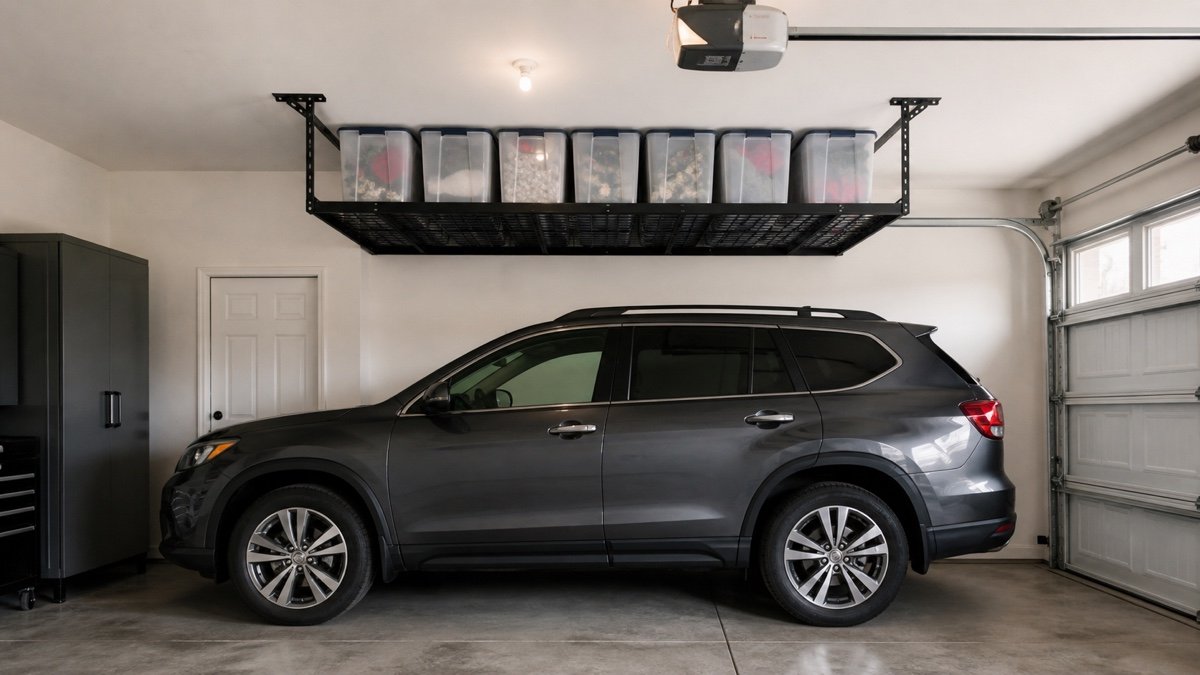
The best overhead garage storage racks fit the ceiling structure and the moving garage door before they hold a single tote. Capacity numbers matter, but they come later. A 4 by 8 rack may be a poor bargain when the opener, tracks, attic hatch, or tall vehicle forces it into the wrong bay. A smaller rack installed exactly as the manual describes can store more useful gear because people can load it without scraping a roof or leaning from a ladder.
This shortlist compares current published specifications from four rack families. It is a documentation-based fit guide, not a load test. Confirm the exact model, hardware, ceiling material, joist direction, and installation instructions before purchase.
Quick answer
Choose the Gladiator 4 by 8 GearLoft when you need the highest published capacity in this group and its 23 to 37 inch drop fits the bay. SafeRacks offers wider drop choices and brackets designed to span two wood joists. The Fleximounts GR48 is a strong value with a 750-pound rated load, while the GR48F lets you supply the deck. For a narrow obstruction-filled ceiling, Gladiator’s 2 by 4 or 2 by 8 formats are often the more sensible buy.
Best overhead garage storage racks at a glance
Every capacity below depends on correct installation and the manufacturer’s stated load distribution. The ceiling connection remains part of the system, so a larger number on the product page does not prove that your structure can carry it.
| Rack | Footprint | Published capacity | Drop range | Best fit |
|---|---|---|---|---|
| Gladiator GearLoft | 4 x 8 feet | 1,000 lb evenly distributed | 23 to 37 inches | High-capacity full bay |
| SafeRacks | 4 x 8 feet | 600 lb total | 12 to 24 or 24 to 45 inches | More drop choices |
| Fleximounts GR48 Classic | 4 x 8 feet | 750 lb rated | 22 to 40 inches | Six-post value option |
| Fleximounts GR48F | 4 x 8 feet | 600 lb with specified plywood | 22 to 40 inches | Owner-supplied deck |
| Gladiator smaller GearLoft | 2 x 4, 4 x 4, or 2 x 8 feet | 350 to 500 lb for cited small formats | 23 to 37 inches | Tight ceiling bay |
Use the overhead rack clearance calculator to compare rack drop, tote height, door position, and vehicle roof before ordering.
Gladiator 4 by 8 GearLoft for a high published capacity
Gladiator publishes a 1,000-pound evenly distributed capacity for its 4 by 8 GearLoft rack. The official product page lists a 96 by 48 inch platform, adjustable height from 23 to 37 inches, built-in decking, and up to 96 cubic feet of storage. The brand also lists a ten-year limited warranty.
This is the capacity pick for a large, open wood-framed ceiling bay where the installation instructions can be followed exactly. Built-in decking removes the separate plywood decision and gives bins a continuous supported platform. Yet 1,000 pounds above a car is not a target to chase. Keep the actual load modest, distribute it, and include the rack and every accessory when evaluating the structure.
The 23-inch minimum drop may be too low above a tall SUV or an open door. Draw the full vertical stack before assuming the largest model is best.
SafeRacks 4 by 8 for two useful drop ranges
SafeRacks lists its 4 by 8 rack at a 600-pound total capacity. The official page offers 12 to 24 inch and 24 to 45 inch ceiling-drop versions, includes five hooks, and describes ceiling brackets that span two wood joists. The manufacturer says installation into wood joists is required and specifically rules out I-beams, steel joists, concrete ceilings, and other nontraditional materials for this product.
The short-drop choice is useful over a vehicle when only low totes need to fit. The long-drop version suits high ceilings but brings the rack edge closer to heads, doors, and tall cargo. Select the range from measured clearances, not from maximum storage volume. The included hooks are a bonus only where hanging items cannot swing into people or paint.
This model is attractive when the bracket design suits the joist layout and a local professional installation option is available.
Fleximounts GR48 Classic for a 750-pound rated load
Fleximounts publishes the GR48 Classic at 96 inches long, 48 inches wide, and 22 to 40 inches high. Its official page states a 750-pound rated capacity after a 1,200-pound test and describes six vertical posts with long ceiling brackets. The listed joist conditions allow spacing up to 24 inches, with a separate 48-inch case described when joists are farther apart.
This rack offers a useful mix of drop range and capacity for a standard 4 by 8 footprint. Six posts can spread connection points, but they also demand more accurate ceiling layout. A post that lands on an opener rail is not solved by moving the fastener sideways. Shift the entire plan or choose another rack.
The test number is not the working capacity. Use the 750-pound rated figure, distribute the load, and follow the current manual. The ceiling may set a lower practical limit.

Fleximounts GR48F when you want to choose the deck
The GR48F is a 4 by 8 frame sold without decking. Fleximounts recommends a 4 by 8 sheet of plywood at least 3/8 inch thick and publishes a 600-pound capacity when the specified deck condition is met. The official product page gives a 22 to 40 inch drop and describes the same basic joist-spacing conditions.
This version appeals to someone who wants a solid surface, already has suitable material, or needs to finish the deck to match the room. It is not automatically cheaper after plywood, fasteners, finishing, transport, and cutting are counted. A solid deck also hides leaks and can trap small debris that falls through wire.
Use the deck thickness and attachment method in the current instructions. Do not replace the specified material with a thinner sheet because it feels stiff in your hands. The deck is part of the rated assembly.
Smaller GearLoft racks for awkward ceiling bays
Gladiator’s official overhead storage guide lists several smaller formats. The cited 2 by 4 rack holds up to 350 pounds, the 2 by 8 holds up to 500 pounds, and the 4 by 8 holds up to 1,000 pounds, all as evenly distributed loads. The smaller platforms use the same vertical space more selectively.
A 2-foot-deep rack can fit beside an opener or above a side aisle where a 4-foot platform would cross moving hardware. It also keeps the back row within reach. Deep racks tempt owners to shove forgotten boxes behind the front row, which makes every later retrieval a ladder shuffle.
Do not join separate racks or share supports unless the manufacturer explicitly provides that configuration. Two smaller units create more mounting points and may cost more, but they can respect the actual ceiling instead of fighting it.
Map joists before falling in love with a footprint
Find the ceiling structure named in the rack instructions. A stud finder is a starting clue, not proof of joist size, direction, or condition. Finished drywall can hide blocking, trusses, plumbing, wiring, and repairs. Confirm the layout by the method permitted for the building and installation. When anything is uncertain, use a qualified installer or contractor.
Mark every proposed ceiling bracket, then compare that pattern with the rack manual. Joist direction may force the platform to rotate. Some products permit parallel and perpendicular arrangements under different conditions. Others do not. Never improvise a plywood bridge or move a lag screw outside the bracket slot merely to miss an obstruction.
The existing overhead garage storage buying guide covers structure, load wording, access, and installation questions in more detail.

Measure door and vehicle clearance in their worst positions
Open the garage door fully and park the tallest vehicle beneath the proposed rack. Measure from the lowest rack edge, including hooks and hanging gear, to the highest vehicle point. Count roof rails, antennas, an open hatch, and anything carried on top. Then test the vehicle’s normal approach because suspension movement and a sloped driveway can change the roof path.
Keep the rack, bins, and straps clear of door panels, hinges, torsion components, tracks, opener rail, release rope, photo-eye wiring, and service access. The overhead storage clearance guide provides a repeatable measurement sequence. Do not use a photo of the closed door as evidence that the open door clears.
Add a human margin. The measured gap should survive an imperfect parking position and a bin that is not seated with millimeter precision.

Choose tote height before choosing rack drop
Measure the actual lidded tote at its highest point, including domed lids and handles. Add hand clearance so you can lift and slide it without scraping the ceiling. A shallow tote on a short-drop rack often works better above a vehicle than a tall tote on the lowest possible rack setting.
Use matching footprints where possible. Bins that overhang a wire deck can deform, snag, or load the platform poorly. Place the heaviest acceptable bins closest to an easy retrieval edge and keep contents modest enough for controlled ladder handling. Overhead storage is a poor home for liquids, dense metal parts, frequently used tools, or anything that leaks.
Label the visible end of every tote. A bin that must be rotated on the rack to identify it creates another overhead handling step.
Treat access as part of capacity
A rack can hold more than a person can safely retrieve. Plan the ladder position on the floor with cars, cabinets, and door tracks in their normal places. Use a stable ladder rated for the user and load, place it on a sound surface, and keep the body between the rails. If a bin requires reaching sideways, unload the path or change the layout.
Store seasonal decorations, empty luggage, folding chairs, and other light bulky items overhead. Keep weekly supplies on wall or floor storage. The garage storage planning guide helps assign items by frequency and reach.
Hooks under a rack deserve their own check. A bicycle or tool can reduce headroom and swing. The rack’s shelf capacity does not automatically describe an accessory hook or the way that hook changes loading.
A practical overhead rack buying checklist
- Confirm the ceiling structure and joist direction.
- Mark every bracket position and obstruction.
- Measure the open door, opener, tallest vehicle, and hatch.
- Choose the tote and required hand clearance.
- Read the rated load and distribution language for the exact model.
- Check deck material, accessory limits, and installation hardware.
- Plan a safe ladder position and retrieval route.
- Arrange help or professional installation before delivery.
Then buy the smallest rack that handles the intended group of items. Empty ceiling is not wasted space when it preserves door travel, service access, light spread, and a comfortable parking margin. A well-fitted 2 by 8 rack can beat a 4 by 8 model that nobody wants to load.
Useful products to compare
These links open current Amazon search results. Check the dimensions, manual, mounting hardware, warranty, and current availability for the exact model before you order.
Before you buy or install
Read the current manual for the exact product you are considering. Confirm its assembled dimensions, rated capacity, mounting requirements, included hardware, working clearances, warranty, and any limits that apply to your wall, floor, electrical circuit, or garage layout.
Frequently asked questions
How much weight can an overhead garage rack hold?
It depends on the exact rack, correct installation, load distribution, and ceiling structure. The models here publish totals from 350 to 1,000 pounds for specific formats. Do not treat a product rating as proof that your ceiling can carry that load.
Can an overhead rack go above a garage door?
Only when the rack, bins, supports, and accessories clear the door through its full travel and the installation follows the manual. Measure with the door fully open and keep service access to tracks, springs, opener parts, and release hardware.
Is a 4 by 8 overhead rack too large for a one-car garage?
Often, but not always. A one-car bay may have enough ceiling area yet lack vehicle, door, or ladder clearance. A 2-foot-deep rack is easier to reach and can fit beside an opener. Let the ceiling map choose the footprint.
What should never be stored on a ceiling rack?
Avoid leaking containers, very dense items, frequently used tools, fragile valuables, hazardous materials not approved for that storage, and anything you cannot lift safely from a ladder. Light seasonal gear is the better use.