
Affiliate disclosure: As an Amazon Associate I earn from qualifying purchases. This article may contain affiliate links, and Bay & Bench may earn a commission at no extra cost to you. Read our full Affiliate Disclosure.
A wall vacuum earns its space only when the hose reaches the mess and the tank remains easy to service. The best wall mounted shop vac for garage use may be a removable wet and dry canister, a fixed wet and dry detailing vacuum, or a dry bagged unit with a long hose.
This guide covers three models with current manufacturer product pages: Craftsman CMXEVBE17925, Bissell Garage Pro 18P03, and VacuMaid Garage Vac. It also examines two older formats without presenting them as current picks. Vacmaster’s VWM510 page is marked sold out, while Shop-Vac maintains a 5HM400 parts page rather than a current product listing. The best current choice still depends on the mess, hose route, and emptying routine.
Quick answer
Among the three current picks, the Craftsman CMXEVBE17925 is the flexible general choice because its five gallon wet and dry canister detaches from the wall and includes a 21 foot hose. The Bissell Garage Pro favors vehicle detailing with a 32 foot hose. VacuMaid is the fixed dry debris option. Vacmaster VWM510 and Shop-Vac 5HM400 remain useful design references, but neither is treated here as a current recommendation.
Best wall mounted shop vac for garage: current and legacy options
A wall bracket solves one problem, but it can create another if the tank is hard to empty or the hose stops short of the driveway. The table separates current manufacturer product pages from legacy references. Peak horsepower claims do not describe suction at the end of a long, bent hose, so they are not used as the ranking shortcut.
| Model or format | Status reviewed | Format | Wet pickup | Best fit |
|---|---|---|---|---|
| Craftsman CMXEVBE17925 | Current product page | Detachable five gallon canister | Yes | Mixed garage cleanup |
| Bissell Garage Pro 18P03 | Current product page | Fixed four gallon wall unit | Yes | Car interiors and broad reach |
| VacuMaid Garage Vac | Current product page | Fixed wall canister | No | Dry debris and detailing |
| Vacmaster VWM510 | Legacy format, sold out | Detachable wall wet and dry vac | Yes | Design reference only |
| Shop-Vac 5HM400 | Legacy format, parts page only | Five gallon wall utility vac | Yes | Parts and used unit reference |
Availability can change after publication. Confirm that a seller offers a complete new vacuum with the expected hose, filter, floor nozzle, and mounting hardware before ordering. A parts diagram or used listing is not proof of a current retail model.
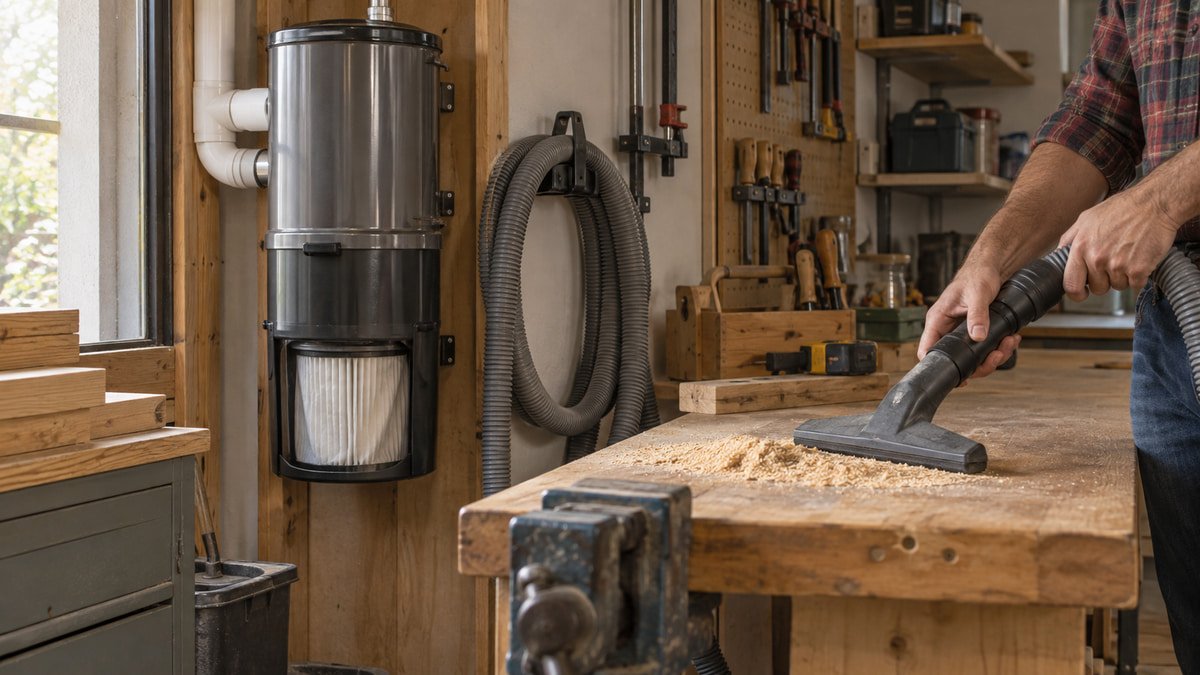
Decide between a fixed unit and a removable canister
A fixed garage vacuum is pleasant when most cleaning happens within one hose radius. Pull down the hose, clean, and coil it again. The body never rolls beneath the car or competes with bikes for floor space. Fixed units are especially tidy for dry bench debris and routine vehicle detailing.
A detachable wall mount wet dry vac gives up a little simplicity for range. You can carry the canister to a driveway spill, a clogged utility sink, or another room. The tradeoff is a bracket that must release without wrestling, plus a tank that still needs a sensible emptying route. Picture that route while planning your garage workshop layout.
Do not assume every wall vacuum can collect liquid. Dry only central style units use different bags and filtration. Feeding water into one can damage the machine and create an electrical hazard. The words wet and dry must appear in the documentation for the exact model, not merely in a reseller category.
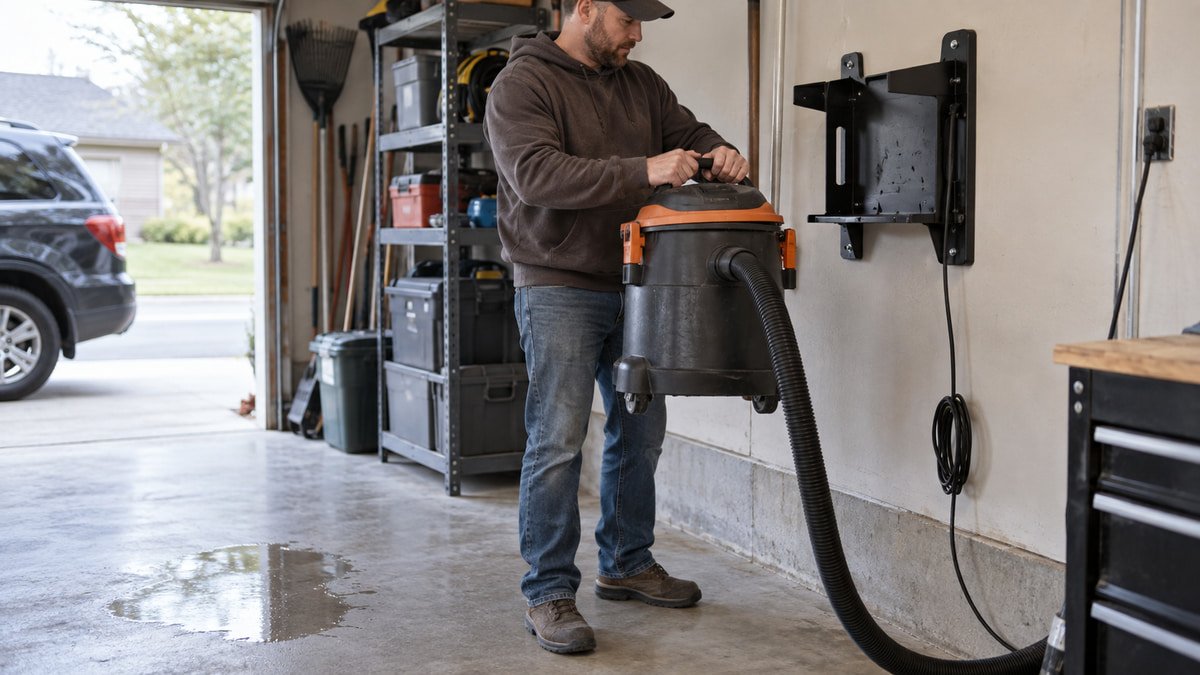
Craftsman CMXEVBE17925 for mixed cleanup
Craftsman’s CMXEVBE17925 product page describes a five gallon wet and dry vacuum that can be removed from its wall mount. The package includes a 21 foot hose, onboard accessory storage, and a three year limited warranty. That combination covers sawdust, floor debris, car interiors, and the occasional liquid pickup without dedicating a second vacuum to wet work.
The 21 foot hose is generous in a one car bay and may cover much of a compact two car garage from a central wall. Measure around the vehicle, not through it. Seats, bumpers, benches, and door openings all consume reach. If the hose must stretch tight, the wall position is wrong or the garage needs a removable unit more than a fixed one.
Five gallons is manageable for dry debris. A tank full of liquid becomes heavy, so the release height and drain route deserve the same attention as suction.
Bissell Garage Pro 18P03 for vehicle detailing
The Bissell Garage Pro 18P03 is built around reach. Bissell lists a 32 foot hose, an 11 amp motor, a four gallon dirt tank, seven tools, wet and dry pickup, and a blower function. A hose that long can reach the rear cargo area, front footwells, and workbench from one well chosen wall position.
Long reach has a cost. Every foot, bend, and small tool adds resistance, so the hose should be stored in broad loops rather than crushed behind a cabinet. The translucent tank helps with fill checks, yet the wall location still needs enough clearance to remove and empty it.
This model fits someone who cleans vehicles often and wants crevice, upholstery, and floor tools ready nearby. Review our garage wall storage guide before mounting it, because a 32 foot hose needs far more hanging area than the vacuum body suggests.
VacuMaid Garage Vac for dry debris
The VacuMaid Garage Vac takes a central vacuum approach. It mounts permanently, plugs into a standard grounded outlet, and is intended for dry pickup. The design makes sense for car interiors, tracked dirt, and wood chips when liquid collection is not part of the job.
A dry bagged unit can feel cleaner to empty than a small wet and dry canister because debris stays contained. Replacement bag availability matters, though. Check the exact bag and filter part numbers before buying, then see whether they are stocked from more than one reliable seller. A wall vacuum is inconvenient if a discontinued consumable sidelines it.
Installation details are covered in the company’s Garage Vac manual. Read the mounting and electrical instructions for the current package. A long hose places repeated sideways pull on the bracket, so fastening into the specified structure is more important than making the unit look centered between cabinets.
Legacy format: Vacmaster VWM510 detachable wall vac
The manufacturer’s current VWM510 page is marked sold out, so this model is a legacy format here, not one of the three current picks. Its removable wet and dry canister, wall bracket, remote handle, and long combined reach still show why this style became popular. Those old specifications should not be transferred to a different Vacmaster model.
If a new old stock or used VWM510 appears, verify that the hose set, nozzle kit, filters, bracket, and remote handle are present. Replacement filters deserve a separate check because a generic five gallon Vacmaster filter may not fit this particular model. A low purchase price loses its appeal when the wall hardware or a model specific consumable is missing.
A removable canister should come off the wall in one controlled motion. Reserve a clear rectangle around that release path. The same thinking used for safe workshop aisle clearance applies here: a door, drawer, or vacuum tank should not force the user backward into a parked vehicle.
Legacy format: Shop-Vac 5HM400 wall utility vac
Shop-Vac currently provides an official parts page for the 5HM400 wall mount series, not a current vacuum product listing. That makes the 5HM400 useful for identifying parts on an existing unit, but it is not one of this guide’s current recommendations.
Anyone considering a used example should match the catalog and model number to the diagram. Confirm that the wall bracket, hose supports, latches, filters, and wet pickup pieces are present, then price the missing parts before agreeing to buy. An accessible diagram helps, but it does not guarantee that every component remains stocked.
The old five gallon layout illustrates a straightforward wall utility format. Current buyers should compare that idea with the three models above instead of assuming a parts page means a complete new 5HM400 is available.
Hose reach matters more than the number on the carton
Measure a hose route with a flexible tape or an old extension cord. Begin at the proposed inlet, follow the wall to the floor, loop around the front of the vehicle, then reach the far seat or cargo corner. Add a little slack so the hose is not used as a tow rope. A nominal 20 foot hose can feel much shorter after furniture and turns are included.
Long hoses trade convenience for pressure loss. Keep bends broad, clear clogs promptly, and use the largest compatible hose for bulky chips. A small detailing hose is easy to snake between seats but clogs sooner on planer shavings. Some owners are better served by a main large hose plus a short reducer at the tool.
Store the hose where loops cannot slip into the aisle. A shallow reel, wide hook, or smooth hose saddle can share the wall with your broader garage storage system. Tight hooks and sharp cabinet corners eventually flatten flexible hose.
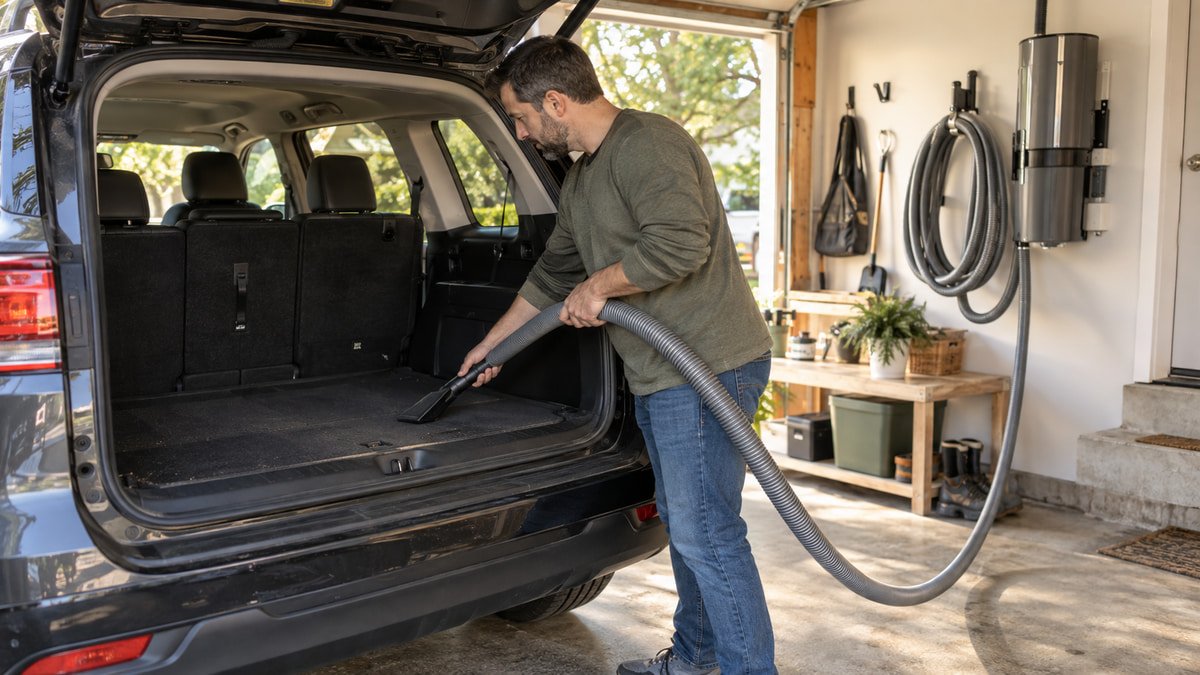
Match filters and accessories to the mess
Fine sanding dust, ordinary floor grit, pet hair, and water ask different things of a vacuum. For fine dust, use the manufacturer approved fine particle filter and bag combination. A bag can improve containment and keep the pleated filter cleaner. For wet pickup, remove or change components exactly as the manual directs. Never improvise around a filter that is not rated for liquid use.
Vehicle cleaning benefits from a soft dusting brush, a narrow crevice tool, and an upholstery nozzle. Workshop cleanup benefits from a wide floor nozzle and a hose large enough to pass chips. A blower port can clear leaves outside, but it also throws dust into the air if used inside.
Look at replacement cost before the machine cost. One uncommon cartridge purchased every year can erase a small purchase discount. Favor a model whose filters, bags, and hose cuffs have clear part numbers and remain easy to find.
Mount it where emptying stays easy
The ideal wall spot is near a grounded outlet, close to the dirt path, away from direct spray, and clear of doors and drawer fronts. It also needs the structure required by the manual. Drywall anchors alone are rarely a sensible answer for a machine that vibrates and gets tugged by a long hose. Use the specified framing or a properly secured mounting board.
Leave room beneath the tank for release, latches, and a collection bag. If wet pickup is likely, imagine carrying the loaded tank to a drain without stepping over a threshold. Do the same check with the garage door open and the car parked. Our garage measuring guide helps account for trim, tracks, and swing zones.
The best wall vacuum feels available, not trapped. When the hose lifts off in seconds, tools remain visible, and emptying is simple, the machine gets used. A more powerful unit hidden behind stacked totes does not.
Useful products to compare
These links open current Amazon search results. Check the dimensions, manual, mounting hardware, warranty, and current availability for the exact model before you order.
Before you buy or install
Read the current manual for the exact product you are considering. Confirm its assembled dimensions, rated capacity, mounting requirements, included hardware, working clearances, warranty, and any limits that apply to your wall, floor, electrical circuit, or garage layout.
Frequently asked questions
Are wall mounted shop vacs as powerful as rolling shop vacs?
Some are comparable for routine garage cleanup, but hose length and diameter affect suction at the tool. Compare current performance specifications, filter setup, and hose design rather than peak horsepower alone. A shorter rolling vacuum may feel stronger at the same motor class.
Can every wall mounted garage vacuum pick up water?
No. Only use liquid pickup when the exact model is marked and documented for wet use. Fixed central style garage vacuums may be dry only. Follow the manual for filter changes and tank emptying before collecting any liquid.
How long should a garage vacuum hose be?
Measure from the mounting point around obstacles to the farthest seat, bumper, or work surface, then add slack. Many one car garages work with about 20 feet, while a two car bay or vehicle detailing setup may benefit from 30 feet or more.
Where should I mount a garage wall vacuum?
Choose a framed wall position near a suitable grounded outlet and near the center of the cleaning area. Keep the tank release path, hose storage area, cabinet doors, and vehicle doors clear. Follow the manufacturer’s bracket height and fastening instructions.
Should I use a bag in a wall mount wet dry vac?
A compatible dust bag often makes dry fine debris cleaner to handle and protects the main filter. Bags are normally removed for wet pickup unless the manual says otherwise. Use only the filter and bag combination approved for the exact machine.