Affiliate disclosure: As an Amazon Associate I earn from qualifying purchases. This article may contain affiliate links, and Bay & Bench may earn a commission at no extra cost to you. Read our full Affiliate Disclosure.
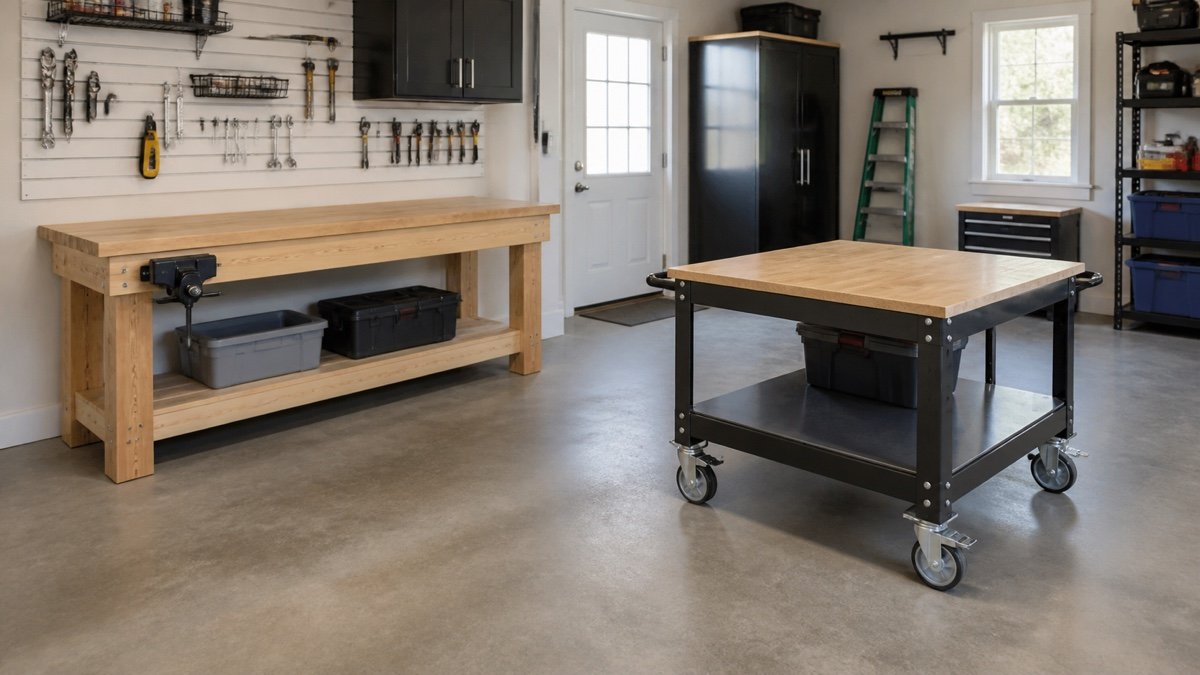
The mobile vs fixed workbench choice depends on how often your garage changes jobs. The wheels are only part of it. A rolling bench can move into open space for assembly, then return to the wall before the car comes home. A fixed bench is ready without a setup ritual and gives a vise or mounted tool a steady home. Mobility loses its appeal when the loaded bench is difficult to start, the slab has joints and slopes, or every move requires clearing cords and loose tools. Fixed placement becomes frustrating when a long project needs access from all sides or when the same floor area must serve parking. Compare the two formats with the bench fully loaded, the vehicle parked, and the normal work route open. Loaded movement across your own floor is the test that matters.
Quick answer
Choose a fixed workbench when stability, a permanently mounted vise or tool, immediate readiness, and wall services matter most. Choose a mobile workbench when shared parking space, access around wide projects, and layout changes are routine. Test a secured representative load across ordinary floor joints, follow the caster instructions, and stop before any unsafe slope. A hybrid setup often works well: one fixed wall bench for forceful work and a smaller rolling table for assembly or temporary support.
Mobile vs fixed workbench decision matrix
| Decision point | Mobile workbench | Fixed workbench |
|---|---|---|
| Access around a project | Can move into open space when the route is clear | Usually limited to front and side access |
| Forceful work | Depends on caster locks, leveling feet, frame stiffness, and floor | Can use fixed feet and approved wall or floor restraint |
| Parking conversion | Can leave the bay, but needs a storage position | Always consumes its assigned footprint |
| Mounted tools | Cords, top weight, vibration, and movement need planning | Stable service location is easier to maintain |
| Setup time | Route clearing, wheel locking, and leveling may repeat | Ready at the same position |
| Floor sensitivity | Joints, slope, debris, and thresholds affect movement | Leveling and anchoring matter, but daily rolling does not |
Neither format wins every row. Circle the two rows that affect your weekly work, then test those conditions in the actual garage.
A fixed bench stays ready for repeat work
A fixed workbench stays connected to its light, power, dust hose, wall storage, and vise. You can begin a ten minute repair without rolling, locking, leveling, or reconnecting anything. That lack of setup is easy to undervalue.
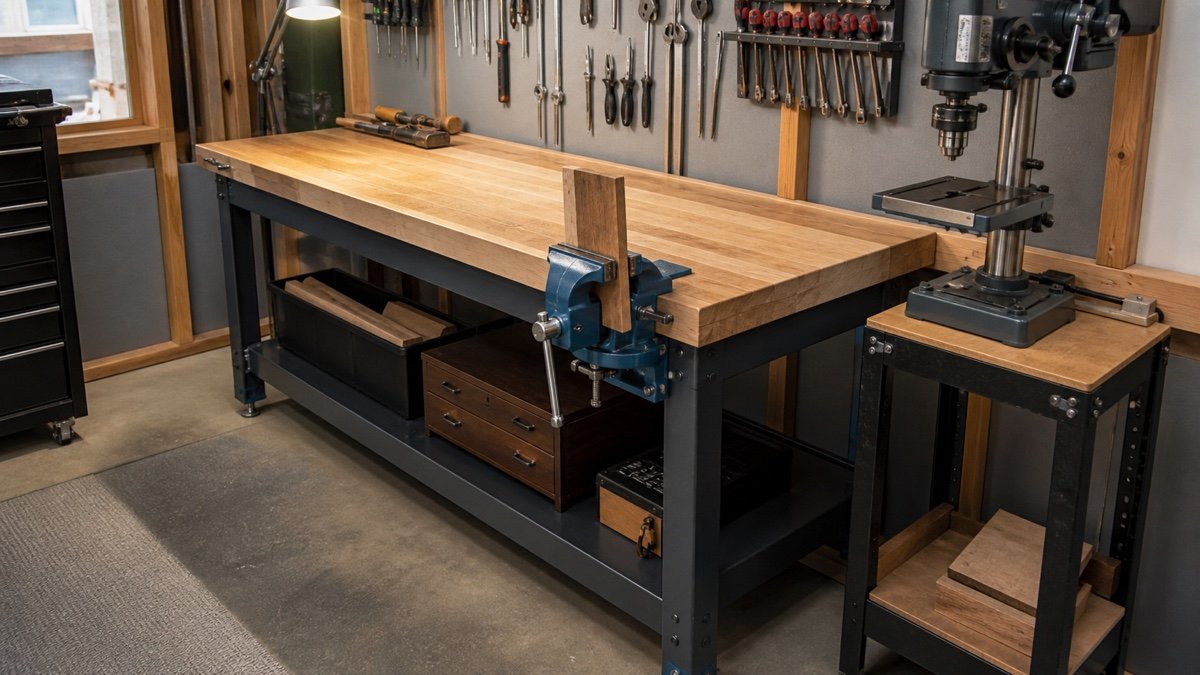
Fixed feet also give the frame a direct path to the floor. If the bench and building structure allow approved restraint, the setup can resist racking during planing, filing, or vise work better than a casual rolling cart. Follow the bench and anchor instructions. A wall finish alone does not prove that a fastening point is suitable.
The cost is permanent space. Measure the full working envelope, including the cabinet, vise handle, clamped board, open drawer, stool, and your body. Each part can project into the aisle. Use the garage workbench buying guide to compare top, frame, storage, and mounting after the basic format is chosen.
A mobile bench has to move well when loaded
A mobile bench makes sense when it moves often enough to justify its compromises. It can become an island for a cabinet door, support long stock near another tool, or clear a parking bay. Access from four sides can make a moderate top feel more useful than a deeper wall bench.
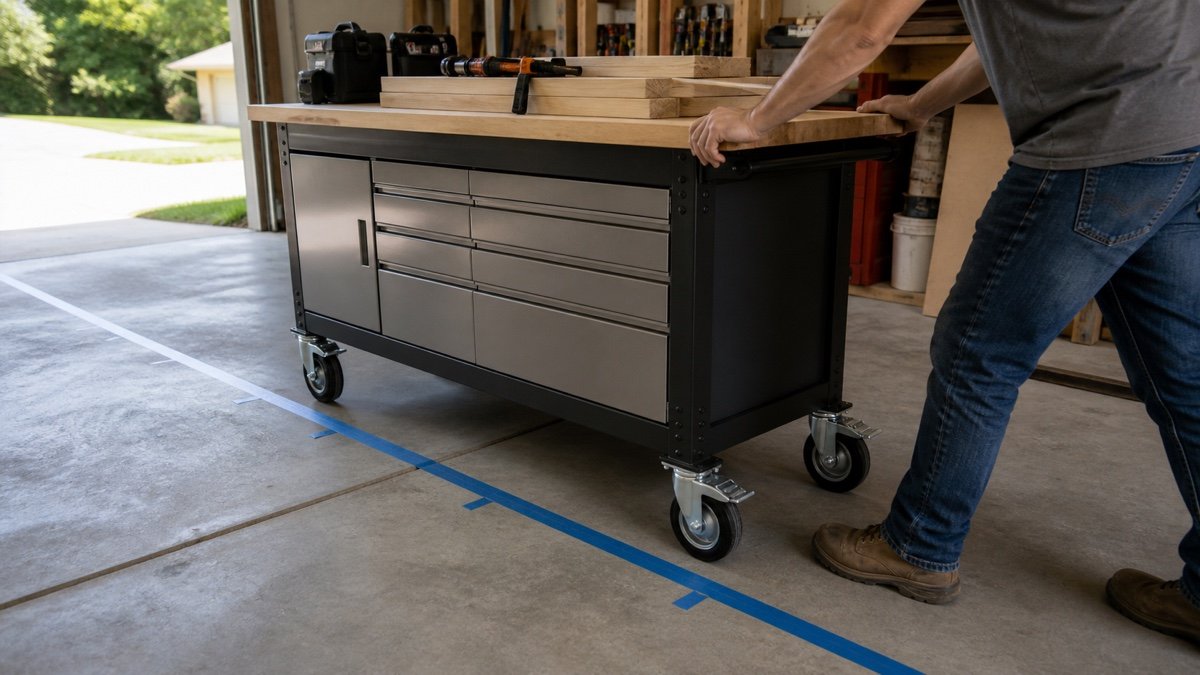
The bench must still have a destination. Mark both its working position and its parked position. Then draw the route between them. Door tracks, car mirrors, floor joints, shelving feet, and stored bins can turn a short move into a slow shuffle.
Wheel diameter, tread, bearing, total load, and floor condition affect how easily the bench starts and rolls. Hamilton Caster’s selection guidance notes that larger wheels generally roll more easily and that uneven floors, shock loads, moisture, and debris change the application. Use the caster maker’s data for the exact load and conditions rather than judging by wheel appearance.
Stability has several weak links
Locking the wheels leaves several other sources of movement. Some brakes stop wheel rotation but allow the swivel to pivot. Some total locks secure both motions. Frame flex, wheel play, mounting plate movement, top overhang, floor slope, and a high center of gravity can still produce movement.
Test the same direction of force the work will create. A vise on the corner loads the bench differently from sanding near the center. Press lightly at the front, side, and diagonal while the bench is empty, then repeat with a secured representative load. Stop if a caster lifts, the frame racks, or hardware shifts.
Leveling casters or retractable wheel systems can place the bench on feet during work and on wheels during movement. They add cost, height, and hardware that needs inspection. Confirm their combined rating and installation requirements. Do not improvise a lift mechanism around a bench that was not designed for it.
The garage floor can settle the question
Walk the proposed route slowly and inspect every joint, crack, drain, threshold, patch, and slope. Sweep it, then test again after normal garage use. A wheel that rolls well on clean polished concrete may catch when the floor carries sawdust or a small screw.
Sloped garage slabs can make an unlocked bench move and can shift weight toward fewer casters. Brakes are parking devices, not permission to work on an unsafe incline. Check the caster and bench instructions for slope limits, brake use, and required leveling.
A fixed bench avoids daily travel but still needs a stable bearing surface. Check each foot, use the approved leveling method, and keep water away from materials that cannot tolerate it. The garage measuring guide includes floor and obstruction checks that apply to either setup.
Parking and project space need separate drawings
A rolling bench saves parking space only if its parked location does not block something else. Tape the working footprint, the parked footprint, and the entire route. Park the vehicle, open its doors and hatch, then move a box along the normal path to the house.
Use the garage storage fit calculator to compare the main rectangles, but add moving envelopes by hand. A swiveling caster can swing beyond the frame. A vise handle and a long workpiece can turn a compact cart into a wide object. Keep required access clear around doors, utilities, and electrical equipment.
A fixed bench asks for only one permanent zone, although the user and project still need space in front. If that zone never conflicts with parking, mobility may add work without solving a problem. If every fixed location blocks a recurring task, wheels may be worth the routine.
Mounted tools favor predictable support
A heavy vise, grinder, drill press, or other benchtop machine changes the center of gravity and the force entering the frame. Read both manuals. Confirm top thickness, bolt pattern, edge distance, support, capacity, and whether the bench must be secured. A strong tool does not make a light cart suitable.
Fixed placement simplifies cords, task lights, and dust connections. Route them so they do not cross a walking path or contact moving parts. A mobile station needs a deliberate disconnect and storage routine. Never roll the bench with a live cord trailing behind it.
Mobile mounting can still work when the tool and bench are designed for it. Keep loose accessories in closed storage, lower the table or head if the manual calls for it, and secure anything that can shift. Move slowly from a position where you can see the route. If a machine has its own stand requirements, those instructions govern.
Run a loaded mobility test
- Estimate or weigh the empty bench, drawers, tools, mounted equipment, and normal project.
- Secure the load and close every drawer and door.
- Clear the route and remove cords, hoses, scraps, and floor debris.
- Unlock the correct wheel and swivel controls.
- Push slowly from the frame, not from a drawer pull or project.
- Cross each joint in both directions and make the tightest normal turn.
- Park, lock, level if required, and check movement at the work surface.
If the bench needs a hard shove, catches at a joint, or cannot turn without striking storage, it is not practically mobile for that load and route. Reducing the load may help. A smaller assembly cart may be a better companion to a fixed bench than one very heavy rolling station.
Hybrid layouts often waste less effort
A fixed wall bench can hold the vise, dense tools, chargers, and task light. A lighter rolling table can handle assembly, outfeed support, or temporary projects in open space. Each unit does the job that suits its format.
The garage storage planning guide helps place daily work, mobile equipment, and stored gear into separate zones. The broader garage storage systems guide can keep the rolling route free instead of letting totes and sports gear creep into it.
Before buying either style, compare the complete dimensions, loaded capacity wording, top attachment, wheel or foot hardware, brake type, drawer latches, handle position, and warranty. A mobile bench should remain easy to move after it is useful. A fixed bench should earn the floor it occupies by being stable and ready. If neither statement is true in the mockup, revise the layout first.
Useful products to compare
These links open current Amazon search results so you can compare dimensions, manuals, ratings, and availability for the exact models on your shortlist.
Before you buy or install
Check the current manual for the exact product you are considering. Confirm the assembled dimensions, load rules, mounting requirements, included hardware, clearances, warranty, and any limits that apply to your wall, floor, or garage layout.
Frequently asked questions
Is a mobile workbench stable enough for a vise?
Some are, but the frame, top, caster system, floor, vise position, and manufacturer instructions all matter. Test controlled force in every direction and stop if the bench racks or a wheel lifts.
Do locking casters make a workbench stationary?
They reduce movement, but lock designs differ. A wheel brake may not stop swivel motion, and play can remain in the frame or mounting. Leveling feet or a retractable system may feel steadier when approved.
When is a fixed workbench better?
A fixed bench is usually better when forceful work, mounted tools, wall services, and immediate readiness matter more than changing the layout.
Can one garage use both bench types?
Yes. A fixed bench can hold the vise and dense tools, while a lighter rolling table handles assembly or temporary support. Keep a clear route and a defined parking place for the mobile unit.