Affiliate disclosure: As an Amazon Associate I earn from qualifying purchases. This article may contain affiliate links, and Bay & Bench may earn a commission at no extra cost to you. Read our full Affiliate Disclosure.
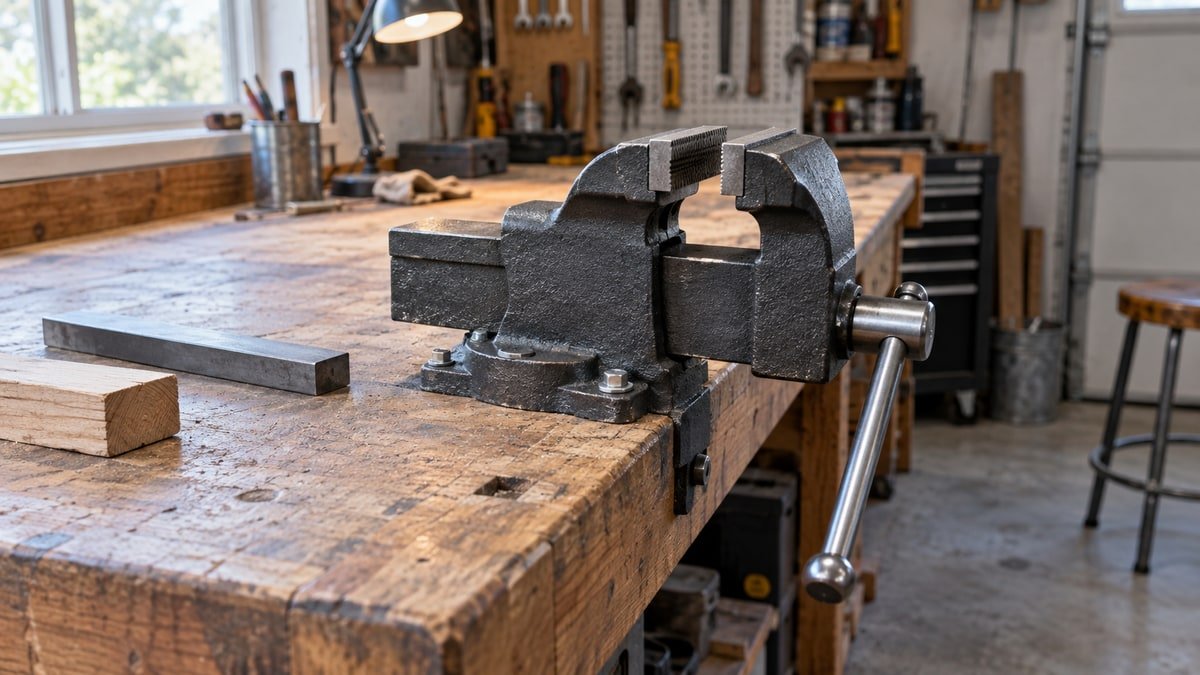
A useful workbench vise size guide has to cover more than jaw width. The familiar 4, 5, and 6 inch labels describe the width of the top jaws, but they do not tell you how far the vise opens, how deeply it grips, what its base will cover, or whether the bench can handle the weight. Two 5 inch models may feel like completely different tools.
For a typical home garage, a 5 inch mechanics vise is the safest general recommendation. A 4 inch model suits lighter repairs and a small bench. A 6 inch vise makes sense for heavier, wider stock when the worktop and mounting structure are stout enough. This guide starts with the jobs, then checks the dimensions that tend to surprise buyers after delivery.
Quick answer
A 5 inch bench vise fits most home garage work because it has useful jaw area without overwhelming a normal workbench. Choose 4 inches for light hobby work and limited bench space. Choose 6 inches for larger metal parts, pipe, and heavier work within the manufacturer’s limits when the bench, top, mounting bolts, and floor stance can control the extra weight and leverage.
Workbench vise size guide at a glance
Size the vise to the hardest regular job, not the biggest object that might appear once. Long stock can extend beyond modest jaws. Thick stock cannot fit if the opening or throat is too small.
| Nominal jaw width | Good garage fit | Typical limitation | Bench demand |
|---|---|---|---|
| 4 to 4 1/2 inches | Small repairs, hobby parts, mower blades | Less jaw area and mass | Compact bench with sound mounting point |
| 5 to 5 1/2 inches | General repair, fabrication, pipe work | Too heavy for some folding benches | Solid top and rigid base |
| 6 inches | Larger parts and more forceful work | Weight, cost, and large footprint | Heavy bench anchored or very stable |
| Reversible jaw model | Occasional wide clamping | More moving interfaces | Room for full body rotation |
| Woodworking front vise | Boards and furniture parts | Poor substitute for a mechanics vise | Compatible apron and wooden jaw liners |
This is a starting point, not a load chart. Materials and castings vary. The garage workbench buying guide helps check whether the bench beneath the vise is suitable in the first place.
Jaw width is only the name on the box
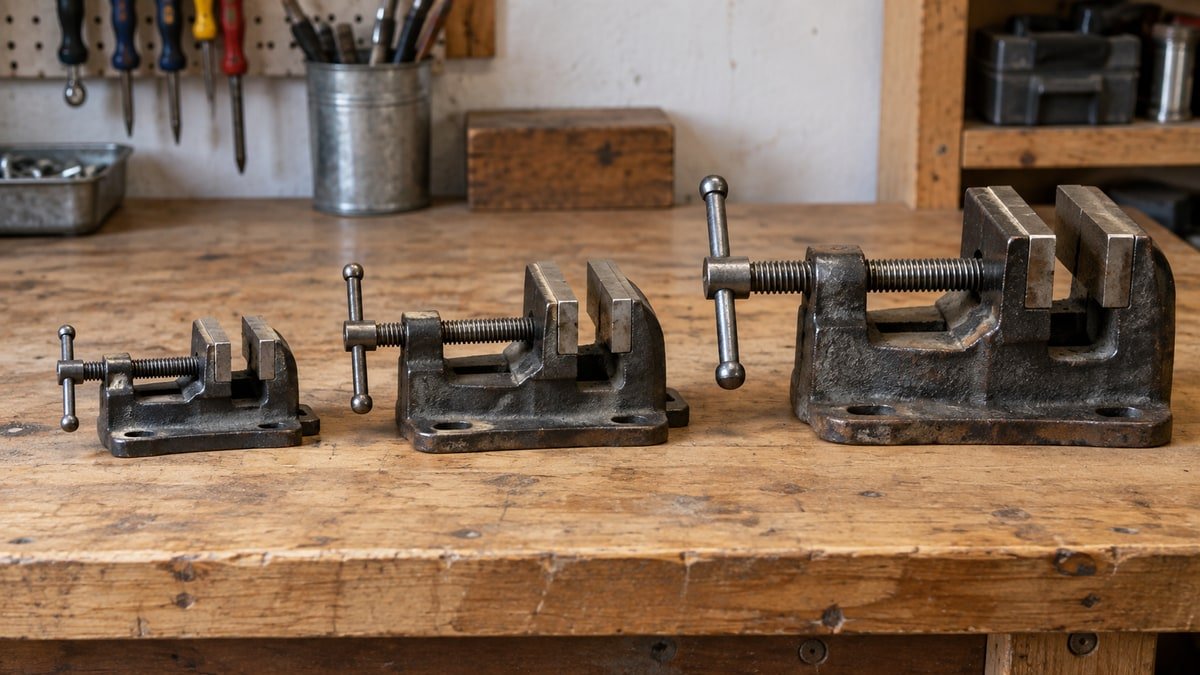
Jaw width is the left to right length of the replaceable gripping face. Wider jaws spread force over more of the part and can hold a wider piece with less tendency to twist. That does not mean a 6 inch vise automatically opens 6 inches. Opening is measured between the jaws when the screw is backed out to its allowed limit.
Throat depth runs from the top of the jaw down toward the slide or screw body. More throat gives a deeper bite on a plate. Pipe capacity describes a separate set of jaws on combination vises. Each number answers a different question, so write the thickness, width, and shape of five recurring workpieces before comparing models.
Yost’s official LV-4 homeowner vise page is a useful example. It lists 4 1/2 inch jaw width, 3 inch opening, and 2.6 inch throat depth. Those numbers are close, but they are not interchangeable.
A 4 inch vise works for light garage jobs
A 4 or 4 1/2 inch vise belongs on a compact bench used for sharpening mower blades, holding brackets, cutting threaded rod, light bicycle repairs, and hobby fabrication. It takes less room near the edge and usually weighs less than a full 6 inch mechanics model. That can be the right balance in a one car garage where the bench also folds or rolls.
Small does not mean disposable. Look for replaceable jaws, a smooth screw, firm base locks, and a casting intended for the job. A cheap swivel that lifts under load is more frustrating than a fixed base. Pipe jaws are useful only if their stated diameter range matches the tubing you handle.
The limitation appears when hammering, bending, or gripping a wide plate. A small vise offers less mass and less contact area. Instead of adding a pipe to the handle for more force, move the job to a more suitable vise. Extending the handle can damage the screw, nut, casting, or workbench.
A 5 inch vise is the practical middle
Five inch jaws suit a broad mix of home maintenance and light fabrication. The vise can grip suspension brackets, angle iron, pipe, lawn equipment parts, and ordinary project stock without occupying the whole corner. It also has enough body mass to feel settled during filing and sawing when the bench is rigid.
There is still a wide range inside this class. The Yost MV-5 product page lists 5 inch jaws, a 2.9 inch maximum opening, and a 2.62 inch throat. Another 5 inch model can open much farther and weigh several times as much. Read the whole specification table.
A medium vise also suits the common 24 to 30 inch deep worktop. Use the workbench depth comparison to make sure the body, swivel base, and rear jaw will not steal the main assembly area.
A 6 inch vise needs a serious bench
Six inch jaws are helpful for wider stock and jobs that benefit from more mass. The larger body often brings a wider opening, deeper throat, bigger pipe jaws, and a broad anvil. Those gains come with a mounting footprint and weight that can surprise anyone shopping from a close product photo.
A thin worktop may flex before the vise reaches its useful range. A folding leg can rack sideways when a long pipe is pulled. Mobile benches need locked casters and enough wheelbase to resist tipping. If the bench moves during ordinary filing, adding a heavier vise makes the problem worse.
Check how the work height changes too. Taller jaws raise the clamping line. Our garage workbench height guide explains how task height affects posture. A bench that already feels high for sawing may become uncomfortable with a large vise sitting several inches above the top. The official Yost ADI-6 product page shows the mounting footprint, weight, opening, and throat figures that should be checked on a current 6 inch candidate.
Material and construction matter as much as size
Cast gray iron is common in homeowner vises and can be perfectly useful within its intended duty. Ductile iron and forged steel designs are usually chosen where impact and demanding service justify higher cost. Marketing strength numbers describe the material or a test condition, not permission to use the vise as a press or striking block.
Compare the screw, nut, slide guidance, jaw attachment, and swivel lock. Replaceable serrated jaws extend service life. An enclosed screw keeps some grit away from the threads. Two base locks can hold rotation more evenly than one small lock, provided both are accessible after mounting.
The official Yost 205 page shows how a heavy 5 inch machinist vise differs from a homeowner model. It lists a ductile iron body, four mounting holes, replaceable jaws, and a far larger overall body. Nominal width alone would hide most of that difference.
Mount the vise at a useful bench corner
Right handed users often place a mechanics vise near the front left corner, while left handed users may prefer the opposite. The correct side is the one that lets the dominant hand file, saw, or turn a wrench without the bench blocking the work. Long stock should project into open space instead of crossing a doorway.
Set the fixed jaw slightly beyond the bench edge so vertical pieces can hang without hitting the apron. Then rotate the swivel through its full range. Check handle travel, base locks, drawers, doors, and anything stored below. A vise that clips a cabinet handle every half turn will stay locked in one awkward position.
Placement belongs in the room plan. Review where to put a workbench in a garage before drilling holes, especially when a car door or the path into the house passes near the vise.
Use through bolts and a sound load path
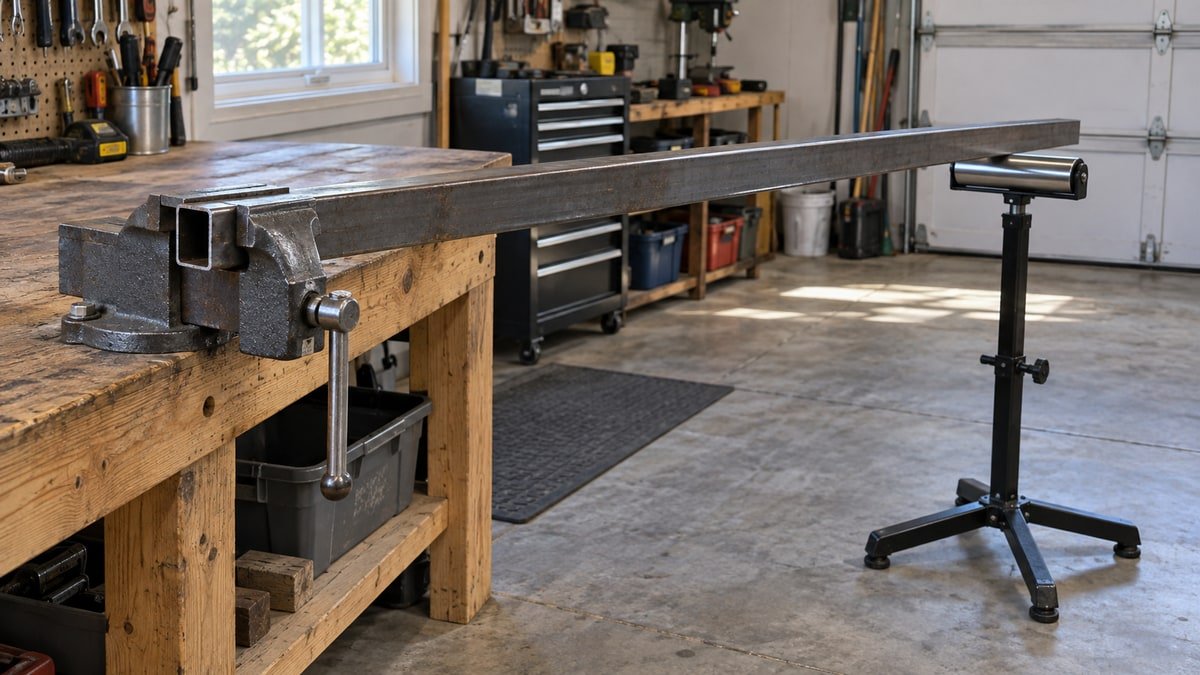
The manual for the exact vise controls mounting hardware and hole pattern. Many permanent bench vises belong on through bolts with washers and locking nuts rather than short lag screws in particleboard. A broad steel plate or hardwood backing block can spread load under a suitable wood top, but it cannot repair a weak, wet, or delaminating bench.
Position holes away from a fragile edge and avoid drilling through hidden fasteners. The rear jaw should sit where the base and worktop carry force into legs or a stout frame. After the first few jobs, check bolt tightness. Wood can compress beneath washers, especially on a soft laminated top.
Do not assume mounting hardware comes with the vise. Product pages often specify hole diameter while leaving bolt selection to the installer. Match fastener grade, diameter, length, washers, and nuts to the maker’s directions and the bench construction. Ask a qualified fabricator or carpenter when the load path is unclear.
Plan for pipe jaws, soft jaws, and odd shapes
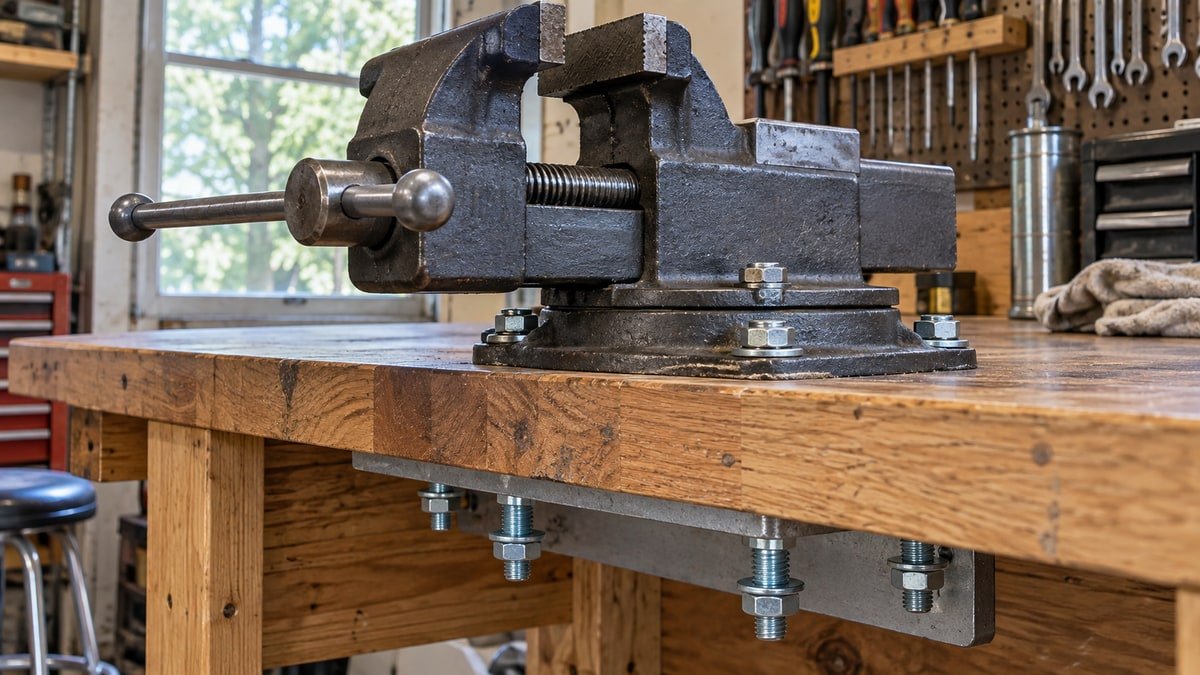
Combination vises put serrated pipe jaws below the main jaws. They are handy for steel pipe and round stock within the stated diameter range. Thin wall tubing can crush before it feels secure, so use the correct jaws and modest force. Plumbing parts with finished surfaces may need another clamping method.
Magnetic soft jaws protect aluminum, brass, plastic, wood, and finished parts. Rubber faces add grip. Aluminum faces tolerate more heat, while fiber or wood liners suit delicate surfaces. Covers reduce the available opening and may shift the work higher, a small detail that matters when the vise is already near its limit.
For boards, a woodworking front vise or holdfast may be better than a mechanics vise with jaw pads. The best clamping system can use more than one tool. Keep accessories visible in the garage tool storage layout so the soft jaws get used instead of lost behind the vise.
Leave room to work around the vise
A vise pulls the user toward the bench edge. Filing and hacksawing also create an elbow arc. Leave a clear stance in front and a route for long stock beside the bench. If the garage shares space with a vehicle, test the setup with the vehicle parked and its doors open.
Floor clutter becomes more dangerous when both hands are controlling a part. Air hoses, extension cords, and scrap should not cross the stance area. The garage workshop aisle clearance guide can help protect the route past the bench without demanding an empty showroom.
Think about sparks and filings before choosing the corner. A vise used for grinding should not sit beside stored fuel, paper, a battery charger, or a vehicle covered in polishing towels. A removable mounting plate can move the vise outdoors for dirty work if the receiver is engineered for the forces involved.
Inspect the vise before every forceful job
Look for loose mounting bolts, cracks, jaw screws backing out, a bent handle, gritty screw travel, or a swivel base that will not lock evenly. Clean chips from the slide and lubricate only where the manual directs. Oil on the jaw faces can reduce grip and migrate onto the workpiece.
Use the handle by hand. A cheater pipe creates forces the designer did not intend. Do not strike the vise body unless the manufacturer identifies a surface and operation for that purpose. The small anvil on some models is useful for light forming, but it is not a replacement for a supported anvil.
Wear eye protection when cutting, striking, brushing, or grinding clamped work. Support long or heavy material at the far end. A vise holds one point; it does not make an unbalanced part harmless. Stop if the bench lifts, wheels move, or the casting makes a new sound.
Make the final size choice with five measurements
Record the widest regular workpiece, thickest regular workpiece, desired throat, available base footprint, and clear handle radius. Add the vise weight to the decision. Then compare those numbers with the dimensional drawing for each candidate, including the mounting holes and the body behind the fixed jaw.
A small garage does not automatically need a small vise. A compact but rigid bench may carry a quality 5 inch model beautifully. A huge bench does not need a 6 inch vise if the work is limited to mower blades and brackets. The jobs should decide.
For most mixed home repair, pick a well made 5 inch vise and mount it properly. Step down when portability and light work dominate. Step up only when the workpieces, forces, and bench structure all support the move. That approach costs less than buying a large casting that never finds a comfortable place to live.
Useful products to compare
These links open current Amazon search results. Check the dimensions, manual, mounting hardware, warranty, and current availability for the exact model before you order.
Before you buy or install
Read the current manual for the exact product you are considering. Confirm its assembled dimensions, rated capacity, mounting requirements, included hardware, working clearances, warranty, and any limits that apply to your wall, floor, electrical circuit, or garage layout.
Frequently asked questions
What size vise is best for a home workbench?
A 5 inch mechanics vise covers a useful range of home repair and light fabrication without the bulk of many 6 inch models. A 4 inch vise is enough for lighter hobby work. The right choice still depends on opening, throat depth, body weight, and whether the bench can support the mounting forces.
Does a 5 inch vise open 5 inches?
Not necessarily. Five inches usually describes the jaw width. Maximum opening is a separate specification, and it may be smaller or larger depending on the design. Check the official dimensional drawing or product page for jaw width, opening, throat depth, pipe capacity, and base footprint.
Can I mount a bench vise with wood screws?
Use the mounting method stated by the vise manufacturer and suited to the workbench. Many permanent vises need through bolts, broad washers, and locking nuts. Short screws in a thin composite top can pull out under leverage. A backing plate spreads force but does not rescue damaged material.
Should the fixed jaw extend past the workbench edge?
A slight extension often lets long vertical work hang clear of the bench apron. The complete base must remain fully supported, and all specified mounting holes need sound material beneath them. Test swivel movement, handle travel, drawers, and the working stance before drilling.
Is a cast iron bench vise strong enough for garage work?
A sound cast iron vise used within its stated duty can handle many homeowner jobs. Ductile iron or forged steel may be better for demanding impact and professional service. Construction quality, screw design, mounting, and correct use matter alongside the material name.