Tag: ceiling storage

  • Best Garage Ceiling Storage Lift: 5 Smart Picks

    Best Garage Ceiling Storage Lift: 5 Smart Picks

    Affiliate disclosure: As an Amazon Associate I earn from qualifying purchases. This article may contain affiliate links, and Bay & Bench may earn a commission at no extra cost to you. Read our full Affiliate Disclosure.

    The best garage ceiling storage lift brings seasonal totes down to a safe loading height, raises them above the parking zone, and stops before cargo reaches the door tracks or ceiling. Motorized systems add remote or wall controls. Manual systems use a drill or crank and avoid another powered motor overhead.

    Capacity is only one part of the decision. Platform size, lifting travel, minimum stored height, joist direction, opener position, and emergency lowering all matter. A four by eight platform can hold plenty of light household gear, yet it also occupies the same ceiling rectangle as two sheets of plywood. This guide compares five current lift styles and walks through the measurements that should happen before installation.

    Quick answer

    Auxx-Lift offers the widest range of platform sizes and capacity configurations, while Auxx-One is a simpler single motor option for loads up to 400 pounds. GarageSmart’s 4 by 4 lifter fits a smaller ceiling bay and uses app controls. ONRAX Ascension suits buyers who prefer a keyed wall control. The E-Z 4 by 8 lift is the straightforward drill powered choice with no dedicated outlet or app.

    Best garage ceiling storage lift choices at a glance

    The figures below come from current manufacturer pages, but capacity can change with platform size, motor count, cable layout, and installation kit. Match the exact model and manual before purchase. Never transfer the headline capacity from one configuration to another.

    PickPlatform choicesPublished cargo or system capacityOperationBest fit
    Auxx-Lift3 by 6 through 4 by 8 feet400, 600, or 800 pounds by setupMotorized remoteConfigurable large storage
    Auxx-OneMultiple platform packagesUp to 400 poundsSingle motor remoteSimpler powered lift
    GarageSmart 4 by 44 by 4 feet400 pound system, 365 pound cargoMotorized app controlCompact smart platform
    ONRAX Ascension3 by 4 through 4 by 8 feet400 poundsMotorized wall controlKeyed fixed controls
    E-Z 4 by 8 lift4 by 8 feet400 poundsDrill poweredNo outlet or app needed

    Capacity includes more than the totes. Some makers state cargo capacity after subtracting the platform, while others publish a total system rating or offer different ratings by motor package. Read the definitions closely and stay within every component limit.

    Measure the moving volume, not one ceiling rectangle

    Mark the platform outline on the floor, then imagine that rectangle moving from loading height to the ceiling. Nothing may enter that column: the car roof, an open hatch, a raised garage door, shelves, lights, opener rail, people, or a ladder. Cargo can extend above the deck, so measure the tallest loaded tote too.

    Our garage measuring guide helps capture wall offsets and obstructions. The more specific overhead storage clearance guide covers doors, vehicles, and the usable zone near the ceiling. Record measurements with the door open and closed because its panels occupy different positions during travel.

    Check the lowest point on the platform, not the ceiling height. Motors, cable drums, frames, and deck structure consume vertical room. A lift that stores close to the ceiling can leave more headroom, while another may hang nearly two feet even when empty.
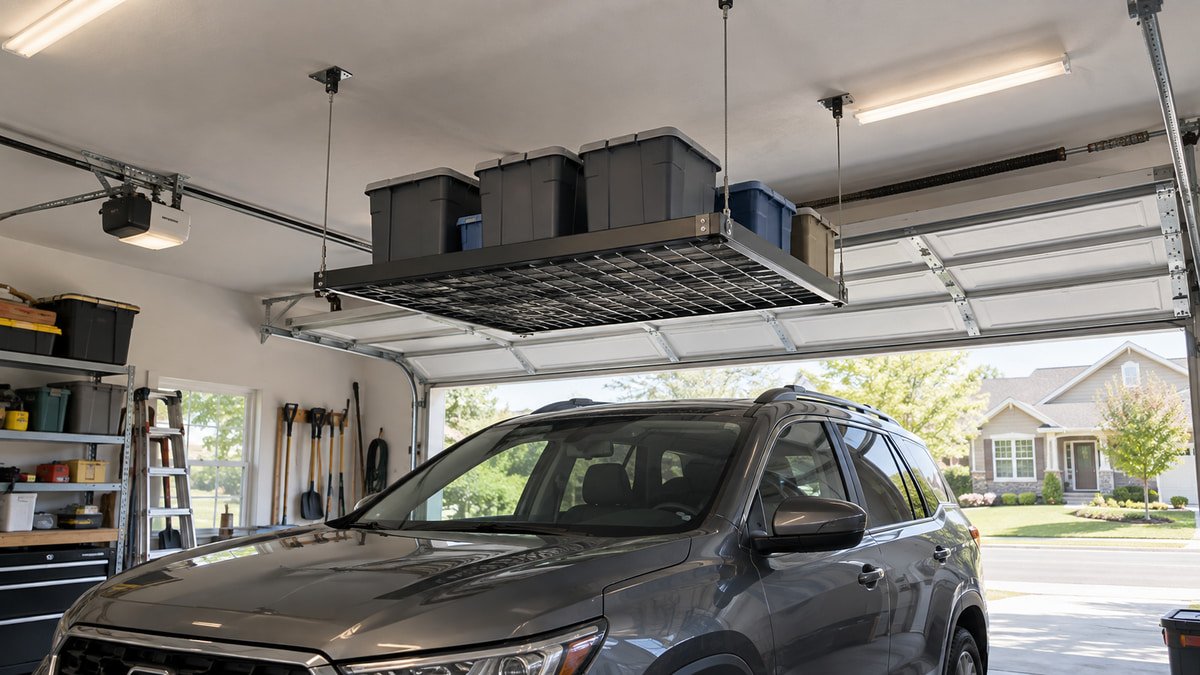
    Ceiling storage lift raised above an SUV with clear door track space
    The raised platform must clear the vehicle, open door, tracks, opener, lights, and carried cargo.

    Auxx-Lift for configurable platform size and capacity

    The Auxx-Lift comes in 3 by 6, 3 by 8, 4 by 6, and 4 by 8 foot formats. The maker lists 400, 600, and 800 pound capacity configurations, depending on platform and motor setup. It operates from 120 volt power with a remote, and Auxx-Lift publishes a minimum stored height of eight inches for specified arrangements.

    This range makes it the strongest choice when the ceiling bay is unusual or the owner wants more than a 400 pound class. More capacity also raises the installation stakes. Joist position, fastener pattern, motor spacing, cable geometry, and electrical routing need to match the selected manual.

    Use the platform for evenly distributed household storage within its rating, not as a person lift or vehicle service device. Heavy items still need to be raised onto the lowered deck, so a high capacity number does not make dense equipment easy to handle.

    Auxx-One for a simpler powered lift

    The Auxx-One is the streamlined sibling. Auxx-Lift describes one motor, an E-beam structure, remote operation, 120 volt power, and capacity up to 400 pounds. A 22 foot travel option is available for tall spaces, which can suit a lofted garage or high ceiling installation.

    One motor reduces the number of powered units to coordinate, but the complete cable and platform system still has to remain level. Follow the balancing, limit setting, and inspection procedures for the exact configuration. A platform that begins to tilt should be stopped and checked before another cycle.

    This model fits a homeowner who wants powered convenience without selecting a multi-motor high capacity package. Compare its stored height, platform kit, control method, and installation needs with the full Auxx-Lift. The cheaper or simpler motor arrangement may not be the better fit when ceiling obstructions dictate cable positions.

    GarageSmart 4 by 4 for a compact smart platform

    The GarageSmart 4 by 4 Platform Storage Lifter targets a smaller ceiling bay. GarageSmart lists a 400 pound system capacity with 365 pounds available for cargo after the 35 pound platform. Published travel is 11 feet 9 inches, and the empty hanging height is 18 inches. Control comes through the company’s Bluetooth connected system and app.

    A 4 by 4 platform fits where a full 4 by 8 deck would conflict with lights or an opener. It also creates a more modest load area, which can make even distribution easier. The 18 inch empty hanging dimension needs attention in a low garage because totes add more depth below that.

    App control introduces a phone, software, and hub relationship. Confirm current device compatibility, local manual controls, shared household access, and recovery after a phone change. A storage lift should have a clear operating plan even when the primary phone is missing.

    ONRAX Ascension for a keyed wall control

    The ONRAX Ascension series includes platforms from 3 by 4 through 4 by 8 feet. ONRAX publishes a 400 pound lifting capacity, use with ceilings up to 16 feet, and a minimum clearance figure of 29 inches. Operation uses a wall pushbutton with a key lock rather than relying on a mobile app.

    A keyed fixed control can suit a shared household because the operating point is predictable and access can be limited. Place the switch where the user sees the entire platform path. A control hidden around a corner makes it harder to notice an open hatch, shifted bin, or person entering the area.

    The 29 inch minimum clearance is meaningful in a standard eight foot garage. Add vehicle height and cargo height, then compare the result with our overhead garage storage buying guide. The platform may fit above a sedan and fail above an SUV.

    E-Z 4 by 8 lift for drill powered operation

    The E-Z 4 by 8 lift uses a common drill to raise and lower the platform. The current product page lists 400 pound capacity and configurations for eight to fourteen foot ceilings. There is no dedicated lift motor, wall switch, or app to power.

    Manual drill operation trades pushbutton convenience for mechanical simplicity. The drill still needs the torque, chuck fit, direction, and speed called for by the instructions. Keep it under control throughout travel and store the operating tool where authorized adults can find it.

    A 4 by 8 deck holds bulky seasonal bins well, but its size makes obstruction checks especially important. Compare it with the fixed rack formats in our 2 by 4 versus 4 by 8 overhead rack guide. A lift adds access, while a smaller fixed rack can preserve ceiling room for lights and door travel.

    Distribute weight across the platform

    Think in zones rather than one total. Put similar weight in opposite corners and keep the center of mass near the platform center. Do not stack one edge with dense boxes while the other holds pillows. Strap or contain items as the manufacturer directs so a tote cannot walk toward the edge during travel.

    The limit includes every stored object and may include the deck or accessories depending on the maker’s definition. Our overhead storage weight guide explains why product rating, attachment points, framing, and load distribution are separate limits. The lowest limit governs the installation.

    Use lidded, undamaged totes that sit flat. Keep loose balls, folding chairs, and long objects restrained. Label bins on the side visible from the floor. That avoids unnecessary cycles just to discover which opaque box contains holiday lights.
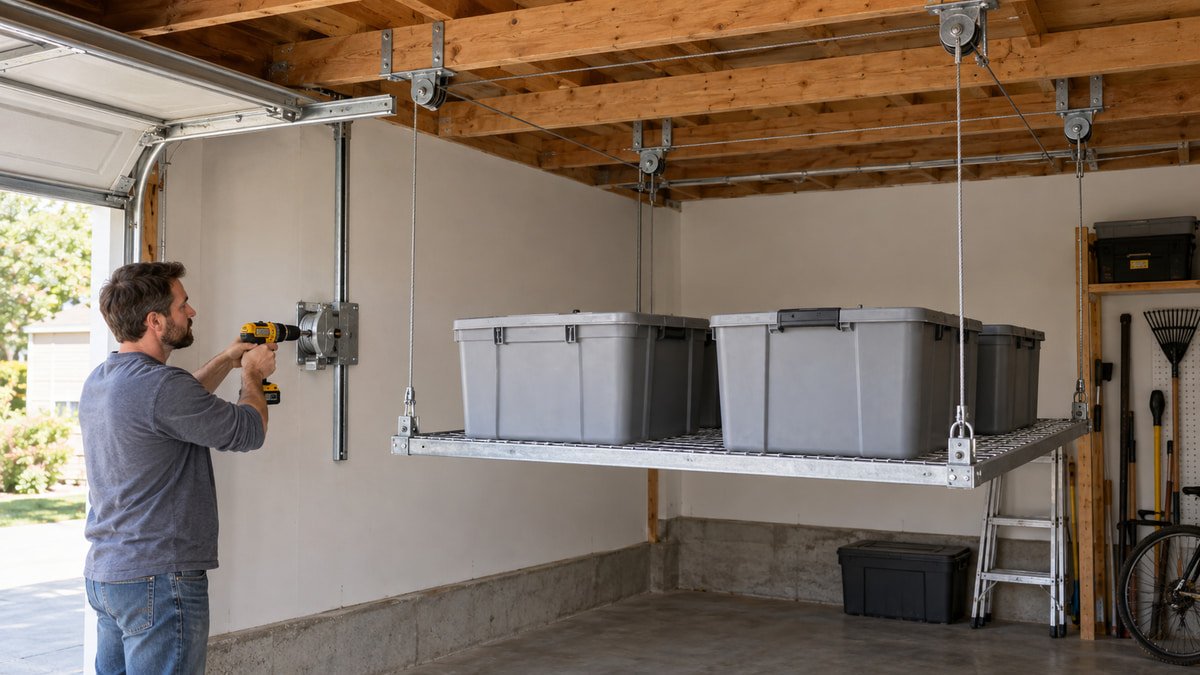
    Drill powered garage ceiling lift holding evenly spaced lightweight totes
    A manual drill powered lift removes a dedicated motor while keeping loads balanced across the platform.

    Treat installation as a structural project

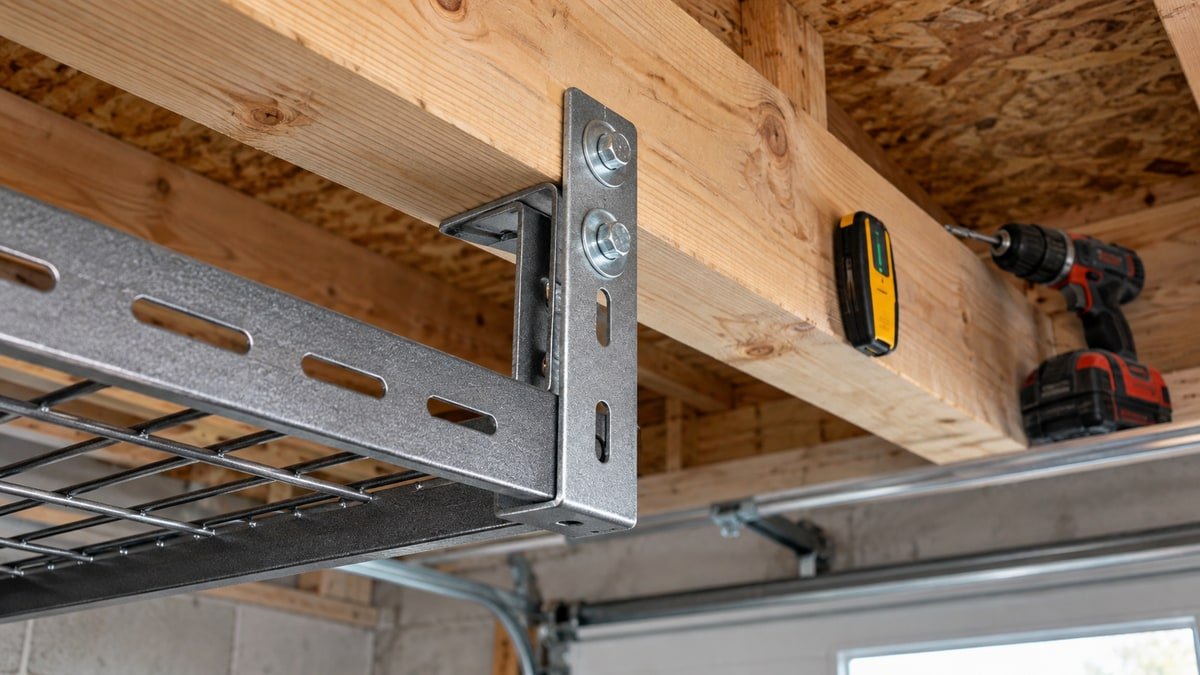
    A ceiling lift applies static load, moving load, and repeated cycles to its attachment points. Joist size, direction, spacing, condition, and any engineered truss restrictions matter. Do not drill or cut structural members merely to make a bracket land neatly. When framing is hidden, damaged, or unclear, bring in a qualified professional.

    Lay out every attachment from the exact manual. Check diagonals and level before the platform is loaded. Follow torque, cable routing, limit setup, electrical, and inspection instructions. A motorized lift also needs a suitable power route that remains clear of moving hardware and complies with local electrical rules.

    Compare installation complexity with a fixed system using our fixed versus adjustable overhead rack guide. A lift earns its cost when frequent access or a high ceiling makes lowering useful. Infrequently used light bins may not need a motor and cables.

    Inspect controls, cables, and recalls over time

    Before each cycle, look for a shifted load, frayed or crossed cable, loose fastener, damaged deck, odd motor sound, and anything entering the travel path. Stop if the platform tilts or one corner moves differently. Keep people, pets, and vehicles out of the moving zone, and never stand beneath a loaded platform.

    Check current safety notices by manufacturer and exact model. CPSC issued separate 2022 recalls for certain Fleximounts overhead racks and SafeRacks and Monsterrax racks. Those notices concern other fixed products, not the five lifts above. They are a useful reminder to identify the exact model, hardware, and remedy rather than assuming all overhead products share one status.

    Save the manual and purchase record. Know the emergency lowering or release process before the first full load. A ceiling lift is most useful when everyone who operates it understands the same limits and stopping procedure.
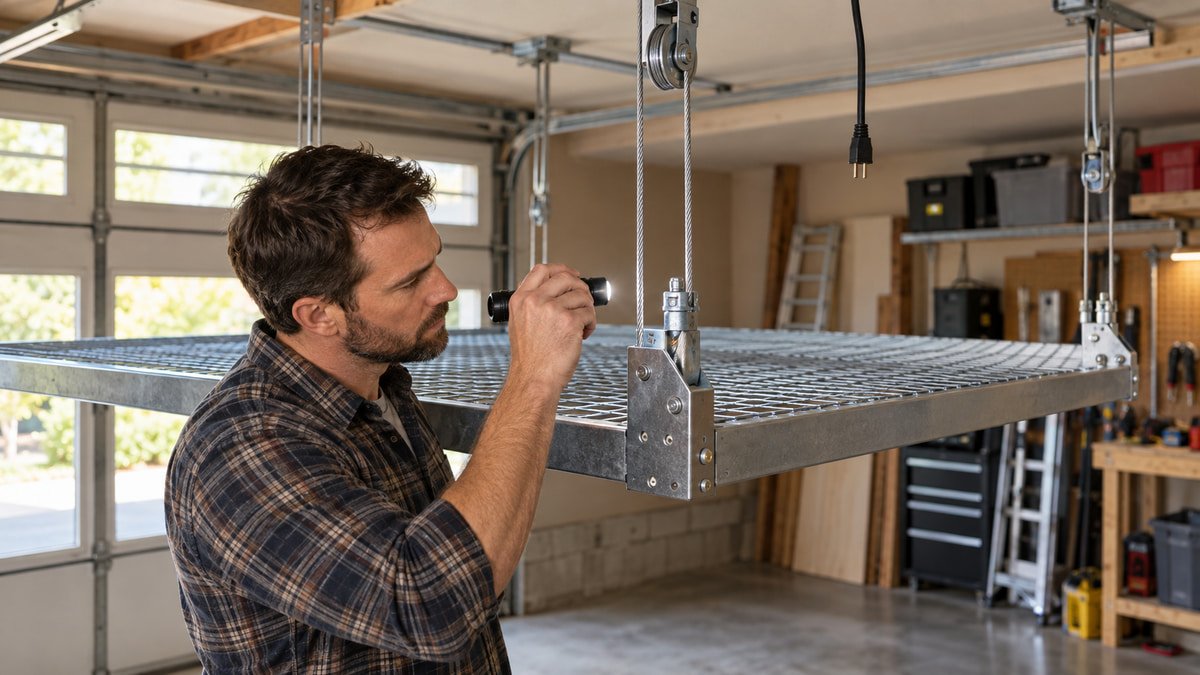
    Garage owner inspecting lift cables and platform corners from floor level
    Routine visual checks can catch a shifted tote, frayed cable, or loose corner before the next cycle.

    Useful products to compare

    These links open current Amazon search results. Check the dimensions, manual, mounting hardware, warranty, and current availability for the exact model before you order.

    Before you buy or install

    Read the current manual for the exact product you are considering. Confirm its assembled dimensions, rated capacity, mounting requirements, included hardware, working clearances, warranty, and any limits that apply to your wall, floor, electrical circuit, or garage layout.

    Frequently asked questions

    How much weight can a garage ceiling storage lift hold?

    Current home garage systems commonly publish capacities around 400 pounds, while some configurations go higher. Confirm whether the number covers cargo or the whole platform system. The framing, fasteners, platform, cables, and lift each have limits, and the lowest one controls.

    Can a ceiling storage lift go above a garage door?

    Sometimes, but only when the raised platform and cargo clear the door panels, tracks, springs, opener rail, and service zones through the full door cycle. Measure with the door open and closed, then keep the lift outside every moving path.

    Is a motorized or drill powered garage lift better?

    Motorized lifts offer convenient remote or wall controls and may suit frequent access. Drill powered lifts avoid a dedicated motor and app, but require controlled manual operation. Compare capacity, travel, emergency procedure, electrical needs, and who will use it.

    Do I need a professional to install a garage ceiling lift?

    A qualified installer is sensible when framing is hidden, engineered, damaged, unusually spaced, or when electrical work is required. Follow the product manual and local rules. Never cut a truss or improvise attachment hardware to force a layout.

    What should be stored on a garage ceiling lift?

    Use secure, evenly distributed items within the exact cargo rating, such as lidded seasonal totes or restrained light gear. Avoid leaking fluids, unstable stacks, loose objects, and anything that could be damaged by temperature. Follow the maker’s prohibited item list.

  • Garage Storage Lift vs Overhead Rack: Which Fits Better?

    Garage Storage Lift vs Overhead Rack: Which Fits Better?

    Affiliate disclosure: As an Amazon Associate I earn from qualifying purchases. This article may contain affiliate links, and Bay & Bench may earn a commission at no extra cost to you. Read our full Affiliate Disclosure.

    A garage storage lift vs overhead rack decision comes down to access more than appearance. Both put light, bulky belongings near the ceiling. A fixed rack costs less and stores more per dollar, yet every retrieval involves a ladder. A lift brings the platform down, which is easier on knees and shoulders, although the mechanism takes more room and asks for a more involved installation.

    The garage decides which compromise works. Ceiling height, joist direction, garage door travel, parked vehicle clearance, and how often the bins come down all matter. So does the person using the system. A healthy adult who reaches holiday decorations twice a year may be happy with a fixed rack. Someone who rotates camping gear every month may soon resent it. This comparison works through those ordinary details before the shopping begins.

    Quick answer

    Choose a fixed overhead rack when budget and maximum storage area matter most, the items are light, and access is infrequent. Choose a ceiling storage lift when comfortable retrieval matters enough to justify higher cost, moving parts, and a smaller platform. In either case, verify framing, door movement, vehicle clearance, and the exact rated load before installation.

    Garage storage lift vs overhead rack at a glance

    The two systems solve the same floor space problem in different ways. A rack stays put. A lift trades some capacity and simplicity for a platform that travels between storage height and loading height. That difference affects almost every part of ownership.

    Decision pointFixed overhead rackCeiling storage lift
    Purchase costUsually lowerUsually higher
    Loading methodLadder or step platformPlatform lowers toward the floor
    Storage areaMany large formats availableTravel path limits platform placement
    Moving partsNone after installationCables, drive, locks, or pulleys
    Best useRarely accessed light itemsSeasonal items accessed several times a year
    Routine checksFasteners, frame, deckFasteners plus lifting mechanism

    A rack is the plain answer, and that is often a compliment. It has fewer failure points and uses a broad ceiling rectangle efficiently. The lift earns its keep when a ladder has become the weak part of the routine. If the comparison still feels abstract, the broader overhead garage storage buying guide explains rack formats and the measurements behind them.

    Start with the items and retrieval schedule

    Write down what will live overhead. Holiday decor, empty coolers, folding camp chairs, and spare bedding are common candidates because they are bulky without being dense. Paint, fuel, car batteries, loose tools, and liquids that can leak are poor candidates. Heavy objects are awkward above shoulder height even when a product rating appears generous.

    Frequency changes the answer. A fixed rack is easy to tolerate for two planned visits each year. Monthly retrieval is different. The ladder has to come out, a safe landing spot has to remain open, and each tote must move through the same narrow path. People begin storing things on the floor again when overhead access feels like a chore.

    Mark every planned bin as monthly, seasonal, or archival. Give the lift to monthly and seasonal gear if access is the reason for buying one. Archival bins can stay on a rack. This mixed approach often beats forcing one system across the whole ceiling.

    A fixed rack wins on simple capacity

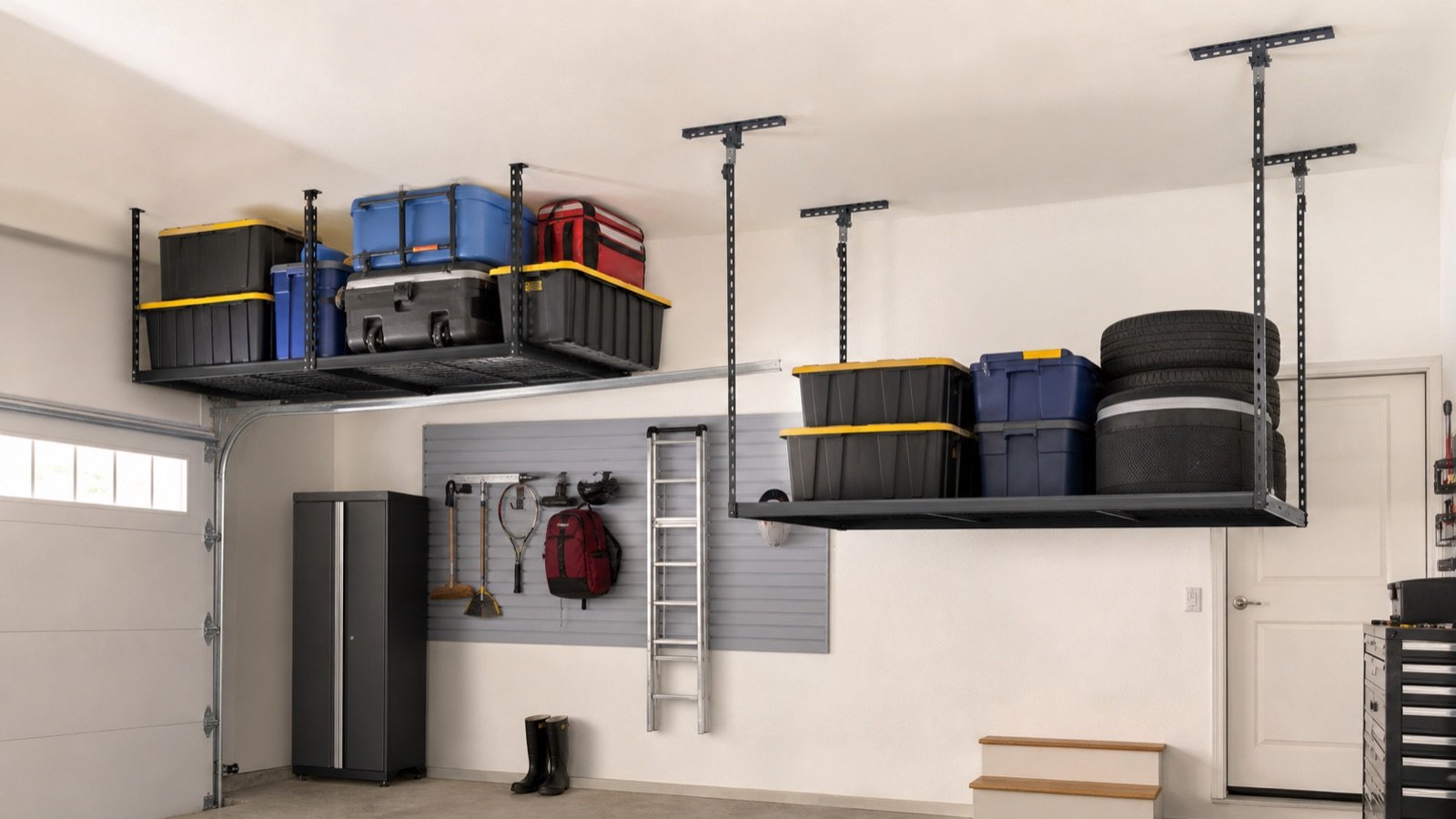
    Fixed racks come in broad platforms and can fill long runs along a side wall or above part of the garage door. Their structure is straightforward: ceiling supports, vertical drops, a perimeter frame, and a deck. Once correctly installed, there is no winding mechanism to operate and no platform travel zone to keep open.

    Capacity on the carton is not permission to load every square inch with dense objects. The framing connection, installation pattern, load distribution, and condition of the hardware remain part of the system. Work through the limits in the overhead rack weight capacity guide, then set a lower household limit that is easy to remember. A large label on each tote can record its contents and weight without advertising a made up total for the rack.

    Fixed racks also work better where the platform never needs to descend. A narrow band above shelving may hold a rack nicely but leave no clear landing rectangle for a lift.

    A storage lift wins on comfortable access

    The useful part of a lift is the lowered platform. Instead of carrying a tote down a ladder, the user loads or unloads near waist or chest height. That can reduce an awkward sequence, especially for someone with limited shoulder reach or balance. It also makes a quick inventory possible because several bins come down together.

    The platform still needs rules. Keep people clear while it moves, stop if the load shifts, and follow the operating steps for the exact model. A manual crank asks for a reachable operating position. A powered lift needs the specified electrical setup and controls that cannot be triggered accidentally. Neither type turns overhead space into a place for very heavy shop equipment.

    FlexiMounts shows the parts and staged installation of one manual platform in its GL44B lift installation guide. Use that as a picture of the work involved, then use the current manual packed with the product you buy.

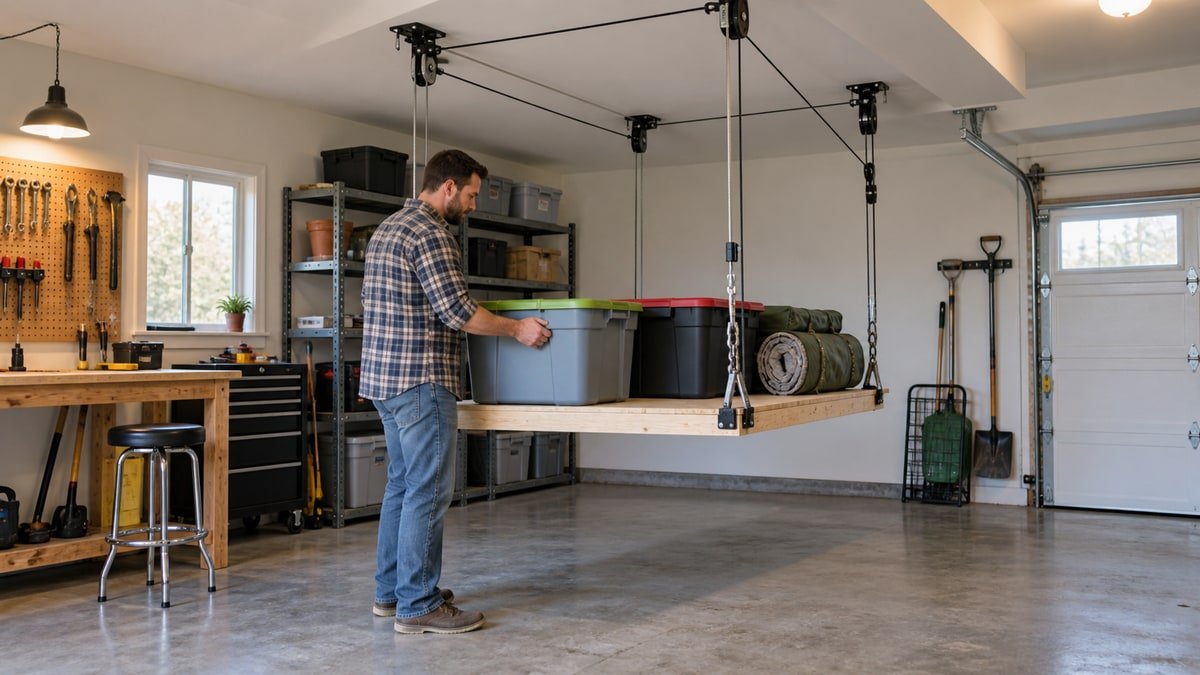
    Ceiling storage lift lowered for loading lightweight seasonal garage bins
    A lift is most useful when stored items need to come down several times during the year.

    Clearance can eliminate one choice quickly

    A lift needs two clear volumes: its raised storage envelope and its travel path. A fixed rack needs only the first. That sounds small on paper, but the lowered platform may meet a car hood, workbench, freezer, or the path people use to reach the house. If the floor rectangle cannot stay clear during operation, the lift will be annoying or unsafe.

    Park the tallest expected vehicle, open its hatch, and cycle the garage door by hand after disconnecting the opener according to its manual. Watch the door panels, tracks, springs, opener rail, emergency release, lights, and wiring. Then use the steps in the overhead garage storage clearance guide to record the smallest gap, not the nicest one.

    Low ceilings often favor a shallow fixed rack because the lift mechanism and platform consume some of the height. Tall ceilings can favor a lift because ladder access becomes less pleasant as the rack rises.

    Homeowner measuring vehicle clearance below a fixed garage ceiling rack
    Measure with the vehicle parked because the roof, hatch, and garage door can all enter the storage zone.

    Joist direction shapes the installation

    Ceiling storage hardware must connect to the structure specified by the manufacturer. Drywall is a finish, not the supporting frame. Joist direction, spacing, engineered trusses, finished ceilings, ducts, and hidden wiring can all change the plan. When the structure is uncertain, a qualified installer or contractor is cheaper than guessing overhead.

    The manufacturer pattern matters because loads enter the framing through specific brackets. Moving a bracket a few inches to dodge a light may no longer match the tested arrangement. The FlexiMounts GR48F fixed rack installation guide shows the measuring, bracket placement, and assembly sequence for that model. Other products can use different spacing and fasteners.

    Do the structural check before comparing finishes. A black frame and a white frame perform the same job. A layout that misses framing does not.

    Steel overhead rack bracket secured beneath a solid wooden ceiling joist
    Either system depends on a sound structural connection, straight hardware, and the fasteners specified by its maker.

    Compare total cost, not the first price

    A fixed rack usually has a lower purchase price. It may also be a realistic project for an experienced homeowner who can identify framing, work safely at ceiling height, and follow the manual. A lift costs more because the package includes a drive or pulley system, cables, locks, and extra hardware. Installation time tends to rise with the part count.

    Add the costs that sit outside the box: delivery, a suitable ladder, blocking or mounting boards if approved, electrical work for a powered unit, professional installation, and matching totes. If a fixed rack requires buying a tall platform ladder that has nowhere to live, part of its apparent savings disappears.

    Compare usable square feet after leaving clearance around obstacles. The 2×4 versus 4×8 overhead rack guide shows why one wide platform is not automatically a better fit than two smaller ones.

    Maintenance is different, even when both look sturdy

    A fixed rack needs periodic inspection for loose fasteners, corrosion, bent members, damaged decking, and shifted loads. The habit is simple. Look up when seasonal bins come down, empty any tote that has collected moisture, and correct a leaning stack before it becomes permanent.

    A lift adds cables, pulleys, drums, drive parts, stops, and locks, depending on the design. Follow its manual for inspection and lubrication. Do not substitute a household oil where the manufacturer calls for another product. Frayed cable, uneven travel, binding, a changed sound, or a platform that will not stay level calls for stopping the system until it is checked.

    Fixed systems generally age quietly. Lift systems announce some problems during movement, but only if the user pays attention. Either one deserves a short inspection after a ceiling leak, a vehicle strike, or work on nearby framing.

    Choose the right position in the garage

    Side wall ceiling zones are often easier than the center of the bay. They can avoid the opener rail and keep a lowered lift away from the vehicle. The tradeoff is reach. A rack too close to the wall can be difficult to load because the tote must clear both the platform edge and the wall.

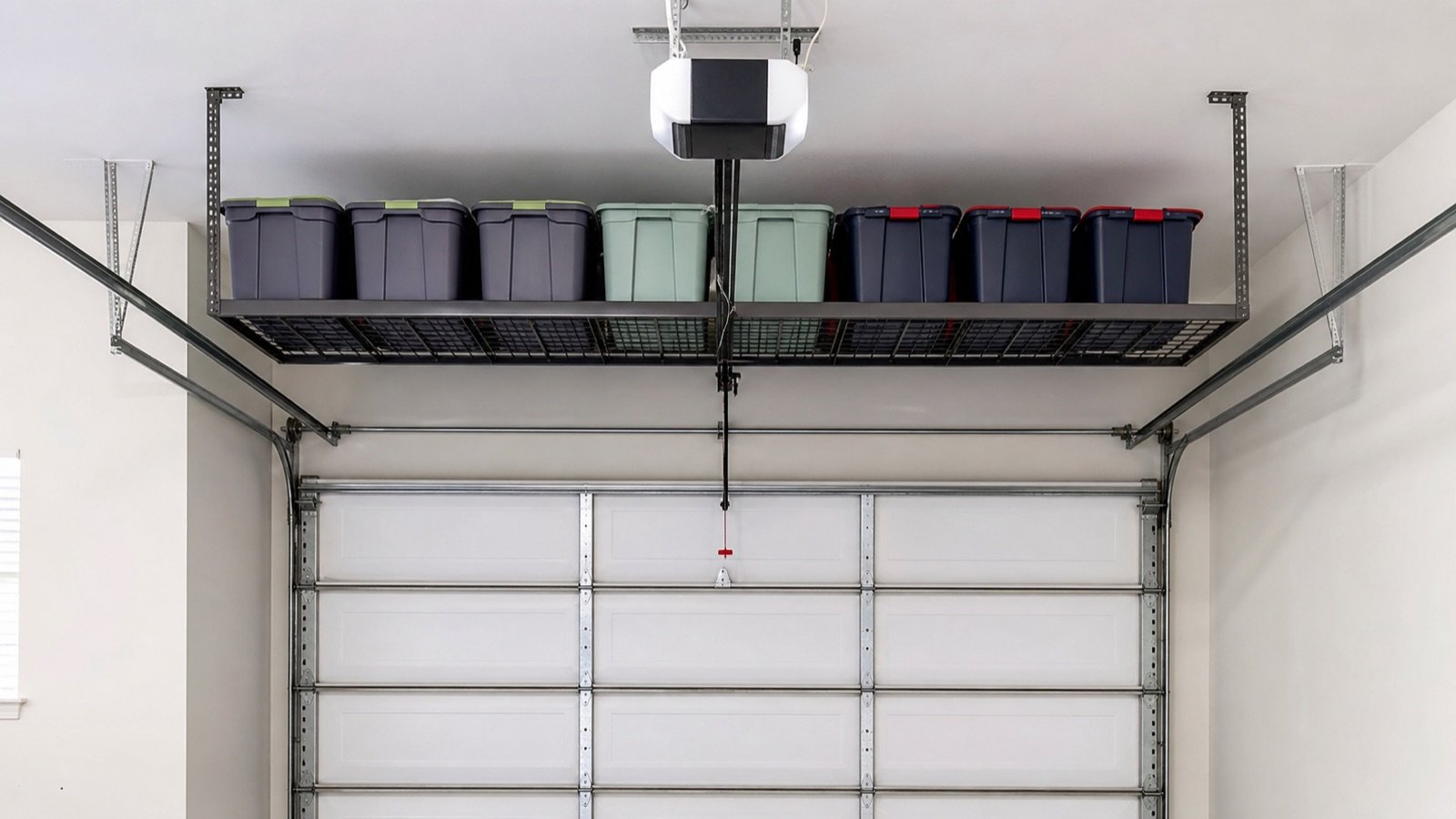
    Space above the garage door can be useful for a fixed rack when the door, tracks, springs, and opener retain their required clearances. Read the over garage door storage rack guide before assuming that empty looking space is available. A lift in that zone is less common because its moving platform must share the door’s operating envelope.

    Keep emergency controls, lighting, attic access, and fire protection equipment visible and reachable. The cleanest visual arrangement is secondary. The system should work with the garage on a rainy night, with the car parked and the door moving.

    A hybrid ceiling plan often works best

    One small lift can handle the things that rotate through the year. One fixed rack can hold empty luggage, spare patio cushions, and other light items that rarely move. This pairing keeps the expensive moving platform focused on access instead of paying lift prices for every square foot.

    Another good split uses adjustable and fixed racks in separate zones. The fixed versus adjustable overhead rack comparison explains how drop length affects fit. Adjustable drops help around uneven ceiling zones, while a fixed format can feel stiffer and simpler where the height is already known.

    Do not cover the entire ceiling simply because space exists. Open areas make leaks easier to spot, give future tradespeople access, and keep the garage from feeling pressed down. Buy enough capacity for named belongings, plus a modest reserve. Undefined spare capacity has a way of filling with things nobody planned to keep.

    Use a final fit check before ordering

    Draw the platform outline on the floor with painter’s tape. For a lift, keep that rectangle clear and pretend the platform is down. Walk around it, open the car doors, move the mower, and carry a tote toward the house. For a fixed rack, place the ladder where it will stand and repeat the same routine.

    Next, confirm ceiling structure, smallest vertical clearance, bin dimensions, proposed load, hardware access, and delivery path. Read the current manual from beginning to end. If the maker requires two installers, special blocking, a particular joist arrangement, or professional electrical work, put that into the decision now.

    The better system is the one the household can use without improvising. A fixed rack is hard to beat for economical, quiet storage. A lift is worth its premium when it removes a ladder from a job that happens often. The measurements usually make the choice less dramatic than the product photos suggest.

    Useful products to compare

    These links open current Amazon search results. Check the dimensions, manual, mounting hardware, warranty, and current availability for the exact model before you order.

    Before you buy or install

    Read the current manual for the exact product you are considering. Confirm its assembled dimensions, rated capacity, mounting requirements, included hardware, working clearances, warranty, and any limits that apply to your wall, floor, electrical circuit, or garage layout.

    Frequently asked questions

    Is a garage storage lift safer than a fixed overhead rack?

    A lift can remove much of the ladder handling, which is a meaningful benefit. It also has moving parts and an operating zone that must stay clear. Safety depends on correct structural installation, sensible loading, inspection, and following the exact manual. Neither design is safe when overloaded or attached only to ceiling finish.

    How much ceiling height does a garage storage lift need?

    There is no single number because the mechanism, platform, tote height, door path, and vehicle all consume space. Add those dimensions using the clearances required by the chosen model. Measure the lowest obstruction and the tallest expected vehicle rather than using the nominal ceiling height alone.

    Can a ceiling storage lift go above a parked car?

    Storage above a car needs verified clearance and explicit approval for the chosen model. Account for the raised load, vehicle roof, antennas, open hatch, and garage door movement. Move the vehicle before raising or lowering the platform, and keep every person and pet outside the full travel zone during operation.

    What should be stored on an overhead garage rack?

    Light, bulky, dry belongings that tolerate garage temperature changes are the best candidates. Seasonal decorations, empty coolers, folding chairs, and soft goods in sealed totes often fit. Keep fuel, paint, leaking liquids, batteries, loose tools, and very dense objects in safer storage closer to the floor.

    Do garage ceiling racks need to attach to joists?

    They need the structural attachment described by the product manufacturer. In many residential installations that means wood framing or approved blocking, not drywall alone. Engineered trusses and unusual ceilings may need professional review. Do not invent a bracket pattern to make the rack fit around an obstacle.

  • Garage Storage Rack Above the Garage Door: A Clearance Guide

    Garage Storage Rack Above the Garage Door: A Clearance Guide

    Affiliate disclosure: As an Amazon Associate I earn from qualifying purchases. This article may contain affiliate links, and Bay & Bench may earn a commission at no extra cost to you. Read our full Affiliate Disclosure.

    The space above a garage door can be useful, but it is not empty space. Door panels, tracks, the opener, springs, cables, and emergency hardware all need room to move and service access.

    Quick answer

    Operate the door through its full cycle and map the highest moving point. Add the rack frame, tote height, handling gap, and every clearance required by both the rack and door equipment. If those zones overlap, move or resize the rack.

    Garage Storage Rack Above the Garage Door: A Clearance Guide
    Planning example for garage storage rack above the garage door: a clearance guide.

    Watch a complete door cycle

    Stand inside the garage and watch from the side while another person operates the door safely. The panel path changes through the curved track. The opener arm and emergency release move too.

    Never place yourself beneath unsupported components or interfere with door hardware while measuring.

    Map service space

    Technicians need access to springs, cables, tracks, fasteners, opener components, and manual release hardware. A rack that clears normal movement can still make inspection or repair difficult.

    Ask the door manufacturer or service provider when required clearances are not documented.

    Build the vertical stack

    Start at the lowest usable ceiling point. Subtract mounting space, tote height, handling room, platform thickness, and the moving door envelope. Use the calculator to organize the numbers, then verify them physically.

    Choose the rack orientation

    A narrow platform parallel to the door may stay outside the opener rail. A rack across the garage may offer more capacity but cross several moving and service zones. Smaller modules can work around hardware more easily.

    Store the right things

    Above-door storage favors light seasonal totes. Keep each bin closed and stable. Avoid loose objects that vibration might move, and do not store materials whose labels prohibit garage heat or overhead locations.

    Final check before ordering

    • Door clears through the entire cycle.
    • Emergency release remains visible and reachable.
    • Tracks, springs, cables, and opener retain service access.
    • Rack mounting follows the exact structural requirements.
    • Totes can be loaded from a stable position.
    • The selected load remains within every verified limit.

    Return to the broader overhead storage buying guide to compare platform sizes and deck formats.

    Door type changes the available zone

    A sectional overhead door follows curved tracks. Other door types move differently, and high-lift configurations change the ceiling envelope. Do not transfer measurements from a neighbor’s garage or an online diagram to your door.

    Record the door and opener model when possible. Current technical documents or a service technician can answer questions that a tape measure cannot.

    Vibration and falling objects deserve attention

    A garage door cycles beneath or beside the storage area. Use closed bins in good condition and keep every object within the platform edge. Loose sports gear, scrap wood, and open boxes do not belong above a moving door.

    Listen after loading. New rattles, rubbing, or movement are reasons to stop the door and inspect the area.

    Useful products to compare

    Use these searches to compare current dimensions, ratings, manuals, and availability. Check the exact model before buying.

    Before you buy or install

    Download the current manual for the exact model. Confirm assembled and packaged dimensions, individual and total load ratings, required clearances, mounting structure, included hardware, warranty, and inspection instructions. Product listings and specifications can change.

    Mark the footprint or platform edges in the garage. Operate the vehicle doors and garage door, carry the intended bin through the access route, and check service panels and utilities. Do not improvise around electrical, gas, fire, or structural conditions.

    Frequently asked questions

    Can a rack touch the garage door tracks?

    No. Keep the clearances required by the rack and door equipment, including service access.

    Can I move the opener to make space?

    Changes to door and opener systems should follow manufacturer requirements and may need qualified service. Do not redesign them around a rack casually.

    What is best stored above the door?

    Light, stable, seasonal goods in closed totes are usually the sensible use.

    Last reviewed: July 2026. Verify current product specifications and installation requirements before purchase.

  • Fixed vs Adjustable Overhead Garage Racks

    Fixed vs Adjustable Overhead Garage Racks

    Affiliate disclosure: As an Amazon Associate I earn from qualifying purchases. This article may contain affiliate links, and Bay & Bench may earn a commission at no extra cost to you. Read our full Affiliate Disclosure.

    Adjustability is useful when it solves a measured problem. If every support ends up at the same height and never moves again, a simpler fixed setup may be the cleaner choice.

    Quick answer

    Choose adjustable drop supports when ceiling height, obstructions, or tote sizes demand a specific platform level permitted by the manual. Choose fixed supports when the required height is known, the mounting plane is straightforward, and fewer joints suit the application.

    Fixed vs Adjustable Overhead Garage Racks
    Planning example for fixed vs adjustable overhead garage racks.

    What adjustable usually means

    Many adjustable racks use slotted vertical posts with a set of approved hole positions. Adjustment is not continuous, and the allowed range may change with rack size or configuration. Read the exact manual before assuming a desired drop is available.

    Where adjustment helps

    A measured drop can place the platform above an open door while preserving tote space. Separate approved settings may also help with a sloped ceiling or a beam, although every support and connection must follow the instructions.

    The clearance guide shows which dimensions to collect.

    Why fixed can be appealing

    Fixed hardware has fewer adjustment points and fewer opportunities to choose the wrong hole. That simplicity can make inspection easier. It does not remove the need for correct structure, fasteners, leveling, and load distribution.

    Side by side

    FactorFixedAdjustable
    Drop choicesOne designed heightApproved positions within a range
    Changing totesMay require new storage planMay permit a different setting
    PartsOften fewer jointsMore connection points to inspect
    Uneven geometryLess flexibleCan offer approved correction

    Do not plan on frequent adjustment

    A loaded ceiling rack is not a height adjustable desk. Changing the drop normally means unloading, supporting, loosening, aligning, and reinstalling parts according to the manual. Choose a setting you expect to keep.

    Decision rule

    Measure the lowest obstruction and the loaded tote. If one fixed configuration gives comfortable handling room and clearance, extra adjustment may add little. If the fit depends on a narrow height window, an adjustable model can be worth comparing.

    Whatever you choose, record the final setting and include it in periodic inspections.

    Adjustment can create setup errors

    More holes mean more possible configurations to verify. Count exposed holes or measure the final drop at every post before loading. Photograph the connections so a later inspection can tell whether anything moved.

    Use only approved fasteners and hole positions. A post that looks nearly aligned should not be forced into a custom setting.

    Future vehicles are worth one measurement

    If you expect to replace a sedan with an SUV, record the likely roof and hatch height before settling on a low rack. This does not justify buying excess adjustment. It simply prevents a platform from locking the garage to the current vehicle.

    Changing the rack later may be possible, but unloading and reinstalling it is work. A sensible initial height is cheaper.

    Useful products to compare

    Use these searches to compare current dimensions, ratings, manuals, and availability. Check the exact model before buying.

    Before you buy or install

    Download the current manual for the exact model. Confirm assembled and packaged dimensions, individual and total load ratings, required clearances, mounting structure, included hardware, warranty, and inspection instructions. Product listings and specifications can change.

    Mark the footprint or platform edges in the garage. Operate the vehicle doors and garage door, carry the intended bin through the access route, and check service panels and utilities. Do not improvise around electrical, gas, fire, or structural conditions.

    Frequently asked questions

    Can I change rack height after installation?

    Only as the manufacturer permits. Unload the rack and follow the adjustment procedure rather than moving loaded supports.

    Are fixed racks stronger?

    Not automatically. Compare the exact published ratings and required configuration.

    Can adjustable posts handle a sloped ceiling?

    Some systems may accommodate certain layouts, but the manual must explicitly support the installation.

    Last reviewed: July 2026. Verify current product specifications and installation requirements before purchase.