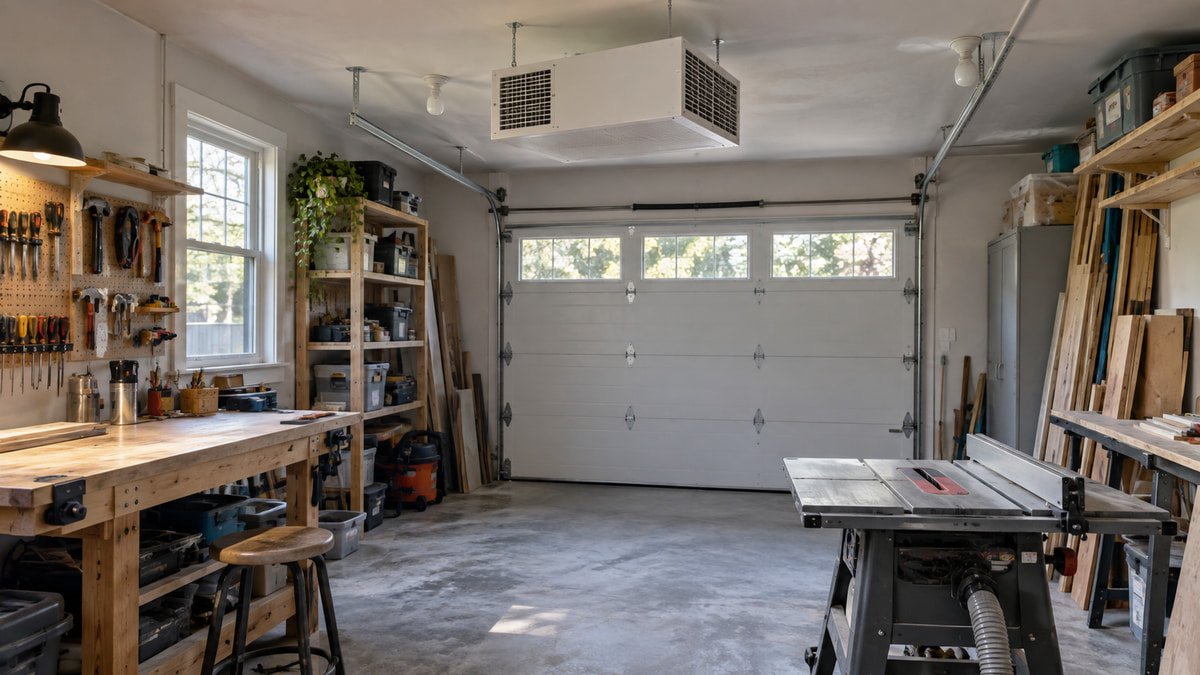
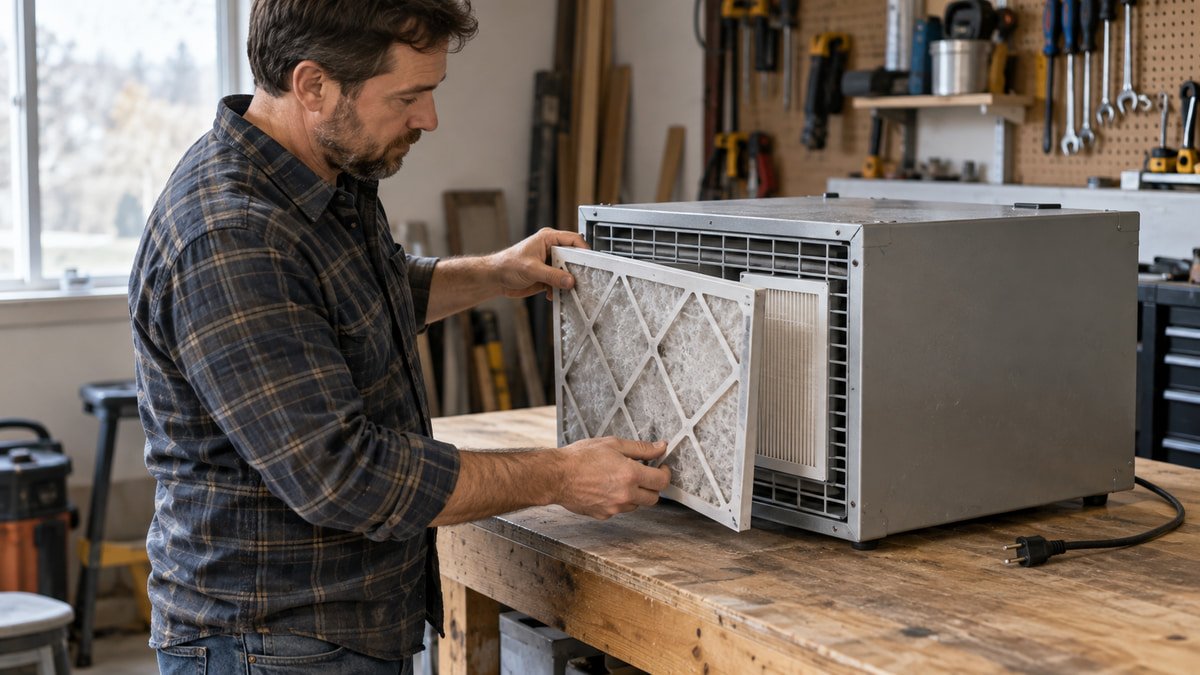
Tag: shop safety

  • Best Dust Collector for Small Shop: 5 Garage Picks

    Best Dust Collector for Small Shop: 5 Garage Picks

    Affiliate disclosure: As an Amazon Associate I earn from qualifying purchases. This article may contain affiliate links, and Bay & Bench may earn a commission at no extra cost to you. Read our full Affiliate Disclosure.

    Small shops expose weak dust collection layouts quickly. The best dust collector for small shop work has enough airflow at the machine, a filter suited to the dust, and a footprint that does not consume the room it is supposed to clean. In a garage, that often means a wall mounted one horsepower unit, a compact mobile canister collector, or a cyclone positioned close to one demanding tool.

    Catalog CFM is only the start. Hose length, elbows, reducers, dirty filters, and restrictive machine ports all lower the airflow that reaches the blade or cutterhead. A small system with a short four inch run can outperform a bigger collector connected through a maze of narrow hose. The five options below represent useful performance steps, from a simple single machine collector to a HEPA equipped wall cyclone.

    Quick answer

    The Rikon 60-105 is a strong first choice for a tight garage because it combines a compact one horsepower collector, two micron bag, casters, and a wall bracket. Pick the Grizzly G0710 when low cost and wall space matter, the G0944 for more airflow and a one micron canister, or the G0990 when HEPA filtration and cyclone separation justify the added cost. Keep duct runs short.

    Comparing the best dust collector for small shop setups

    These machines are not interchangeable. The first three work best beside one tool at a time. The larger wall units can support a more permanent branch layout, although real airflow depends on static pressure and duct design. Published CFM is useful for broad comparison only.

    PickPublished airflowFilter setupMounting styleBest fit
    Rikon 60-105660 CFM2 micron bagMobile or wallFlexible one machine use
    Rikon 60-100624 CFM5 micron bagMobile floor unitBudget chip collection
    Grizzly G0710537 CFM30 micron bag standardWall hangingCompact footprint with upgrade path
    Grizzly G09441,250 CFM1 micron canisterWall mountHigher airflow and fine filtration
    Grizzly G0990Model specific performanceHEPA systemWall mount cyclonePremium compact separation

    Do not select by the largest catalog number without checking power, port size, and floor plan. A collector must stay close enough to the machine that duct losses remain reasonable. It must also leave room to remove a full bag or drum.

    Capture dust where the machine creates it

    Room cleanup begins at the source. A collector connected to the machine hood catches chips and part of the fine dust before they spread. The NIOSH Pocket Guide entry for wood dust lists local exhaust and general dilution ventilation among exposure controls. That supports a practical first principle: put suction close to the cutter, then contain the path between them.

    An ambient air cleaner can reduce particles that escaped, but it cannot replace source capture. A shop vacuum on a random adapter is not automatically equivalent to a dust collector either. Vacuums create higher pressure through small hose. Dust collectors move larger air volume through larger duct. Many planers, jointers, and cabinet saws need that wider path.

    Place the collector while working through your garage workshop layout. A short route with one smooth bend is usually more useful than a distant corner chosen only because it looks neat.
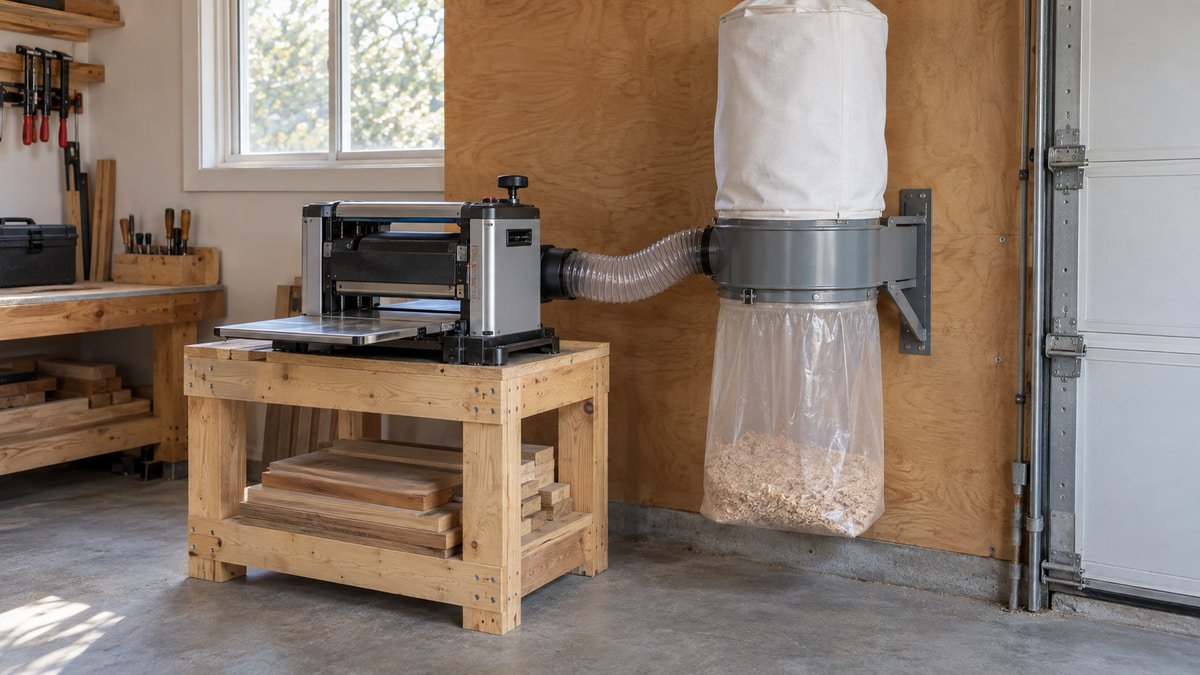
    Wall mounted bag dust collector beside a benchtop planer in a garage
    A wall collector saves floor space when one nearby machine does most of the cutting.

    Rikon 60-105 for a flexible first system

    The Rikon 60-105 is a practical small shop starting point. Rikon lists a one horsepower motor, 660 CFM, a four inch inlet, and a two micron filter bag. The machine includes both casters and a wall mounting bracket, which lets the owner try a mobile arrangement before committing scarce wall space.

    Its two micron bag is a better standard fine dust choice than the coarser bags found on some entry models. It is still a bag collector with limited capacity. Plan on cleaning the filter as directed and emptying the lower bag before debris reaches the inlet. A packed bag and loaded filter reduce airflow quietly, so performance can fade before the problem looks dramatic.

    The dual mounting option suits a garage where the table saw shares floor space with a car. Roll the collector beside the active machine, then park it against a wall after the work. Preserve the walking path described in our garage aisle clearance guide.

    Rikon 60-100 for basic chip collection

    The Rikon 60-100 is the simpler sibling. Its published specifications list a one horsepower motor, 624 CFM, a four inch inlet, and a five micron filter bag. It is a mobile floor unit rather than a wall convertible design.

    This model can make sense for collecting larger shavings from a planer or jointer when price and simplicity lead the decision. The standard five micron bag is less appealing for fine sanding dust. Ask whether a compatible finer bag or canister is available, then include that upgrade in the true cost. A cheap collector with an immediate filter replacement may land close to the price of the better equipped model.

    The wheeled base favors direct machine connections. Keep a short length of four inch hose attached and move the collector instead of building long branches. That arrangement takes setup time but can preserve airflow in a garage that does not need simultaneous collection at several machines.

    Grizzly G0710 for the smallest wall footprint

    The Grizzly G0710 hangs on the wall and keeps the motor and bag off the floor. Grizzly lists a one horsepower motor, a four inch intake, 537 CFM, and a standard 30 micron bag. Its stated sound range is 77 to 79 dB. The compact package is attractive, but the coarse standard bag is the clear compromise.

    Grizzly offers a compatible one micron canister option. Include the canister, collection bag access, and wall structure in the plan before choosing the base machine. A fine filter may improve emitted air, yet it can also add resistance as it loads. Regular cleaning remains part of the system.

    Wall mounting works best beside a stationary tool or a very short main duct. Coordinate its bracket with your garage wall storage. The lower bag needs open space to expand and a clear path for removal, so shelves cannot crowd every inch beneath it.

    Grizzly G0944 for higher airflow and a canister

    The Grizzly G0944 moves beyond entry level airflow. The current listing gives it a 1.5 horsepower motor, 1,250 CFM, a one micron canister filter, and two four inch branch inlets. Grizzly publishes a 75 to 77 dB sound range.

    That extra capacity fits a small permanent duct system better than the one horsepower bag units. It does not remove the need for duct calculations. Two open branches split airflow, and a web of flex hose can consume the advantage quickly. Use smooth duct where appropriate, open one blast gate at a time when the system is designed that way, and keep reducers close to the machine.

    The wall carries a heavier machine and repeated vibration. Follow the mounting instructions and confirm the framing can accept the stated loads. If the collector sits near a table saw, maintain the infeed, outfeed, and side clearances covered in our garage table saw clearance guide.

    Grizzly G0990 for HEPA cyclone filtration

    The Grizzly G0990 combines a 1.5 horsepower wall mount cyclone layout with HEPA filtration and 110 volt operation. A cyclone separates much of the heavy debris before it reaches the fine filter. That can slow filter loading and keeps collection in a rigid drum that is easier to inspect than an opaque bag.

    This is the premium choice in the group, not the automatic choice. The cyclone, drum, filter, and wall support occupy meaningful volume. The owner also has to empty the drum before chips rise into the separator. HEPA at the collector does not fix dust that escapes around an open blade guard or poor machine hood.

    Choose it when fine filtration, compact wall placement, and service access justify the expense. A lower cost collector paired with a well designed hood may capture more at the source than an expensive unit connected badly.

    Treat catalog CFM as a starting point

    Manufacturers commonly publish maximum or free air airflow. The number at the machine drops once a filter, separator, hose, elbow, reducer, and tool hood enter the path. Static pressure is the resistance the blower must overcome. A useful comparison would include a fan curve, yet compact collector listings do not always provide one.

    You can still make a better system with simple choices. Use the largest port the machine accepts, minimize corrugated flex hose, choose sweeping bends instead of tight elbows, and seal leaks. Avoid stepping down to a small shop vacuum hose several feet before a planer. The narrow section becomes the system bottleneck.

    When one collector moves between machines, label each adapter and keep them near the relevant tool. A few seconds saved during connection makes it more likely the collector gets used for a short cut. Size and store those fittings with the same care used for the main machine.
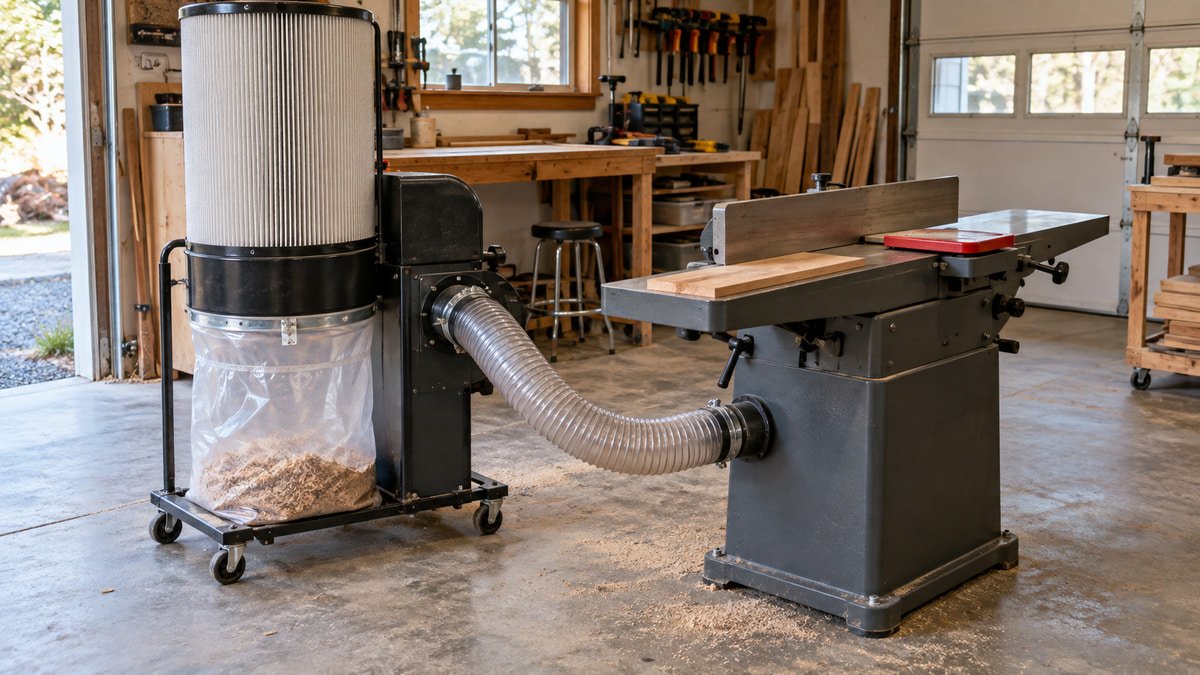
    Canister dust collector connected to a jointer with a short flexible hose
    A pleated canister filter adds surface area while a short duct run preserves more useful airflow.

    Filter rating and source capture are separate questions

    A finer filter describes the size range it is designed to retain, but it says nothing about dust that never enters the hood. Start by improving capture. Close unnecessary openings around the port where the machine design allows, use the guard collection point, and position auxiliary pickup near the dust plume without interfering with the work.

    Then consider the air returning from the collector. A coarse bag may stop chips while passing visible fine dust. A one or two micron filter is a more suitable starting point for a garage attached to a house. HEPA systems add another level, provided every seal and component belongs to the rated system.

    Wood dust exposure is a health concern, so a respirator selected for the task and good ventilation may still be needed. The broader NIOSH engineering control directory explains why controlling contaminants near their source is preferred. Follow tool, collector, and respiratory protection instructions rather than relying on one machine as the entire safety plan.
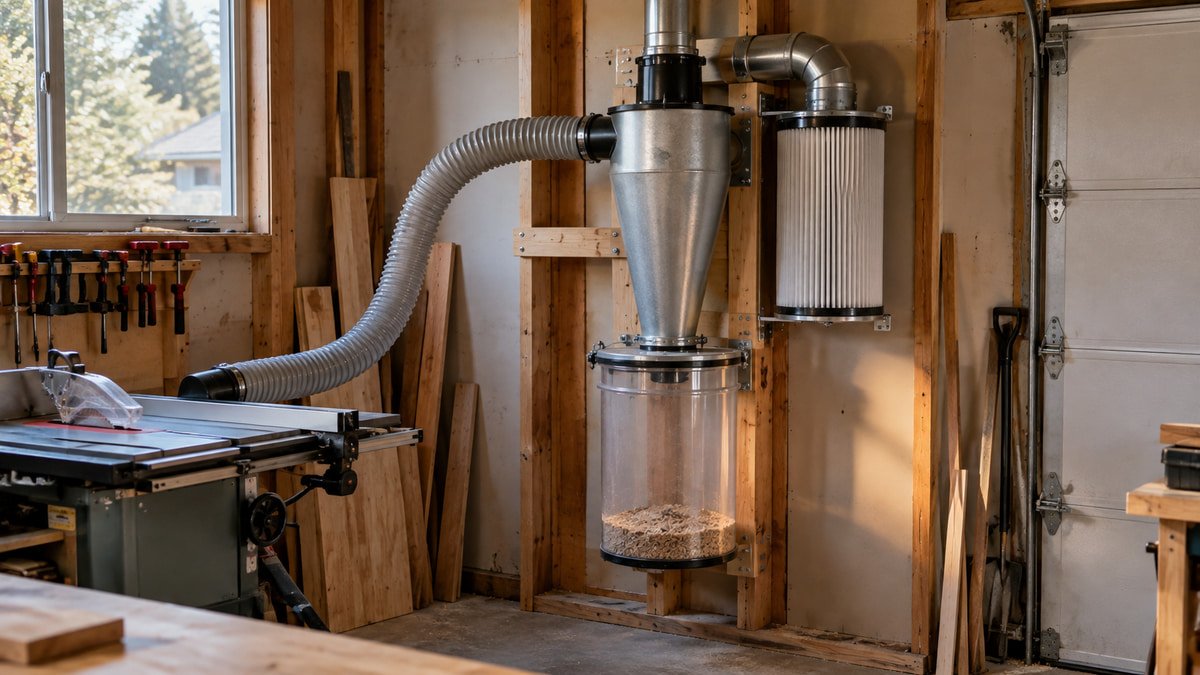
    Compact cyclone dust collector with a clear collection drum in a home shop
    A separator keeps much of the heavy debris out of the fine filter and makes fill level visible.

    Plan power, noise, and emptying before purchase

    Check voltage, full load current, plug type, and circuit requirements in the manual. A collector and a large cutting tool can overload a shared circuit even when each one runs alone without trouble. Automatic switches are convenient only when their current ratings and tool compatibility are correct.

    Noise in the mid to upper 70 dB range is noticeable in a hard garage. Move the collector away from the work position when the duct design allows, but do not ruin airflow with unnecessary distance. Hearing protection may be appropriate for the cutting machine regardless of the collector rating.

    Finally, rehearse filter cleaning and waste removal. A lower bag squeezed between cabinets, a drum that cannot clear the motor, or a canister trapped against the ceiling makes routine care unpleasant. Reserve that service zone beside the workbench and primary tools. The collector that stays easy to empty is the one most likely to keep moving air well.

    Useful products to compare

    These links open current Amazon search results. Check the dimensions, manual, mounting hardware, warranty, and current availability for the exact model before you order.

    Before you buy or install

    Read the current manual for the exact product you are considering. Confirm its assembled dimensions, rated capacity, mounting requirements, included hardware, working clearances, warranty, and any limits that apply to your wall, floor, electrical circuit, or garage layout.

    Frequently asked questions

    How much CFM does a small woodworking shop need?

    The answer depends on the machine, hood, and duct resistance. Read the tool maker’s collection guidance and compare it with the collector fan data when available. Planers and cabinet saws often need more air volume than a benchtop sander or small band saw.

    Is a one horsepower dust collector enough for a garage shop?

    It can work well for one machine at a time through a short four inch hose. It is less suited to long permanent duct runs or several open branches. Good source hoods and minimal hose resistance are especially important with a one horsepower unit.

    Do I still need an air filtration system with a dust collector?

    Often, yes. The dust collector handles debris captured at the machine. An ambient cleaner can reduce fine particles that escape and remain suspended. Neither makes the other unnecessary, and respiratory protection may still be appropriate for dusty operations.

    Is a one micron filter good enough for woodworking dust?

    A one micron rated filter is a meaningful step above a coarse chip bag, but the complete system and source capture matter. HEPA offers finer filtration when correctly sealed. Check how the manufacturer defines the rating and whether replacement filters are available.

    Should a small shop use a wall mounted or mobile dust collector?

    A wall unit saves floor space and suits a nearby stationary tool or short duct. A mobile collector can move close to several machines and reduce hose length. Choose the format that keeps both the duct path and emptying process simple.
  • Best Air Filtration System for Workshop: 4 Smart Picks

    Best Air Filtration System for Workshop: 4 Smart Picks

    Affiliate disclosure: As an Amazon Associate I earn from qualifying purchases. This article may contain affiliate links, and Bay & Bench may earn a commission at no extra cost to you. Read our full Affiliate Disclosure.

    The best air filtration system for workshop use moves enough air for the room, captures fine suspended dust, and remains quiet enough to run during and after a project. In a home garage, a compact 400 CFM box may be plenty for one bay. A tall or open two car shop can call for a higher output unit or two smaller cleaners placed in a deliberate loop.

    An ambient cleaner is the second line of defense. The dust collector or shop vacuum should catch debris at the saw, sander, or router first. The ceiling unit then recirculates room air and catches a share of what escaped. This guide compares four current systems, shows how to estimate air changes, and explains the filter and mounting details that determine whether the machine remains useful.

    Quick answer

    The WEN 3410 and Grizzly G0738 are sensible compact garage choices with roughly 400 CFM maximum airflow, timers, remotes, and one micron inner filters. The Powermatic PM1250 suits buyers who want a quieter electrostatic system with a published 754 CFM maximum. The larger PM1200 fits more room volume and publishes up to 1,196 CFM. Size the cleaner from cubic feet, not floor area alone.

    Best air filtration system for workshop use at a glance

    Choose from room volume and operating habit. A high output machine on its lowest setting may be calmer than a small unit running at full speed, but it will cost more and weigh more overhead. Filter price matters too, since a cleaner without fresh filters becomes a noisy shelf.

    PickPublished airflowFilter approachPublished soundBest fit
    WEN 3410300, 350, 400 CFM5 micron outer, 1 micron inner50 to 60 dBBudget one car garage
    Grizzly G0738260, 362, 409 CFM5 micron outer, 1 micron inner62 to 69 dBCompact shop with easy filters
    Powermatic PM1250Up to 754 CFMElectrostatic fine particle filter41.3 to 50.8 dBQuiet higher output cleaning
    Powermatic PM1200547, 706, 1,196 CFMReplaceable multi-stage filtersCheck current manualLarge garage or high ceiling

    Published airflow is measured with clean filters under manufacturer test conditions. Expect performance to fall as filters load. A model that is simple to inspect and maintain can provide more useful air movement over its life than a stronger unit mounted where nobody can reach it.

    Use source collection before ambient filtration

    A ceiling cleaner cannot pull a dense dust stream backward into a saw cabinet. It works on particles that have already entered the room. The NIOSH Pocket Guide entry for wood dust lists local exhaust among exposure controls. The same idea applies to saws, sanders, and routers: catch the plume close to where it forms.

    Connect the main machine to an appropriate dust collector or vacuum, keep the guard collection point in place, and repair obvious leaks. Then run the ambient cleaner to recirculate the shop. If a sunbeam still shows a dense cloud moving past the inlet, improve the hood or reposition the cleaner.

    Plan both systems while laying out the garage workshop. Ducts, a ceiling box, lights, and the garage door all compete for the same overhead space. Solving those paths on paper costs much less than moving lag screws later.

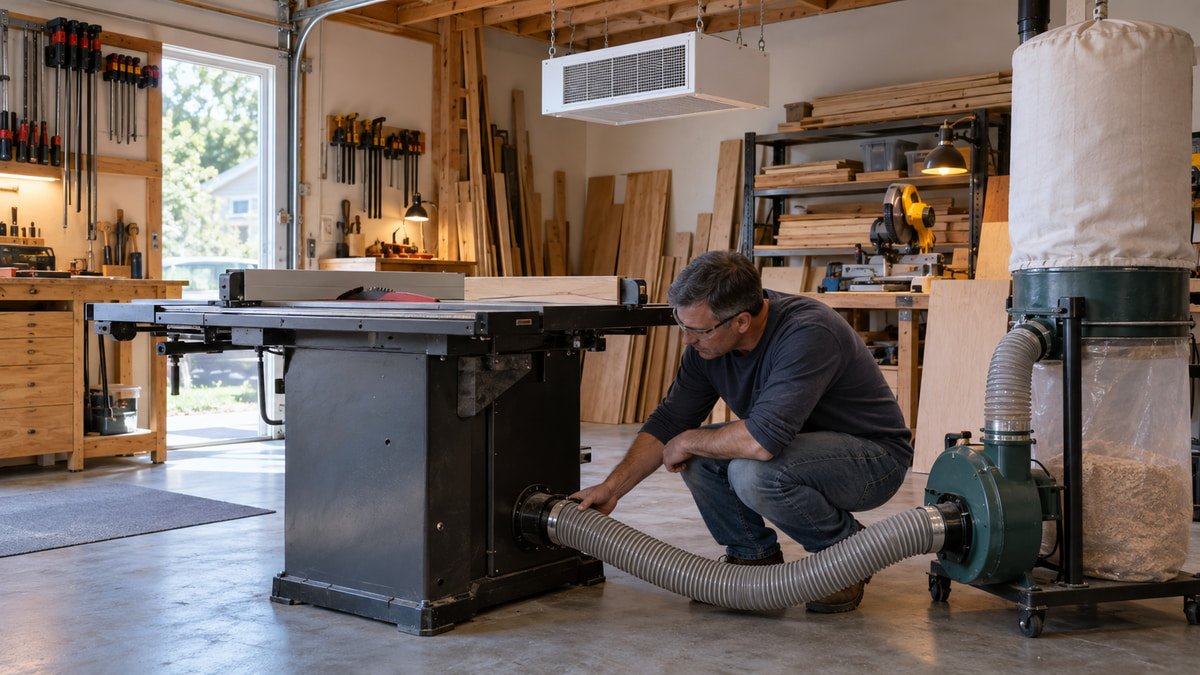
    Table saw with source dust collection and an overhead ambient air cleaner
    Source capture and ambient filtration handle different parts of the same dust problem.

    WEN 3410 for an affordable one car shop

    The WEN 3410 covers the common compact format. WEN lists three speeds at 300, 350, and 400 CFM, a five micron outer filter, a one micron inner filter, a remote, and a programmable timer. Its published sound range is 50 to 60 dB, and the unit weighs about 31 pounds.

    That combination fits a one car garage or a divided workshop zone where the ceiling is near eight feet. The timer is useful after sanding because the cleaner can continue cycling air while the room is empty. Follow the manufacturer’s guidance for unattended operation and electrical connection rather than assuming every timer mode is suitable in every setting.

    The rectangular outer filter is visible from the floor, which makes buildup easier to notice. Before buying, compare the price and stock of both replacement stages. A common filter size is an ownership advantage only when the frame and airflow direction match the machine specification.

    Grizzly G0738 for clear performance specifications

    The Grizzly G0738 publishes 260, 362, and 409 CFM across its three speeds. Grizzly lists a five micron outer filter, one micron inner filter, timer settings for one, two, or four hours, and sound ratings from 62 to 69 dB. The remote works without a direct line of sight according to the current product page.

    Grizzly calculates roughly 7.7 room cycles per hour in a 20 by 20 by 8 foot room. That example is useful because it connects airflow to cubic volume, though an open garage door, loaded filter, or obstructed outlet changes the result. The G0738 is also designed for hanging or bench placement, giving a renter or low ceiling owner another option.

    Bench placement consumes work area and may pull debris directly from a sanding zone, so protect the intake from large chips. If the unit hangs, preserve the walking and machine zones in our workshop clearance guide.

    Powermatic PM1250 for quiet higher output cleaning

    The Powermatic PM1250 uses an electrostatic filter rather than the familiar outer pad and inner bag arrangement. Powermatic publishes airflow up to 754 CFM, a 0.1 micron filter description, sound levels of 41.3 dB on low and 50.8 dB on high, an RF remote, and a filter service alert.

    Those specifications make it appealing when the cleaner will run near conversation or an attached living space. The unit can be mounted on a ceiling or wall, or used on a bench. The filter is a model specific component, so check its current replacement cost and availability. A proprietary fine filter can cost much more than a common disposable outer pad.

    Electrostatic collection does not remove the need for a dust collector at the tool. Think of the PM1250 as the quiet room cleaner that follows good source capture, not as permission to disconnect the saw hood.

    Powermatic PM1200 for larger room volume

    The Powermatic PM1200 is the high volume choice in this set. Powermatic lists three filtered air speeds of 547, 706, and 1,196 CFM. The heavier cabinet fits a large two car workshop or a tall space where a 400 CFM cleaner would need many hours to provide repeated cycles.

    The current web listing uses inconsistent filter wording between its page title and specification area. Confirm the current manual, data plate, and included filter part numbers before purchase. Powermatic sells separate PM1200 inner and outer replacement filters, which at least makes the consumable path identifiable.

    A 76 pound suspended machine demands proper structure and a careful lift. It should not hang from drywall or a decorative ceiling grid. Check the manual, locate framing, and use a qualified installer when the support or wiring is uncertain. The open area below must remain clear during installation.

    Calculate air changes from the real room volume

    Multiply length by width by average ceiling height to estimate cubic feet. Then multiply the cleaner CFM by 60 and divide by room volume. A 20 by 20 by 8 foot garage contains 3,200 cubic feet. A 400 CFM cleaner has a simple theoretical rate of 7.5 air changes per hour: 400 times 60, divided by 3,200.

    That result is not a promise. Loaded filters, grille resistance, cabinets, a partial loft, and poor placement reduce effective circulation. A garage open to another bay has more volume than the taped floor rectangle suggests. Include connected space unless a real partition closes it.

    For unusual layouts, two smaller machines can create more even circulation than one large box at the far end. They also provide lower speed operation near the user. Compare their combined filter cost, power draw, remotes, and mounting work before assuming the split system is cheaper.

    Place the intake and outlet in a clean loop

    Most rectangular cleaners pull air through the rear filter and push it from the front grille. Aim that outlet along the long dimension of the shop, not straight into a nearby wall or cabinet. Leave the manufacturer specified clearance at both ends. Avoid placing the intake directly above the dustiest machine if large chips can strike the filter.

    A gentle room loop is the goal. The discharged air travels across the ceiling, drops at the far wall, and returns through the occupied zone. You do not need decorative arrows or smoke tests to start. Hang lightweight thread at a few safe locations with machines off, then observe whether air movement stalls behind a tall cabinet.

    Coordinate the box with wall storage and table saw clearance. Keep the cleaner outside the garage door travel and away from a board that might rise during an awkward cut.

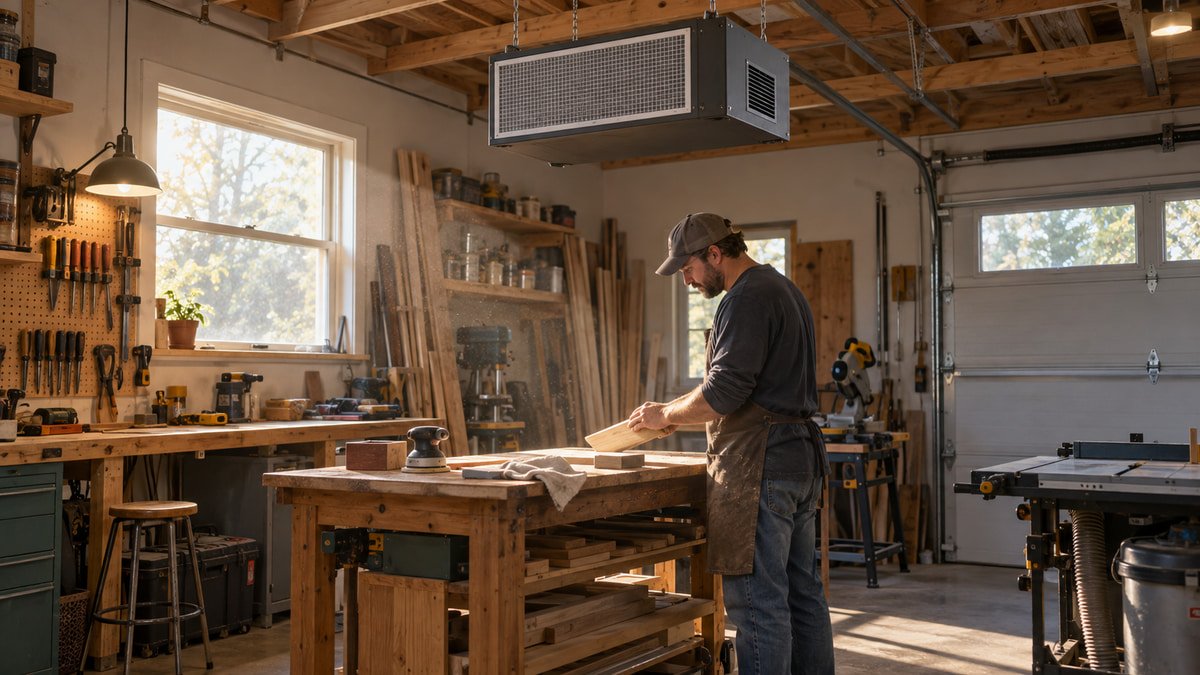
    Small garage workshop with a ceiling air cleaner above an open work area
    A clear intake and outlet path helps the cleaner move air around the occupied shop zone.

    Filter access and replacement cost decide long term value

    A prefilter catches larger particles and protects the finer second stage. Inspect it often during the first few projects, because dust production varies widely. A planer and random orbit sander can load a shop differently. Clean or replace each filter only by the method in the manual. Compressed air can damage some media or drive fine dust deeper.

    Before purchase, find the exact replacement part numbers. Add the cost of one full filter change to the machine price. Check whether the inner stage can be cleaned, how the maker defines end of life, and whether a warning light measures time or actual resistance. A timer based alert cannot know that one month included heavy sanding.

    Mounting height should allow safe filter removal. If service requires a tall ladder squeezed beside a vehicle, it will be postponed. Our garage storage planning guide can help reserve a clear ladder position beneath overhead equipment.

    Homeowner replacing the prefilter on an unplugged workshop air cleaner
    Easy filter access matters because a loaded prefilter can quietly reduce useful airflow.

    Run it when dust is produced and after work ends

    Use the cleaner during dusty operations when it does not disrupt source capture or throw dust across the breathing zone. Higher speed clears the room faster, while a lower setting may be tolerable for a longer session. The timer can continue the cycle after the final cut, provided the maker permits that operating pattern.

    Do not use a cleaner as evidence that the air is safe. Fine particles can be hard to see, and a clean looking room can still contain airborne dust. The NIOSH engineering controls directory explains the role of local exhaust and other controls. Suitable respiratory protection, housekeeping, and ventilation remain separate decisions.

    Listen for a changing fan tone and watch for dust leaking around the filter frame. A properly fitted filter, open grille, and regular inspection keep airflow more consistent. Turn the unit off and isolate power before service, following the manual for the exact model.

    Useful products to compare

    These links open current Amazon search results. Check the dimensions, manual, mounting hardware, warranty, and current availability for the exact model before you order.

    Before you buy or install

    Read the current manual for the exact product you are considering. Confirm its assembled dimensions, rated capacity, mounting requirements, included hardware, working clearances, warranty, and any limits that apply to your wall, floor, electrical circuit, or garage layout.

    Frequently asked questions

    How many CFM should a workshop air cleaner have?

    Calculate from room volume. Multiply CFM by 60, then divide by the room cubic feet to estimate theoretical air changes per hour. Allow for loaded filters and imperfect circulation. A compact one car bay often fits a roughly 400 CFM class, while larger shops may need more.

    Does an air filtration system replace a dust collector?

    No. A dust collector or suitable vacuum captures debris at the machine. An ambient cleaner recirculates room air and catches part of what escaped. Use both roles where the process creates fine airborne dust, and follow appropriate respiratory protection guidance.

    Where should a ceiling mounted shop air filter go?

    Place it where the intake and outlet can create a long circulation path without obstruction. Keep it clear of garage door hardware, lights, tall stock, and the direct chip stream. Mount only to structure allowed by the manufacturer’s instructions.

    How long should a shop air cleaner run after sanding?

    There is no single duration for every room. Dust load, airflow, filter condition, and room volume all matter. Use the manufacturer’s timer guidance, watch how quickly visible dust settles, and improve source capture if the cleaner must chase a dense cloud.

    Is a one micron shop air filter enough?

    A one micron second stage is common in compact woodworking cleaners and is far finer than a coarse prefilter. Some systems use HEPA or electrostatic media for smaller particles. Compare the complete system rating, seals, airflow, and replacement filter availability.