Affiliate disclosure: As an Amazon Associate I earn from qualifying purchases. This article may contain affiliate links, and Bay & Bench may earn a commission at no extra cost to you. Read our full Affiliate Disclosure.
The best air filtration system for workshop use moves enough air for the room, captures fine suspended dust, and remains quiet enough to run during and after a project. In a home garage, a compact 400 CFM box may be plenty for one bay. A tall or open two car shop can call for a higher output unit or two smaller cleaners placed in a deliberate loop.
An ambient cleaner is the second line of defense. The dust collector or shop vacuum should catch debris at the saw, sander, or router first. The ceiling unit then recirculates room air and catches a share of what escaped. This guide compares four current systems, shows how to estimate air changes, and explains the filter and mounting details that determine whether the machine remains useful.
Quick answer
The WEN 3410 and Grizzly G0738 are sensible compact garage choices with roughly 400 CFM maximum airflow, timers, remotes, and one micron inner filters. The Powermatic PM1250 suits buyers who want a quieter electrostatic system with a published 754 CFM maximum. The larger PM1200 fits more room volume and publishes up to 1,196 CFM. Size the cleaner from cubic feet, not floor area alone.
Best air filtration system for workshop use at a glance
Choose from room volume and operating habit. A high output machine on its lowest setting may be calmer than a small unit running at full speed, but it will cost more and weigh more overhead. Filter price matters too, since a cleaner without fresh filters becomes a noisy shelf.
| Pick | Published airflow | Filter approach | Published sound | Best fit |
|---|---|---|---|---|
| WEN 3410 | 300, 350, 400 CFM | 5 micron outer, 1 micron inner | 50 to 60 dB | Budget one car garage |
| Grizzly G0738 | 260, 362, 409 CFM | 5 micron outer, 1 micron inner | 62 to 69 dB | Compact shop with easy filters |
| Powermatic PM1250 | Up to 754 CFM | Electrostatic fine particle filter | 41.3 to 50.8 dB | Quiet higher output cleaning |
| Powermatic PM1200 | 547, 706, 1,196 CFM | Replaceable multi-stage filters | Check current manual | Large garage or high ceiling |
Published airflow is measured with clean filters under manufacturer test conditions. Expect performance to fall as filters load. A model that is simple to inspect and maintain can provide more useful air movement over its life than a stronger unit mounted where nobody can reach it.
Use source collection before ambient filtration
A ceiling cleaner cannot pull a dense dust stream backward into a saw cabinet. It works on particles that have already entered the room. The NIOSH Pocket Guide entry for wood dust lists local exhaust among exposure controls. The same idea applies to saws, sanders, and routers: catch the plume close to where it forms.
Connect the main machine to an appropriate dust collector or vacuum, keep the guard collection point in place, and repair obvious leaks. Then run the ambient cleaner to recirculate the shop. If a sunbeam still shows a dense cloud moving past the inlet, improve the hood or reposition the cleaner.
Plan both systems while laying out the garage workshop. Ducts, a ceiling box, lights, and the garage door all compete for the same overhead space. Solving those paths on paper costs much less than moving lag screws later.
WEN 3410 for an affordable one car shop
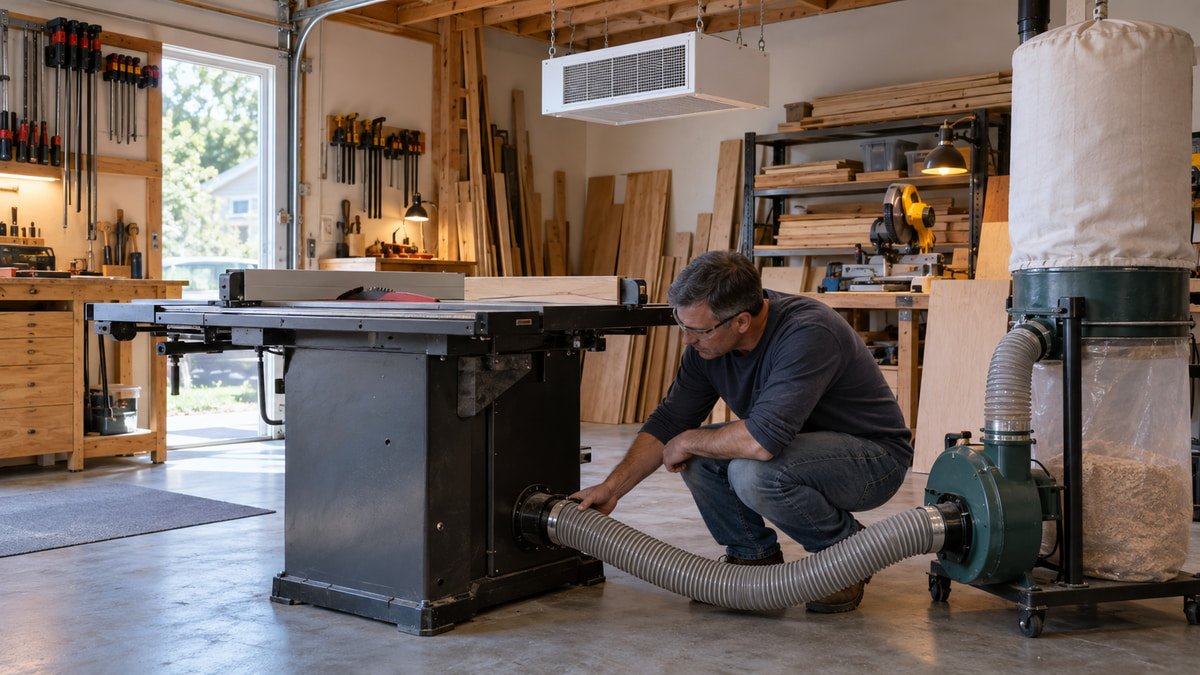
The WEN 3410 covers the common compact format. WEN lists three speeds at 300, 350, and 400 CFM, a five micron outer filter, a one micron inner filter, a remote, and a programmable timer. Its published sound range is 50 to 60 dB, and the unit weighs about 31 pounds.
That combination fits a one car garage or a divided workshop zone where the ceiling is near eight feet. The timer is useful after sanding because the cleaner can continue cycling air while the room is empty. Follow the manufacturer’s guidance for unattended operation and electrical connection rather than assuming every timer mode is suitable in every setting.
The rectangular outer filter is visible from the floor, which makes buildup easier to notice. Before buying, compare the price and stock of both replacement stages. A common filter size is an ownership advantage only when the frame and airflow direction match the machine specification.
Grizzly G0738 for clear performance specifications
The Grizzly G0738 publishes 260, 362, and 409 CFM across its three speeds. Grizzly lists a five micron outer filter, one micron inner filter, timer settings for one, two, or four hours, and sound ratings from 62 to 69 dB. The remote works without a direct line of sight according to the current product page.
Grizzly calculates roughly 7.7 room cycles per hour in a 20 by 20 by 8 foot room. That example is useful because it connects airflow to cubic volume, though an open garage door, loaded filter, or obstructed outlet changes the result. The G0738 is also designed for hanging or bench placement, giving a renter or low ceiling owner another option.
Bench placement consumes work area and may pull debris directly from a sanding zone, so protect the intake from large chips. If the unit hangs, preserve the walking and machine zones in our workshop clearance guide.
Powermatic PM1250 for quiet higher output cleaning
The Powermatic PM1250 uses an electrostatic filter rather than the familiar outer pad and inner bag arrangement. Powermatic publishes airflow up to 754 CFM, a 0.1 micron filter description, sound levels of 41.3 dB on low and 50.8 dB on high, an RF remote, and a filter service alert.
Those specifications make it appealing when the cleaner will run near conversation or an attached living space. The unit can be mounted on a ceiling or wall, or used on a bench. The filter is a model specific component, so check its current replacement cost and availability. A proprietary fine filter can cost much more than a common disposable outer pad.
Electrostatic collection does not remove the need for a dust collector at the tool. Think of the PM1250 as the quiet room cleaner that follows good source capture, not as permission to disconnect the saw hood.
Powermatic PM1200 for larger room volume
The Powermatic PM1200 is the high volume choice in this set. Powermatic lists three filtered air speeds of 547, 706, and 1,196 CFM. The heavier cabinet fits a large two car workshop or a tall space where a 400 CFM cleaner would need many hours to provide repeated cycles.
The current web listing uses inconsistent filter wording between its page title and specification area. Confirm the current manual, data plate, and included filter part numbers before purchase. Powermatic sells separate PM1200 inner and outer replacement filters, which at least makes the consumable path identifiable.
A 76 pound suspended machine demands proper structure and a careful lift. It should not hang from drywall or a decorative ceiling grid. Check the manual, locate framing, and use a qualified installer when the support or wiring is uncertain. The open area below must remain clear during installation.
Calculate air changes from the real room volume
Multiply length by width by average ceiling height to estimate cubic feet. Then multiply the cleaner CFM by 60 and divide by room volume. A 20 by 20 by 8 foot garage contains 3,200 cubic feet. A 400 CFM cleaner has a simple theoretical rate of 7.5 air changes per hour: 400 times 60, divided by 3,200.
That result is not a promise. Loaded filters, grille resistance, cabinets, a partial loft, and poor placement reduce effective circulation. A garage open to another bay has more volume than the taped floor rectangle suggests. Include connected space unless a real partition closes it.
For unusual layouts, two smaller machines can create more even circulation than one large box at the far end. They also provide lower speed operation near the user. Compare their combined filter cost, power draw, remotes, and mounting work before assuming the split system is cheaper.
Place the intake and outlet in a clean loop
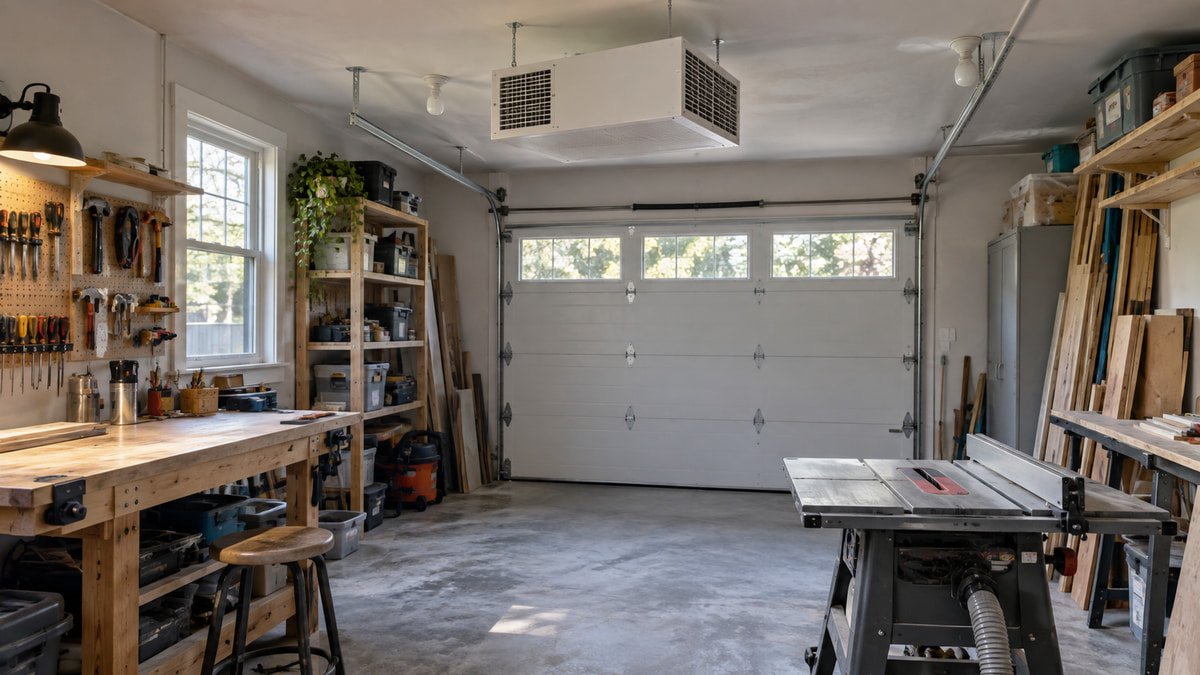
Most rectangular cleaners pull air through the rear filter and push it from the front grille. Aim that outlet along the long dimension of the shop, not straight into a nearby wall or cabinet. Leave the manufacturer specified clearance at both ends. Avoid placing the intake directly above the dustiest machine if large chips can strike the filter.
A gentle room loop is the goal. The discharged air travels across the ceiling, drops at the far wall, and returns through the occupied zone. You do not need decorative arrows or smoke tests to start. Hang lightweight thread at a few safe locations with machines off, then observe whether air movement stalls behind a tall cabinet.
Coordinate the box with wall storage and table saw clearance. Keep the cleaner outside the garage door travel and away from a board that might rise during an awkward cut.
Filter access and replacement cost decide long term value
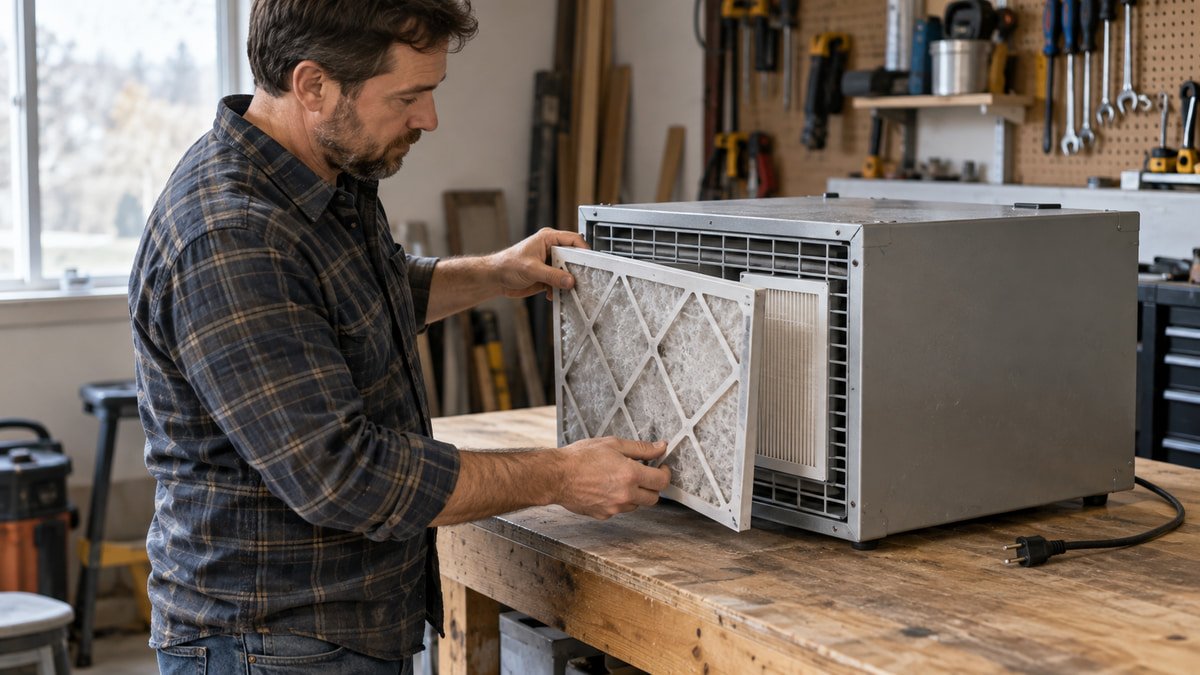
A prefilter catches larger particles and protects the finer second stage. Inspect it often during the first few projects, because dust production varies widely. A planer and random orbit sander can load a shop differently. Clean or replace each filter only by the method in the manual. Compressed air can damage some media or drive fine dust deeper.
Before purchase, find the exact replacement part numbers. Add the cost of one full filter change to the machine price. Check whether the inner stage can be cleaned, how the maker defines end of life, and whether a warning light measures time or actual resistance. A timer based alert cannot know that one month included heavy sanding.
Mounting height should allow safe filter removal. If service requires a tall ladder squeezed beside a vehicle, it will be postponed. Our garage storage planning guide can help reserve a clear ladder position beneath overhead equipment.
Run it when dust is produced and after work ends
Use the cleaner during dusty operations when it does not disrupt source capture or throw dust across the breathing zone. Higher speed clears the room faster, while a lower setting may be tolerable for a longer session. The timer can continue the cycle after the final cut, provided the maker permits that operating pattern.
Do not use a cleaner as evidence that the air is safe. Fine particles can be hard to see, and a clean looking room can still contain airborne dust. The NIOSH engineering controls directory explains the role of local exhaust and other controls. Suitable respiratory protection, housekeeping, and ventilation remain separate decisions.
Listen for a changing fan tone and watch for dust leaking around the filter frame. A properly fitted filter, open grille, and regular inspection keep airflow more consistent. Turn the unit off and isolate power before service, following the manual for the exact model.
Useful products to compare
These links open current Amazon search results. Check the dimensions, manual, mounting hardware, warranty, and current availability for the exact model before you order.
Before you buy or install
Read the current manual for the exact product you are considering. Confirm its assembled dimensions, rated capacity, mounting requirements, included hardware, working clearances, warranty, and any limits that apply to your wall, floor, electrical circuit, or garage layout.
Frequently asked questions
How many CFM should a workshop air cleaner have?
Calculate from room volume. Multiply CFM by 60, then divide by the room cubic feet to estimate theoretical air changes per hour. Allow for loaded filters and imperfect circulation. A compact one car bay often fits a roughly 400 CFM class, while larger shops may need more.
Does an air filtration system replace a dust collector?
No. A dust collector or suitable vacuum captures debris at the machine. An ambient cleaner recirculates room air and catches part of what escaped. Use both roles where the process creates fine airborne dust, and follow appropriate respiratory protection guidance.
Where should a ceiling mounted shop air filter go?
Place it where the intake and outlet can create a long circulation path without obstruction. Keep it clear of garage door hardware, lights, tall stock, and the direct chip stream. Mount only to structure allowed by the manufacturer’s instructions.
How long should a shop air cleaner run after sanding?
There is no single duration for every room. Dust load, airflow, filter condition, and room volume all matter. Use the manufacturer’s timer guidance, watch how quickly visible dust settles, and improve source capture if the cleaner must chase a dense cloud.
Is a one micron shop air filter enough?
A one micron second stage is common in compact woodworking cleaners and is far finer than a coarse prefilter. Some systems use HEPA or electrostatic media for smaller particles. Compare the complete system rating, seals, airflow, and replacement filter availability.
Leave a Reply