Affiliate disclosure: As an Amazon Associate I earn from qualifying purchases. This article may contain affiliate links, and Bay & Bench may earn a commission at no extra cost to you. Read our full Affiliate Disclosure.
The best heavy duty garage shelving is not necessarily the rack with the largest number on the box. A useful rack fits the wall, accepts the bins you already own, lets you adjust shelves around tall equipment, and carries real loads without encouraging bad habits. A 10,000-pound published total sounds decisive until the bottom shelf blocks an outlet or a 24-inch frame steals the only comfortable path past the car.
This is a documentation-based shortlist, not a hands-on durability test. I compared current U.S. product pages, published dimensions, deck materials, adjustment intervals, and evenly distributed load language. The four racks suit different garages. Your floor, assembly, environment, and loading pattern still determine how well any of them works at home.
Quick answer
The DEWALT DXST10000 is the capacity leader here, with a published 10,000-pound total across four shelves, while the 90-inch Husky spreads storage across five shelves and a wider frame. Gladiator’s 77-inch rack offers four steel mesh shelves and a published 8,000-pound total. The Kobalt is the more moderate choice at 6,000 pounds total and uses a 2.5-inch shelf adjustment pattern. For most homes, footprint, deck type, and shelf spacing matter sooner than the maximum rating.
Best heavy duty garage shelving at a glance
All capacities below are manufacturer or retailer claims for evenly distributed loads on correctly assembled racks. They are not permission to place the full total on one spot, and they do not certify your floor.
| Rack | Published size | Published capacity | Shelves | Best fit |
|---|---|---|---|---|
| DEWALT DXST10000 | 77 W x 24 D x 72 H | 2,500 lb per shelf, 10,000 lb total | 3 wire decks, 1 wood deck | Dense shop equipment and mixed deck needs |
| Husky 90-inch rack | 90 W x 24 D x 90 H | 1,800 lb per shelf, 9,000 lb total | 5 wire shelves | Maximum wall coverage and more shelf levels |
| Gladiator 77-inch rack | 77 W x 24 D x 72 H | 2,000 lb per shelf, 8,000 lb total | 4 steel mesh shelves | Broad, open garage storage |
| Kobalt 77-inch rack | 77 W x 24 D x 72 H | 1,500 lb per shelf, 6,000 lb total | 4 shelves | Heavy household storage without chasing the top rating |
If 24 inches feels deep against your parking bay, compare the tradeoffs in our 18-inch versus 24-inch shelf guide before choosing a model.
What the large capacity number does and does not mean
Every rack here expresses capacity as an evenly distributed load. That phrase matters. Ten cases spread across a sound shelf are different from a compact engine block placed between two deck supports. Total capacity is also the sum of separate shelf limits. A 10,000-pound four-shelf rack does not have one 10,000-pound shelf.
Capacity assumes the specified configuration, all beams seated and locked, decks correctly installed, and the frame standing as instructed. Missing pins, a bent connector, a damaged deck, or a rack twisted to follow an uneven floor changes the situation. Stop and correct those issues rather than treating the rating as a safety cushion.
Most residential owners do not need anything near the advertised total. The benefit of a stout rack is often less bounce, wider bays, and confidence with bags, cases, and bins. Load the heaviest appropriate items low. Keep chemicals in storage allowed by their labels, and do not use a utility rack as a substitute for a flammable-liquid cabinet or other purpose-built enclosure.
DEWALT DXST10000 for the highest documented capacity
The DEWALT DXST10000 product page lists a 77-inch-wide, 24-inch-deep, 72-inch-high frame with four shelves. Each shelf is rated for 2,500 pounds, producing the published 10,000-pound total when loads are evenly distributed. Three shelves use wire decks; one uses an MDF deck. Shelf beams adjust in 3-inch increments.
That mixed deck arrangement is useful. Wire makes dust and small leaks visible, while the solid shelf supports cases or containers whose feet do not sit well on mesh. MDF is still vulnerable to persistent moisture. If winter slush reaches the rack or the garage floods, keep the solid deck safely above the wet zone and inspect it for swelling.
The three-inch adjustment steps are coarse compared with some rivals. Map your tallest cases and stacked bins before assembly. Losing three inches of air above every level can erase a surprising amount of capacity.
Husky 90-inch rack for broad wall coverage
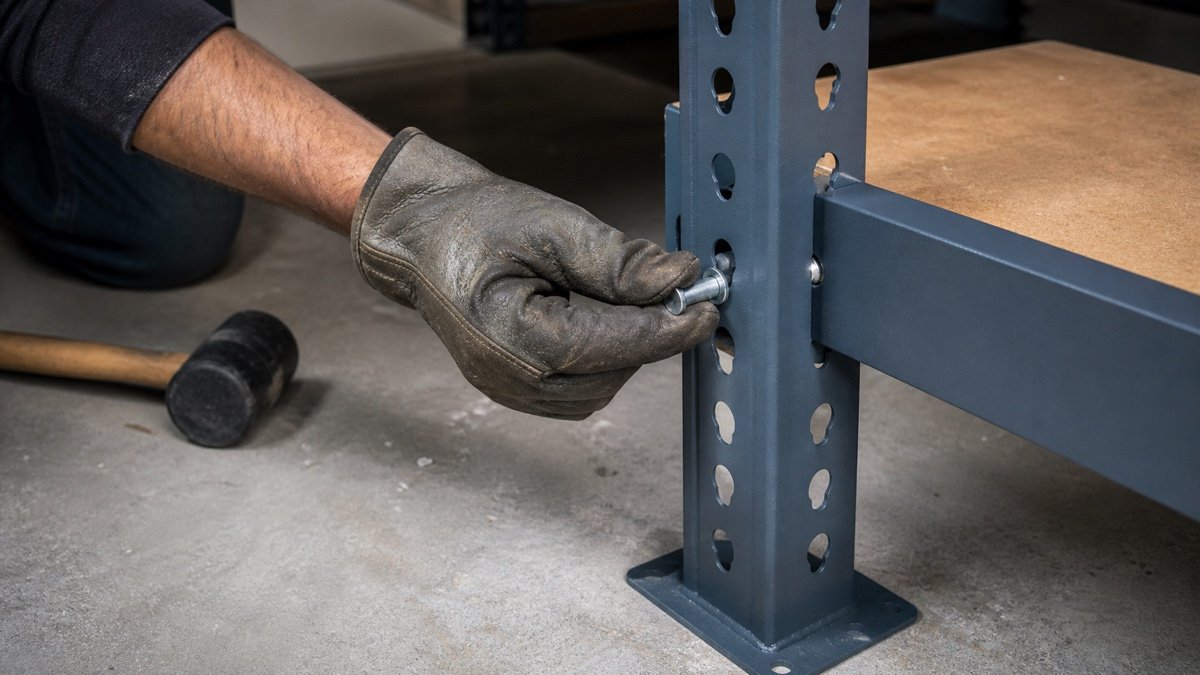
Home Depot lists the Husky N2W902490W5B at 90 inches wide, 24 inches deep, and 90 inches high. It has five wire shelves, a published 1,800-pound capacity per shelf, and a 9,000-pound total when evenly distributed. The shelf positions adjust in 1.5-inch increments.
The extra width and fifth level make this an efficient choice for a tall uninterrupted wall. They also make it harder to transport, stand up, and reposition. Check ceiling height, garage-door hardware, light fixtures, and the diagonal clearance needed during assembly. A nominal 90-inch ceiling does not give a 90-inch rack usable breathing room.
Fine shelf adjustment helps when standardized totes differ by only a few inches. Leave enough space to tilt lids, grip handles, and pull a bin forward. A diagram that packs every shelf to the nearest half inch can look efficient while being miserable to use.

Gladiator 77-inch rack for simple steel mesh storage
The Gladiator 77-inch heavy duty rack measures 77 inches wide, 24 inches deep, and 72 inches high. Gladiator publishes 2,000 pounds per shelf and 8,000 pounds total for evenly distributed stationary loads. Four steel mesh shelves avoid the moisture concerns of fiberboard decks and make the contents below visible.
Mesh is not ideal for every object. Small feet can wobble, aerosol cans can tip, and fabric bags can sag into openings. Put those items in stable bins or on an approved shelf liner that does not interfere with the deck or create an unrecognized load condition.
This size is easier to fit than a 90-inch rack while still swallowing common 27-gallon totes two across on many layouts. Confirm your actual bin dimensions, including lid lips and handle bulges. Product names are not reliable measurements.
Kobalt 77-inch rack when 6,000 pounds is already plenty
Lowe’s lists the Kobalt four-tier rack at 77 by 24 by 72 inches with four shelves. The published rating is 1,500 pounds per shelf and 6,000 pounds total for evenly distributed loads. Shelf positions adjust in 2.5-inch increments.
Six thousand pounds is far beyond the contents of many household garages. Choosing this rack over a higher-rated one can make sense if its price, availability, finish, or assembly details suit the room better. Capacity you never use is not a benefit if the shelf layout wastes space or the frame blocks the car door.
Check the current page and instructions for included parts, deck style, anchoring guidance, and assembly method. Retailer listings can change as models are revised. Match the model number, not just the color and width.
Measure the rack as a working object
Start with the published outside dimensions, then add operating space. Tape a 24-inch-deep rectangle on the floor and park the vehicle normally. Open its nearest door. Walk past it carrying the largest tote. If you turn sideways or lift the tote over a mirror, the rack is too deep for that location.
Measure baseboards, foundation ledges, pipes, outlets, door trim, switches, and any wall bow. A rack foot sitting two inches away from the wall because of a curb moves the front edge two inches into the aisle. Our garage shelving buying guide covers footprint, deck, frame, and access decisions in a useful order.
Finally, inspect the delivery route. A boxed rack can be carried in pieces, but large wire decks may not turn through a tight stairwell or side door. Decide where the assembly happens and whether the finished frame can be stood upright without hitting the ceiling.
Set shelf spacing around bins, not empty air
List the five tallest things that genuinely belong on the rack. Measure them with lids, casters, handles, and protective cases. Add grip room above each item. Then assign them to shelf levels before opening the hardware.
Put dense, stable objects low and light bulky gear high. Frequently used bins should sit between knee and shoulder height when practical. The lowest shelf can stay several inches above the floor in wet climates, creating room to inspect for water and sweep underneath. Our garage shelf spacing guide includes a step-by-step layout method.
A wide bay does not require every shelf to match. You might leave the bottom opening tall for a mower attachment, use tighter spacing for hand-tool cases, and reserve the top for empty coolers. Adjustable spacing matters because household storage changes. Leave yourself one easy future move.
Freestanding or wall mounted is a layout decision
These are freestanding racks, though manufacturers may provide restraint or anchoring instructions for particular installations. A freestanding frame carries its load through its feet, uses floor depth, and can sometimes be relocated after unloading. Wall-mounted shelves free the floor but transfer loads into the wall structure and usually offer less depth or capacity per bay.
Do not improvise an attachment simply because a rack feels tall. Follow the exact instructions for the model and wall condition. If the garage wall is masonry, framed oddly, or damaged, get qualified advice. The comparison in wall-mounted versus freestanding garage shelves can help choose the right system before hardware enters the picture.
Whichever format you use, keep required access to electrical equipment, utilities, windows, and doors. Storage should not make routine service a demolition project.
Common mistakes that turn a strong rack into a nuisance
- Buying a 24-inch-deep frame without testing the parked-car aisle.
- Reading total capacity as a single-shelf limit.
- Concentrating dense loads in the center of a wire deck.
- Putting absorbent wood decks in a known wet zone.
- Leaving too little hand space above a heavy tote.
- Mixing parts from different racks or omitting locks and clips.
- Climbing the frame instead of using a suitable ladder.
- Ignoring a bent beam, damaged connector, rust, or loose foot.
Another quiet mistake is filling every shelf on day one. Leave some open space. It gives incoming supplies a home and lets you rearrange categories without creating a floor pile.
A final selection checklist
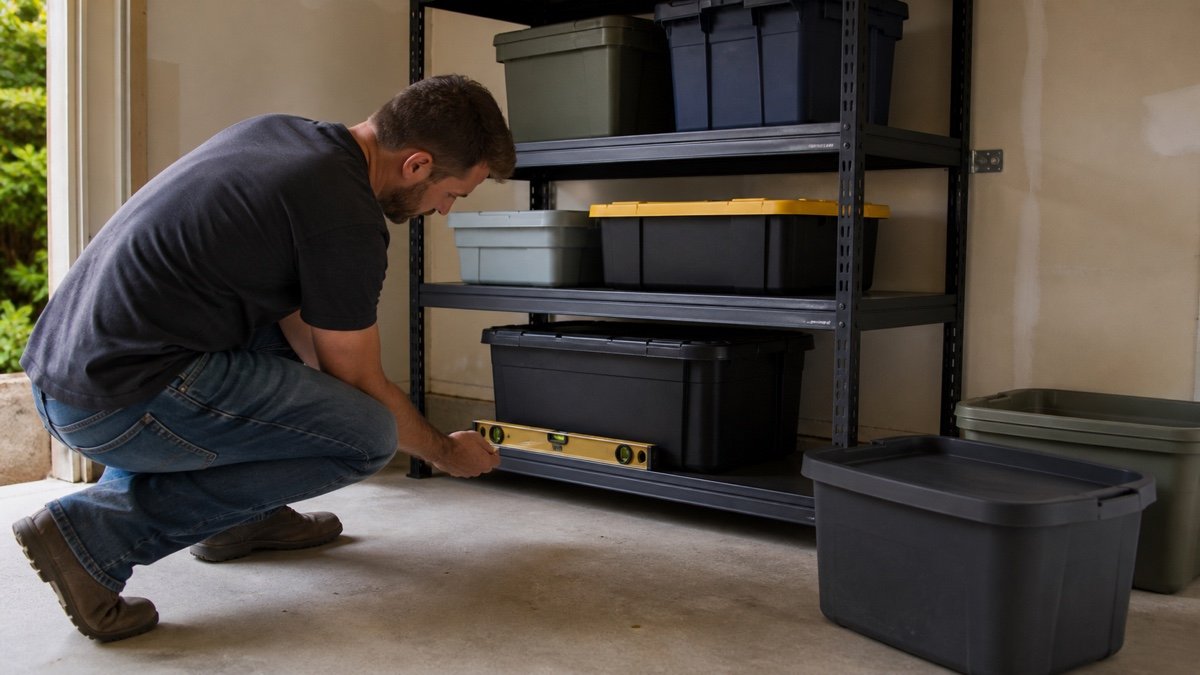
- Tape the complete footprint on the occupied garage floor.
- Measure the five tallest bins and the heaviest realistic shelf group.
- Choose deck material for moisture, object feet, and cleaning.
- Compare per-shelf ratings with rack totals.
- Check adjustment intervals against the planned openings.
- Inspect the delivery and assembly route.
- Read the current instructions before loading.
- Recheck the rack after the first week and after any major move.
If two models fit, pick the one that makes the common bin easiest to reach. In a home garage, an orderly 1,500-pound shelf is usually more useful than a 2,500-pound shelf hidden behind a car door.
Useful products to compare
These links open current Amazon search results. Check the dimensions, manual, mounting hardware, warranty, and current availability for the exact model before you order.
Before you buy or install
Read the current manual for the exact product you are considering. Confirm its assembled dimensions, rated capacity, mounting requirements, included hardware, working clearances, warranty, and any limits that apply to your wall, floor, electrical circuit, or garage layout.
Frequently asked questions
How much weight does heavy duty garage shelving really need to hold?
Add the actual contents planned for each shelf, then leave sensible headroom within the manufacturer’s evenly distributed rating. Most household bins, tools, and supplies do not approach 1,500 pounds per shelf. Fit and access usually become limiting factors first.
Is wire decking better than wood decking in a garage?
Wire tolerates occasional dampness better and reveals leaks, but small objects need bins or an approved liner. Wood or MDF supports small feet smoothly yet can swell after repeated moisture exposure. Choose for the room and the objects, not appearance alone.
Should heavy items go on the bottom shelf?
Yes, stable dense items are generally easier and safer to handle low on the rack. Keep them off a floor area that regularly gets wet, and distribute them across the shelf rather than creating one concentrated point load.
Can I combine parts from two garage shelving systems?
Do not assume parts that look similar are compatible. Beam tabs, locks, deck supports, and ratings are system specific. Use components approved for the exact rack and follow its current assembly instructions.
Leave a Reply