Tag: buying guides

  • Best LED Shop Lights for Garage: Five Fixtures Compared by Fit

    Best LED Shop Lights for Garage: Five Fixtures Compared by Fit

    Affiliate disclosure: As an Amazon Associate I earn from qualifying purchases. This article may contain affiliate links, and Bay & Bench may earn a commission at no extra cost to you. Read our full Affiliate Disclosure.

    The best LED shop lights for garage use are the ones that put usable light on the bench, floor, and machine surfaces without turning every polished tool into a glare source. That sounds obvious, yet lumen numbers make it easy to buy one fierce fixture and leave the corners dim. This comparison uses current manufacturer data and official retailer specifications, so treat it as a fit shortlist rather than a lab ranking. It covers five current U.S. fixtures, then shows how to judge quantity, mounting, linking, color, and controls in your own room.

    Quick answer

    For an ordinary residential garage, begin with several diffused 4-foot fixtures in two rows rather than one bright line. The Feit SHOP/4/840/MM is a practical control-focused option with 5,000 lumens, 4000K light, motion sensing, and linkability. The Braun 59506 is a simpler 5,500-lumen hanging light, while the Braun 56780 supplies 10,000 lumens where a higher ceiling or demanding task warrants it. Pick the layout first. Then confirm fixture rating, mounting method, cord route, switching, and the manufacturer’s linking limit.

    Best LED shop lights for garage use at a glance

    These are not ranked as universal winners. Each solves a different garage problem, and the published output does not describe beam distribution or glare by itself. Current specifications can change, so use the linked product page and manual as the final reference.

    FixturePublished outputColorMounting and controlsBest fit
    Feit SHOP/4/840/MM5,000 lumens, 55 W4000KPlug-in, hang or flush mount, motion sensor and remoteEveryday garage with automatic entry lighting
    Braun 595065,500 lumens, 55 WCheck current listingHanging chains, pull chain, linkableSimple budget-minded rows
    Braun 5678010,000 lumens, 100 W5000KHanging chains, pull chain, linkableTaller bay or concentrated high-output zone
    Commercial Electric 545911425,500 lumens, 60 W4000KSurface or suspended, pull chain, linkableWider fixture body and general work light
    Lithonia 1290L3,300 lumensCheck exact configuration4-foot integrated shop lightLow-output layer, small bay, or supplemental row

    Before laying out fixtures, map the active stations in the garage workshop layout guide. A light directly over an empty aisle does less work than one positioned beside a bench or machine.
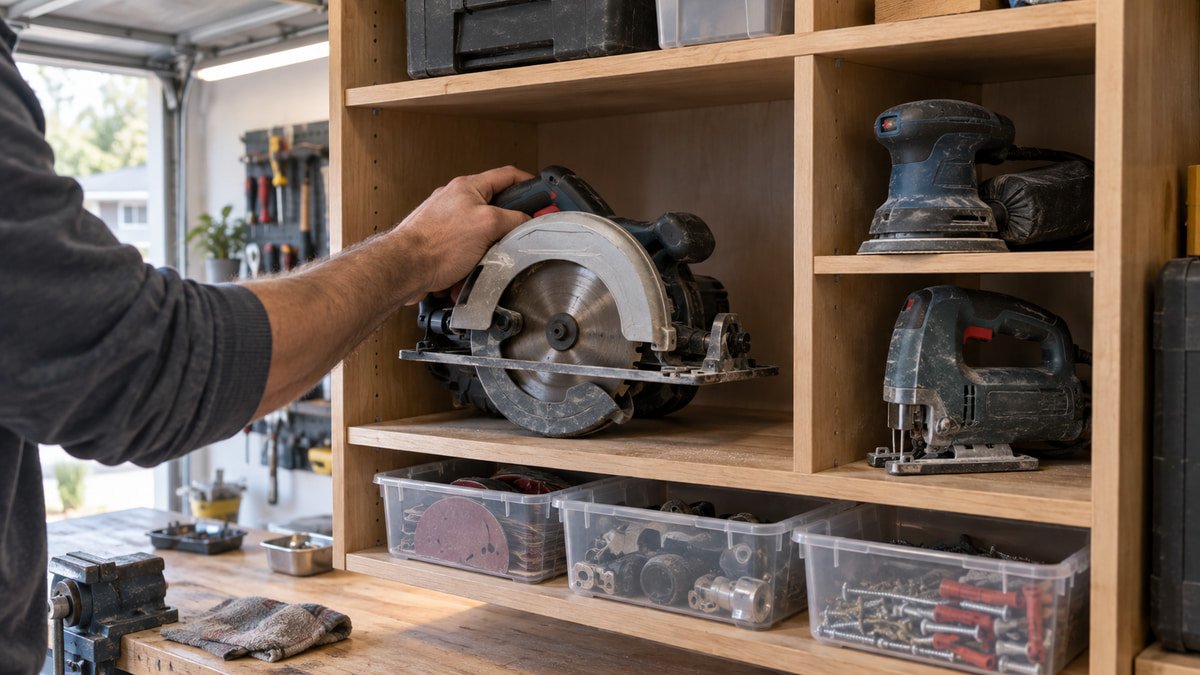
    How this shortlist was built

    We looked for current fixtures with an accessible manufacturer page or official retailer listing, published lumen output, and enough installation information to compare them honestly. The shortlist deliberately includes modest and high-output choices. A 10,000-lumen fixture is not automatically better than a 3,300-lumen one. It may create a hot stripe, pull more power, or feel harsh below a low ceiling.

    We also favored ordinary linear shapes. Four-foot fixtures are easier to place in rows, beside garage door tracks, and across a bench than multi-panel screw-in lamps with intense point sources. The models below are examples of useful configurations, not a claim that their LEDs last exactly as long as a laboratory rating in every hot, cold, dusty, or frequently switched garage. Read the environmental rating and warranty terms for the exact SKU.

    Feit SHOP/4/840/MM for useful controls without an app

    Feit lists the SHOP/4/840/MM at 5,000 lumens, 4000K, 55 watts, and 80 CRI. It can hang or flush mount, and its motion sensor offers several detection and timer settings. A remote gives you manual control without reaching a pull chain. The official Feit product page also describes it as damp-location rated and linkable, with up to six fixtures in the specified arrangement.

    This is the most balanced choice here for a garage that doubles as a passage into the house. The sensor can bring up the room while your hands are full, yet 4000K light is less stark than the daylight cast many people associate with basic shop fixtures. Still, motion control can be annoying over a quiet seated task if the timer is set too short. Confirm that the sensor sees the entry path, and keep a convenient manual option.

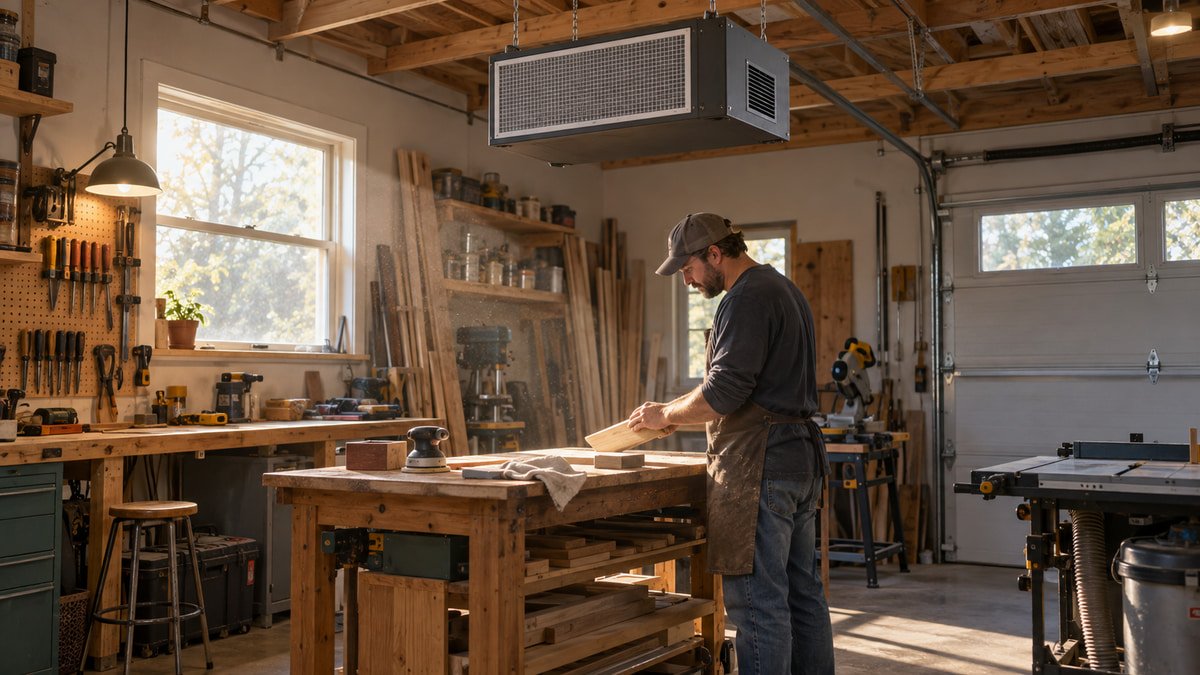
    Four-foot LED shop lights mounted over a garage workbench and tool wall
    A broad fixture over the bench reduces the hard shadows created by a single ceiling bulb.

    Braun 59506 for a straightforward hanging row

    The Braun 59506 is a light, narrow 4-foot hanging fixture. Harbor Freight publishes 5,500 lumens from 55 watts, a 5-foot power cord, included chains and S-hooks, and a limit of eight linked fixtures. The current official Braun listing states a 30,000-hour LED life and ETL certification.

    Its appeal is simplicity. Hang a pair over a bench line or create two parallel rows across a garage, then use the pull chain only where it remains reachable. The narrow body leaves more ceiling space around tracks and openers. It also concentrates the luminous surface, so position it where you cannot stare directly into the LEDs while working under a car hood. If you need a fixed wall switch or flush appearance, another fixture may be cleaner.

    Braun 56780 when 10,000 lumens genuinely help

    The Braun 56780 doubles the nominal output to 10,000 lumens at 100 watts. Its official product page lists 5000K light, a wider 7.43-inch body, included 24-inch chains, and a maximum link of four fixtures. That combination fits a tall bay, a detailed mechanical zone, or a room where one row must cover a broad working area.

    Do not buy four merely because they link. At a low residential ceiling, 10,000 lumens concentrated over a polished workbench can feel brutal. Start with a layout calculation, separate general and task lighting when possible, and use the table saw clearance guide to keep suspended fixtures and cords away from the full material path. The heavier fixture also deserves careful mounting into the structure named in its manual.

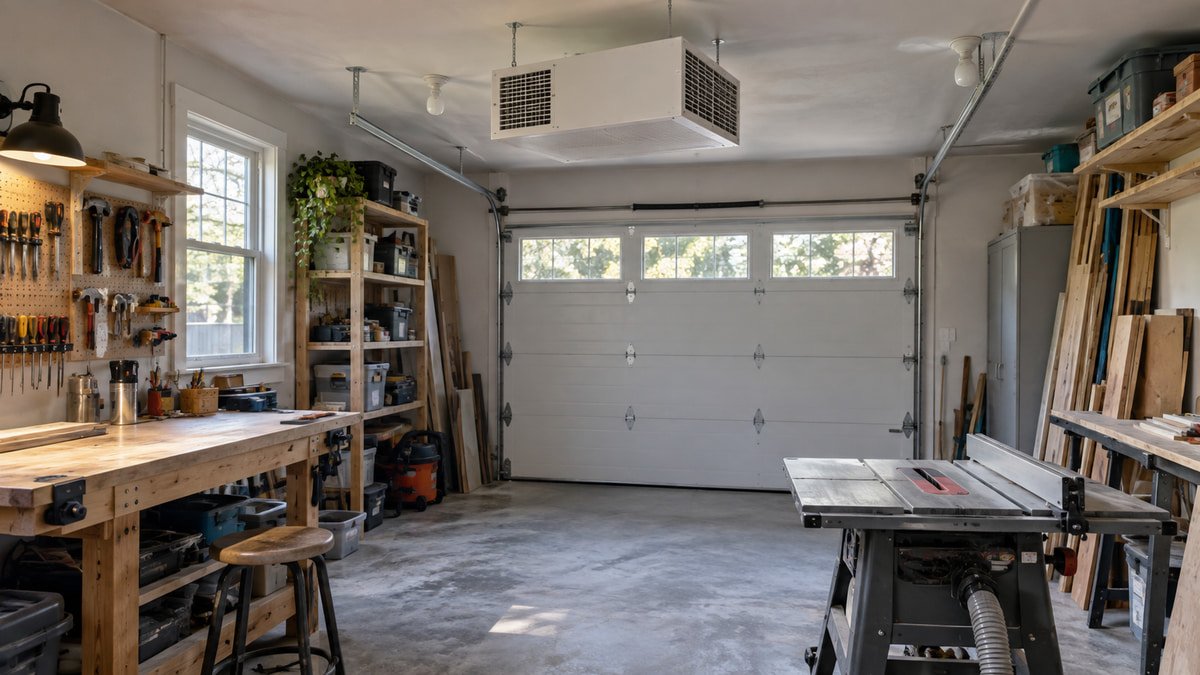
    Linkable hanging LED fixtures arranged in two rows above an open garage bay
    Two modest rows usually distribute light more evenly than a high-output strip down the centerline.

    Commercial Electric 54591142 for a broader 4000K source

    The Commercial Electric 54591142 is listed at 5,500 lumens, 60 watts, and 4000K. Its wider 10-inch housing can soften the visual impression compared with a bare narrow strip. The official retailer page describes surface and suspended mounting, included chains and cord, damp-location suitability, and linkability up to the stated limit.

    This model makes sense above a fixed bench where a broader luminous surface matters more than a minimal body. Check the actual mounting kit before choosing its exact ceiling position. A 10-inch housing can conflict with a garage door support or storage rack where a slim strip would pass. If the fixture sits above open drawers or the edge of a wall cabinet, stand at the work position and look up before drilling. That quick sightline test catches a surprising amount of glare.

    Lithonia 1290L for a smaller or layered lighting plan

    Lithonia lists the 4-foot 1290L at 3,300 lumens. The manufacturer page is sparse, so the exact SKU documentation should settle color, input, cord, mounting parts, and environmental limits before purchase. Its lower output can be useful in a one-car bay, over a secondary bench, or as one of several closely spaced fixtures.

    A lower-output light is often easier to live with when the ceiling is low and the walls are pale. More fixtures also let you reduce shadows at the sides of a vehicle or machine. The tradeoff is more mounting points and a more complicated power route. If you are replacing an existing fluorescent body, do not assume a shop light can reuse the old wiring. A plug-in fixture and a hardwired fixture are different installations.
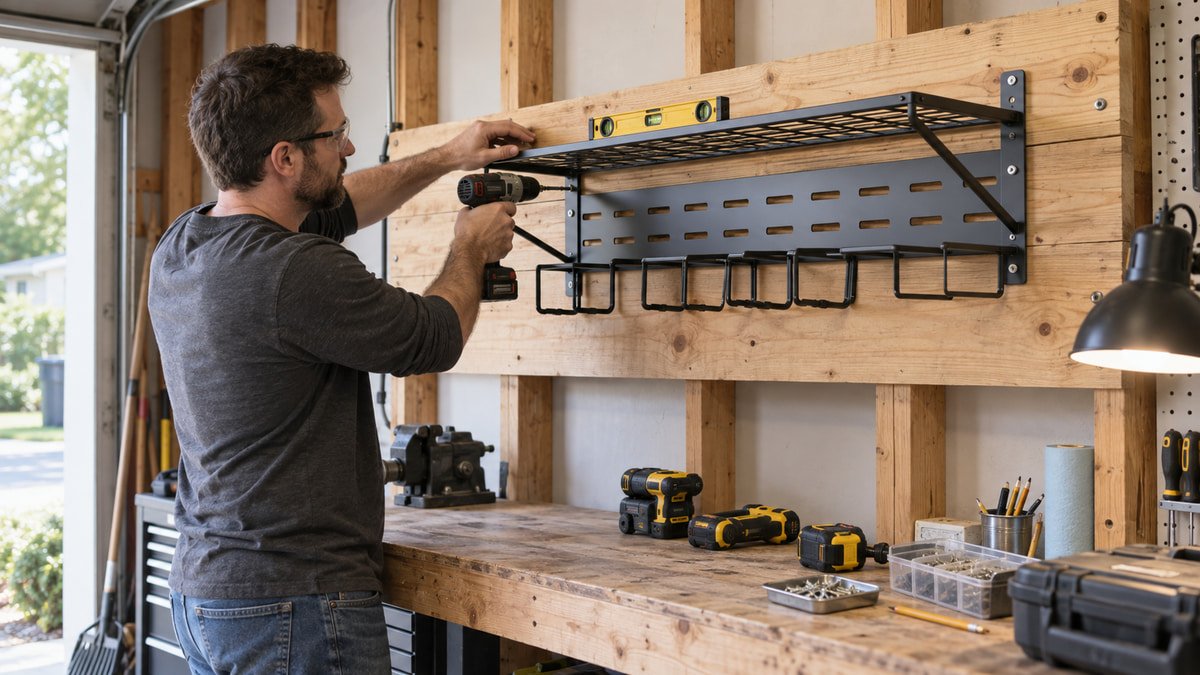
    Plan total light, then split it across the room

    Multiply room length by width to get square feet, then use a starting target appropriate to the work. The number is only a planning estimate because wall color, fixture distribution, mounting height, and shadows change what reaches the surface. A 22 by 22 foot garage is 484 square feet. Four 5,000-lumen fixtures provide 20,000 initial lumens, or about 41 lumens per square foot before losses. That may feel comfortable for general work in one room and weak in another.

    Place the total in two rows and add task lighting at the bench rather than chasing one huge center fixture. Run the positions through the garage workshop aisle clearance guide; you should be able to move a tall project, ladder, or sheet good without striking a low hanging chain. Paint and clean surfaces matter too. A dusty dark ceiling swallows more light than a clean pale one.

    Check linking, cords, and switching as one system

    A published linking limit is not a suggestion to fill every socket. It is the maximum arrangement for that exact model under its instructions. Never mix a manufacturer’s linking cords with unrelated fixtures. Add the input watts of the planned run, follow the manual, and keep cords away from door hardware, sharp edges, hot surfaces, vehicle roofs, and any place they can be snagged.

    Decide what should turn on together. General rows may share a wall control, while a bench light benefits from its own switch. Motion sensing works well for entry light but may switch off during careful stationary work. Smart controls add scheduling, yet an app should not be the only practical way to light a dark garage. Permanent electrical work belongs with a qualified electrician and the requirements that apply at the property.

    Close view of a diffused LED shop light above detailed mechanical work
    A frosted lens and thoughtful angle can be easier on the eyes during close work.

    Look beyond lumens before ordering

    Confirm color temperature, CRI, damp or dry location rating, operating temperature, dimming compatibility, warranty, and whether the LEDs or driver can be serviced. Look at the fixture dimensions rather than the familiar “4-foot” label. Width and hanging depth determine whether it clears an open garage door, ceiling rack, or tall cabinet. If the manufacturer supplies photometric files, they are more useful than a marketing photo for a serious layout.

    Then check the room at night. Tape the proposed fixture centerlines to the ceiling and stand at the bench, vehicle hood, and floor work area. Note where your head and hands cast shadows. A small movable work light can reveal whether the fixed layout needs another row. Lighting should support the garage storage system, not disappear behind open cabinet doors or illuminate the tops of bins.

    The sensible pick for each garage

    Choose the Feit motion model if automatic entry lighting and 4000K color suit the room. Choose the Braun 59506 when you want a simple, light, linkable hanging row. The Braun 56780 earns its place where mounting height and demanding work can use 10,000 lumens without glare. Commercial Electric’s broader body suits a fixed bench, while the Lithonia 1290L makes more sense as a modest layer than a brute-force centerpiece.

    Whichever you choose, order one fixture first when returns are practical. Temporarily hang it at the intended height, inspect shadows and glare, then copy the successful spacing. That small test tells you more than a lumen race and avoids covering the ceiling with a layout you dislike.

    Useful products to compare

    These links open current Amazon search results. Check the dimensions, manual, mounting hardware, warranty, and current availability for the exact model before you order.

    Before you buy or install

    Read the current manual for the exact product you are considering. Confirm its assembled dimensions, rated capacity, mounting requirements, included hardware, working clearances, warranty, and any limits that apply to your wall, floor, electrical circuit, or garage layout.

    Frequently asked questions

    How many LED shop lights does a two-car garage need?

    There is no fixed count. Multiply the room area by a reasonable starting lumen target for your work, then divide that total across several fixtures. Check ceiling height, wall color, beam spread, shadows, and task lighting. A mockup with one temporary fixture is more reliable than choosing by floor area alone.

    Is 4000K or 5000K better for a garage?

    4000K usually feels neutral and comfortable for a mixed-use garage. 5000K looks cooler and can make detail feel crisp, but some people find it stark at night. Color temperature does not measure brightness or color accuracy. Compare both if the room is also a laundry, entry, or hobby space.

    Can I link different brands of LED shop lights?

    Do not assume so. Use only the linking cord, connector, and arrangement approved for the exact fixture. Stay within the manufacturer’s unit and electrical limits. A matching plug shape does not prove electrical or mechanical compatibility.

    Should garage shop lights hang or mount flush?

    Hanging lights are easier to lower over a bench and can avoid an uneven ceiling. Flush fixtures preserve headroom and reduce movement near doors and stored items. Check the exact fixture instructions, structure, cord path, open garage door envelope, and every overhead storage location.

  • Tool Chest vs Tool Cabinet: Choose by Access, Weight, and Space

    Tool Chest vs Tool Cabinet: Choose by Access, Weight, and Space

    Affiliate disclosure: As an Amazon Associate I earn from qualifying purchases. This article may contain affiliate links, and Bay & Bench may earn a commission at no extra cost to you. Read our full Affiliate Disclosure.

    The tool chest vs tool cabinet choice gets muddled because stores use the words loosely. In mechanic-style storage, a tool chest is usually the drawer box that sits on a bench or compatible rolling base. A rolling tool cabinet is the lower wheeled unit that carries heavier tools and may support a matching chest. A tall two-door garage cabinet is a third category entirely. This guide compares the first two formats by reach, load, footprint, mobility, work surface, and the awkward reality of getting several hundred pounds of steel into a garage.

    Quick answer

    Choose a top tool chest when you already have a strong compatible base or bench and want many shallow drawers without using more floor area. Choose a rolling tool cabinet when you need the foundation of the system, deeper lower drawers, mobility, and a useful top surface. Most growing mechanic collections are better served by a rolling cabinet first. Add only the matching chest when the upper drawer height remains comfortable and the manufacturer approves the combination.

    Tool chest vs tool cabinet in one table

    The comparison assumes a mechanic’s top chest and a drawer-style rolling cabinet. If you are considering a tall door cabinet for drills, chemicals, or bulky cases, use the garage cabinets buying guide instead.

    QuestionTop tool chestRolling tool cabinet
    Floor spaceUses a bench or compatible base footprintNeeds its own full footprint
    Typical drawer mixMore shallow drawers near eye levelShallow top drawers plus deeper lower drawers
    MobilityNot safely mobile by itself when loadedDesigned around casters and a push handle
    Work surfaceTop usually unavailable once stackedTop can be a landing surface when no chest is added
    Best first purchaseExisting compatible base is already ownedStarting a serious drawer system
    Main mistakeStack becomes too tall or mismatchedCabinet is too deep, heavy, or awkward for route

    Both can organize hand tools well. The room and the load decide which one earns its space.

    Clear up the naming before comparing models

    Retail listings sometimes call a wheeled cabinet a rolling tool chest, and a combined upper and lower stack may be sold as a chest and cabinet set. Read the product type, dimensions, caster information, and installation manual instead of relying on the title. A top chest generally has no push handle or floor casters. It must rest on a surface that the manufacturer allows.

    That distinction matters for safety and fit. A top chest may be heavy before the first socket goes in. It can shift, overload a bench, or create a top-heavy stack when paired with an unrelated base. A rolling cabinet is engineered as the lower foundation, but its rating still assumes the load distribution and operating conditions stated in the manual.

    A top chest buys drawers without another footprint

    A top chest uses vertical space efficiently. Shallow full-extension drawers put sockets, wrenches, pliers, and precision tools close to eye level. A hinged top compartment, when present, holds taller items. This layout suits a collection with many small hand tools and few bulky power tools.

    The price is reach. Every added drawer raises the top rows, especially when the chest sits on a tall rolling base. Stand beside the proposed stack and mark each drawer height on the wall. The upper drawer should open where you can see and lift its contents without reaching above your comfortable range. A matching chest can also remove the cabinet top as a work surface. If the garage needs every landing area, that loss is real.

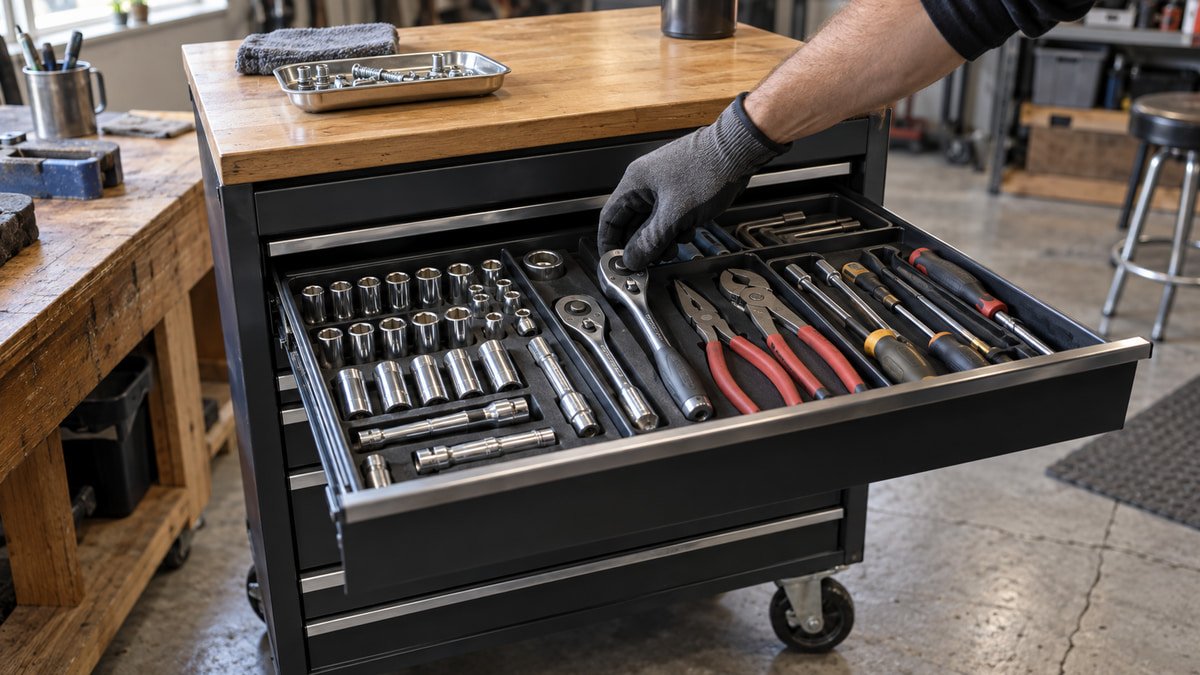
    Open shallow drawers in a top tool chest showing organized hand tools
    Top chests favor visible, shallow storage, though the upper drawers become harder to reach as the stack grows.

    A rolling cabinet is the working foundation

    A rolling cabinet stores dense tools low, supports mobility, and provides a stable base for a compatible chest. The wide top drawer often holds sockets and wrenches, while deeper lower drawers accept cordless tools, pullers, and cases. Large casters roll more easily over slab joints, although a loaded cabinet should move only on the route and in the manner the manual permits.

    Current products show how much ratings vary. Milwaukee lists its 46-inch 8-drawer steel cabinet with 100-pound soft-close drawer slides, an 1,800-pound overall capacity, and 5-inch casters on the manufacturer page. Those numbers apply to that cabinet, not every 46-inch box and not every drawer loading pattern.

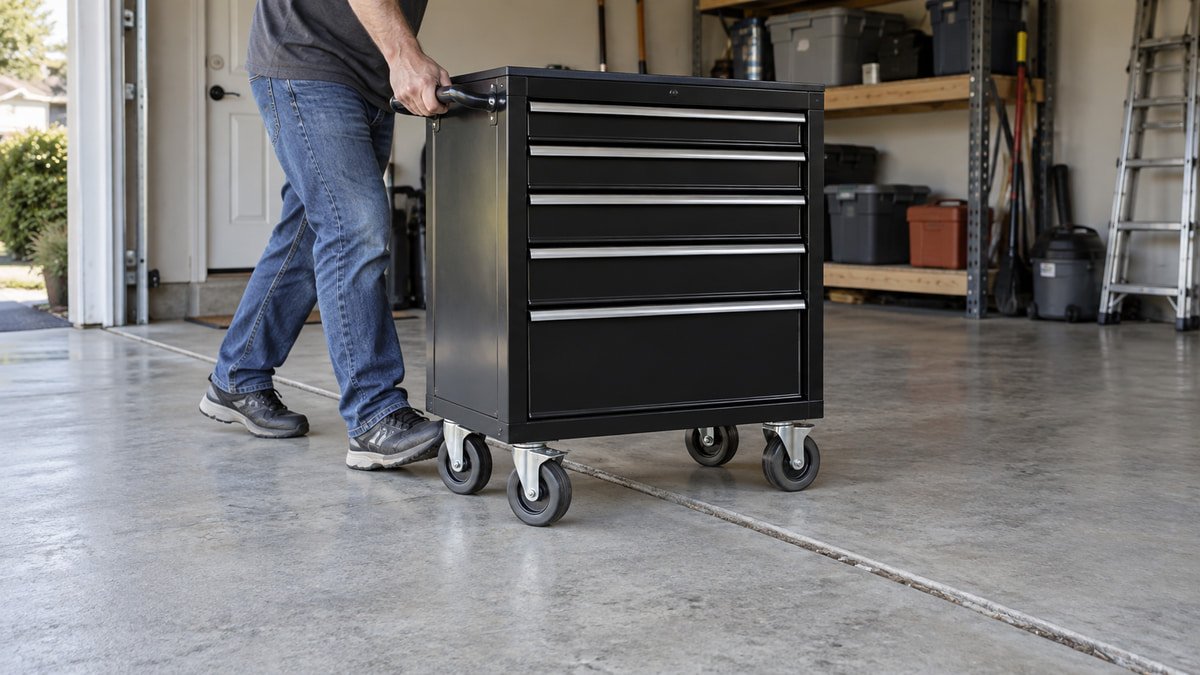
    Rolling steel tool cabinet with deep lower drawers and locked casters
    A rolling cabinet handles dense tools low and can move for service, provided the route and floor cooperate.

    Compare the drawer layout with actual tools

    Lay your tool groups in single layers and measure them. Top chests often win for small tools because shallow drawers prevent stacking. Rolling cabinets win when the lower drawer depth matches bulky tools. Neither format helps if the wrench drawer is too short or the cordless saw must lie diagonally and block the latch.

    Check internal drawer width, depth, and height. Exterior width includes walls, slides, trim, and handles. Count the weight of organizers too. Foam and rails consume height; socket sets become surprisingly dense. Use the process in the garage storage measuring guide for both the tool box and the room around it.

    Read ratings in context

    A cabinet’s total working load and a drawer slide rating describe different limits. Harbor Freight lists the U.S. General Series 3 42-inch roll cabinet at 2,600 pounds overall and 120 pounds per pair of drawer slides. The current product page also identifies the caster arrangement and cabinet dimensions. Follow its manual for distribution, movement, assembly, and stacking.

    Do not multiply a slide rating by drawer count and assume the result is a safe cabinet load. Cabinet structure, casters, floor, and load distribution still matter. Put dense tools in lower drawers, keep loads within every applicable limit, and avoid opening several loaded drawers at once. The lock secures drawers against casual access; it does not correct an unstable setup.

    Mobility is useful only with a measured route

    Measure the cabinet body, side handle, bumpers, casters, and the space needed to steer. Then inspect the route from delivery point to final location. Door thresholds, steps, narrow gates, sloped driveways, and slab joints can turn a mobile cabinet into an immovable object. A 22-inch cabinet depth may work beside a car but not through an interior doorway once the handle is attached.

    Mark the parked footprint and drawer-open footprint with tape. Compare both with the garage workshop aisle clearance guide. Casters should be locked during use, yet some swivel movement may remain. Do not use the cabinet as a step, seat, vehicle dolly, or support for work that the manufacturer has not approved.

    Work surface value changes the answer

    A bare rolling cabinet top can hold a parts tray, laptop, or repair manual. Some mobile workstations add a wood top specifically for light bench work. Once a top chest is installed, that surface disappears. You gain drawers but may end up buying another bench.

    If work surface is scarce, a cabinet with a protected top may beat a chest stack. Craftsman describes its S2000 52-inch mobile workstation with a butcher block top and 100-pound drawer slides on the official page. Treat the worktop and overall cabinet as the manual describes. A wood top does not make the cabinet suitable for hammering, clamping, or hot work by default.

    Low rolling tool cabinet used as a work surface beside a garage workbench
    A cabinet with a protected top can add a landing surface, while a stacked chest usually gives that surface back to storage.

    Stack only approved components

    A chest and cabinet that share a color and width are not necessarily compatible. Confirm model family, attachment hardware, maximum upper load, and the exact stacking instructions. Install the chest before loading it when the manual calls for that sequence. Use enough people or lifting equipment for the empty unit weight; do not improvise a lift from open drawers.

    After assembly, load from the bottom upward. Check that drawers latch, the cabinet sits level, and the casters or leveling feet contact the floor correctly. Recheck the stack after it has been moved. A mismatch saved at purchase can become a permanent wobble that no drawer liner fixes.

    Security and power are secondary filters

    Integrated locks are useful for casual security and child access, but thin steel storage is not a vault. Confirm whether one lock secures every drawer and whether replacement keys are available. Keep an inventory and consider the garage door and building security as part of the system.

    Built-in power strips can charge batteries and devices, yet they add cord routing and heat considerations. Keep the supply cord protected and use the electrical arrangement only as instructed. Do not run a cabinet across the garage while it remains plugged in. If charging is the main goal, a fixed, clean, ventilated station may work better than routing power through mobile furniture.

    Which one should you buy first?

    Start with a rolling cabinet if you are building from scratch, own several dense or bulky tools, or value a movable landing surface. Start with a top chest only when you already have a compatible rated base and the extra height stays reachable. A small collection may need neither. A compact drawer unit and the right garage wall storage system can cost less floor space.

    Make the decision with a paper tool map, a taped floor footprint, and the published empty weight. Then plan delivery before ordering. The best storage is the one you can place safely, open fully, and use without moving the car for every socket.

    Useful products to compare

    These links open current Amazon search results. Check the dimensions, manual, mounting hardware, warranty, and current availability for the exact model before you order.

    Before you buy or install

    Read the current manual for the exact product you are considering. Confirm its assembled dimensions, rated capacity, mounting requirements, included hardware, working clearances, warranty, and any limits that apply to your wall, floor, electrical circuit, or garage layout.

    Frequently asked questions

    Is a tool chest the same as a rolling tool cabinet?

    Usually not. In mechanic storage, a chest is the upper drawer box that rests on a compatible base or bench. A rolling cabinet is the lower wheeled unit. Retail names vary, so confirm casters, handles, dimensions, product type, and the installation manual.

    Can any tool chest sit on any cabinet?

    No. Match the approved model family, width, attachment hardware, base capacity, and stacking instructions. Similar dimensions do not prove compatibility. An unsupported or unsecured top chest can damage the cabinet and make the stack unstable.

    Which has more useful storage?

    A top chest usually concentrates shallow drawers for hand tools. A rolling cabinet often combines shallow upper drawers with deeper lower drawers for bulky tools. Measure your tools in groups. Cubic-inch totals cannot show whether the drawer heights fit them.

    Can I use a rolling tool cabinet as a workbench?

    Use its top only for the tasks and loads the manufacturer allows. A protective mat or wood surface makes a convenient landing area, but it does not prove the cabinet is suitable for hammering, vise loads, clamping, welding, or standing. Follow the exact manual.

  • How to Choose a Rolling Tool Chest Without Buying Too Much Box

    How to Choose a Rolling Tool Chest Without Buying Too Much Box

    Affiliate disclosure: As an Amazon Associate I earn from qualifying purchases. This article may contain affiliate links, and Bay & Bench may earn a commission at no extra cost to you. Read our full Affiliate Disclosure.

    Learning how to choose a rolling tool chest is mostly an exercise in resisting oversized specifications. A huge capacity number looks reassuring until the cabinet blocks a car door, the shallow drawers do not fit your cordless tools, or the loaded box cannot cross a slab joint. Start with a drawer map and loaded footprint. Then judge capacity wording, casters, stability, worktop, power, locks, and expansion. The comparison uses current manufacturer specifications to show how differently similar-looking cabinets can be rated, so treat it as a fit guide rather than a shop test.

    Quick answer

    Measure your tool groups in one layer, then choose drawer widths and heights that fit them with room for organizers and fingers. A 26 to 42 inch cabinet often suits a home collection better than a 56 or 72 inch unit, but the tool map decides. Put dense drawers low, compare per-drawer and overall ratings separately, and plan the fully assembled footprint. Check empty weight, caster diameter, threshold route, drawer-open clearance, power cord, compatible top pieces, and delivery before ordering.

    How to choose a rolling tool chest in ten checks

    Use this list in order. Later features cannot rescue the wrong footprint or drawer layout.

    CheckWhat to recordFailure it prevents
    Tool mapGrouped tool dimensions and weightWide cabinet with useless drawers
    Cabinet footprintBody, handle, bumpers, caster sweepBlocked vehicle or door
    Drawer mapInternal width, depth, heightStacked tools and jammed latches
    RatingsDrawer, cabinet, top, accessory limitsOverloaded slides or base
    StabilityDrawer latches, load order, floor levelTip or uncontrolled opening
    CastersDiameter, width, locks, floor jointsCabinet that cannot move
    WorktopSurface material and allowed tasksDamaged top or lost landing area
    PowerCord exit, outlets, ventilationSnagged cord or hot charging zone
    ExpansionApproved chest, locker, side cabinetMismatched unstable stack
    DeliveryPackaged size, weight, threshold routeCrated cabinet stuck outside

    Plot the two-dimensional footprint with the garage storage fit calculator before comparing paint colors.

    Inventory by drawer, not by total tool count

    Lay sockets, wrenches, pliers, measuring tools, cordless tools, and specialty equipment in separate groups. Arrange each group as you would like to see it in a drawer. Measure the rectangle, the tallest item, and the rough weight. Leave room for a hand to lift the tool and for an organizer to hold it.

    This exercise often points to fewer, better-shaped drawers. Ten shallow drawers are wasteful when half the collection consists of drills and large pullers. Four deep drawers are miserable when every socket hides below another. Photograph the layouts and carry the numbers while shopping. A cabinet width tells you little about usable drawer width.

    Pick width after the parking test

    A 26-inch single-bank cabinet is easy to place and steer. A 41 or 42-inch double-bank cabinet opens a broad top drawer and holds a mature home collection. Wider 52, 56, and 72-inch boxes provide volume and work surface, but their depth, weight, and turning radius become serious room-planning issues.

    Tape the cabinet body and side handle on the floor. Add the deepest open drawer. Park the vehicle and walk past it carrying a case. If the layout works only with the handle removed or the cabinet rolled out for every use, choose a smaller width. The garage workshop aisle clearance guide helps test the active space rather than the closed rectangle.

    Read drawer and overall ratings separately

    The cabinet rating, drawer slide rating, caster rating, and worktop rating are not interchangeable. Craftsman lists its S2000 41-inch 9-drawer cabinet with 100-pound soft-close drawer slides and a 2,000-pound overall weight capacity. The manufacturer page also identifies 6 by 2 inch casters and steel gauge range.

    A high overall number does not mean one drawer can hold that load. Nor should you multiply the drawer ratings and ignore the cabinet limit. Check how the manual defines evenly distributed loads and accessory limits. Weigh dense drawers with a bathroom or shipping scale when the estimate is close.

    Build a stable load from the bottom up

    Put jacks, large sockets, pullers, and other dense tools in the lowest suitable drawers. Light hand tools can sit higher. Open one loaded drawer at a time and close it before moving the cabinet. Full-width latches are useful because they reduce accidental opening, but you still need to verify that every drawer is fully shut.

    Harbor Freight publishes a 2,600-pound overall rating and 120-pound capacity per pair of drawer slides for the U.S. General Series 3 42-inch roll cabinet. See the current official listing and manual for the exact loading language. Use the ratings only for that model. Another cabinet of the same width may be built very differently.

    Mechanic measuring a cordless tool and an open tool chest drawer
    Internal drawer dimensions decide whether bulky tools fit without wasteful stacking.

    Caster size has to match the floor

    Large-diameter, wider casters cross small joints and debris more easily than tiny hard wheels. The arrangement matters too. Two fixed and two swiveling casters track predictably in a straight move, but they need room to turn. Four swivel casters maneuver in tighter spaces and can feel less settled while steering a heavy box.

    Inspect the slab for control joints, spalls, slope, mats, and the lip at the garage door. A caster brake may stop rolling while allowing swivel. Park the cabinet on level concrete and use any leveling system as instructed. Do not test mobility for the first time after filling every drawer.

    Large casters on a loaded rolling tool chest crossing a concrete garage joint
    Caster diameter, floor joints, and steering room determine whether a cabinet is truly mobile.

    Decide whether the top is storage or work space

    A rubber-matted steel top makes a convenient staging area. A wood top can support light assembly and protects tools from a hard surface. Adding a matching top chest converts that same area into more drawers. Choose the final role before buying either component.

    If you need a real bench for clamping and forceful work, keep it separate. The garage workbench buying guide covers frame stiffness, overhang, vise access, and surface choice. A mobile tool cabinet is storage first. Do not infer hammering, vise, welding, or standing capacity from the overall tool-load number.

    Treat built-in power with ordinary caution

    Integrated outlets can keep chargers and diagnostic tools ready, but they require a clean cord route and accessible plug. Confirm outlet type, total rating, cord length, and how the cord exits with drawers open. Keep it away from caster paths and do not move the cabinet while it is plugged in.

    Charging inside a drawer may be a listed feature on a specific cabinet, yet charger and battery instructions still apply. Keep contacts free of metal debris. Do not assume a powered drawer is fireproof or appropriate for damaged batteries. If the cabinet sits near grinding or finishing, a separate clean charging station is usually easier to manage.

    Plan compatible expansion before you need it

    Ask which matching top chests, side lockers, end cabinets, and hutches the manufacturer currently supports. Record how they attach and how each accessory changes total width, height, load, caster behavior, and wall clearance. A side cabinet can add leverage to a base that is not approved for it.

    Milwaukee lists the 46-inch 8-drawer steel cabinet at an 1,800-pound overall capacity with 100-pound soft-close slides on its official product page. That is a good example of why you should compare a whole model family rather than assuming the specifications of a familiar competitor carry across.

    Delivery deserves its own measurement sheet

    Find the packaged dimensions and shipping weight. Measure gates, driveway turns, thresholds, door openings, and any step. Decide where the pallet or carton can be opened and how the cabinet will be controlled during the move. Remove drawers only if the manual allows it and explains the procedure.

    Large cabinets may need lift-gate service, a pallet jack, several capable adults, or professional delivery into place. Do not use drawers as lifting handles. Assemble near the final location, then inspect fasteners, caster attachment, drawer action, brakes, and locks before loading. Our garage measuring guide includes fixed obstacles, but the delivery path must extend beyond the room.

    Rolling tool chest delivery path measured through a residential garage doorway
    The shipping weight and narrowest doorway belong in the buying decision.

    Check parts support and warranty details

    A rolling cabinet lives a hard life even in a home garage. Drawer clips, locks, keys, liners, caster hardware, slides, and power components may need service long before the steel shell is worn out. Look for a current parts diagram, a reachable support channel, and warranty terms that explain what the manufacturer will provide in practice. A long headline warranty is less useful when routine wear parts cannot be identified.

    Save the model, serial information, receipt, manual, and key code before the cabinet is loaded. Photograph the label. If replacement casters are offered, match the exact mounting plate and rating rather than installing a similar wheel that changes cabinet height or load distribution. Availability changes, so confirm service information at purchase instead of assuming a familiar brand keeps every part forever.

    A right-sized cabinet beats an empty giant

    Buy enough room for the collection you can reasonably expect, not every tool you might own. Twenty percent spare drawer area is pleasant. Half an empty 72-inch cabinet is an expensive way to lose a wall. A smaller box also keeps categories from spreading until each drawer contains three unrelated things.

    Choose only after the taped footprint, drawer map, rating check, and delivery plan all work. Then load slowly and revise the drawer arrangement after several projects. A rolling tool chest should shorten a job. Its size and polish are secondary.

    Useful products to compare

    These links open current Amazon search results. Check the dimensions, manual, mounting hardware, warranty, and current availability for the exact model before you order.

    Before you buy or install

    Read the current manual for the exact product you are considering. Confirm its assembled dimensions, rated capacity, mounting requirements, included hardware, working clearances, warranty, and any limits that apply to your wall, floor, electrical circuit, or garage layout.

    Frequently asked questions

    What size rolling tool chest is best for a home garage?

    Many home collections fit a 26 to 42 inch cabinet, but width alone is a poor selector. Map the tools into measured drawer groups and tape the body, handle, and open-drawer footprint beside the parked vehicle. Choose the smallest cabinet that fits those groups with modest room to grow.

    How much spare drawer space should I buy?

    Around 15 to 25 percent spare usable area is a reasonable planning cushion for a stable hobby. More may make sense for an expanding trade collection. Do not buy a huge cabinet solely for hypothetical tools if it compromises parking, work surface, or delivery.

    Are bigger casters always better?

    Larger wheels generally cross joints and debris more easily, but cabinet height, caster width, steering arrangement, locks, and floor slope still matter. Compare the full system and test the unloaded cabinet first. Keep the rolling route clear.

    Can I add any top chest later?

    No. Use only a chest and attachment method approved for the exact cabinet. Confirm the model family, combined height, load limits, installation sequence, and access to upper drawers. Similar width and color do not establish compatibility.

  • Vertical vs Horizontal Bike Storage: Which Wall Layout Fits?

    Vertical vs Horizontal Bike Storage: Which Wall Layout Fits?

    Affiliate disclosure: As an Amazon Associate I earn from qualifying purchases. This article may contain affiliate links, and Bay & Bench may earn a commission at no extra cost to you. Read our full Affiliate Disclosure.

    The vertical vs horizontal bike storage decision comes down to which dimension your garage can spare. Vertical racks use less wall width per bicycle but push the bike farther into the room and usually require a higher lift. Horizontal cradles use a long wall section and tend to keep the bike at a friendlier height. Neither orientation is automatically safer for a rim or frame. Fit depends on the exact rack, bicycle, mounting structure, and the person loading it.

    Quick answer

    Choose vertical storage for three or more light to medium bikes when wall width is limited and riders can lift the front wheel comfortably. Stagger rack heights so handlebars overlap. Choose horizontal storage for one or two bikes, frequent access, and riders who prefer a lower lift. It works best on a long clear wall and with frame geometry that sits securely on padded cradles. Heavy electric bikes often belong on the floor even when a wall rack lists enough capacity.

    Vertical vs horizontal bike storage at a glance

    DecisionVertical storageHorizontal storage
    Wall widthLower per bike, especially when staggeredRoughly a bike-length wall per bike
    Projection into roomBike length unless rack pivotsHandlebar, pedal, and rack projection
    LiftingFront wheel rises highWhole bike lifts to cradle height
    Bike contactUsually tire or rim at front wheelUsually frame tubes on padded arms
    Multiple bikesDense rows are practicalRows require substantial wall length
    Daily accessGood when each bike has a clear loading laneVery good for one bike at waist to chest height
    Common mismatchTire, fender, weight, or liftFrame shape, wide bars, or short wall

    The garage storage systems overview helps decide whether bicycles should share a wall with tools or claim a separate zone.

    Compare wall width and floor projection together

    A vertical bike may need only a modest strip of wall, but its wheels can project five to six feet into the garage during loading and storage. A pivoting rack reduces that projection after the bike is hung, though pedals and bars still occupy depth. A horizontal bike stretches along most of its wheelbase while the bars and pedals define room depth.

    Measure the complete bicycle, not a generic diagram. Mark both the wall outline and the floor shadow. Open the nearest car door. A vertical system may win on paper yet block the driver’s shoulder path, while a horizontal bike above a low cabinet may use otherwise dead wall space.

    Vertical bike rack spacing depends on handlebars

    Feedback Sports recommends roughly 16 to 24 inches between its Velo Hinge 2.0 hooks, depending on stud spacing and staggered heights. The manufacturer FAQ suggests laying bikes together to see how the handlebars fit into neighboring frame triangles, then carrying the height difference to the wall.

    This is a useful mockup technique, not a universal spacing rule. A modern mountain bike with broad bars may require more room than a drop-bar road bike. Baskets, mirrors, brake levers, and child seats can prevent the intended overlap. Stagger only as high as the regular rider can comfortably load.

    Three bicycles staggered on vertical wall hooks in a narrow garage
    A staggered vertical row lets handlebars overlap, but the bike bodies project into the room.

    Horizontal racks depend on frame geometry

    Horizontal racks usually support the top tube or other frame tubes on two padded cradles. A level traditional diamond frame is easy to picture. Step-through, compact, full-suspension, and small children’s frames may require independently adjustable arms or a different storage style.

    The Feedback Sports Velo Wall Rack 2D allows horizontal and vertical arm adjustment, with cradles 8 to 12 inches from the wall and a 50-pound maximum load. Its official product page notes possible limitations with 780 mm and wider handlebars, long wheelbases, and fat bikes. Check cable routing and frame finish at both support points before trusting the fit.

    Single bicycle supported horizontally on adjustable padded wall arms
    Adjustable arms can level an unusual frame, provided the contact points and handlebar depth fit.

    Lifting style may decide before space does

    To load a vertical hook, you usually roll the bike onto the rear wheel and raise the front. To load a horizontal cradle, you lift most of the bike and place it onto two arms. One motion is not easier for everyone. Bicycle weight, handlebar shape, rider height, shoulder mobility, and balance all matter.

    Rehearse with the real bike away from vehicles. If the rider twists, strains, or loses control, lower the rack or choose floor storage. Capacity is only the hardware limit. It does not measure whether a parent, child, or tired commuter can make the required movement safely every day.

    Tire and wheel fit control vertical storage

    A vertical rack may contact the front tire, rim, or wheel at several points. Read the allowed wheel diameter, tire width, rim depth, fender clearance, and bike weight. Feedback Sports lists its Velo Hinge 2.0 for 700C by 23 mm through 29 by 3.0 inch combinations and up to 50 pounds with proper stud mounting. The product page provides the current fit details.

    Do not squeeze a fat tire into a narrow hook or let a hook press a fender. Deep carbon rims and unusual wheel systems deserve explicit manufacturer confirmation. A basic hook may carry plenty of weight but still be the wrong shape for the wheel.

    Frame contact controls horizontal storage

    Padded cradles protect paint only when the bike rests at stable, approved points. Dirt trapped under a pad can abrade a finish. Brake hoses, shift cables, and electronic wires should not carry the load. Inspect the support after the first few uses and periodically afterward.

    Some adjustable racks can angle their arms to accommodate a sloping tube. That does not guarantee every suspension layout or carbon frame is suitable. Ask the bicycle and rack manufacturers when the frame has delicate aerodynamic shapes, integrated storage, or unusual routing. If contact remains uncertain, tire-supported floor storage is the conservative choice.

    A pivot changes the vertical footprint

    Pivoting vertical racks let a stored bike swing toward the wall, which can recover aisle space. Steadyrack’s Classic range illustrates how fit is split by wheel diameter and tire width: its road, mountain, and fat-bike racks use different tire ranges. The current comparison page also publishes maximum weights and fender compatibility for each model.

    Measure the entire sweep. The handlebar arcs sideways and the pedal may approach the wall. Bikes must still separate enough to retrieve one without scraping its neighbor. Pivoting helps a dense row, but it does not erase the physical width of bars and bodies.

    Heavy electric bikes favor the floor

    An electric bike can fall below a wall rack’s published weight limit and still be impractical to lift. A stable floor stand avoids the high movement and makes daily access easier. It also accommodates many step-through frames without cradle questions.

    If wall storage remains attractive, weigh the complete bicycle as stored and follow both the bike and rack instructions. Consider the battery, front fender, wheel size, and where the motor mass sits. Keep charging cords outside the walking and rolling path. Do not use the rack as a charging-cable anchor.

    Test the orientation against the whole garage

    Tape full-size bike outlines on the wall and floor. Include a loading lane. Park the vehicle, open every door, run the garage door, and move trash bins or lawn equipment through their normal route. Compare the active space with the garage workshop aisle clearance guide.

    The test should include the shortest rider and the heaviest bike. Use cartons to represent nearby cabinets so handles and pedals cannot hide in a flat drawing. A few days of living with the tape usually settles the vertical vs horizontal argument faster than another product review.

    Cardboard bike outlines taped on a garage wall beside a parked car
    A full-size wall and floor mockup reveals collisions before the first mounting hole.

    One bike and a family row need different answers

    For one frequently ridden bicycle, horizontal storage can be wonderfully simple. Put the cradles at a height the rider can reach, leave space for the bars, and the bike comes down in one motion. The long wall footprint is less troublesome because no neighboring bikes need to overlap. A single vertical hook wins when the available wall is narrow, but make sure its loading lane does not cross the car.

    A family row changes the math. Vertical racks usually pack more bikes into a reasonable width, especially when road and mountain-bike handlebar heights alternate. Keep children’s bikes low or on the floor and reserve the highest position for a light bicycle handled by a capable adult. Use the garage storage planning guide to assign each rider a route. Test with every bicycle present. Product photos often make the row look easier by leaving one bike out.

    Choose the orientation that stays easy

    Vertical storage is the strong choice for a family row on a short wall, particularly when bikes are light enough to tip and lift. Horizontal storage is better for one or two bikes on a long wall and for riders who want a more direct lift. A mix is often best: daily heavy bikes on the floor, light adult bikes vertical, and one high-cost bike on an adjustable horizontal cradle.

    Renters and anyone unsure about wall structure should review garage wall storage for renters. A freestanding rack can be less compact, but it is better than an anchor chosen by guesswork.

    Useful products to compare

    These links open current Amazon search results. Check the dimensions, manual, mounting hardware, warranty, and current availability for the exact model before you order.

    Before you buy or install

    Read the current manual for the exact product you are considering. Confirm its assembled dimensions, rated capacity, mounting requirements, included hardware, working clearances, warranty, and any limits that apply to your wall, floor, electrical circuit, or garage layout.

    Frequently asked questions

    Does vertical bike storage damage wheels?

    A compatible wheel-support rack used within its fit and weight limits should support the bike as designed. Confirm tire width, rim depth, wheel diameter, fenders, and contact points. Do not force an incompatible wheel into a hook, and inspect both rack and wheel regularly.

    Which orientation saves more garage space?

    Vertical storage usually saves wall width per bike. Horizontal storage may use dead space above a low cabinet and can project less than a fixed vertical bike. Measure both the wall outline and floor projection with the car and doors in place.

    Is horizontal storage easier to load?

    It often keeps the bike at a lower final height, but you lift most of the bicycle at once. Vertical loading raises the front wheel while the rear stays on the floor for part of the motion. Test both movements with the real bike and regular rider.

    Can I mix vertical and horizontal racks?

    Yes. Many garages work better with daily heavy bikes on floor stands, lighter bikes in a vertical row, and one frequently maintained bike on a horizontal cradle. Keep every loading lane and rack sweep clear.

  • Best Adjustable-Height Workbenches for a Garage: Choose by Range and Task

    Best Adjustable-Height Workbenches for a Garage: Choose by Range and Task

    Affiliate disclosure: As an Amazon Associate I earn from qualifying purchases. This article may contain affiliate links, and Bay & Bench may earn a commission at no extra cost to you. Read our full Affiliate Disclosure.

    The best adjustable height workbenches serve very different jobs. A bolted four-leg bench can hold a large static load but may take two people and an upside-down top to reset. A crank model moves more easily. An electric model can change height several times in one session, although its rated load may be much lower. This shortlist comes from current manufacturer product pages and manuals. The comparison keeps the maker’s load wording intact, separates stationary and caster ranges, and flags missing knee-clearance dimensions so a big capacity number does not hide an awkward daily fit.

    Quick answer

    For a compact, stationary garage station, the Seville Classics UltraHD 48-inch manual bench has a broad 28.5 to 42 inch range and a 1,000 lb evenly distributed rating. Choose the Husky 52-inch crank model when one person will switch between seated and standing heights. The Global Industrial 72-inch hand-crank bench offers the widest documented range here, 28 to 48 inches, with a deeper maple top. Pick the Seville electric model for frequent push-button changes and lighter work. Borroughs suits a heavy bench that will be set once for a task or user. Measure your stool, knees, crossbars, cords, and clamp path before ordering.

    Best adjustable height workbenches at a glance

    The ranges below are finished work-surface heights, not bare leg lengths. Load descriptions stay as the manufacturers publish them because a total rating and an evenly distributed rating are not interchangeable. Seated clearance is reported only where the maker gives a useful dimension or construction detail.

    Model and best useSurface heightAdjustmentTopPublished load wordingSeated clearanceWarranty and caveat
    Seville Classics UltraHD UHD20288B
    Compact general work
    28.5 to 42 in, 1 in settingsFour locking knobs on telescoping legs48 x 24 x 1.5 in, polyurethane-coated solid wood1,000 lb evenly distributed37.875 x 22.75 in inner dimensions; knee height not stated1 year limited; indoor use only
    Husky HOLT52XDB12
    Manual sit and stand changes
    26 to 39 in on levelers; 29 to 42 in on castersSynchronized hand crank52 x 24 x 1.2 in, coated parawood or rubberwood300 lb load capacityNo drawer; required support rail can mount at center or rear; knee box not stated3 years limited; original consumer and normal use
    Global Industrial 338345BK
    Wide, deep crank bench
    28 to 48 inHand crank, telescoping legs72 x 30 x 1.75 in, maple butcher block500 lb weight capacityOpen front with frame crossbar; no knee dimensions stated1 year limited
    Seville Classics UltraHD UHD20200B
    Frequent powered changes
    28 to 42 inDual motor, digital control, 3 memories48 x 24 x 1.5 in, polyurethane-coated solid wood264 lb total; family page describes the electric rating as evenly distributedOpen front; underframe and cord path present; knee box not stated1 year limited; indoor use only
    Borroughs E1-WB4830HW-A
    Heavy stationary work
    32.375 to 38.375 in on current product page, 1 in settingsBolted telescoping legs48 x 30 x 1.75 in, solid hardwood2,000 lb evenly distributedFront is open, but minimum height favors a shop stool; exact knee box not statedLimited lifetime; original purchaser and authorized channel
    Gladiator GAWB06HWEG
    Stock watch, not a current first choice
    27.5 to 40.8 inFour bolted, hole-indexed legs adjusted with bench upside down72 x 25 in, UV-coated solid hardwood; thickness not stated3,000 lb max distributedRear panel; no exact knee dimensions statedLifetime limited legs, 1 year top; direct listing is out of stock

    How the shortlist was built

    Each pick needed a current manufacturer listing with a surface range, top specification, adjustment method, and load rating. Manuals filled gaps on setup and warranty. A capacity number was never treated as proof that the bench can withstand hammering, vise torque, or machine vibration. Those forces differ from an evenly spread static load.

    The Seville Classics workbench family page, for example, says its one-year coverage applies to defects under normal home or office use and requires proof of purchase. For size and bench type, start with the garage workbench buying guide.

    Adjustment method decides how often the height will change

    Four locking knobs suit occasional changes, provided the cleared top can be supported while each leg moves. Bolted legs may stay at one height for months. A synchronized crank is better for regular changes because both sides rise together. Electric motors make sense when a button will be used often.

    Threaded feet level a bench on a sloped slab; they do not replace working range. Casters may shift the whole range upward. Enter your measurements in the workbench height calculator, then confirm the bench reaches the result on the feet you will install.

    Close view of locking knob and hand crank adjustable bench frames on leveling feet
    A locking leg is suited to occasional resets; a linked crank is far more convenient when the same bench changes jobs regularly.

    Best compact manual bench: Seville Classics UltraHD 48 inch

    The UltraHD manual model suits a compact garage where height changes are occasional. It has a 48 by 24 inch, 1.5 inch coated solid wood top, four locking knobs, and a 28.5 to 42 inch range in 1 inch steps. Its 1,000 lb rating is expressly evenly distributed, so it should not be read as a vise rating.

    The 37.875 inch inner width helps with a first stool or cabinet check, though Seville does not publish a knee-height rectangle. It is an indoor bench. Optional 3 inch wheels may change working height and behavior.

    Best manual sit and stand bench: Husky 52 inch crank model

    Husky’s crank moves a 52 by 24 inch coated wood top through 26 to 39 inches on levelers or 29 to 42 inches on casters. That three-inch shift can make the caster version too high for a seated target.

    The Husky use and care guide identifies parawood, also called rubberwood, and shows a rod linking the legs. The required support rail can mount at center or rear. Rear placement preserves legroom, but no knee box is published. Capacity is 300 lb. The three-year warranty excludes finish wear, misuse, modification, and improper setup.

    Best wide range hand crank bench: Global Industrial 72 inch

    Global Industrial pairs a wide 28 to 48 inch range with a 72 by 30 inch, 1.75 inch maple butcher block top and a 500 lb capacity. The listing specifies a rounded safety edge; verify how it feels and clears your work. The deep top supports broad assemblies but consumes more aisle space.

    Its manual crank frame guide says to remove items and inspect rather than force a stuck adjustment. The listing gives a one-year limited warranty without detailed terms. Measure the crossbar and stool because no knee box is published.

    Best electric bench for repeated changes: Seville UltraHD 48 inch

    The electric UltraHD fits repair, electronics, and assembly sessions with several height changes. Dual motors cover 28 to 42 inches, and the controller stores three positions. Its 48 by 24 inch top is 1.5 inch coated solid wood. A removable tool rack and built-in power strip keep light tools close.

    The tradeoff is a 264 lb total rating, which Seville’s family page describes as evenly distributed. Do not treat it as a point-load or vise rating. The frame also needs an indoor outlet, a safe cord route, and a real knee and thigh test.

    Electric adjustable wood workbench lowered for a garage stool with a second bench raised behind it
    Memory controls are useful when seated and standing positions repeat, provided the cord stays clear and the task fits the lower load rating.

    Best heavy stationary bench: Borroughs 48 inch hardwood

    Borroughs gives this model a 32.375 to 38.375 inch range, a 48 by 30 by 1.75 inch solid hardwood top, and a 2,000 lb evenly distributed capacity. Bolted legs move in 1 inch steps, so this bench favors one user or a repeatable task.

    The Borroughs assembly manual lists 32.25 to 38.25 inches, one eighth inch below the model page at both ends. Plan from the model page, then confirm the supplied hardware. The limited lifetime warranty covers the original purchaser through Borroughs or an authorized distributor and excludes misuse, modification, and installation damage.

    Gladiator 6 foot has strong specifications, but check stock

    Gladiator’s 6 foot bench has a 72 by 25 inch top, a 27.5 to 40.8 inch range, and a 3,000 lb max distributed rating. Adjustment is slow. The Gladiator and Whirlpool manual puts the bench upside down while four hole-indexed legs are secured with bolts and wingnuts. It also warns that casters can create a tipping hazard.

    Gladiator’s current adjustable workbench collection lists all three sizes as out of stock for direct purchase. Treat this as a stock watch. Warranty coverage is lifetime limited on the legs and one year on the top.

    Seated clearance is a separate measurement

    A 28 inch surface does not guarantee knee room. Subtract top thickness and underframe depth, then check the rail, crank shaft, motor housing, drawer, and stool foot ring. Sit at a temporary top in your garage shoes. Your thighs should enter cleanly and your feet need stable support.

    Because few makers publish a complete knee box, tape the bench and stool footprints on the slab. The garage storage fit calculator compares stored and working depth. The guide to measuring a garage for storage catches doors, cars, ledges, and outlets.

    Choose the range by task, then check clamping and load

    Lower settings suit seated electronics and close inspection. Middle heights work for many assembly jobs. A higher top can reduce bending during detailed standing work, while forceful planing may feel better below elbow level. A benchtop machine raises the real working surface above the wood.

    Next inspect the edge. A vise needs enough overhang, thickness, and support; clamp jaws need a path past rails and controls. A distributed rating does not describe vise torque, hammer blows, or machine vibration. Ask the manufacturer about unusual loads.

    A five step decision before ordering

    Record one seated target and two standing task heights. Reject benches that miss them on the feet you will use. Decide how often the height will change, then mock up the top, stool, cords, clamps, and longest workpiece. Read the current manual and warranty for the exact model.

    Price delivery, power, casters, stool, vise, and lighting with the garage storage budget calculator. Place the station beside cabinets and parking in a garage storage plan. Choose the range and mechanism that fit your common jobs.

    Useful products to compare

    These links open current Amazon search results so you can compare dimensions, manuals, ratings, and availability for the exact models on your shortlist.

    Before you buy or install

    Check the current manual for the exact product you are considering. Confirm the assembled dimensions, load rules, mounting requirements, included hardware, clearances, warranty, and any limits that apply to your wall, floor, or garage layout.

    Frequently asked questions

    What height range should an adjustable garage workbench have?

    Choose a range that includes your measured seated position and the working heights of your recurring tasks. A range beginning around 28 or 29 inches can suit many seated setups, while a top near 40 to 42 inches can support close standing work. Body size, stool height, shoes, tool thickness, and task force can shift those targets. Mock up each position before relying on a catalog range.

    Can I adjust a workbench while tools are on it?

    Clear the top unless the exact manual permits adjustment under load and states a moving-load limit. Even a large static rating may not describe what the crank or motor can lift. If a crank binds, stop rather than forcing it. Check for an uneven load, obstruction, loose connection, or leg that is out of sync.

    Is an electric adjustable workbench strong enough for woodworking?

    It can suit layout, sanding, light assembly, carving, and other work within its stated limits. Capacity alone does not cover sideways planing force, hammering, vise torque, or machine vibration. Check frame stiffness, top attachment, clamp path, motor housing, and the manufacturer’s allowed use before mounting a vise or heavy machine.

    Do casters change an adjustable workbench height or capacity?

    Often, yes. The Husky model in this guide moves from a 26 to 39 inch range on levelers to 29 to 42 inches on casters. Borroughs also publishes different heights and lower load ratings for some mobile configurations. Use the rating and range for the exact wheel kit, support layout, and working state rather than adding generic casters to stationary specifications.

  • Best Folding Workbenches for Garage Use: A Fit First Shortlist

    Best Folding Workbenches for Garage Use: A Fit First Shortlist

    Affiliate disclosure: As an Amazon Associate I earn from qualifying purchases. This article may contain affiliate links, and Bay & Bench may earn a commission at no extra cost to you. Read our full Affiliate Disclosure.

    The best folding workbenches for garage projects fall into several distinct formats. A wall mounted shelf, a clamping platform, a compact resin table, and a larger portable surface behave differently. This shortlist compares current manufacturer documentation checked on August 21, 2026. It looks beyond the largest load number to open size, stored size, clamping method, setup, restrictions, and missing specifications. Those details matter when the car must return after the project.

    Quick answer

    The WORX Pegasus is the clearest documented all-around clamping model, while the Duramax Spence makes sense when a clear wall can support a permanent folding surface. The current U.S. Keter table weighs 24.03 pounds, includes two adjustable clamps, and carries a 1,000 pound stated load with important manual restrictions. DEWALT emphasizes rapid setup and a large stated support load. BLACK+DECKER offers versatile clamping, yet its current page contains conflicting load figures, so capacity alone should not decide the purchase.

    Best folding workbenches for garage: normalized comparison

    This table keeps manufacturer wording visible instead of forcing unlike claims into one ranking. Dimensions describe what the cited page actually labels. A missing folded measurement is marked as missing, not estimated from a photograph. Stated loads are not directly comparable because the brands use different modes, surfaces, and wording.

    Model and formatDocumented working sizeDocumented folded sizePublished load wordingHolding formatBest fit
    Duramax Spence, wall mounted48 by 20 inch topNot stated on current page250 lbPlain wood surfacePermanent wall station
    WORX Pegasus WX051, portable clamping31 by 25 inches, 32 inches high35 by 25 by 5 inches300 lb table, 1,000 lb sawhorseTwo clamps, four dogsGeneral repair and clamping
    BLACK+DECKER WM425-A, clamping centerNot labeled; overall panel lists 33.6 high by 28.7 long by 9.5 wideNot separately labeledPage conflicts between 550 lb and 55 lbOne handed clamp and four jaw positionsIrregular workpieces
    Keter Folding Work Table, resin portableNot labeled; U.S. page lists exterior dimensions of 35.8 deep by 21.6 wide by 29.7 highNot stated on current pageUp to 1,000 lb, with balanced load rulesTwo adjustable clampsTemporary support and hand clamping
    DEWALT Express DWST11556, portable tableNot stated on current pageNot stated on current pageMetal legs support up to 1,000 lbCompatible with trigger clampsFast temporary setup

    Once a format looks plausible, compare its full station requirements with the garage workbench buying guide. A folded table still needs a safe storage position, and a wall bench still needs open floor space for the person using it.

    How this documentation based shortlist was built

    Each model fills a distinct role and has a current official page with enough information to discuss honestly. The shortlist rewards transparent dimensions, a clear folding method, useful holding features, and a believable place in a residential garage. It does not claim that the benches were tested side by side. Manufacturer capacity statements are reported as statements, not independently verified performance.

    Before ordering, draw the open footprint and the stored footprint. Include clamps, handles, legs, wall brackets, and the working stance. The garage storage fit calculator helps keep those two states separate. If the exact product page omits a folded dimension, ask the manufacturer or measure a local display. Do not invent the number from shipping dimensions, which can include packaging or a different orientation.

    Duramax Spence for a permanent folding wall station

    The official Duramax Spence product page lists a 48 by 20 inch worktop, an approximate product weight of 28.2 pounds, and a 250 pound capacity. It describes a stained wood top supported by a heavy duty bracket. The format leaves the floor open when folded, which is attractive beside a vehicle or in a narrow utility bay.

    Wall mounting moves the hard questions into the building. The useful height is set during installation. Fastener type, wall structure, bracket spacing, and obstructions behind the finish all matter. The current page does not publish a folded projection, so measure the bracket and top in person or request that figure before assuming a car door will clear. This is the least portable choice here, but it also avoids caster wobble and does not need a separate floor parking spot. It fits repair, potting, packing, and light assembly better than work that demands integrated clamp jaws.

    WORX Pegasus WX051 for repeat clamping jobs

    The official WORX Pegasus WX051 page publishes both open and folded dimensions: 31 by 25 inches at a 32 inch working height, then 35 by 25 by 5 inches folded. It weighs 30 pounds. WORX states a 300 pound table capacity and a 1,000 pound sawhorse capacity. Those are different modes, so use the number tied to the way the unit is configured.

    Two integrated clamps, four clamp dogs, and an 18 inch maximum clamping width make this the most clamping-focused entry on paper. The top is modest, yet the edge and dog arrangement can be more useful than a larger plain table when a door, frame, pipe, or mower part needs to stay still. Its 5 inch folded depth is unusually helpful for planning a wall slot. Thirty pounds remains a real carry, especially when lifting it over stored bins. Reserve a floor level or waist level home rather than balancing it overhead.

    Two portable clamping workbenches open for comparison in a garage
    Integrated jaws and bench dogs can make a compact top more useful than a larger table that cannot hold the work.

    BLACK+DECKER WM425-A when jaw positions matter

    The official BLACK+DECKER WM425-A page describes a one handed clamp, four swivel pegs, vertical clamping to 1 9/16 inches, parallel clamping to 7 1/2 inches, peg clamping to 19 inches, and diagonal clamping to 30 inches. Its specification panel lists 33.6 inches high, 28.7 inches long, 9.5 inches wide, and 40.4 pounds. The page does not clearly label that set as open versus folded dimensions.

    There is also a material contradiction that should stop any load based ranking. The page heading and overview refer to 550 pounds, while a feature bullet says 55 pounds. Until BLACK+DECKER corrects or explains the discrepancy, confirm the current manual or ask support for the applicable working load. The clamping geometry remains the reason to consider this model. It can hold shapes that slide around on a flat table, but at 40.4 pounds it is not the light option. Check whether its stored stance is stable and whether you can carry it without catching the jaw assembly on nearby objects.

    Keter Folding Work Table for a quick-opening temporary station

    The current U.S. Keter product page lists exterior dimensions of 35.8 inches deep, 21.6 inches wide, and 29.7 inches high. It gives a product weight of 24.03 pounds, a 1,000 pound loading capacity, and two adjustable clamps. The page does not label those exterior measurements as open or folded, so they should not be treated as a verified stored envelope.

    The official Keter assembly and use manual adds the rules the headline cannot show. It says not to exceed 1,000 pounds, warns against unbalanced loads, and says not to mount or clamp power tools to the table. Those limits narrow the fit. This is a temporary support and hand clamping surface, not a substitute router table or a base for a benchtop machine. At just over 24 pounds, it still deserves a low, stable storage spot. Verify the folded dimensions before buying it for a tight slot.

    DEWALT Express DWST11556 for rapid setup

    The official DEWALT DWST11556 page says the Express Folding Workbench can be set up and folded in less than three seconds. It describes a large work surface, compatibility with trigger clamps, and metal legs that support up to 1,000 pounds. The plastic top and metal leg combination aims at a portable temporary station rather than a permanent cabinet bench.

    The current page does not publish the full open and folded dimensions in its main specification area. That omission matters more than the setup speed if the bench must slide between a freezer and a wall. Confirm those dimensions through current DEWALT support or a physical measurement before committing the space. Also check which clamps are included versus merely compatible. This format suits users who value a broad surface and quick reset, provided the verified stored size fits and the work does not depend on built in vise jaws.

    Stored size usually matters before capacity

    A folding bench spends more hours stored than open. Measure the exact home first: wall slot width, available height, floor ledges, door trim, outlets, and the swing of anything nearby. Then measure the route to the working location. A handle or clamp that extends only two inches can snag a vehicle mirror or stop the unit passing between shelving.

    Use the room process in how to measure a garage for storage, and mark both rectangles on the floor. The stored rectangle needs retrieval space in front of it. The open rectangle needs a working stance and room for the normal workpiece. Capacity enters after fit. A 1,000 pound statement has little value if the bench blocks the car, is too heavy to move comfortably, or lacks the clamping format the task requires.

    Wall mounted or portable is a behavior choice

    A wall mounted bench is always in the right room and never needs a floor parking place. It also commits one wall, depends on sound mounting, and must be cleared before folding. A portable bench can move outdoors for dusty work and can serve different parts of the garage. In return, someone must unfold it, stabilize it, and put it away. That routine decides whether the space saving feature will actually be used.

    Renters and owners with uncertain wall framing should not treat wall mounting casually. Check lease terms and use the manufacturer’s anchoring instructions. The article on garage wall storage for renters explains why freestanding support can be a safer fit when drilling is restricted. Whichever format you select, keep the closed unit from tipping. Do not lean a narrow folded bench in a traffic path unless the manual identifies that as a safe storage position.

    Folding workbenches stored vertically in dedicated garage wall positions
    Plan a stable stored position with enough hand room to retrieve the bench without shifting other equipment.

    Price the complete working station

    The carton price may omit the pieces that make the bench useful. Count clamps, bench dogs, wall hardware, a vise, task lighting, a sacrificial top, storage hooks, and delivery. A wall unit may require suitable blocking or professional installation. A portable unit may need a dedicated rack so it does not become a trip hazard. Replacement clamps and proprietary parts also affect long term value.

    Enter those additions in the garage storage budget calculator. Compare the total with a simple fixed bench if the garage can spare the footprint. Folding hardware earns its cost only when it restores space you use. The best purchase is often the least complicated model that fits the stored slot, supports the usual work, and can be reset without turning cleanup into another project.

    Choose by the job you repeat

    Pick Duramax when the wall is known, the floor must remain clear, and a plain 48 inch surface is enough. Pick WORX when integrated clamps and a documented 5 inch folded depth solve the real problem. Consider BLACK+DECKER for its jaw range only after resolving the load discrepancy. Keter makes sense for temporary hand work when its 24.03 pound product weight and manual restrictions fit the routine. DEWALT suits rapid table setup once its missing dimensions are verified.

    Before paying, download the current manual for the exact model and confirm dimensions, load conditions, clamp inclusions, storage orientation, warranty, and setup steps. Product pages change, and similar names can hide different revisions. A folding bench should make the garage easier twice: when work begins and when the car comes home.

    Useful products to compare

    These links open current Amazon search results so you can compare dimensions, manuals, ratings, and availability for the exact models on your shortlist.

    Before you buy or install

    Check the current manual for the exact product you are considering. Confirm the assembled dimensions, load rules, mounting requirements, included hardware, clearances, warranty, and any limits that apply to your wall, floor, or garage layout.

    Frequently asked questions

    What is the best folding workbench for a small garage?

    The best model is the one whose verified folded size fits a stable storage spot and whose open format supports your usual job. WORX publishes a useful 5 inch folded depth and integrated clamping. A wall model can save more floor space when the wall structure and installation are suitable.

    Can I mount a power tool on a folding workbench?

    Only if both the tool and bench manufacturers permit that exact use and the mounting method follows their instructions. The cited Keter manual specifically says not to mount or clamp power tools to its table. Do not assume a high static load statement means the surface can handle machine vibration or torque.

    Are folding workbench load ratings comparable?

    Usually not without more context. Brands may state table mode, sawhorse mode, evenly distributed load, or support through the legs. Read the exact wording and manual. BLACK+DECKER currently shows conflicting figures on one page, which demonstrates why a single capacity number should not drive the purchase.

    Should a folding workbench be stored upright?

    Follow the model’s manual and use a stable position that cannot tip into people, pets, or a vehicle. Some folded benches stand securely while others need a wall hook or rack. Check handles, clamps, and latches before lifting, and avoid overhead storage if the weight makes retrieval awkward.

  • Wood vs Steel Workbench: Which Material Fits Your Work?

    Wood vs Steel Workbench: Which Material Fits Your Work?

    Affiliate disclosure: As an Amazon Associate I earn from qualifying purchases. This article may contain affiliate links, and Bay & Bench may earn a commission at no extra cost to you. Read our full Affiliate Disclosure.

    A wood vs steel workbench decision looks simple until the frame, top, and actual job are separated. A wood top can sit on a steel base. A steel top can be added to one end of a timber bench. Either material can be sturdy, awkward, quiet, loud, repairable, or expensive depending on thickness and construction. Start with the work you do every month, then judge clamping, moisture, sparks, noise, and repair. The result should fit the room and the routine, not merely match the cabinets.

    Quick answer

    Choose a thick wood top when you clamp irregular parts, assemble furniture, want a quieter surface, or expect to flatten and refinish the bench later. Choose a steel top for oily components, abrasive work, and jobs that benefit from a nonporous surface. Many home garages work well with a rigid steel base, a replaceable wood top, and a removable metal tray used only for dirty or oily parts. Hot work needs a purpose built, noncombustible welding setup approved for the process.

    Wood vs steel workbench comparison by task

    Compare how each bench behaves during your routine work; abstract material strength does not answer that. A thick hardwood slab spreads impacts differently from thin sheet steel. A welded frame resists racking differently from a bolted timber base. Read a capacity number only after checking whether it describes an evenly distributed static load or a concentrated working load.

    Decision factorWood top and baseSteel top and baseCommon hybrid
    Woodworking clampsEasy to add dog holes and holdfastsUsually needs edge access or fixturesWood top on steel frame
    Hot workCombustible and unsuitable as a welding surfaceUse only when the bench is designed and approved for the processUse a separate purpose built, noncombustible welding setup
    NoiseAbsorbs more impact soundCan ring, especially with hollow panelsWood top with rigid metal base
    Surface repairFlatten, fill, sand, or replaceDress burrs, repair coating, or replace panelReplaceable sacrificial skin
    Moisture responseMoves and can swell if unfinishedCan rust where coating is damagedSealed top and coated frame
    Best fitAssembly, carving, hand toolsMechanical work and oily partsMixed household workshop

    If you are still deciding on size and bench type, the broader garage workbench buying guide puts material beside depth, height, mobility, and storage.

    Separate the worktop from the base

    A bench is a system, not one material. The top handles impacts, clamps, spills, and abrasion. The base handles racking, floor contact, drawers, and the load path to the slab. That distinction opens better combinations. A welded or heavily bolted steel frame can provide stiffness without making every dropped wrench ring against metal. A laminated maple or beech top then gives a forgiving, renewable work surface.

    The opposite combination is less common but still useful. A timber base can carry a sheet steel skin over a solid substrate for occasional mechanical work. The skin needs fully supported edges so it does not drum or curl. Before buying, look for the top thickness, frame gauge or section size, cross bracing, fastener access, and replacement part availability. A large advertised capacity cannot rescue a flexible top or a base that racks sideways.

    Wood wins when clamping is part of the job

    Wood is unusually easy to adapt. You can drill dog holes, add a face vise, screw down a temporary stop, cut a clearance notch, or replace a damaged strip. That freedom matters for cabinet parts, frames, small repairs, sharpening, and household assembly. Thick tops also give holdfasts enough material to grip. Softwood construction lumber can work for a budget bench, but it dents readily and may twist as it dries. Laminated hardwood costs more yet provides a flatter, longer wearing surface.

    Think about clamp reach before choosing depth. A 30 inch top sounds generous, but a normal clamp cannot reach the center from an edge. Dog holes, T tracks, or a split top solve that problem. Keep the underside of the edge clear where bar clamps must land. Drawers and aprons often occupy the exact space a clamp jaw needs, which is why a plain wood edge can be more useful than a crowded fascia.

    Wood workbench edge with a board secured by bench clamps
    Clear edges and enough top thickness make a wood bench easy to adapt for changing clamp setups.

    Use purpose built equipment for hot work

    A smooth steel surface is easier to wipe after oily mechanical work, and it does not absorb solvents the way unfinished timber can. It also tolerates sharp metal parts and abrasive grit better than a furniture grade wood top. Hot work is a different decision. A loose steel plate over timber can conduct heat into the combustible top, so it does not turn a wood bench into a welding station. Sparks can still reach drawers, cardboard, sawdust, fuel, finishes, and wall storage. Coatings may burn as well.

    OSHA’s fire prevention rules for welding and cutting require combustible material to be moved or protected and suitable fire extinguishing equipment to be ready. Its arc welding rules treat the work lead and equipment grounding as separate matters: the work lead must be firmly attached to the work, while the welding machine frame has its own grounding requirements. Follow the welder manual and use a purpose built, noncombustible table approved for the process. Do not use a utility bench, building metal, or an improvised plate as the welding current return path.

    Repairability changes the lifetime cost

    A scarred workbench is not automatically worn out. Wood can be resurfaced if enough thickness remains. Shallow cuts can be filled, high spots planed, and a sacrificial hardboard layer replaced cheaply. Fasteners should stay below the future flattening depth. A glued laminated slab takes more effort to repair than a loose replaceable panel, but both are approachable with ordinary woodworking tools.

    Steel repair depends on the construction. Small burrs can be dressed carefully. Damaged paint needs cleaning and recoating before rust spreads. A dent in thin formed sheet can be difficult to make flat again, while a thick plate can sometimes be ground or machined. Welded frames are durable but less convenient to modify without fabrication tools. Bolted frames are easier to disassemble, though their joints need periodic inspection. Include replacement tops and hardware when comparing two benches instead of stopping at the initial carton price.

    Noise and vibration are daily comfort issues

    Steel benches often sound harsher because broad panels and empty cabinets act like resonators. A dropped socket can produce a sharp ring that carries into the house. Wood dampens that impact and feels warmer under small parts. The difference is noticeable in an attached garage used early in the morning or late at night.

    Construction matters as much as material. A thick steel plate on a rigid frame behaves differently from a light folded panel. Drawer liners, rubber feet, a dense top substrate, and securely fastened panels can reduce noise. Do not use soft isolation pads where they make a tall bench unstable. Fix rattles at loose fasteners first. If quiet work is the priority, a wood top over a braced metal frame usually offers a sensible balance of stiffness and sound control.

    Moisture, rust, movement, and electrical concerns

    Garage humidity punishes both materials in different ways. Unsealed wood exchanges moisture with the air. Wide boards may cup, joints can open, and end grain can absorb spills quickly. Seal all faces, including the underside and edges, while accepting that seasonal movement still occurs. Keep timber feet out of standing water and leave wet rags somewhere safer than the worktop.

    Steel needs intact coating and dry contact points. Scratches, welds, fastener holes, and the bottom of legs deserve inspection. Salt carried in by a winter vehicle accelerates corrosion. Conductivity creates another distinction. A metal bench can become part of an unintended electrical path, so damaged cords and improvised grounding are especially poor companions. Route power where plugs stay visible and protected. Pairing the bench with closed storage may help; our comparison of metal vs plastic garage cabinets explains how humidity and chemical storage affect that choice too.

    Total cost includes the room around the bench

    The cheapest bench can become expensive if it needs a new top, extra bracing, casters, clamp accessories, lighting, and wall storage before it works. List the complete station. Include delivery, assembly hardware, floor leveling, a vise, task lighting, power routing, drawer liners, protective finish, and any sacrificial surface. Then estimate which parts may need replacement over five years.

    A wood bench often asks for finish and occasional flattening. A steel bench may need coating repair, liners, or noise control. Heavy welded units can also cost more to move. Put every item into the garage storage budget calculator, including the storage that would otherwise migrate onto the worktop. That produces a more honest comparison than selecting the highest capacity number at the lowest sticker price.

    Hybrid workbenches suit mixed garages

    Most home garages do not perform one trade all week. The same surface may hold a bicycle hub on Saturday, a cabinet door on Sunday, and a leaking garden tool on Monday. A steel base with a thick replaceable wood top handles that variety well. Add a removable steel work plate or shallow metal tray for oily parts, but never use that plate for welding or other hot work over timber. Store it vertically when woodworking so metal grit cannot scratch the next project.

    Another practical arrangement uses two zones on one long bench. Keep a vise and dog holes at the wood end, with a steel covered service area at the other. Reserve actual welding for a separate noncombustible setup. Do not split the surface so narrowly that neither zone can hold the usual workpiece. If the wall also carries tools, map the bench against your garage wall storage system. Doors, bins, and long handled tools must clear the work surface and your head.

    Steel workbench set up for mechanical parts in an organized garage
    A defined metalwork zone keeps oil, grit, and sharp parts away from the wood assembly surface.

    A short decision sequence before you buy

    Write down the three jobs that occupy the bench longest, not the exciting project that happens once a year. Note the largest workpiece, the clamp style, expected spills, heat, impacts, and cleanup method. Decide whether the surface must accept holes or screws. Then choose the top. Next choose a base that resists racking at the required width and leaves room for knees, drawers, or clamp jaws.

    Finally, check the garage itself. Measure floor slope, outlets, door travel, vehicle clearance, and the route from delivery point to final position. Read the exact product manual for assembly, loading, anchoring, and electrical limits. A wood vs steel verdict reached in this order tends to be durable because it follows the work. Color, drawer count, and matching cabinets can come afterward.

    Useful products to compare

    These links open current Amazon search results so you can compare dimensions, manuals, ratings, and availability for the exact models on your shortlist.

    Before you buy or install

    Check the current manual for the exact product you are considering. Confirm the assembled dimensions, load rules, mounting requirements, included hardware, clearances, warranty, and any limits that apply to your wall, floor, or garage layout.

    Frequently asked questions

    Is a steel workbench stronger than a wood workbench?

    Not automatically. Strength depends on top thickness, frame design, joints, bracing, fasteners, and how the load is applied. Compare the manufacturer’s load wording and the bench’s resistance to sideways racking. A thick wood slab on a rigid base may feel more solid than a light steel bench with thin formed panels.

    Can I weld on any steel workbench?

    No. A painted steel utility bench is not necessarily designed as a welding table. Confirm that the manufacturer approves the exact use, remove or protect combustibles, and follow the welder manual. The welding work lead must attach to the work as instructed; it is not the same thing as grounding the welding machine frame. Use a purpose built, noncombustible welding setup for hot work.

    What wood is best for a garage workbench top?

    Laminated maple and beech are durable, flat, and renewable, while construction softwood can make an affordable working bench that is easy to repair. Plywood or MDF can be used as a replaceable sacrificial layer over a strong substrate. Choose based on clamping needs, humidity, budget, and willingness to refinish it.

    Does a steel frame with a wood top make sense?

    Yes. It combines a stiff, compact base with a quieter surface that accepts common woodworking fixtures. Check how the top attaches, whether movement is allowed, and whether clamp jaws can reach the edges. Add a removable metal tray or plate if occasional oily work would otherwise soak into the wood.