Affiliate disclosure: As an Amazon Associate I earn from qualifying purchases. This article may contain affiliate links, and Bay & Bench may earn a commission at no extra cost to you. Read our full Affiliate Disclosure.
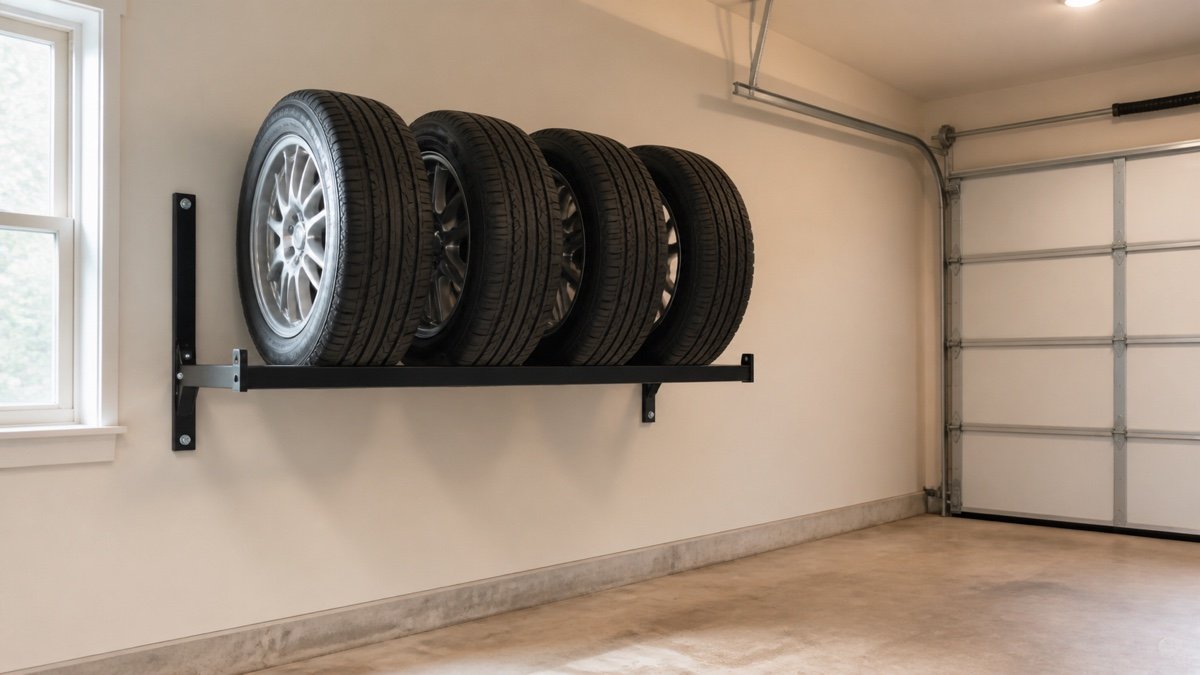
A garage tire storage rack guide should begin with the wheels in front of you, not with a product photo. Four mounted SUV wheels can be much heavier and wider than four bare passenger tires. A rack that looks generous online may crowd the garage door track, put the top tire beyond a comfortable lift, or miss every useful wall stud. This guide works from the set outward: identify whether the tires are mounted, measure the bundle, calculate the actual load, inspect the wall, and then choose a rack style. That order is less exciting than clicking “buy,” but it prevents most expensive mistakes.
Quick answer
For one seasonal set, a properly installed wall rack saves the most floor area when the wall structure and lifting height are suitable. A rolling rack is kinder to your back and easier to relocate, but it consumes floor space. Mounted wheels may be stacked or hung according to the tire maker’s guidance; unmounted tires should generally stand upright rather than hang or sit in a long stack. In every case, keep tires cool, dry, clean, shaded, and away from ozone-producing electrical equipment.
Garage tire storage rack guide: start with the set you own
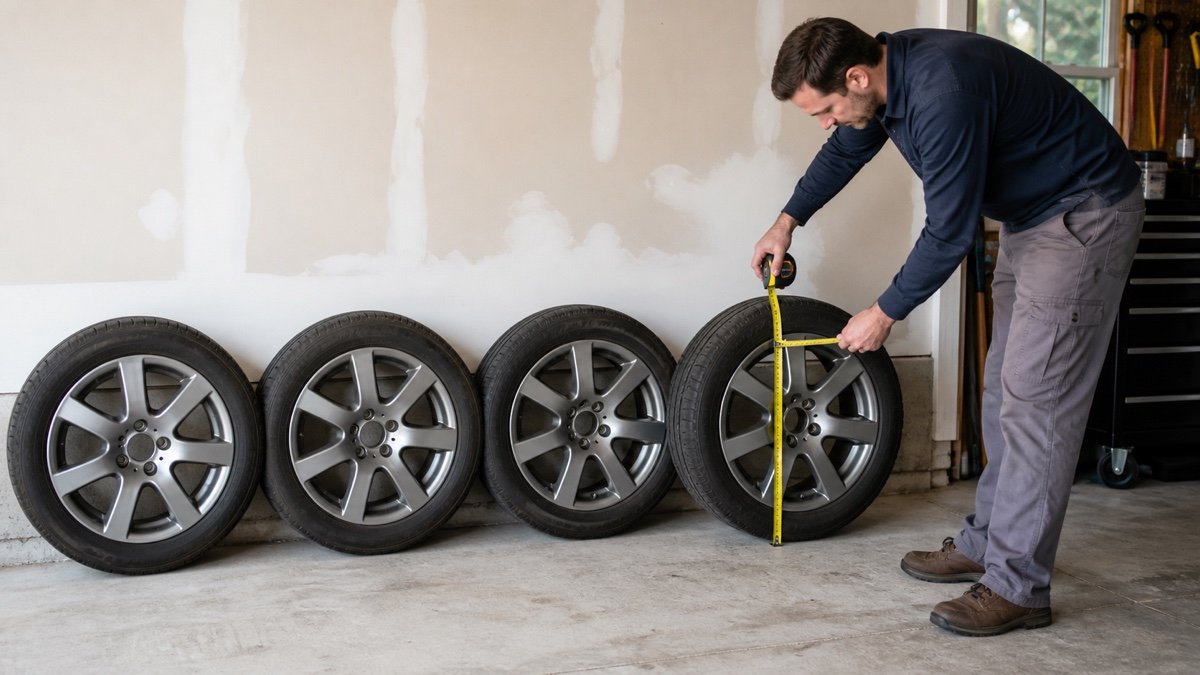
Write down five facts before comparing racks: tire quantity, mounted or unmounted condition, maximum overall diameter, maximum section width, and weight of the heaviest tire or wheel assembly. Do not assume four matching wheels weigh the same after repairs, aftermarket wheel changes, or staggered fitments. If you cannot find a trustworthy wheel-and-tire weight, use a bathroom scale with a safe lifting method or ask the tire shop to weigh one assembly.
Measure the set as it will sit. For an upright wall rack, line the wheels together and measure the total row width. Add room for your hands and for the rack’s end brackets. Measure the deepest projection from the wall, including the wheel face. Then use the process in our garage measurement guide to record door tracks, opener rails, windows, switches, steps, and the vehicle envelope.
A rack is not a magic box. Its published width may describe the frame, the adjustable span, or usable tire space. Read the dimension drawing and installation manual for the exact model. If the page has no drawing, no load rating, and no anchoring instructions, keep shopping.
Mounted and unmounted tires need different support
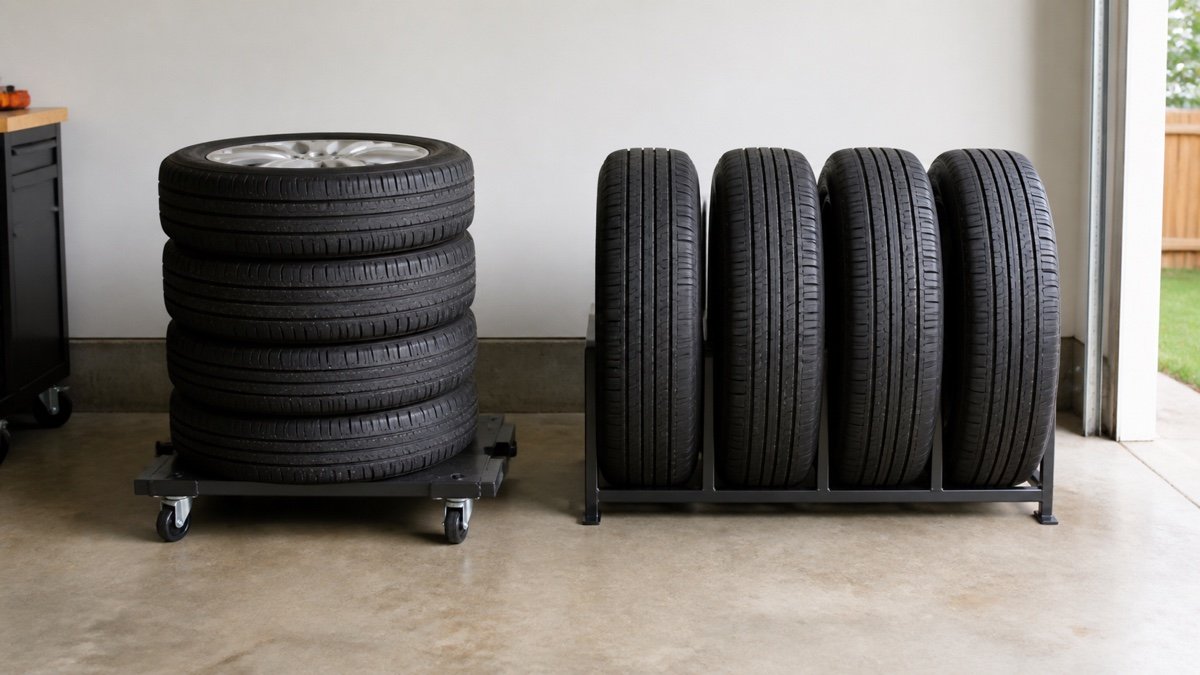
The storage orientation matters because the wheel changes how the tire carries its own shape. Michelin’s current consumer tire storage guidance says mounted tires can be hung or stacked, while tires without rims should stand upright and should not be hung or stacked. Follow the guidance for your tire brand if it differs.
| What you are storing | Sensible rack styles | Main fit check | Handling concern |
|---|---|---|---|
| Four tires mounted on wheels | Wall cradle, low floor rack, wheel tree, rolling rack, or stable stack | Total weight and wheel-face clearance | Each assembly may be awkward to lift |
| Four unmounted tires | Upright floor rack or upright wall cradle | Side support without pinching the sidewalls | Keep the row stable and rotate tires periodically if the maker advises it |
| Two staggered pairs | Adjustable-width wall or floor rack | Widest pair plus separators | Label positions before storage |
| Multiple seasonal sets | Rolling two-level rack or several low racks | Total room, rated load, and caster capacity | Avoid repeated lifting above shoulder height |
The table is a starting point, not permission to improvise. A shelf intended for boxes may have a wire spacing or edge shape that treats rubber poorly. A wheel hook must support the wheel in the manner its maker describes. Use a product designed for the load and orientation you own.
Calculate the load without optimistic arithmetic
Add the weight of every stored assembly, then compare that total with the rack’s stated capacity. Do not divide a 400-pound rating by four and assume each position is independently rated to 100 pounds. The rating applies to the complete installed product under the maker’s test and fastening conditions. Uneven loading, a missed stud, damaged masonry, or an extended adjustable frame can change the situation.
As a useful reference point, Tire Rack’s current wall-mounted tire rack lists a 400-pound capacity, an inner width adjustable up to 52 inches, and a total width of 66 inches. Those figures describe that product, not all wall racks. Its page also says the unit attaches to wall studs. A lighter-looking rack from another maker may use different geometry and instructions.
Leave a practical margin rather than shopping right at your calculated load. That margin does not repair weak framing or replace correct installation. It simply keeps normal uncertainty, such as a future wheel change or a mistaken weight estimate, from consuming the whole rating on day one. If the wall condition is uncertain, move the set to a floor rack and ask a qualified person to assess the mounting surface.
Choose a location that works with the garage in motion
Stand where the rack might go and move everything around it. Open the garage door through its full travel. Raise the vehicle hatch. Swing the service door. Pull the nearby cabinet drawer out. A wall can look vacant while the room is still, then become a collision zone during a normal Saturday.
Keep the rack outside the car’s parking envelope and away from the path used to carry a wheel to the driveway. The overhead clearance guide explains how to map door hardware and vehicle height before placing anything high. Tire storage should also stay away from direct sun, hot pipes, generators, electric motors, and chemicals that can affect rubber. Michelin specifically calls for a cool, dry, clean indoor location away from sunlight, heat, and ozone sources.
Height deserves honest judgment. A shelf above head level may clear the car yet force you to lift a heavy wheel with bent wrists while standing beside a fender. I would rather give up a strip of wall at chest height than save that strip and dread every seasonal changeover. If another adult cannot assist and the assemblies are heavy, a low rack or rolling cart is usually the better answer.
A wall rack is only as good as the wall connection
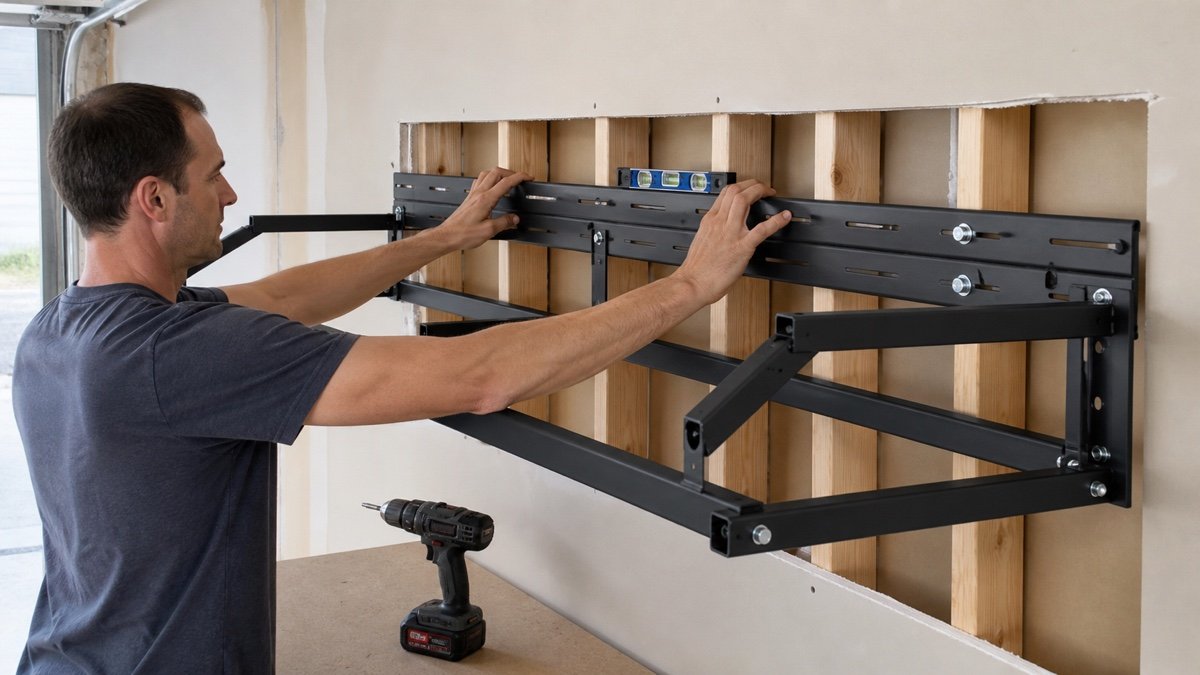
Find the framing or evaluate the masonry before buying. Stud spacing, wall finish thickness, concrete condition, and utilities behind the wall all affect installation. Do not substitute random anchors because the included hardware looks inconvenient. Follow the rack maker’s instructions for fastener type, quantity, spacing, pilot holes, and substrate. When the instructions require a ledger or specific structural attachment, treat that as part of the rack rather than an optional upgrade.
Adjustable racks add another dimension: some change width at the crossbar while others move the tire support rails. Confirm that the chosen setting still lets every bracket land where the manual requires. The broader garage wall storage systems guide helps compare structural attachment and finished projection across rail, slatwall, and dedicated rack products.
Install the empty frame, check it for level and square, then inspect every connection before loading. Add one wheel at a time. Watch for movement, wall crushing, loose hardware, or a rail that twists under the first load. Stop if anything changes. A rack full of wheels is not the moment to discover that one bracket never reached framing.
Floor and rolling racks trade wall work for footprint
A low floor rack avoids structural wall questions and keeps lifting close to the body. It is a strong choice for renters, garages with questionable masonry, and large wheel assemblies. The cost is floor space. Measure the rack with tires loaded, including the handle or caster sweep.
A rolling rack makes sense when the set must move between a storage corner and the driveway. Tire Rack’s current rolling rack, for example, lists room for up to eight passenger or light-truck/SUV tires and publishes a 77 by 61.5 by 19.25 inch overall size. Those dimensions show why a rolling design needs a real parking address. It cannot live indefinitely in the aisle.
Check the capacity of the rack, each shelf, and the casters. Look for wheel locks that can be reached after loading. Roll the empty unit across expansion joints and the garage threshold before trusting it with wheels. A tall loaded cart should move slowly on a clear, level route. If the route slopes or crosses a rough lip, a stationary low rack may be the calmer choice.
Prepare the tires before they disappear for a season
Clean off road salt, grit, brake residue, and moisture, then let the tires dry. Mark each tire’s vehicle position using a removable method that will not damage the wheel finish or tire. Keep the record with the car’s maintenance notes so the next rotation does not depend on memory.
Michelin advises sealed plastic bags when possible and maintaining correct inflation for mounted tires during storage. Use clean, dry bags made for the purpose, remove as much trapped air as practical, and follow the tire maker’s instructions. Do not wrap a damp wheel and create a private humid chamber around its finish.
Inspect tread, sidewalls, beads, valves, and wheels as you handle the set. Storage does not heal damage. If you see cuts, bulges, cracking, bent rims, persistent pressure loss, or anything else concerning, have a tire professional inspect the assembly before it returns to service. Also record the tire identification and manufacture information while it is easy to read. The rack keeps tires organized; it does not decide whether they remain fit for use.
Mock up the rack at its loaded size
Use painter’s tape to mark total width, top height, and loaded projection. A cardboard rectangle at the furthest point helps you feel how far the wheel faces enter the room. Park the car, open its doors, carry a laundry basket through the aisle, and operate the garage door. Leave the mockup up for a few days.
Then rehearse the lift with a harmless object of similar weight and size, held close to your body. Do not climb while carrying a wheel. Do not stand on a rolling stool or the car sill. If the rack requires a ladder for loading, reconsider the height. A tire rack should reduce awkward handling, not turn a twice-yearly chore into a balancing act.
Feed the measured dimensions into the planning sequence in how to plan garage storage. That exercise forces the tire set to compete honestly with bicycles, lawn equipment, doors, and parking. Seasonal items often win a premium wall simply because they arrived first. A mockup shows whether the same space would work harder for daily gear.
Compare rack listings with one short worksheet
For each candidate, record usable width, overall width, loaded depth, rack weight, rated load, required mounting surface, included hardware, adjustment range, warranty, and access to instructions. Add the height at which the bottom support will sit in your garage. These fields make vague listings obvious.
Look closely at how the tires touch the rack. Broad, smooth supports are easier to understand than sharp edges or widely spaced wires. Check whether end stops retain the outside tires and whether the frame can fold when empty. A folding rack still needs room to unfold without hitting a cabinet or vehicle.
Do the same comparison for floor options using our wall-mounted versus freestanding storage framework. The exact products differ, but the trade is familiar: wall storage saves floor space and demands trustworthy attachment; freestanding storage occupies the slab and is easier to relocate. Pick the drawback you can manage, not the product with the most dramatic capacity number.
Mistakes that make a tire rack annoying or unsafe
The first mistake is buying from tire diameter alone. Section width, wheel offset, overall row length, and total mass decide the fit. The second is mounting high because floor space is scarce. If you cannot load the top position with controlled movement, the space is not truly available.
Other failures are quieter. Owners place tires beside a generator or electric motor, load damp wheels into sealed covers, hide the electrical panel, or let a rolling rack become a permanent aisle obstacle. Some use a generic shelf whose capacity is not documented for the span and installation. Others mix loose tires and mounted wheels in an orientation that conflicts with tire-maker guidance.
Finally, avoid permanent assumptions. A future vehicle may use larger wheels. Keep the measurements and product manual, inspect fasteners when the rack is unloaded, and stop using components that bend, crack, corrode, or loosen. The best rack is not invisible. It is easy to load, easy to inspect, and boringly stable every time the seasons change.
Useful products to compare
These links open current Amazon search results. Check the dimensions, manual, mounting hardware, warranty, and current availability for the exact model before you order.
Before you buy or install
Read the current manual for the exact product you are considering. Confirm its assembled dimensions, rated capacity, mounting requirements, included hardware, working clearances, warranty, and any limits that apply to your wall, floor, electrical circuit, or garage layout.
Frequently asked questions
Should tires be stored vertically or horizontally?
It depends on whether the tires are mounted on wheels. Michelin says mounted tires may be hung or stacked, while unmounted tires should stand upright and should not be hung or stacked. Check the current guidance from your tire manufacturer and use a rack designed for that orientation.
How much weight should a garage tire rack hold?
Add the verified weight of every tire or wheel assembly you will store, then choose a rack whose documented capacity exceeds that total under your planned installation conditions. Do not invent a capacity from the rack’s appearance. Follow the exact model’s mounting instructions.
Can I mount a tire rack into drywall anchors?
Drywall itself is not structural support for a loaded tire rack. Many products require attachment to wood studs or suitable masonry with specified fasteners. Follow the manufacturer’s instructions. If you cannot confirm the wall structure, use a floor rack or ask a qualified installer.
Where should tires be stored in a garage?
Choose a cool, dry, clean indoor area away from direct sunlight, heat, chemicals, and ozone-producing equipment such as some motors or generators. Keep the set outside door travel, the vehicle envelope, electrical access, and normal walking routes.
Leave a Reply