Affiliate disclosure: As an Amazon Associate I earn from qualifying purchases. This article may contain affiliate links, and Bay & Bench may earn a commission at no extra cost to you. Read our full Affiliate Disclosure.
Drawer count is easy to compare and surprisingly easy to overvalue. The best workbench with drawers gives you a stable project surface, puts weekly tools within one reach, and still fits the garage with every drawer open. Casters, locks, power strips, and wood tops help only when the basic width, depth, and height suit the work.
This guide compares five current drawer benches from 40 to 77 inches wide. The compact models fit beside a parked car. The 52 inch class balances tool capacity and maneuverability. A 77 inch bench creates a serious assembly surface but can dominate a small bay. Start with a taped floor outline, then decide how much drawer volume the garage can support.
Quick answer
The Milwaukee 52 inch 11 drawer workbench is the broadest fit for an active garage, with a wood top, built-in power, and a manageable footprint. Choose the 40 inch Milwaukee when vehicle space is tight, the 52 inch industrial version for heavier drawer loads, a 77 inch Seville Classics UltraHD for maximum surface area, or the NewAge five drawer workstation for a coordinated cabinet setup.
How the best workbench with drawers options compare
Width gets the attention, but depth and working height decide whether a bench fits comfortably. A deep bench provides more surface near the wall while making the back edge harder to reach. A tall rolling cabinet can feel good for standing work and awkward for a bench vise. Compare the complete dimensions, including handles, bumpers, and raised backs.
| Pick | Width and layout | Top | Published capacity detail | Best fit |
|---|---|---|---|---|
| Milwaukee 40 inch 48-22-8539 | Six drawers | One inch wood | 1,800 pound total rating | Tight one car bay |
| Milwaukee 52 inch 48-22-8553 | Eleven drawers | 1.2 inch wood | 100 pound drawer slides | General garage work |
| Milwaukee 52 inch industrial 48-22-8559 | Twelve drawers | 1.2 inch wood | 120 pound drawer slides, 2,500 pound total | Dense hand tool storage |
| Seville Classics UltraHD 77 inch family | Eleven or twelve drawer options | Wood work surface | Verify by exact configuration | Wide assembly bench |
| NewAge mobile workstation | Five drawers | Integrated worktop | 800 pound published capacity | Coordinated cabinet system |
Ratings are model specific. A bench’s total capacity does not mean every drawer or one square inch of the top can carry that amount. Respect drawer, shelf, caster, and top limits separately.
Tape the full working footprint on the floor
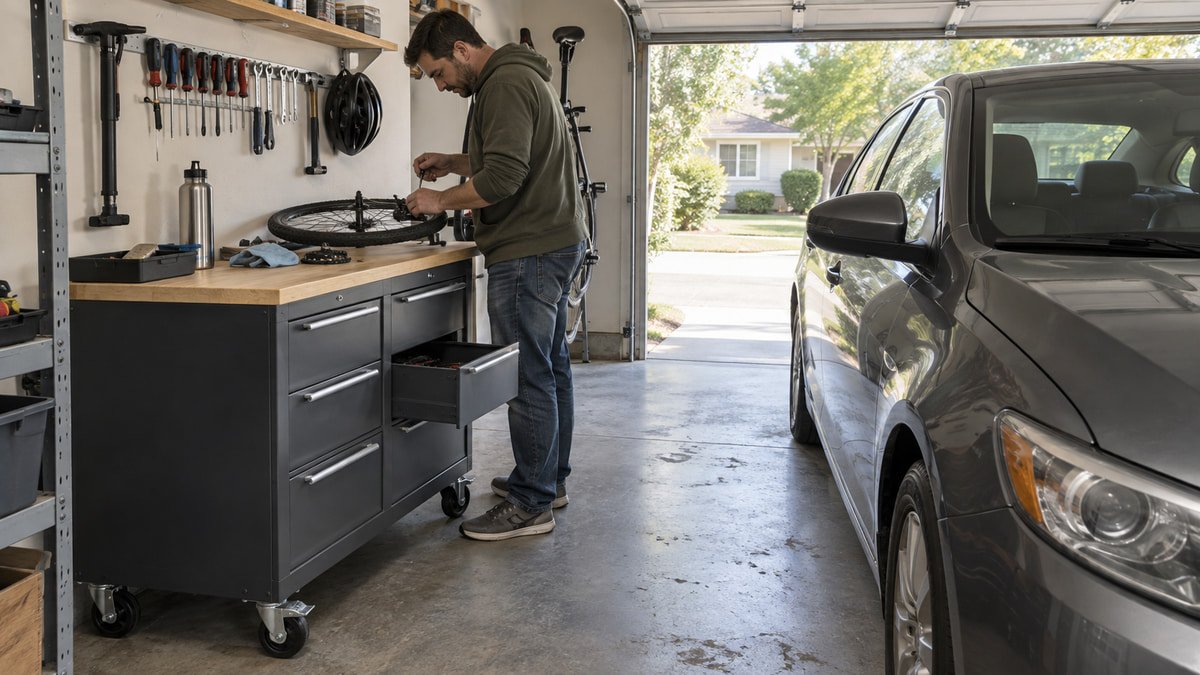
Mark the cabinet outline with painter’s tape, then add the handle, side shelf, vise, and open drawer zone. Park the car, open its door, and stand where a person would work. The bench may fit as a closed box while becoming unusable the moment a 20 inch drawer extends into the aisle.
Measure wall trim, receptacles, door casing, garage tracks, and floor slope. Our garage measuring guide covers those easy to miss details. For a compact room, compare the floor plan with the small garage workbench guide before moving from a 40 inch bench to a 52 inch one.
Leave room to pull out the deepest drawer while standing in front of it. The open drawer should not push the user backward into a vehicle or force a sideways reach. The same clear strip also makes sweeping, caster locking, and dropped fastener recovery much easier.
Milwaukee 40 inch work station for a tight bay
The Milwaukee 48-22-8539 is a 40 inch mobile work station with six drawers and a one inch wood top. Milwaukee lists a 1,800-pound total capacity. The narrow body can fit beside a parked vehicle or along a short wall where a full 52 inch cabinet would crowd a doorway.
Six drawers force some discipline. Shallow top drawers can hold sockets, wrenches, and measuring tools, while the lower space takes drills and cases. Owners with many single-purpose tools may outgrow it, but a smaller cabinet can also prevent forgotten gear from swallowing the work zone.
The compact top fits repairs, sharpening, and benchtop tools. It is less comfortable for long cabinet parts or a large assembly. If the bench moves between parking and project positions, confirm the route with the garage workshop aisle guide, including thresholds and floor drains.
Milwaukee 52 inch 11 drawer bench for most garages
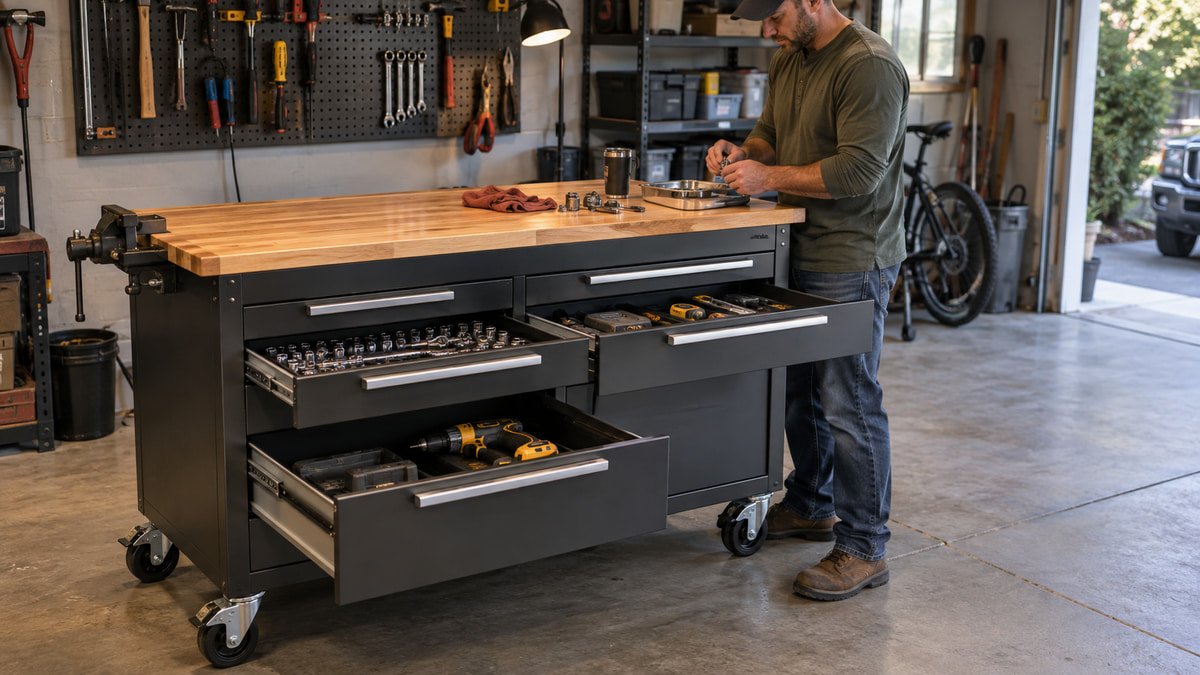
The Milwaukee 48-22-8553 uses an 11 drawer layout beneath a 1.2 inch wood top. Milwaukee specifies 100 pound rated soft close drawer slides and built-in power. At 52 inches wide, it has enough surface for routine assembly without claiming an entire two car wall.
The varied drawer sizes suit a mixed tool collection. Sockets and drivers can stay in shallow trays, while deeper lower drawers accept power tools and chargers. Built-in power is convenient for charging, though the bench cord still needs a safe route that does not wrap around a caster or cross the aisle.
This is the broad recommendation for someone who wants one bench to handle repair, tool storage, and light fabrication. Check the surface height against your elbow and common tasks before ordering. Casters raise the working plane, and that extra inch can matter during long hand tool sessions.
Milwaukee 52 inch industrial bench for heavier drawers
The Milwaukee 48-22-8559 keeps the 52 inch width and 1.2 inch wood top while moving to 12 drawers, 120 pound rated slides, and a 2,500 pound total published capacity. Milwaukee lists the cabinet at about 41.3 inches high and 22 inches deep.
That height is closer to a standing assembly station than a traditional low woodworking bench for many adults. It can feel comfortable for mechanical work, inspection, and packing. Hand planing or heavy vise work may be easier on a lower fixed bench. Compare 34, 36, and 38 inch working planes in our bench height comparison, then account for this taller surface.
Higher drawer ratings are useful for dense socket sets and metal tooling, but spread the load. A drawer pulled open with heavy items at the front changes the cabinet’s center of gravity. Lock drawers and casters before work, and follow the maker’s moving instructions.
Seville Classics UltraHD 77 inch for a wide surface
The current Seville Classics UltraHD workbench collection includes 77 inch rolling benches with 11 and 12 drawer arrangements. The broad wood work surface is the reason to choose this class. Long parts, two small benchtop machines, or an assembly jig can remain on top without covering every square inch.
Seventy-seven inches is nearly six and a half feet before any side handle or clearance. Tape that length on the wall and open every nearby door. In a two car garage, the bench can be excellent across the back wall and troublesome along a side wall where vehicle noses vary.
Configuration matters. Confirm the exact drawer count, overall depth, working height, caster rating, power features, and delivered package size. A large cabinet may arrive on a pallet and need several people or lifting equipment for safe assembly. Measure the path from curb to final position, not merely the final wall.
NewAge mobile workstation for a cabinet system
NewAge workbenches include a mobile workstation with five drawers and a published 800 pound capacity. The appeal is system fit. A matching workstation can roll beneath or beside coordinated cabinets, share finish and handle language, and occupy a planned bay within a larger garage installation.
Five drawers offer less separation than the Milwaukee and Seville options. That can be enough when tall cabinets already hold power tools and supplies. It can be limiting when the workbench must store the entire hand tool collection. Count tool groups, not individual tools, and assign each group a drawer before purchase.
A coordinated system is still constrained by the room. Review our garage cabinet buying guide so the bench, upper cabinets, and tall lockers share safe reach zones. Keep countertop outlets and cord paths accessible rather than burying them behind the rolling unit.
Choose a drawer mix instead of chasing drawer count
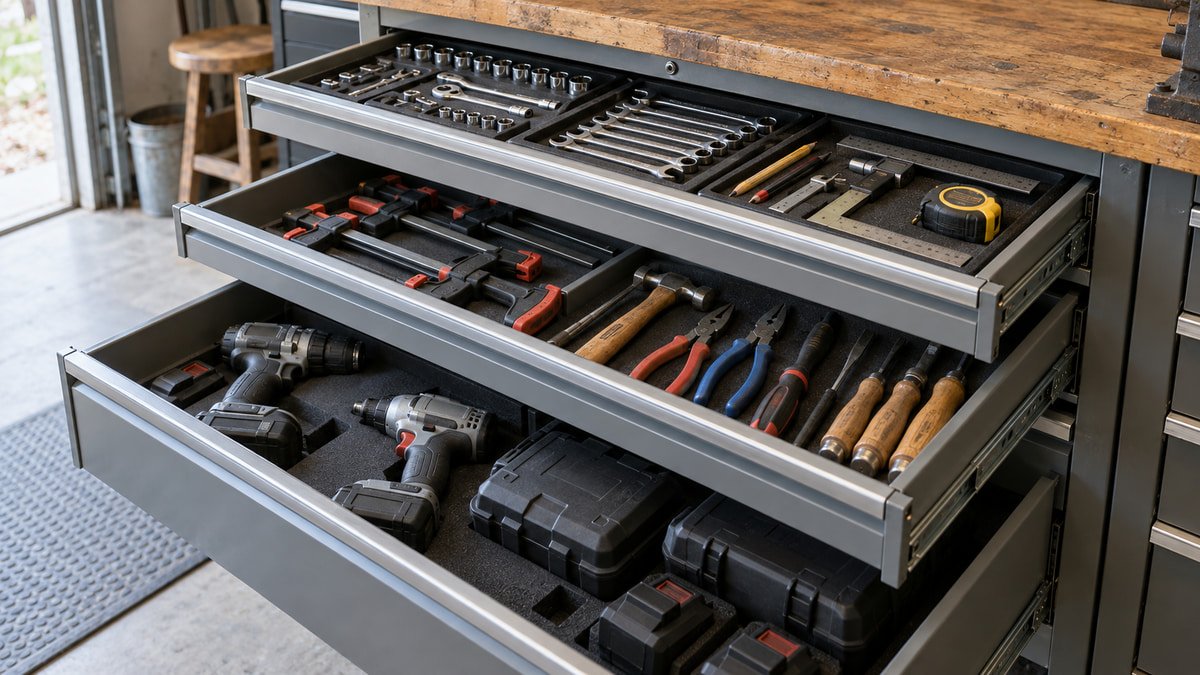
Ten shallow drawers are not automatically more useful than six varied drawers. Measure the tallest tool that should live in the bench: an impact wrench, cordless drill, multimeter case, or hand plane. Add liner thickness and finger clearance. Then reserve shallow drawers for sockets, bits, wrenches, and layout tools that become hard to scan when stacked.
Full extension slides make the back of a deep drawer usable. Soft close action is pleasant, but load rating and cabinet stability matter more. Verify whether a published slide rating applies per drawer, per pair, or under a specific extension condition. Avoid filling every upper drawer with dense steel while leaving the bottom empty.
A drawer lock controls casual access and keeps drawers closed during movement. It is not a substitute for separate secure storage of hazardous tools or chemicals. Keep solvents, fuels, and batteries in storage approved for their needs rather than treating an ordinary steel drawer as a safety cabinet.
Make sure the top accepts your clamps and vise
A thick wood top is friendly to parts and can accept some accessories, but the cabinet beneath determines where bolts and clamp jaws can pass. Open the top drawers and inspect the underside before drilling. A bolt through a slide channel can ruin the drawer, while a vise placed far from the cabinet corner may flex the top.
Look for a front or side overhang deep enough for common clamps. Many rolling tool benches have nearly flush metal edges, which are neat for mechanics and awkward for woodworking. A removable clamping board can solve light work without modifying the cabinet. Heavy pounding and planing are better on a fixed bench designed for lateral forces.
Depth changes reach. A 24 inch surface is easy to use from one side, while a 30 inch top gives more staging room near the wall. Our 24 versus 30 inch workbench comparison shows how that six inch difference affects aisle and reach.
Treat mobility as a setup, not a permanent wobble
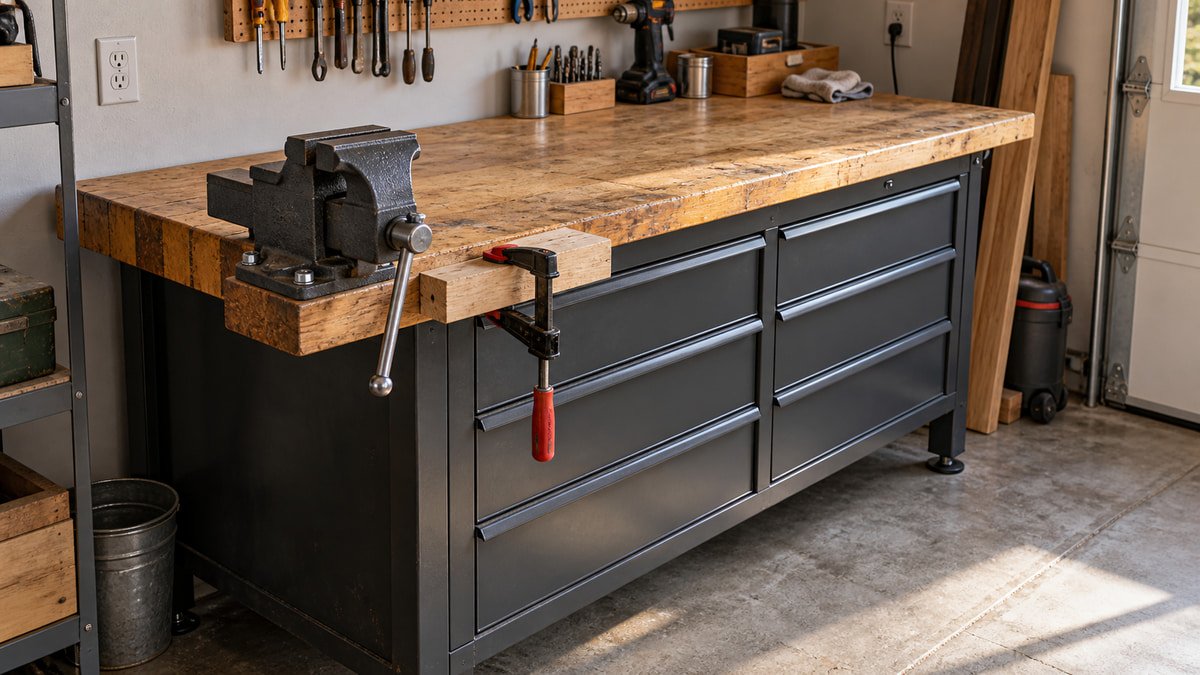
A mobile workbench should roll when the shop changes and behave like a fixed station when work starts. Large casters cross expansion joints more easily. At least two effective brakes are common, though four locking or leveling points can feel steadier. Floor slope, caster material, and total load affect the result more than wheel diameter alone.
Use the push handle and the moving procedure in the manual. Close and lock drawers, clear the top, unplug the power strip, and push slowly. Never pull a heavily loaded cabinet toward yourself down a slope. The comparison in our mobile versus fixed workbench guide helps decide whether casters solve a real layout problem.
Assembly deserves patience. Check the fasteners, handle, cord grommets, drawer action, and caster bolts before loading tools. Recheck them after the first moves. A bench chosen by measured fit, useful drawer sizes, and stable working height earns its floor space every week.
Useful products to compare
These links open current Amazon search results. Check the dimensions, manual, mounting hardware, warranty, and current availability for the exact model before you order.
Before you buy or install
Read the current manual for the exact product you are considering. Confirm its assembled dimensions, rated capacity, mounting requirements, included hardware, working clearances, warranty, and any limits that apply to your wall, floor, electrical circuit, or garage layout.
Frequently asked questions
What is the best width for a garage workbench with drawers?
A 40 inch bench fits a tight bay, while 52 inches gives most garages a useful balance of surface and storage. A 72 to 77 inch bench suits long walls and assembly work. Tape the body and open drawer zone on the floor before choosing.
Are rolling workbenches stable enough for heavy work?
They can be stable for mechanical repair and assembly when loaded within ratings and parked on a level floor with effective locks. Heavy vise work, hand planing, or pounding can favor a fixed bench or a mobile bench with leveling feet.
How tall should a workbench with drawers be?
Many people like 36 to 38 inches for general standing work, while mechanical rolling benches can be above 40 inches. Your height, task, vise, floor mat, and footwear change the fit. Mock up the surface with boxes before buying.
Is a wood top better than a stainless steel top?
Wood is forgiving, quieter, and easier on finished parts. Stainless steel resists many stains and wipes clean, but it can scratch parts and feel loud. Choose for the work, then verify chemical compatibility and how clamps or a vise will attach.
How should heavy tools be arranged in workbench drawers?
Keep dense tools low and distribute weight across the cabinet. Respect each drawer and total cabinet rating. Avoid opening several loaded drawers at once, lock them before moving the bench, and follow the maker’s loading instructions.
Leave a Reply