
Affiliate disclosure: As an Amazon Associate I earn from qualifying purchases. This article may contain affiliate links, and Bay & Bench may earn a commission at no extra cost to you. Read our full Affiliate Disclosure.
The best storage bins for 18 inch deep shelves fit by their outside footprint, not by the capacity printed on the label. An 18 quart tote may be close to 18 inches long, but handles, lid rims, and tapered walls can make the real dimension larger. A bin that overhangs the shelf catches clothing, blocks an aisle, and puts its load where the shelf was not meant to carry it.
Shallow shelves are still a smart garage choice. They keep small tools and household supplies from disappearing behind one another, and they preserve walking room beside a car. The trick is buying bins after the shelf has been measured. This guide covers the small clearances, lid styles, weights, and shapes that decide whether a container feels tidy six months after it comes home.
Quick answer
For an 18 inch deep shelf, choose a bin whose widest outside front-to-back dimension fits fully on the usable deck, with extra room for any rear brace or front lip. Many 16 to 20 quart totes are close, but model dimensions vary. Measure the shelf at its narrowest point, verify the maker’s outside dimensions, and leave enough vertical space to grip and open the bin.
Storage bins for 18 inch deep shelves at a glance
Start with the kind of object, then choose the container. Small hardware needs shallow organizers. Hand tools and cleaning refills often suit medium totes. Bulky, light gear can use a taller bin if the shelf spacing allows it.
| Bin format | Typical garage use | Fit check | Common drawback |
|---|---|---|---|
| Shallow latching box | Fasteners and small parts | Latch width and handle projection | Too many tiny boxes to track |
| 16 to 20 quart tote | Hand tools and supplies | Outside length near shelf depth | Lid may need removal in the bay |
| Open front bin | Frequently used consumables | Front reach and rear taper | Dust enters easily |
| Tall narrow tote | Soft goods and light gear | Shelf opening above the lid | Easy to make top heavy |
| Large garage tote | Bulky seasonal items | Usually too deep for this shelf | Overhang and heavy lifting |
Capacity names are poor shortcuts. Two bins sold as 18 quart containers can have different lids and bases. Use the exact model dimensions and compare them with the measuring steps in the 18 versus 24 inch garage shelf guide.
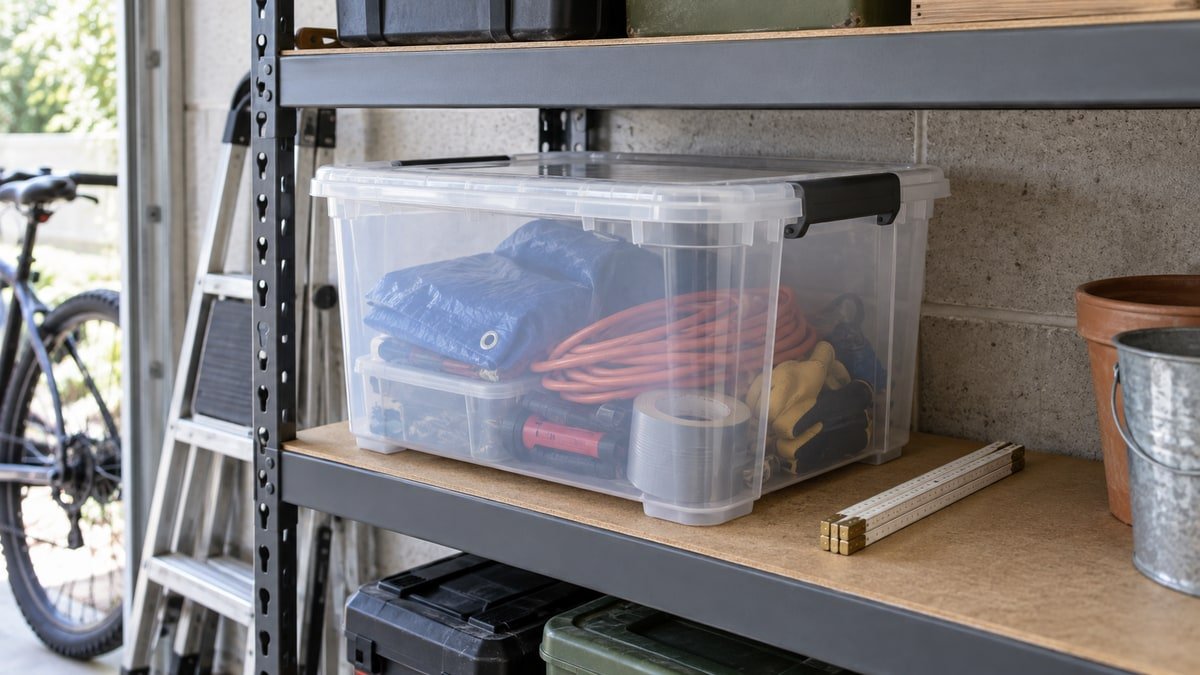
Measure usable shelf depth, not nominal depth
An 18 inch shelf is not guaranteed to provide a flat 18 inch deck. A rear cross brace, diagonal support, wall baseboard, or raised front lip may steal part of that number. On wire shelving, the posts can narrow the corners. Measure each bay at the left, center, and right, then use the smallest result.
Check the wall too. A shelf pushed against a bowed foundation ledge may sit farther forward at one end. If the unit has leveling feet, set it in its final position before measuring. A half inch correction at the feet can change how a tall bin meets the shelf above.
Write three numbers for every opening: usable depth, clear width between posts, and clear height from deck to the lowest obstruction. The broader garage shelf spacing guide helps turn those numbers into sensible shelf levels. Do not order containers from the overall rack dimensions on a retailer page.
Read outside dimensions in the right order
Retail listings often show length, width, and height, but sellers do not always use the terms consistently. On a tote, the longest dimension usually runs front to back on the shelf. Confirm that assumption from a dimensional drawing or the maker’s product page. If the listing gives only capacity, keep shopping.
Measure the widest point, which is often the lid rim or handle rather than the base. A tapered bin may sit on the deck while its lid hits a wall post. Latches can add width. Hinged lids sometimes need an inch or more behind the bin to swing, which turns an apparent 18 inch fit into a 19 inch problem.
The Sterilite 16 Qt Stacker Box page, for example, publishes outside dimensions of 18 by 12 5/8 by 7 1/8 inches. That length uses the full nominal depth, so the particular shelf needs a truly clear deck and a suitable front edge.
Leave a little breathing room at the front and back
A bin that fits with zero spare room can still be irritating. Fingers need a place to pull. A lid lip may scrape the wall. A small rear gap also keeps condensation on a masonry wall from sitting against the tote. Aim for a container that rests fully on the deck without needing to be pressed into place.
Some metal shelves have a raised perimeter. Bin feet must land inside that lip rather than balancing on it. Wire decks can create another issue: narrow feet settle between wires, making the container rock. A manufacturer approved shelf liner or a thin rigid deck can help if it does not change the load rating or create a fire concern.
Front overhang is tempting when a bin misses by half an inch. Resist it. The projected corner snags people, and the shifted center of gravity puts more load near the shelf edge. A smaller tote is cheaper than turning the storage aisle into an obstacle course.
Match bin height to the shelf opening
Vertical fit needs more than the bin height. Add room for the lid, latches, and both hands. A tote that clears the shelf above by a quarter inch may slide in when empty, then refuse to leave once the lid bows under a full load. Three or four inches of hand space feels much better for a medium bin.
A removable lid can work in a tight opening if the bin holds things accessed once a year. For regular use, a latching lid that can be opened after pulling the bin forward is simpler. Hinged lids need space behind and above. Open front bins trade dust protection for immediate reach, which is sensible for sanding discs, clean rags, or garden gloves.
Adjust shelf levels around what you own. The garage shelving buying guide explains why beam spacing and tool free adjustment can matter more than the total number of shelves in the box.
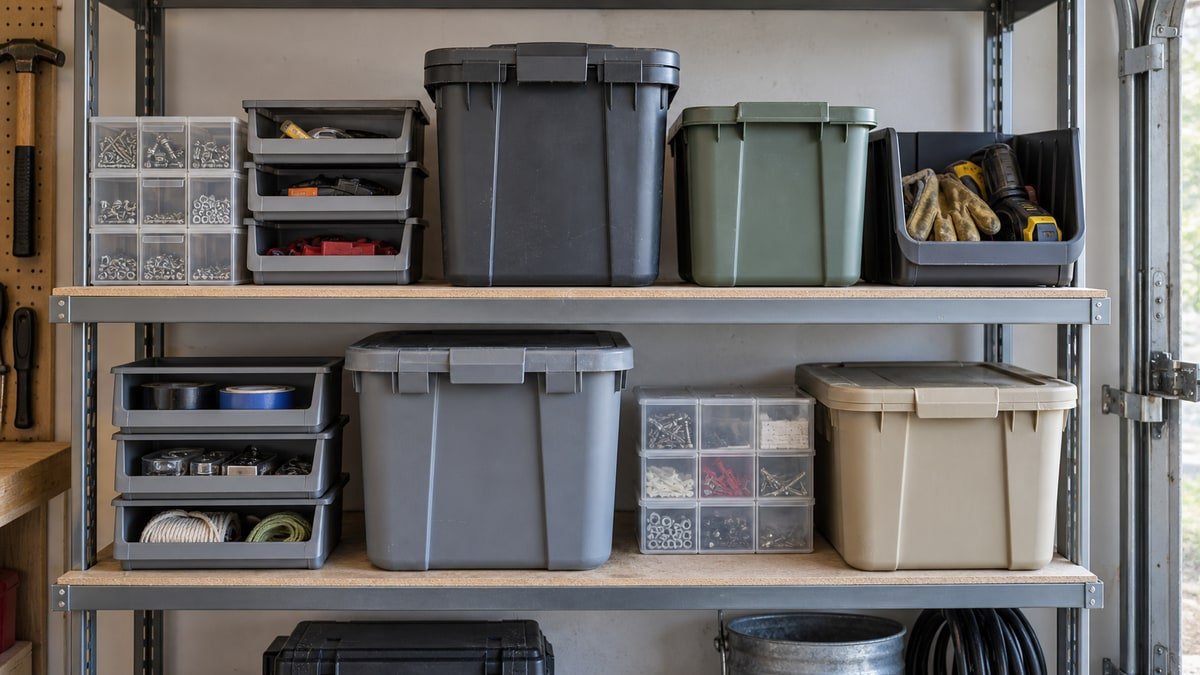
Compare useful 16 to 20 quart formats
The 16 to 20 quart range often suits an 18 inch shelf because it keeps loads manageable and makes decent use of depth. Still, a model name cannot replace measurements. Sterilite lists its 18 Qt Ultra Latch Box at 18 1/8 by 12 1/4 by 7 inches outside. That extra eighth of an inch matters on a shelf with a front lip or a wall directly behind it.
The company’s 20 Qt Hinged Lid Storage Box is listed at 18 1/4 by 13 by 8 inches. Its attached lid prevents a loose lid from wandering, but the hinge changes the space needed to open it. It may fit an open shelf that stands slightly off the wall and feel cramped in a closed cabinet.
Use these examples to see why quart count is not a size system. Verify the exact current dimensions for every model and buy one sample before ordering a dozen.
Choose clear, opaque, or open front bins
Clear totes make forgotten contents visible, which helps in a garage where labels fade and categories drift. They also show the visual mess inside. Opaque bins look calmer and may protect light sensitive supplies, though the user depends more on labels. A simple printed card in a clear sleeve is easier to update than marker written directly on plastic.
Open front bins are good for items touched every week. Put them between knee and shoulder height where the contents can be seen. Dusty garages change the calculation. Grinding debris and sawdust enter open bins quickly, so closed boxes belong near dirty work even when access takes a few more seconds.
Color can carry a small amount of information. One color for car care and another for household backup supplies is enough. Ten colors create a code nobody remembers. The same restraint helps a complete garage storage system look organized after new supplies arrive.
Keep weight low enough for the person using it
A compact tote can become surprisingly heavy when filled with sockets, bolts, or bottles. The shelf may hold it, yet the person still has to slide and lower it. Set a household bin limit based on a comfortable two hand lift. Dense hardware is better divided between two shallow boxes than packed into one deep tote.
Place heavy containers from floor level to waist height. Light, bulky items can go higher. Frequently used bins belong in the easiest reach zone even if their contents are light. Rarely used gear can occupy the top, provided it can be retrieved with a stable step platform and without leaning over a parked car.
Check the shelf rating per level and for the complete unit. Loads should be distributed instead of concentrated on one wire or corner. The heavy duty garage shelving guide covers capacity, deck construction, and anchoring questions that bin shopping cannot solve.
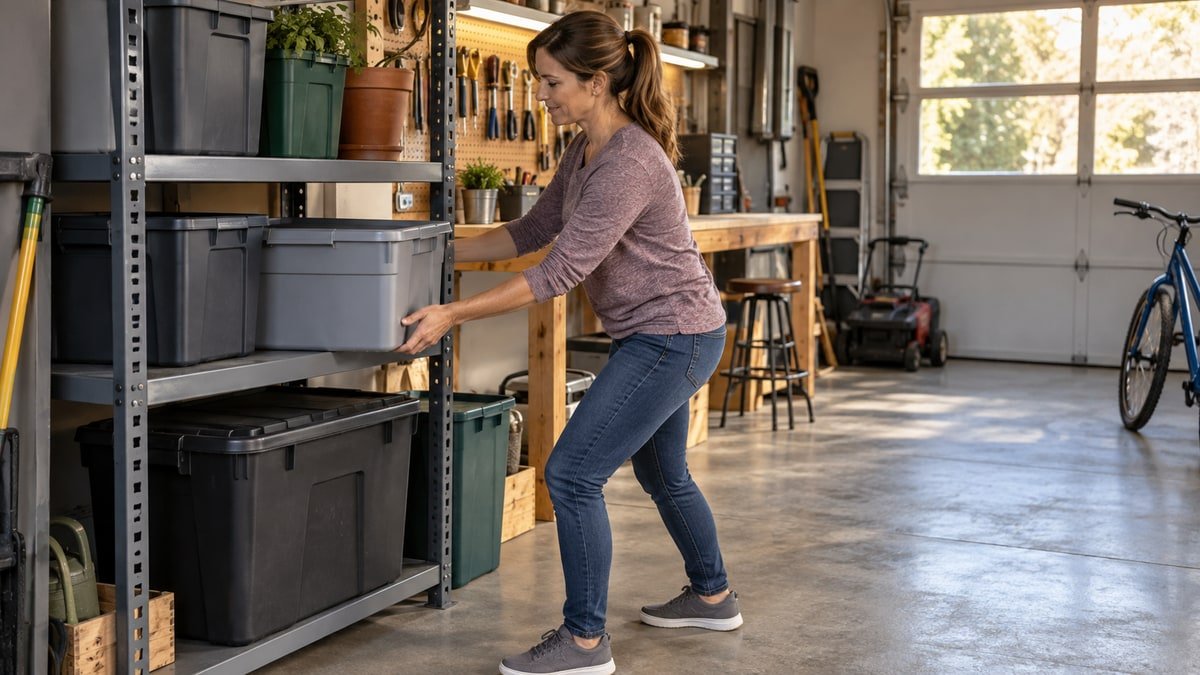
Test one bin before buying the full set
Buy a single sample or use a returnable local purchase. Load it with the actual category, slide it onto every intended shelf, open the lid, grip the handles, and carry it through the garage door. A dimensionally perfect tote may still have sharp latches or a lid that flexes under a stack.
Try the bin in hot and cold conditions if the garage sees big temperature swings. Plastic grows more brittle in the cold, and an overfilled lid can bow in summer heat. The product instructions should decide stacking limits. Do not assume the empty display stack at a store predicts safe loaded stacking at home.
One sample also reveals whether the tote wastes width. Three 13 inch bins need 39 clear inches, not a nominal 36 inch bay. Posts and diagonal braces can spoil an otherwise neat row, so test the exact shelf rather than sketching rectangles from memory.
Avoid chemical and moisture surprises
Garage temperature and humidity can be hard on contents. Paper, fabric, and electronics need sealed bins with dry contents, and even then they may not belong in a damp or freezing garage. A desiccant pack is not a cure for an active leak. Find the water source first.
Do not treat an ordinary storage tote as a safety cabinet. Fuel, solvents, pool chemicals, oily rags, pesticides, and incompatible cleaners have storage requirements that a plastic box cannot satisfy. Keep products in their original containers and follow the label, local rules, and any required ventilation or separation.
Look for roof leaks and wall condensation during the wettest season. Leave a visual gap behind bins so damp spots can be seen. Shelving that holds supplies off the slab helps after minor water entry, but the bottom tote still needs a lid and a base that is not cracked.
Build a simple bin map that lasts
Give every shelf bay a broad job, such as automotive, painting, hardware, or outdoor gear. Put the category name on the shelf edge and the specific contents on the bin. This two level system survives when a container moves because the shelf still tells the user what belongs there.
Leave roughly one open bin position for new supplies. Without it, the first bulk pack lands on the floor and starts another pile. Empty space is working capacity, not waste. Keep an inventory in a phone note only for categories that are expensive or easy to duplicate.
Measure the room before adding another rack. The garage measuring guide accounts for door swings, baseboards, outlets, and parked car space. Eighteen inch shelves save aisle width, but only when their bins stay inside the footprint and the shelves sit where a person can use them.
Useful products to compare
These links open current Amazon search results. Check the dimensions, manual, mounting hardware, warranty, and current availability for the exact model before you order.
Before you buy or install
Read the current manual for the exact product you are considering. Confirm its assembled dimensions, rated capacity, mounting requirements, included hardware, working clearances, warranty, and any limits that apply to your wall, floor, electrical circuit, or garage layout.
Frequently asked questions
Will an 18 inch long bin fit an 18 inch deep shelf?
Maybe. The shelf may lose usable depth to a rear brace, front lip, wall, or posts, and the bin dimension may omit a projecting latch or lid. Measure the actual deck and the widest outside point of the exact bin. It should rest fully on the shelf without being forced against the wall.
What tote capacity usually fits shallow garage shelves?
Many containers in the 16 to 20 quart range are close to the right depth, but capacity is not a reliable dimension. Some 18 quart models exceed 18 inches outside, while another shape may fit. Shop from published outside measurements and test one bin in the shelf bay.
Can storage bins hang over the front of a garage shelf?
A small overhang may look harmless, but it creates a snag point and moves the load toward the unsupported edge. It can also narrow the aisle. Choose a shorter bin or a deeper shelf instead. Follow the shelf manufacturer directions for load placement and deck use.
Are clear or opaque bins better for a garage?
Clear bins make contents easy to identify. Opaque bins hide visual clutter and may suit light sensitive contents. Both need durable lids and readable labels. Dusty work zones favor closed containers, while open front bins are convenient for clean items used every week.
How much space should be left above a storage bin?
Leave enough room to grip both handles and operate the lid without scraping the shelf above. For a medium tote, a few inches is far more usable than a very tight fit. The exact amount depends on whether the lid lifts off, hinges backward, or opens after the bin is pulled forward.
Leave a Reply